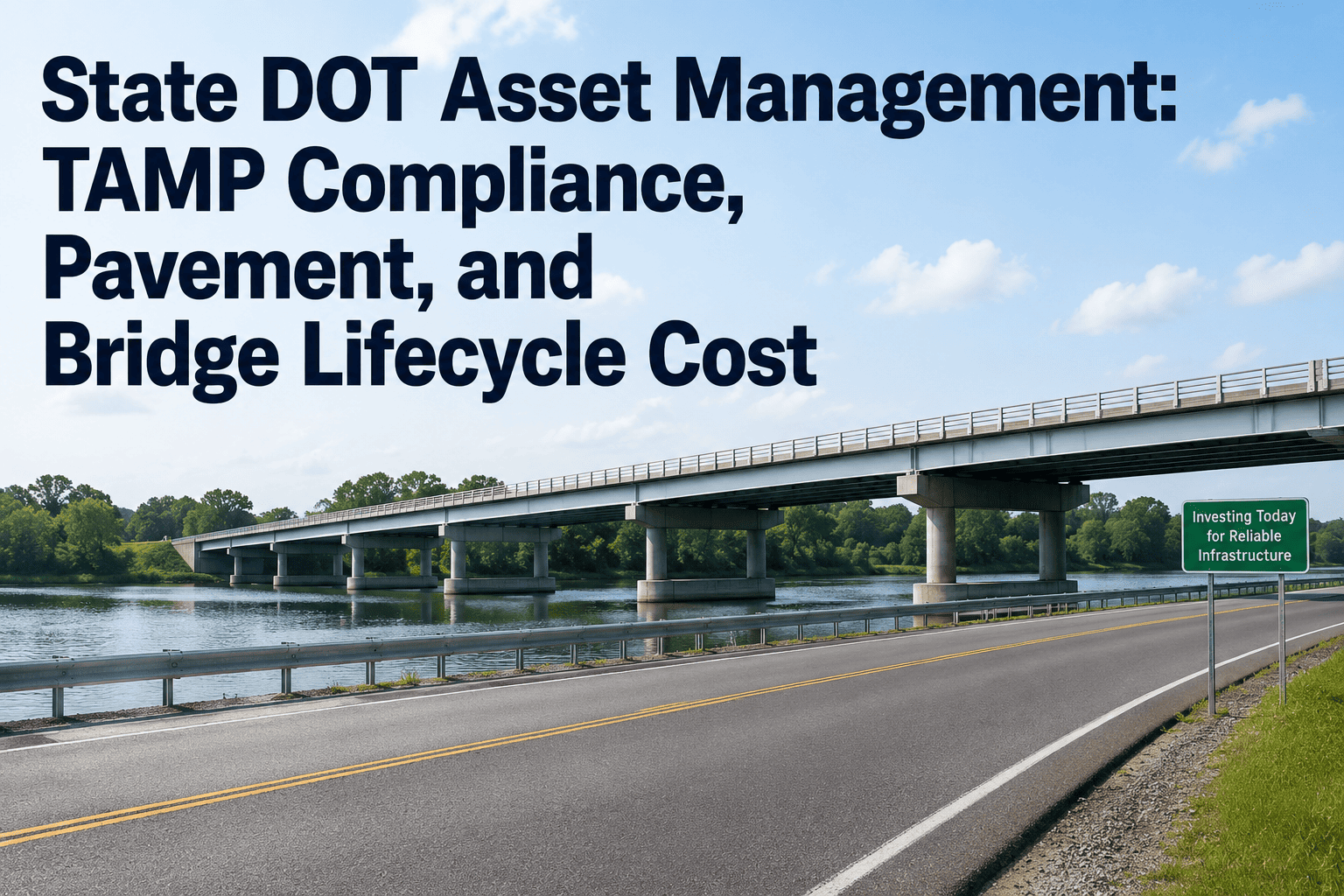
State DOT Asset Management: TAMP Compliance, Pavement, and Bridge Lifecycle Cost

By James Smith on May 16, 2026

state-dot-asset-management-tamp-pavement-bridge-lifecycle

State Departments of Transportation manage infrastructure portfolios measured in billions of dollars — pavements, bridges, tunnels, culverts, signs, signals, and facilities — under a federal requirement to do it systematically. The MAP-21 Transportation Asset Management Plan mandate from FHWA requires every state DOT to maintain an approved TAMP that demonstrates how the agency will achieve and sustain specified performance targets for NHS pavement condition and bridge condition. Meeting that mandate requires data — current condition data, lifecycle cost data, and treatment history data — that can only come from a structured asset management system. Start a free trial with Oxmaint to structure your DOT maintenance data program, or book a 30-minute session with our transportation asset management specialists.

TAMP Requirement Overview

What MAP-21 and FHWA Actually Require in a State TAMP

23 CFR 515
The federal regulation requiring state DOTs to develop and implement a TAMP for NHS assets
2 Asset Types
NHS pavement and NHS bridges are the mandatory minimum scope; states may include additional asset categories
10-Year
Minimum planning horizon for TAMP lifecycle cost analysis and investment strategy
4-Year
TAMP update cycle — must be updated and FHWA-approved every four years
The Three TAMP Data Pillars

Condition Data, Lifecycle Cost, and Performance Targets: What CMMS Tracks

01
Current Condition Assessment
PavementInternational Roughness Index (IRI), Pavement Condition Index (PCI), rutting depth, cracking percentage — collected by automated survey vehicle or manual inspection on defined intervals
BridgesNBI element-level inspection ratings (deck, superstructure, substructure, culverts) — federal bridge inspection on 24-month cycle per 23 CFR 650
CMMS RoleStore inspection results against asset records, track inspection due dates, flag overdue inspections, generate condition trend lines by asset age and location
02
Lifecycle Cost Analysis
Treatment HistoryEvery maintenance and rehabilitation treatment applied to each asset — date, treatment type, cost, contractor — provides the data foundation for lifecycle cost curves and treatment effectiveness analysis
Cost CategoriesPreservation, rehabilitation, and reconstruction costs tracked separately in CMMS to support FHWA investment category reporting in the TAMP
CMMS RoleWork order cost capture by asset, treatment type, and program code — enabling lifecycle cost per lane-mile and per bridge deck square foot calculations for TAMP submission
03
Performance Target Tracking
NHS Pavement Targets2-year and 4-year targets for percent good/poor on IRI, cracking, and rutting — reported to FHWA under 23 CFR 490
NHS Bridge Targets2-year and 4-year targets for percent of bridge deck area in good/poor condition — reported using NBI ratings under MAP-21 PM3 rule
CMMS RoleDashboard tracking of condition metrics against established targets by year, asset class, and district — enabling mid-cycle course correction before federal reporting deadlines
Pavement & Bridge Data

NHS Asset Condition Benchmarks: Where State DOTs Stand

Asset Class Metric National Average FHWA Good Threshold FHWA Poor Threshold TAMP Target Requirement
NHS Pavement IRI (International Roughness Index) 68 in/mile <95 in/mile >170 in/mile Maintain or improve % good; reduce % poor
NHS Pavement Cracking (% cracked area) 14% <5% >20% Set 2-yr and 4-yr targets; report biannually
NHS Bridges NBI Deck/Super/Sub Rating 7.2 avg Rating ≥7 (Good) Rating ≤4 (Poor) <10% of deck area in poor condition
NHS Bridges Structurally Deficient % 7.4% nationally <5% target >10% critical Must not exceed 10% SD by deck area
Structure Your DOT Maintenance Data for TAMP Compliance

Oxmaint CMMS captures inspection results, treatment history, and cost data against every NHS asset — giving your TAMP team the complete data foundation for lifecycle cost analysis and performance target reporting.

Expert Review

State DOT Asset Managers on TAMP Data Quality

"Our first TAMP submission had a lifecycle cost analysis that was essentially a best-guess estimate because our treatment history was in spreadsheets that went back only four years. When we implemented a proper asset management system and began capturing every treatment against the asset record, our second TAMP submission had 12 years of validated treatment cost data. FHWA approved it without questions."
DN
David N., PE, PTOE
State Asset Management Engineer, Mid-Atlantic DOT
"The bridge inspection scheduling function alone justified our CMMS investment. We manage 2,200 bridges with a 24-month federal inspection cycle. Before CMMS, we tracked due dates in a spreadsheet and missed four inspections in three years — each one a federal compliance event. Since deployment we have had zero missed federal bridge inspections in six years."
CJ
Carol J., PE, SE
State Bridge Engineer, Midwest DOT
Frequently Asked Questions

State DOT TAMP and Asset Management: Common Questions

Under 23 U.S.C. 119 and 23 CFR 515, states without an FHWA-approved TAMP are subject to obligation limitations on NHS formula funds — specifically, a 10% transfer of NHPP funds to the Transportation Alternatives Program until a compliant TAMP is approved. In practice, FHWA has worked with states on phased approval, but the financial penalty creates a significant incentive for timely TAMP completion and data quality. Structure your asset data for TAMP compliance in Oxmaint.
NHS pavement condition reporting under 23 CFR 490 is a backward-looking compliance obligation — states report what their pavement condition actually was during the reporting period. TAMP performance targets are forward-looking commitments — states declare what condition they intend to achieve by specific target years and what investment strategy supports that commitment. Both use the same underlying condition data, but the TAMP requires the additional step of demonstrating through lifecycle cost modeling that the declared targets are achievable with the planned investment level. Book a session to configure NHS reporting and target tracking in your CMMS.
The National Bridge Inspection Standards (NBIS) under 23 CFR 650 require routine inspection of all NHS bridges on a maximum 24-month cycle, with reduced intervals for fracture-critical, underwater, and complex structures. A missed inspection is a federal compliance event that must be reported to FHWA and may trigger a bridge closure order until inspection is completed. CMMS scheduling with 60-day and 30-day advance alerts, plus escalation to district management if a scheduled inspection is not assigned, is the standard practice for avoiding missed federal bridge inspections. Configure federal bridge inspection scheduling in Oxmaint.
Yes — and FHWA guidance explicitly encourages states to use their maintenance management systems as primary sources for treatment history and cost data in TAMP lifecycle cost analysis. The key requirement is that the data be asset-specific, treatment-typed, and cost-coded consistently over time. CMMS work orders that capture these three elements against each NHS asset record provide the exact data inputs required for the agency-developed performance gap analysis and investment strategy sections of the TAMP. States using CMMS as their TAMP data source consistently produce more defensible lifecycle cost analyses than those relying on aggregate budget data. Book a session to review your TAMP data structure in Oxmaint.
Build the Data Foundation Your TAMP Requires

Oxmaint captures treatment history, inspection results, and lifecycle costs against every NHS asset — giving your TAMP team the validated data foundation for FHWA approval.


Share This Story, Choose Your Platform!