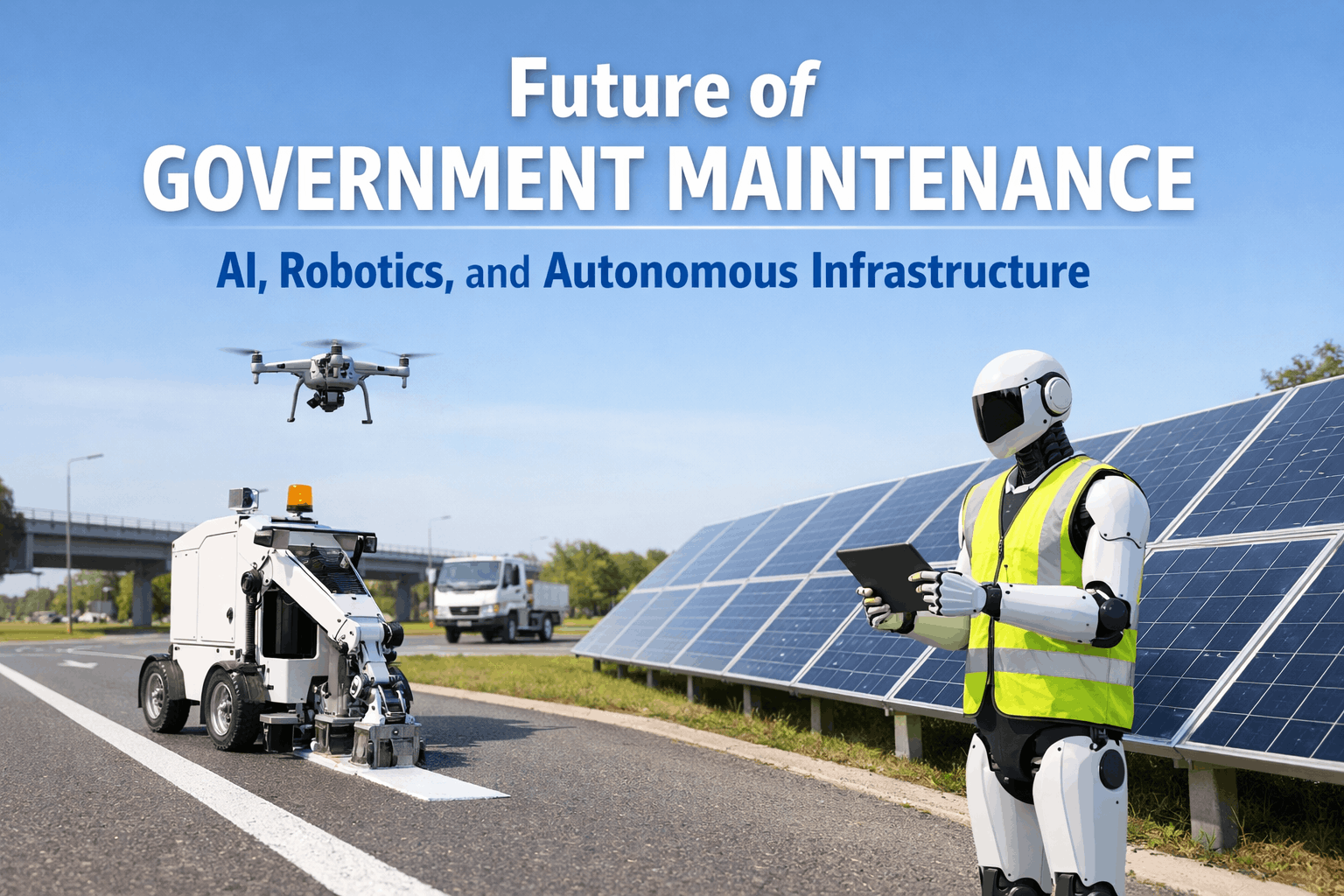
Future of Government Maintenance: AI, Robotics, and Autonomous Infrastructure
By Taylor on February 28, 2026
A regional public works department spends $12.5 million each year maintaining its infrastructure on a fixed calendar schedule—dispatching crews to inspect bridges, patch roads, and service HVAC systems every few months, regardless of actual wear. Half the components replaced still have years of useful life. Meanwhile, acritical stormwater pump that was serviced only three months ago is already vibrating out of alignment, invisible to scheduled visual checks. Across the network, maintenance crews are either too early (wasting parts and labor) or too late (facing emergency infrastructure failures). This is the cost of choosing a legacy maintenance strategy—or worse, relying on run-to-failure in an era of tightening budgets and climate stress.
By 2030, forward-thinking government agencies are moving beyond this outdated model. The future of government maintenance is being reshaped by technology, from self-healing roads to AI-optimized building systems and robotic infrastructure inspection. They are blending preventive maintenance with predictive, AI-driven intelligence into a cohesive strategy powered by autonomous drones, computer vision, digital twins, and IoT structural health monitoring. When orchestrated through a next-generation CMMS platform like Oxmaint, this smart government maintenance approach ensures the right asset gets the right intervention at the precise moment it is needed—maximizing safety, minimizing taxpayer cost, and delivering the reliable service communities demand. Start Free Trial.
Next Generation Government
Future of Government Maintenance: AI, Robotics, and Autonomous Infrastructure
Combine robotic inspections, AI optimization, and CMMS-driven work orders to shift from reactive repairs to predictive, autonomous government systems.
Reduction in emergency infrastructure failures using AI
45%
Lower maintenance costs vs. legacy calendar schedules
24/7
Autonomous Monitoring
Robotics and IoT intelligence provide continuous oversight of critical public assets
Why the Legacy Maintenance Model Is Breaking Down
Preventive maintenance—servicing assets on fixed intervals regardless of condition—served public works well for decades. It is predictable and easy to schedule. But as infrastructure ages, budgets tighten, and the workforce shrinks, the limitations of this government maintenance evolution become severe: agencies over-maintain healthy assets while under-maintaining degrading ones. The result is wasted taxpayer spend, surprise failures, and a false sense of security that collapses the moment an un-monitored component breaks between cycles.
Legacy Preventive vs. Future Predictive: Side-by-Side Comparison
Understanding the fundamental shift from calendar-driven to AI-driven public sector operations
Legacy Maintenance
Calendar-Based
Trigger
Fixed time intervals or usage cycles
Inspection Method
Scheduled manual or visual patrols
Data Usage
Historical averages & OEM recommendations
Cost Profile
Steady spend; frequent over-maintenance
Failure Risk
Failures can still occur between cycles
Best For
Non-critical assets with stable wear patterns
VS
Future Predictive Maintenance
AI & IoT-Based
Trigger
Real-time sensor data & AI anomaly detection
Inspection Method
Drones, robots, IoT sensors — continuous
Data Usage
Live telemetry, digital twins, ML models
Cost Profile
Lower total cost; intervene only when needed
Failure Risk
Failures predicted & prevented weeks ahead
Best For
Safety-critical, high-cost public infrastructure
The real power emerges when preventive and predictive strategies work together inside a single CMMS platform. Oxmaint lets government agencies assign each asset the maintenance approach that matches its criticality, cost, and failure consequence—then automates scheduling, alerting, and compliance documentation across both models simultaneously.
Robotics & Autonomous Inspections: The New Public Workforce
In the future government maintenance landscape, drones and robotics public sector initiatives are the data-collection backbone. They capture high-resolution imagery and sensor data across vast networks—from bridges to sewer lines—at a fraction of the time and risk of manual patrols. Combined with AI government infrastructure classification, they turn raw visual data into actionable maintenance intelligence.
Autonomous Inspection Capabilities
Three pillars of autonomous aerial and AI-powered infrastructure inspection
01
Drone & Rover Workflows
Automated flight missions and rover deployments scan bridges, water towers, and tunnels. They capture thermal, visual, and LiDAR data without disrupting public services.
Robotic Automation
02
AI Vision Defect Detection
Computer vision models trained on thousands of infrastructure defect images classify cracks, corrosion, spalling, and pavement degradation—with severity ratings that feed directly into CMMS work orders.
AI Classification
03
Route Planning & Mission Logs
Pre-programmed inspection corridors ensure repeatable coverage. Every mission is logged in Oxmaint CMMS with GPS coordinates, timestamps, and inspection outcomes for full audit compliance.
Mission Intelligence
Digital Twins & AI-Optimized Systems
Digital twins create living virtual replicas of physical government assets—municipal buildings, road networks, water systems—fed by real-time IoT sensor data. Combined with AI-optimized building systems and risk scoring, they give asset managers an unprecedented view of network health, enabling targeted interventions and evidence-based capital planning for government maintenance 2030.
Digital Twin & AI Intelligence Pipeline
How sensor data becomes actionable asset intelligence through digital twin models
AI Trigger
IoT Sensor Detects Anomaly in HVAC Chiller
Phase 1 — Digital Twin Modeling
Live Sensor Data Feeds Virtual Asset Model
Vibration sensors, smart meters, and temperature probes stream data into a 3D digital twin, updating efficiency maps and wear patterns in real time.
Phase 2 — AI Optimization
Anomaly Evaluated by Machine Learning
The AI compares the current vibration signature against historical failure data, confirming a high probability of bearing failure within 14 days.
Phase 3 — Risk Scoring
Asset Criticality & Risk Score Calculated
AI algorithms combine sensor severity, facility usage, and consequence-of-failure data to assign a dynamic risk score that prioritizes the asset for intervention.
Phase 4 — CMMS Action
Oxmaint Auto-Generates Prioritized Work Order
A work order with GPS location, digital twin evidence, risk score, and recommended repair is auto-created in Oxmaint and assigned to the nearest qualified technician.
The bridge between inspection intelligence and physical repair is the CMMS. As we approach an era of self-healing roads and autonomous infrastructure government networks, Oxmaint acts as the central brain. It converts predictive insights from drones, robots, digital twins, and IoT sensors into structured, prioritized work orders with full documentation and audit trails. This closes the loop from detection to repair to verification.
CMMS / Work Order Automation
Turning predictive intelligence into executed maintenance actions
01
Predictive Insights → Work Orders
AI anomaly alerts from sensors, drones, and robots automatically generate prioritized work orders in Oxmaint—with defect type, severity, GPS location, and recommended repair method.
Auto-Generation
02
Mobile Inspections & Checklists
Field crews receive digital checklists on mobile devices with step-by-step procedures, photo capture, pass/fail criteria, and GPS-stamped completion records—all synced instantly to the central CMMS.
Field Mobility
03
Audit Trails & Documentation
Every inspection, repair, and verification is time-stamped and stored with before-and-after evidence, technician sign-off, and compliance tagging—building an unbreakable audit trail for public accountability.
Compliance Ready
Traditional vs. Next Generation Government: Operational Comparison
The shift from a purely preventive model to an AI-orchestrated hybrid isn't incremental—it is the definition of government maintenance innovation. Every metric that matters to public works directors, city managers, and taxpayers improves. Schedule a demo to see how Oxmaint manages this government technology future from a single platform.
See how Oxmaint orchestrates preventive schedules, predictive AI intelligence, drone & robot inspections, and IoT sensor networks from a single CMMS platform built for the public sector.
The ROI of Autonomous Infrastructure for Government
For city managers and public works directors, the case for embracing the government automation future is compelling. Every dollar redirected from unnecessary scheduled replacements and emergency repairs to precision, AI-driven interventions generates measurable returns for the taxpayer.
Annual Savings: AI & Autonomous Maintenance Model
Based on a mid-sized municipal public works department
Over-Maintenance Elimination
Replace only when condition data says to, not on a fixed calendar
$2.2M Calendar PM
$990K AI Optimized
$1,210,000
Emergency Repair Avoidance
Predictive detection catches failures before they become emergencies
$1.8M Reactive
$450K Predictive
$1,350,000
Robotic Inspection Savings
Replace manual patrol labor and dangerous manual access
$1.5M Manual
$525K Autonomous
$975,000
Energy & Utility Optimization
AI optimizes HVAC and smart lighting in public buildings
$2.0M Standard Use
$1.4M AI Optimized
$600,000
Total Annual Savings
$4.1M+
Per year for a mid-sized municipality, plus safety and citizen satisfaction gains
Implementation Roadmap: From Calendar PM to AI Intelligence
Transitioning to the future of government maintenance is a phased journey. It starts with digitizing your asset register and maintenance history, then layering IoT monitoring and AI public works analytics onto your highest-risk assets. The key is building a clean data foundation before scaling autonomous capabilities across the full municipality.
Next-Gen Maintenance Implementation Roadmap
Six steps to deploy AI & Robotics across your public works
01
Asset Registry
Digitize all infrastructure, buildings, and vehicles into Oxmaint CMMS with criticality ratings.
02
Baseline PMs
Establish preventive maintenance schedules for every asset class based on OEM and regulatory requirements.
03
IoT Deploy
Install IoT sensors on critical bridges, HVAC systems, and pump stations for real-time monitoring.
04
Pilot AI
Deploy drone and robot inspections on high-priority structures; train AI models on your defect data.
05
CMMS Integrate
Connect all sensor, drone, and robot data into Oxmaint for auto work orders and digital twin dashboards.
06
Network Scale
Roll out autonomous maintenance intelligence across the full municipality for continuous optimization.
Expert Perspective: The Autonomous Advantage
"
We can no longer rely solely on human patrols and clipboards to manage a modern city's infrastructure. Expert predictions through 2030 for public sector operations clearly point to a shift: the integration of AI, robotics, and smart sensors into a unified CMMS. This isn't just about saving money; it's about shifting our workforce from doing repetitive inspections to doing high-value problem-solving. Agencies that adopt this autonomous framework will see unprecedented reliability in their public services.
— Chief Innovation Officer, State Department of Transportation
Asset-Specific Strategy
Assign each asset the maintenance approach that matches its criticality—predictive AI for safety-critical structures, preventive for routine components.
Data-Driven Budgeting
Digital twin analytics and CMMS cost tracking provide evidence-based justification for capital renewal programs.
Regulatory Confidence
Complete audit trails with sensor evidence, AI defect classification, and technician sign-off give the public confidence that tax dollars are spent efficiently.
Government agencies that embrace smart government maintenance aren't just optimizing costs—they are building the operational foundation for safe, reliable, and financially sustainable public infrastructure. By combining the discipline of preventive schedules with the intelligence of predictive analytics and robotics, they are delivering the service quality that citizens expect. Schedule a consultation to start your autonomous maintenance transformation.
Transform Your Public Works with Oxmaint
Join forward-thinking agencies using Oxmaint to orchestrate preventive schedules, predictive AI, drone & robot inspections, IoT sensor networks, and digital twin intelligence—all from a single CMMS platform built for the government.
What does the "future of government maintenance" actually mean?
The future of government maintenance refers to the shift from reactive or purely calendar-based maintenance to a predictive, condition-based model. It incorporates AI government infrastructure monitoring, robotics, and IoT sensors to create autonomous government systems. Instead of fixing things when they break or inspecting them on a rigid schedule, AI and sensors predict failures before they happen, and a modern CMMS automatically generates the necessary work orders.
How are robotics used in the public sector?
In the robotics public sector space, autonomous drones and rovers perform dangerous or repetitive inspection tasks. For example, drones can fly over large suspension bridges or through sewer systems, capturing high-resolution and thermal imagery. AI then analyzes this imagery to detect cracks or corrosion, keeping human workers out of harm's way and vastly accelerating the inspection process.
What are "self-healing roads"?
Self-healing roads are an emerging materials technology where asphalt or concrete contains microcapsules of rejuvenators (like bacteria or specific polymers). When micro-cracks form, these capsules break open and seal the crack before it becomes a pothole. While the material heals itself, AI and IoT sensors embedded in the infrastructure alert the CMMS to the stress event, allowing engineers to track the road's health and the effectiveness of the self-healing process.
How does Oxmaint connect AI and robotics to actual repairs?
Oxmaint acts as the central hub that converts AI public works insights into structured maintenance actions. When an IoT sensor or drone detects an anomaly, Oxmaint auto-generates a prioritized work order containing defect type, severity rating, GPS location, and the recommended repair method. Field crews receive the work order on mobile devices, ensuring the repair is completed and documented seamlessly.
What is the ROI timeline for implementing these advanced technologies?
Most public works departments see measurable savings within the first six months of deployment. The largest immediate wins come from eliminating unnecessary calendar-based maintenance and avoiding emergency infrastructure failures through early detection. A mid-sized municipality typically achieves full program payback within 12–18 months, with ongoing annual savings in the millions, alongside significant improvements in public safety. Book a demo to calculate projected savings for your city.