Every food plant preventive maintenance calendar eventually collides with the sanitation schedule, and when that happens, PM tasks get pushed, postponed, or quietly skipped because the equipment was never actually free for the technician. A pump inspection gets bumped because the CIP cycle is running late. A bearing lubrication task gets skipped because sanitation already reopened the line for the next production run. These are not isolated scheduling hiccups — they are one of the most common reasons preventive maintenance compliance slips in food manufacturing facilities. Coordinating PM tasks around sanitation windows, instead of scheduling maintenance and cleaning as two disconnected calendars, closes this gap and protects both equipment reliability and food safety documentation. Facilities that run both schedules from one shared CMMS calendar stop losing PM access windows to conflicting plans.
Stop Losing PM Windows to the Sanitation Schedule
Oxmaint puts your sanitation calendar and your PM calendar on the same board — so every maintenance task is scheduled against an actual open window, not a guess.
Why PM and Sanitation Keep Colliding on the Same Calendar
Sanitation windows are the primary access opportunity maintenance teams get on food-contact equipment, but most facilities still plan cleaning and maintenance in two separate systems that never talk to each other.
Competing Calendars
Production, sanitation, and maintenance teams often plan on separate calendars with no shared visibility, so PM tasks and CIP cycles end up competing for the same equipment access slot.
Deferred by Default
When a PM task cannot be finished before the line is needed again, it rarely gets rescheduled — it gets skipped, and deferred PM is a leading cause of preventable equipment failure in food plants.
Re-Contamination Risk
Mechanical work performed after sanitation verification, without resequencing the clean, can undo a completed CIP cycle and force a full re-clean before the line is allowed to restart.
Undocumented Equipment Access
Auditors expect proof of who accessed equipment, when, and relative to which sanitation cycle — a gap here is treated as a food safety documentation failure, not a scheduling detail.
Three Ways to Fit PM Into a Sanitation Window
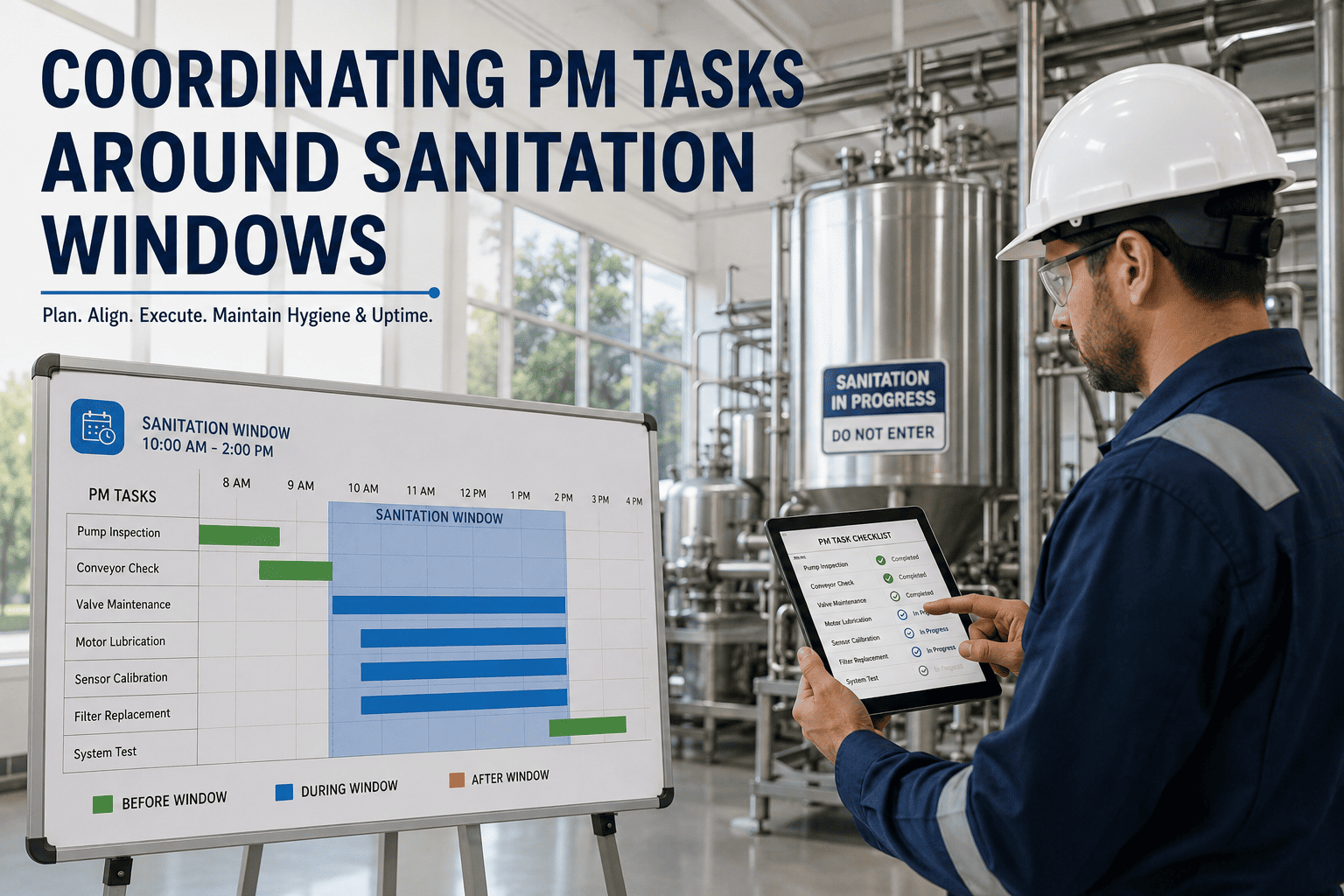
Not every PM task needs the same kind of access. Sorting tasks by when they can realistically happen around a CIP cycle is what turns a fixed sanitation block into usable maintenance time.
Before the Cycle Begins
Visual inspections, vibration readings, and non-invasive checks completed ahead of wash-down, so sanitation still starts on time and no teardown work delays the clean.
Inside a Micro-Window
Short pauses between wash, rinse, and chemical dwell phases give brief access for sensor checks and quick readings that do not require the line to be fully dry.
After Verification Is Signed Off
Mechanical PM, part replacement, and calibration are scheduled only once sanitation verification is complete, followed by a re-verification step before the line is released back to production.
Reactive Coordination vs. a Shared Scheduling Calendar
The gap between the two approaches shows up first in how often PM tasks get bumped — and second in what an auditor finds when they ask for proof.
| Scheduling Approach | Reactive Coordination | Shared CMMS Calendar |
|---|---|---|
| Visibility between teams | Sanitation and maintenance plan separately | Both calendars visible on one shared board |
| PM task not completed in time | Quietly skipped, often unrecorded | Auto-flagged and rescheduled to next window |
| Sequencing after mechanical work | Re-clean requirement often missed | Re-verification step enforced before restart |
| Audit documentation | Access history scattered across logs | Timestamped record per task, per window |
| Typical first-pass audit outcome | Around 38 percent | Around 94 percent |
See Your Sanitation and PM Schedules on One Board
Oxmaint flags conflicts before they happen, reschedules deferred PM automatically, and keeps a timestamped access record for every task run around a CIP cycle.
What Coordinated Scheduling Is Worth
Frequently Asked Questions
What counts as a sanitation window for PM scheduling purposes?
A sanitation window is any protected block of time — pre-operational cleaning, CIP cycles, or post-run wash-down — where a production line is already stopped for cleaning. A CMMS with a shared calendar treats these blocks as scheduling constraints so PM tasks are only assigned into windows that actually exist.
How does a CMMS decide whether a PM task fits before, during, or after CIP?
Each task is tagged by the type of access it needs — visual inspection, brief sensor check, or full teardown — and matched to the phase of the sanitation cycle that offers that level of access, so mechanical work is never queued ahead of a completed clean.
Can PM tasks be scheduled during the CIP cycle itself?
Some tasks can run inside short pauses between wash, rinse, and chemical dwell phases, but only non-invasive checks belong here. Mechanical PM is scheduled after sanitation verification is signed off, never mid-cycle, to avoid undoing a validated clean.
What happens if a PM task cannot be completed inside its assigned window?
Instead of silently disappearing from the plan, the task is automatically flagged and pushed to the next available window with the original due date preserved, so recurring deferrals become visible instead of buried in a technician's memory.
Does coordinating PM with sanitation slow down production?
The opposite tends to happen — facilities coordinating both calendars report fewer unplanned stoppages because equipment issues are caught during scheduled access rather than mid-run. Book a demo to see the scheduling logic on your own line layout.
Give Sanitation and Maintenance One Calendar, Not Two
Oxmaint schedules PM against real sanitation windows, resequences automatically when a task slips, and keeps an audit-ready access record for every food-contact asset in your plant.