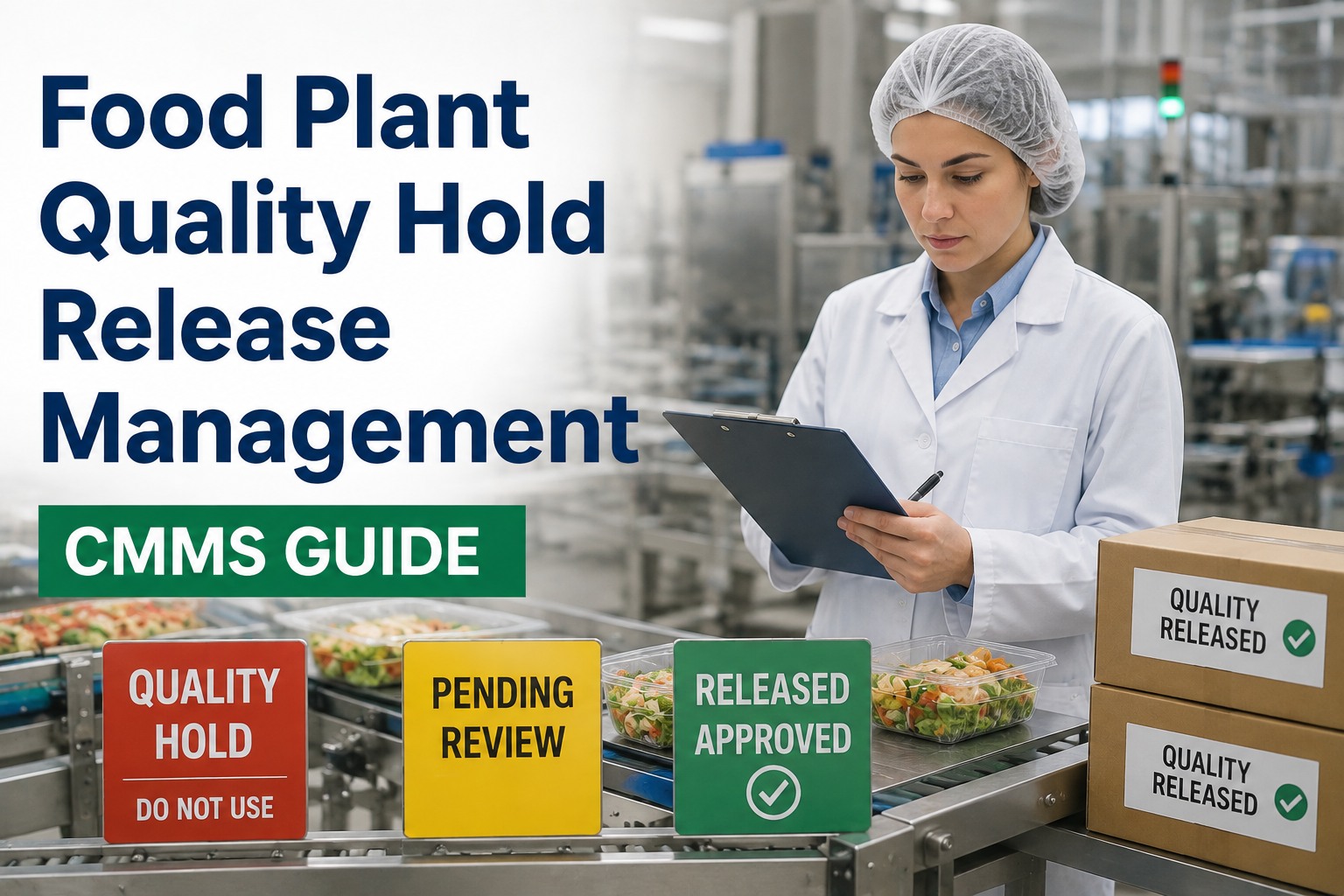
A quality hold triggered by a maintenance event is the critical junction where food plant hold discipline either holds firm — or product ships before it should. In food manufacturing, equipment downtime correlates to quality holds more often than most teams realize: a torn gasket, a replaced motor bearing, or a calibration drift after a repair can all compromise batch safety and trigger a quality hold that halts production until disposition is complete. This guide covers quality hold and release management for maintenance-event-triggered batch holds — automatic hold generation, disposition workflow, release verification, and the CMMS-QMS integration that keeps your quality hold process defensible on every equipment-related event. Ready to modernize your quality hold and release management? You can Start Free Trial today or book a demo to see it live.
CMMS Food Quality Hold Management
When a Maintenance Event Triggers a Quality Hold, Can Your Team Prove the Batch Is Safe?
Every maintenance event — a seal replacement, a motor swap, a calibration adjustment — creates a risk window where product quality can silently drift. Without automatic CMMS-QMS linkage, holds are triggered late, release decisions rely on clipboard notes, and audit trails break down. OxMaint closes the loop: maintenance events generate quality holds instantly, disposition workflows stay defensible, and release verification ties every batch back to the work order that touched the equipment.
The Cost Gap
Why Food Plant Quality Holds Need a CMMS — Not a Spreadsheet
A single unmanaged quality hold on a finished batch can cost a mid-size food plant $18,000–$120,000 in product, labor, and expedited re-testing. When the hold traces back to a maintenance event that was never linked to the batch record, the cost multiplies — because you cannot prove what happened, when, or whether the equipment was verified before production resumed.
Real-World Scenario
A 180-asset dairy processing plant spending $42K/year on manual quality-hold tracking experienced a bearing failure on its HTST pasteurizer separator. The maintenance team replaced the bearing and restarted the line — but quality discovered a temperature-deviation log 6 hours later. Because the work order and the quality hold lived in separate systems, 14,400 units of finished product sat in the warehouse for 11 days while the team reconstructed the timeline. With OxMaint, the work-order completion would have auto-triggered a quality hold on every batch produced after the repair, flagged the deviation in real time, and compressed the disposition cycle to under 8 hours.
Hold & Release Workflow
How a Maintenance-Event-Triggered Quality Hold Should Work
The difference between a defensible quality hold and a liability is whether the CMMS automatically generates the hold, routes the disposition, and verifies release — without a human remembering to start a form. Here is the four-step workflow that ISO 22000 and SQF auditors expect to see.
Automatic Hold Generation
When a maintenance work order is completed on a critical asset — or a predictive-maintenance alert triggers a shutdown — the CMMS automatically generates a quality hold on all batches produced in the risk window. The hold references the work-order ID, the asset tag, the technician, and the timestamp. No manual form, no memory, no gap.
Disposition Routing
The hold routes to the quality team with the full maintenance context attached: what was repaired, what parts were replaced (linked to spare-parts inventory), what calibration checks were performed, and whether the equipment passed post-repair verification. The quality reviewer decides — release, rework, hold-for-test, or scrap — with all evidence in one record.
Release Verification
Before the batch is released, the CMMS enforces a verification checklist: post-maintenance equipment sign-off, calibration confirmation, environmental monitoring review, and QA test results uploaded. The system blocks release until every checkpoint is electronically signed. This is the step that makes your hold discipline audit-proof.
Closed-Loop Audit Trail
Every action — the maintenance event, the hold creation, the disposition decision, the release signature — is time-stamped, user-attributed, and immutable. When an auditor asks "show me the maintenance history for this batch," the answer is one click, not a three-day records search across two departments.
CMMS + QMS Integration
CMMS Food Equipment Hold Correlation: What to Look For in 2026
Most food plants run their CMMS and QMS as siloed systems — maintenance logs a repair, quality discovers a problem days later, and nobody connects the two until a customer complaint or audit forces the issue. A purpose-built quality hold CMMS closes that gap by correlating equipment events to batch quality in real time. Here is what a modern food quality hold CMMS guide should cover for 2026.
| Capability | Spreadsheet / Paper Logs | Generic CMMS (No QMS Link) | OxMaint CMMS + QMS Integration |
|---|---|---|---|
| Hold trigger on maintenance event | Manual — relies on a phone call or email | Work order logged, but no auto-hold | Auto-hold generated on work-order completion |
| Batch-to-equipment traceability | Reconstructed after the fact, often incomplete | Asset history exists, but not linked to batches | Every batch tied to the asset state at time of production |
| Disposition workflow | Email chains, sticky notes, tribal knowledge | Separate QMS form, re-keyed maintenance data | Single record: maintenance context + QA decision + release |
| Release verification enforcement | Checklist on a clipboard, may or may not be signed | Optional — depends on operator discipline | System-blocked release until all checkpoints are e-signed |
| Audit trail (ISO 22000 / SQF / FSMA) | Days of records reconstruction, gaps common | Partial — maintenance trail only | One-click full traceability: asset, work order, hold, release |
| Time from event to hold closure | 24–72 hours typical | 12–24 hours | 2–8 hours |
How OxMaint Helps
How OxMaint Cuts Maintenance-Triggered Hold Closure Time by 70%
OxMaint is not a generic CMMS bolted onto a food plant — it is an AI-powered maintenance and asset management platform built to correlate equipment events with quality outcomes. Here is how four specific capabilities map directly to the quality hold problem.
Auto-Hold on Work-Order Completion
When a corrective or preventive maintenance work order closes on a production asset, OxMaint auto-generates a quality hold on every batch produced since the event timestamp. No human initiation required. Outcome: holds are triggered in seconds, not hours — eliminating the gap where compromised product could ship.
Unified Asset & Batch Traceability
Every asset record links to the batches produced on it, the maintenance events performed on it, and the spare parts consumed. When quality opens a hold, the full equipment history is already attached. Outcome: disposition decisions that used to take 2 days of records reconstruction now take 15 minutes.
Enforced Release Verification
OxMaint blocks batch release until post-maintenance verification, calibration checks, and QA test results are electronically signed — a system-enforced gate, not a suggestion. Outcome: zero batches released without verified post-maintenance equipment sign-off, fully defensible under FSMA and SQF audits.
Predictive Hold Prevention
OxMaint's AI-driven predictive maintenance identifies asset degradation BEFORE it reaches the threshold that triggers a quality risk — scheduling interventions during planned downtime instead of mid-batch. Outcome: 30–50% fewer unplanned maintenance events, meaning 30–50% fewer maintenance-triggered quality holds.
See It On Your Assets
Stop Reconstructing Hold Timelines After the Fact
Book a 30-minute demo and we will show you exactly how OxMaint auto-triggers quality holds from maintenance events, enforces release verification, and gives you a one-click audit trail for every batch.
Quality Hold Guide FAQ
Frequently Asked Questions: Quality Holds & CMMS in Food Production
Common questions from maintenance and quality leaders evaluating CMMS for quality hold and release management.
What is a quality hold triggered by a maintenance event in a food plant?
A maintenance-event-triggered quality hold is an automatic quarantine of all product produced on an asset after a repair, calibration, or preventive maintenance intervention — until quality can verify the equipment is operating within spec. It exists because maintenance interventions (replacing parts, opening housings, adjusting settings) create a risk window where product quality can drift. A proper CMMS like OxMaint generates this hold automatically when the work order closes, so no batch moves before disposition is complete.
How does a CMMS improve quality hold and release management for food production?
A CMMS improves hold management by connecting the maintenance event directly to the batch record — eliminating the manual handoff between maintenance and quality teams. Instead of quality discovering a problem days later, the hold is triggered instantly, the full maintenance context (work order, parts, technician, verification) is attached, and release is system-enforced. Plants using OxMaint typically cut hold-closure time from 24–72 hours down to 2–8 hours. Book a Demo to see the workflow on your assets.
What should a CMMS quality hold guide for 2026 include?
A 2026 quality hold CMMS guide should cover automatic hold generation on maintenance events, disposition workflow with full equipment traceability, system-enforced release verification with electronic signatures, closed-loop audit trails for FSMA/SQF/ISO 22000 compliance, and predictive analytics that prevent the maintenance events causing holds in the first place. It should also address CMMS-QMS integration as a single platform — not two systems bridged by manual data entry.
How does equipment downtime correlate to quality holds in food manufacturing?
Equipment downtime correlates to quality holds because the root cause of the downtime (bearing failure, seal leak, sensor drift) often means the equipment was operating out of spec before the failure was detected — meaning product produced in that window is suspect. Additionally, the repair itself introduces risk: a replaced part may need calibration, a opened housing may introduce contamination. OxMaint's CMMS tracks both the pre-failure risk window and the post-repair verification window, auto-holding all affected batches.
How long does it take to implement OxMaint for quality hold management?
Most food plants are live on OxMaint's core quality-hold workflow within 2–4 weeks, including asset import, work-order template configuration, hold-trigger rules, and release-verification checklists. The AI predictive-maintenance models begin producing actionable insights within 60–90 days of historical data ingestion. You can start with a free trial to explore the platform, or book a demo for a guided walkthrough tailored to your plant's equipment and quality processes.
Ready to Modernize?
Turn Maintenance Events Into Defensible Quality Records — Not Liability Gaps
Every day without CMMS-QMS integration is a day a maintenance-triggered hold could slip through, a batch could ship before verification, and an audit could expose the gap. OxMaint closes the loop in weeks, not months.
Free 14-day trial · No credit card