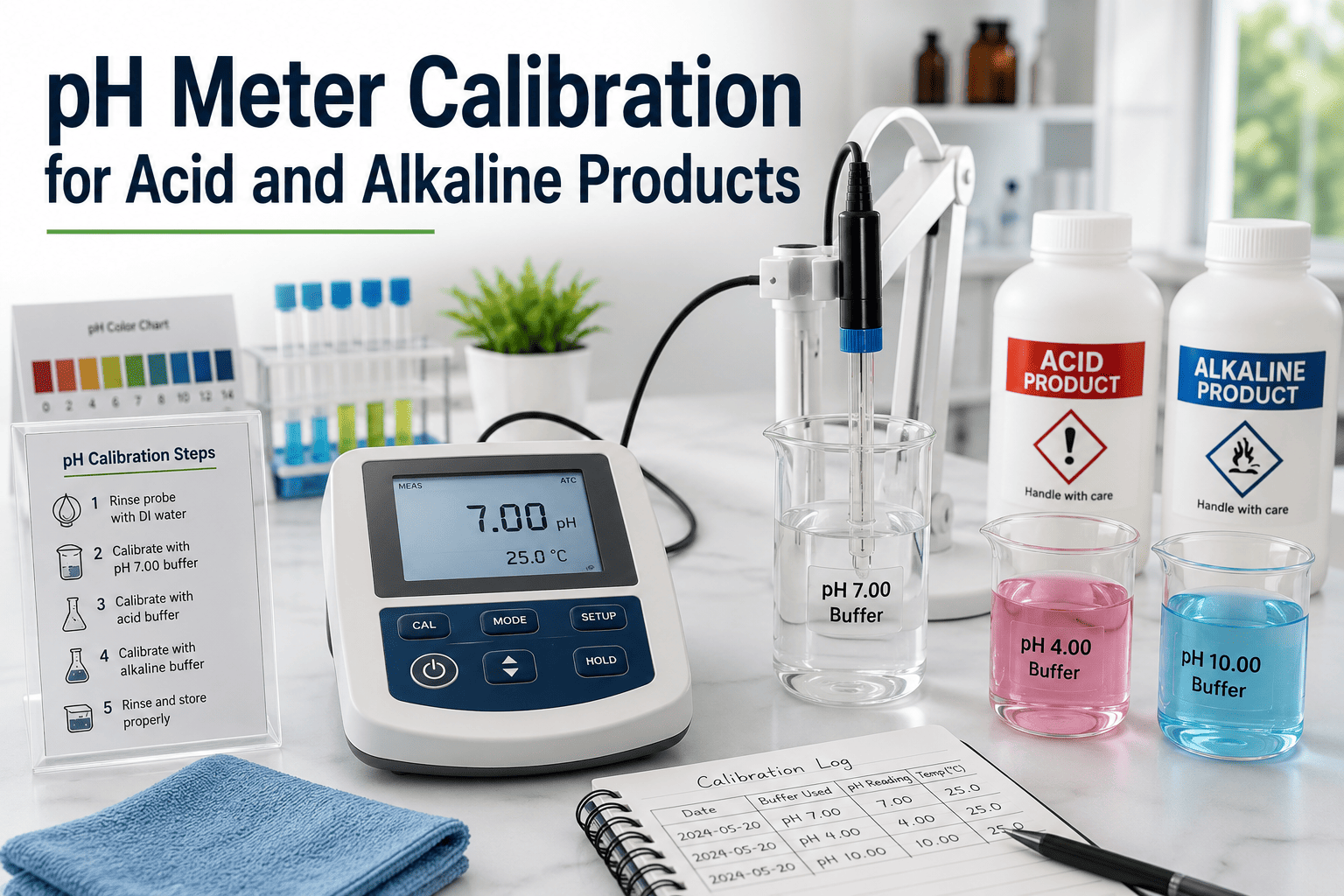
Food plant pH meter calibration is a critical control point function that separates safe, in-spec product from costly recalls, shelf-life failures, and regulatory non-conformance on both the acid and alkaline sides of your operation. This pH meter calibration guide covers multi-point calibration protocols, buffer solution tracking, verification cadence, and the CMMS-driven workflows that keep pH-critical products consistently within specification. Whether you are verifying acidified foods at pH 4.6 or monitoring alkaline cleaning solutions, a structured CMMS food pH meter calibration program eliminates skipped calibrations and missing records. You can explore the full platform with a Start Free Trial or book a personalized walkthrough to see it on your assets.
pH Meter CMMS Guide 2026
Is a Skipped pH Calibration Quietly Putting Your Next Batch at Risk?
In food and beverage manufacturing, pH verification is a CCP function — and a single missed buffer calibration on an acidified product line can trigger a Class I recall costing $10M or more. OxMaint turns pH meter calibration from a clipboard checklist into a closed-loop, audit-ready CMMS workflow.
Calibration as a CCP Function
Why Food Plant pH Meter Calibration Is a Critical Control Point
In acidified food processing, the pH 4.6 threshold is the line between botulinum-safe and hazardous product. A pH meter that drifts by even 0.2 units can pass an unsafe batch — or reject a perfectly good one — costing a mid-size plant upwards of $48,000 per day in lost throughput and rework. Yet most facilities still rely on paper logs, spreadsheets, and operator memory to verify calibration at the right cadence.
Multi-Point Protocol
pH Meter Calibration Guide for Acid and Alkaline Products: The Multi-Point Protocol
A robust food pH meter CMMS guide mandates multi-point calibration — never single-point — for any product where pH is a CCP. Acid-side products (juices, sauces, fermented foods) require bracketing with pH 4.01 and 7.00 buffers. Alkaline products (CIP solutions, wash treatments) require pH 7.00 and 10.01 buffers. A three-point calibration across 4.01 / 7.00 / 10.01 covers dual-use meters and provides the slope data needed to detect sensor degradation before it causes a failure.
Pre-Flight Electrode Check
Inspect electrode fill solution level, junction visibility, and membrane integrity. Log electrode serial number, last calibration date, and slope percentage in OxMaint — sensors below 92% slope are auto-flagged for replacement.
Rinse — Don’t Wipe
Rinse the electrode with DI water between every buffer. Never wipe the glass bulb — static charge creates reading instability. Blot gently with lint-free tissue. OxMaint checklists enforce this step with photo verification on mobile devices.
Two-Point Acid Bracket (pH 4.01 / 7.00)
Start with pH 7.00 buffer for zero calibration, then pH 4.01 for slope. Acceptance: reading within ±0.02 of target at 25°C. OxMaint auto-records timestamp, buffer lot number, temperature, and measured value for every point.
Two-Point Alkaline Bracket (pH 7.00 / 10.01)
For alkaline CIP and wash verification: pH 7.00 zero, then pH 10.01 slope. Acceptance: ±0.02. Alkaline buffers absorb CO2 and degrade faster — OxMaint tracks buffer expiration and blocks expired lots from use.
Verification with Third Buffer
Verify the calibrated meter against a third independent buffer (e.g., pH 4.01 after an alkaline calibration, or pH 10.01 after an acid calibration). If verification drift exceeds ±0.05, the calibration is invalid and triggers an OxMaint non-conformance work order.
Verification Cadence & Post-Cal Check
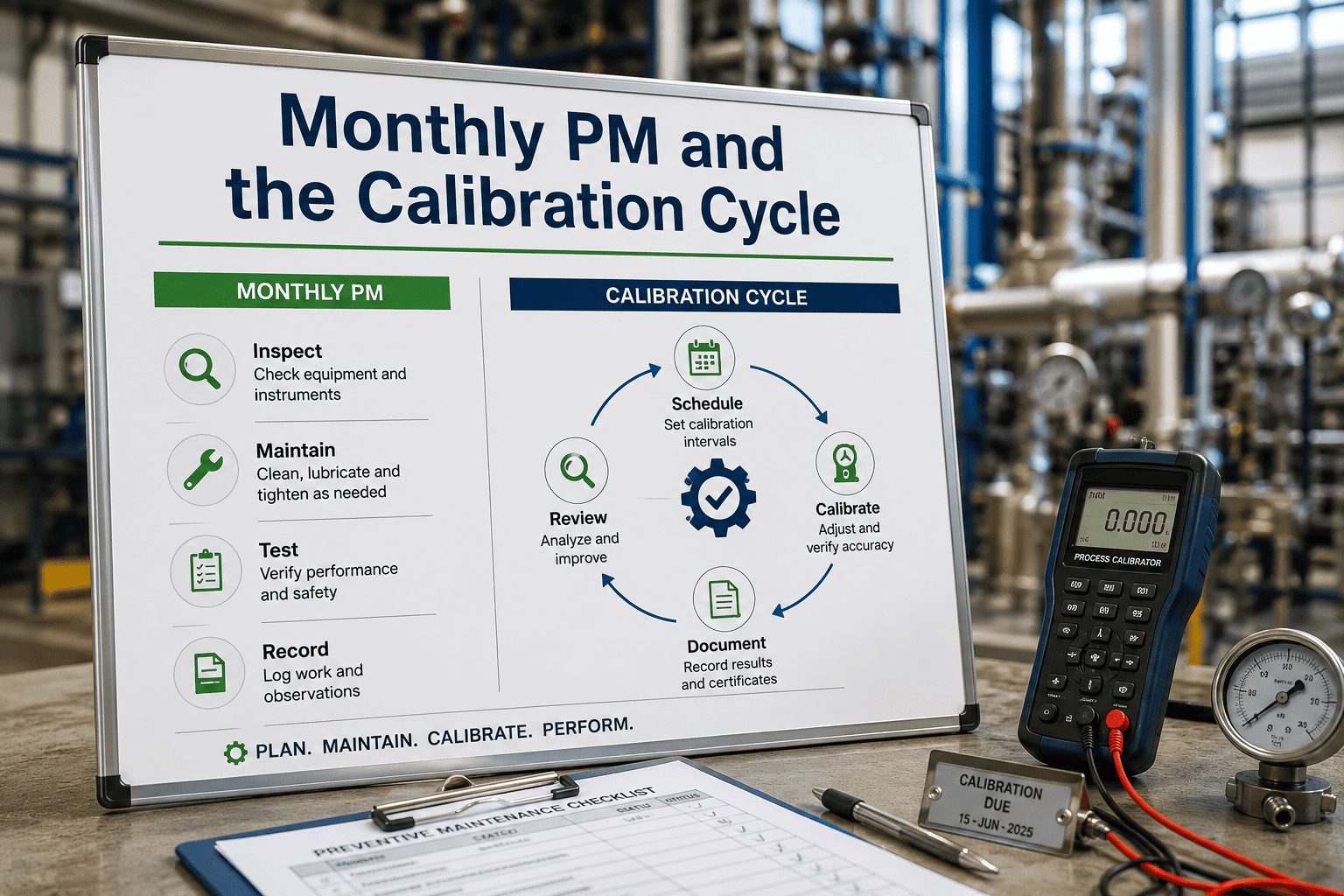
Verify before each production run, every 4 hours during continuous production, and after any meter drop or electrode change. OxMaint’s CMMS food pH sensor CCP module auto-schedules these checks and escalates missed verifications to QA supervisors in real time.
Buffer Management
CMMS Calibration Buffer Food Tracking: Expiration, Lots, and Chain of Custody
Buffer solution integrity is the silent variable in every pH calibration. NIST-traceable buffers have a finite shelf life — typically 6–12 months unopened, but as little as 4–8 weeks once exposed to air. Alkaline buffers (pH 10.01) are especially vulnerable to CO2 absorption, which shifts their actual pH within days of opening. A CMMS food pH calibration program must track buffer lot numbers, open dates, expiration dates, and storage conditions — and block expired or degraded buffers from use at the point of calibration.
A 180-asset beverage plant running 6 pH meters with 4-hour verification cadence consumes approximately 3 buffer sets per meter per month. At $42 per set, annual buffer spend = $9,072. Without CMMS tracking, an estimated 18% of calibrations use expired or CO2-degraded buffers, putting roughly 1 in 6 CCP release decisions at risk. OxMaint’s buffer-lot tracking eliminates this exposure and reduces buffer waste by auto-rejecting expired inventory at the point of use.
| Buffer pH | Primary Use | Shelf Life (Unopened) | Stability (Opened) | OxMaint Tracking |
|---|---|---|---|---|
| 4.01 | Acid product calibration | 12 months | 8 weeks | Lot / expiration / open-date enforced |
| 7.00 | Zero reference (all calibrations) | 12 months | 8 weeks | Lot / expiration / open-date enforced |
| 10.01 | Alkaline CIP / wash calibration | 8 months | 4 weeks (CO2-sensitive) | Lot / expiration / CO2-degradation flag |
| Verification Only | Independent third-buffer check | Per lot certificate | Single-use recommended | Different lot than calibration required |
Platform Capabilities
How OxMaint Powers Your CMMS Food pH Meter Calibration Program
OxMaint replaces clipboard calibration logs, spreadsheet buffer trackers, and reactive electrode replacement with a closed-loop AI-powered CMMS built for food and beverage maintenance and reliability teams. Every calibration event becomes a structured, time-stamped, audit-ready record tied to the specific asset, operator, buffer lot, and product run.
Auto-Scheduled CCP Calibration Work Orders
OxMaint generates preventive maintenance work orders for every pH meter on every line, triggered by run start, 4-hour cadence, or shift change. Missed calibrations escalate to QA and maintenance supervisors automatically — cutting skipped-CCP events by 90%+.
Buffer Lot & Expiration Enforcement
Scan or select buffer lot numbers on the mobile app. OxMaint blocks expired lots, flags CO2-degraded alkaline buffers, and enforces different-lot verification — eliminating the 18% of calibrations that typically use compromised buffer solutions.
Predictive Electrode Degradation Alerts
OxMaint’s AI engine tracks slope percentage, response time, and drift trends across every calibration. When an electrode approaches the 92% slope threshold, the system auto-generates a replacement work order before the sensor causes a CCP failure — reducing unplanned meter downtime 30–50%.
One-Click Audit & Compliance Records
Every calibration — timestamp, operator, meter serial, buffer lots, temperature, readings, slope, and verification result — is stored in an immutable record. FDA, USDA, and SQF auditors get a complete CCP calibration history in seconds, not days. Eliminates 15+ hours per audit spent reconstructing paper logs.
ROI & Cost Avoidance
The Cost of Reactive pH Calibration vs. a CMMS-Driven Program
A 180-asset food plant spending $42,000 annually on reactive pH meter issues — rework, rejected batches, audit findings, emergency electrode purchases, and QA overtime — can cut that figure by 60–75% with a CMMS food pH calibration program. The payback math is straightforward.
Annual Savings = (Rejected batches avoided × $48,000) + (Audit labor saved × $85/hr × 15 hrs) + (Buffer waste eliminated × $9,072 × 18%) + (Electrode life extended × $340/unit) − OxMaint subscription cost
Typical result for a 180-asset plant: $31,000–$52,000 net savings in Year 1, with payback in under 90 days.
| Metric | Reactive (Spreadsheet / Paper) | OxMaint CMMS Program |
|---|---|---|
| Calibration compliance rate | 74% (missed checks common) | 99%+ (auto-scheduled & escalated) |
| Audit prep time per FDA/SQF audit | 15–20 hours reconstructing logs | <1 hour (one-click export) |
| Expired buffer usage rate | 18% of calibrations | 0% (blocked at point of use) |
| Unplanned electrode failures | 3–4 per quarter per meter | 0–1 per quarter (predictive alerts) |
| Annual pH-related production loss | $42,000 average | $8,000–$12,000 (74% reduction) |
| CCP release decision confidence | Operator-dependent, variable | Data-driven, audit-ready, consistent |
See OxMaint on Your pH-Critical Lines — Book a 30-Minute Demo
Walk through a live CMMS food pH meter calibration workflow: auto-scheduled CCP checks, buffer-lot enforcement, predictive electrode alerts, and one-click audit exports. Bring your toughest calibration challenge.
Frequently Asked Questions
pH Meter Calibration FAQs for Food and Beverage Plants
How often should a food plant calibrate pH meters?
For CCP applications, calibrate at the start of every production run, verify every 4 hours during continuous production, and recalibrate after any electrode change, meter drop, or power cycle. OxMaint’s CMMS auto-schedules these intervals and escalates missed calibrations to supervisors, ensuring 99%+ compliance. You can Book a Demo to see the scheduling engine in action.
What buffers should I use for acid vs. alkaline product calibration?
Use pH 4.01 and 7.00 buffers for acid-side products (acidified foods, juices, sauces) and pH 7.00 and 10.01 for alkaline applications (CIP solutions, wash treatments). For dual-use meters, a three-point calibration across 4.01 / 7.00 / 10.01 provides full coverage and slope diagnostics. Always verify with a third independent buffer lot.
When should a pH electrode be replaced?
Replace an electrode when its slope drops below 92%, response time exceeds 30 seconds to stabilize, or it cannot be calibrated to within ±0.02 of target buffers. OxMaint tracks slope and response trends across every calibration and auto-generates a replacement work order before the electrode causes a CCP failure — reducing unplanned meter downtime by 30–50%.
How does a CMMS improve pH meter calibration compliance?
A CMMS like OxMaint eliminates the paper-and-spreadsheet gap by auto-generating calibration work orders, enforcing buffer-lot and expiration checks at the point of use, capturing digital records with timestamps and operator IDs, and escalating missed calibrations in real time. Plants typically move from 74% to 99%+ calibration compliance within the first 90 days.
How long are pH buffer solutions valid after opening?
Most NIST-traceable buffers remain stable for 6–8 weeks after opening, but alkaline pH 10.01 buffers degrade faster — typically 4 weeks — due to CO2 absorption. Always store sealed, label open dates, and never reuse single-use verification buffers. OxMaint tracks open dates and automatically flags buffers past their stability window. Start your Start Free Trial to automate buffer tracking today.
Stop Gambling with Paper pH Calibration Logs
Join the food and beverage plants that have eliminated expired-buffer calibrations, audit findings, and CCP release uncertainty with OxMaint’s AI-powered CMMS. Your 14-day trial includes full calibration work-order automation, buffer tracking, and audit-ready reporting.
Free 14-day trial · No credit card