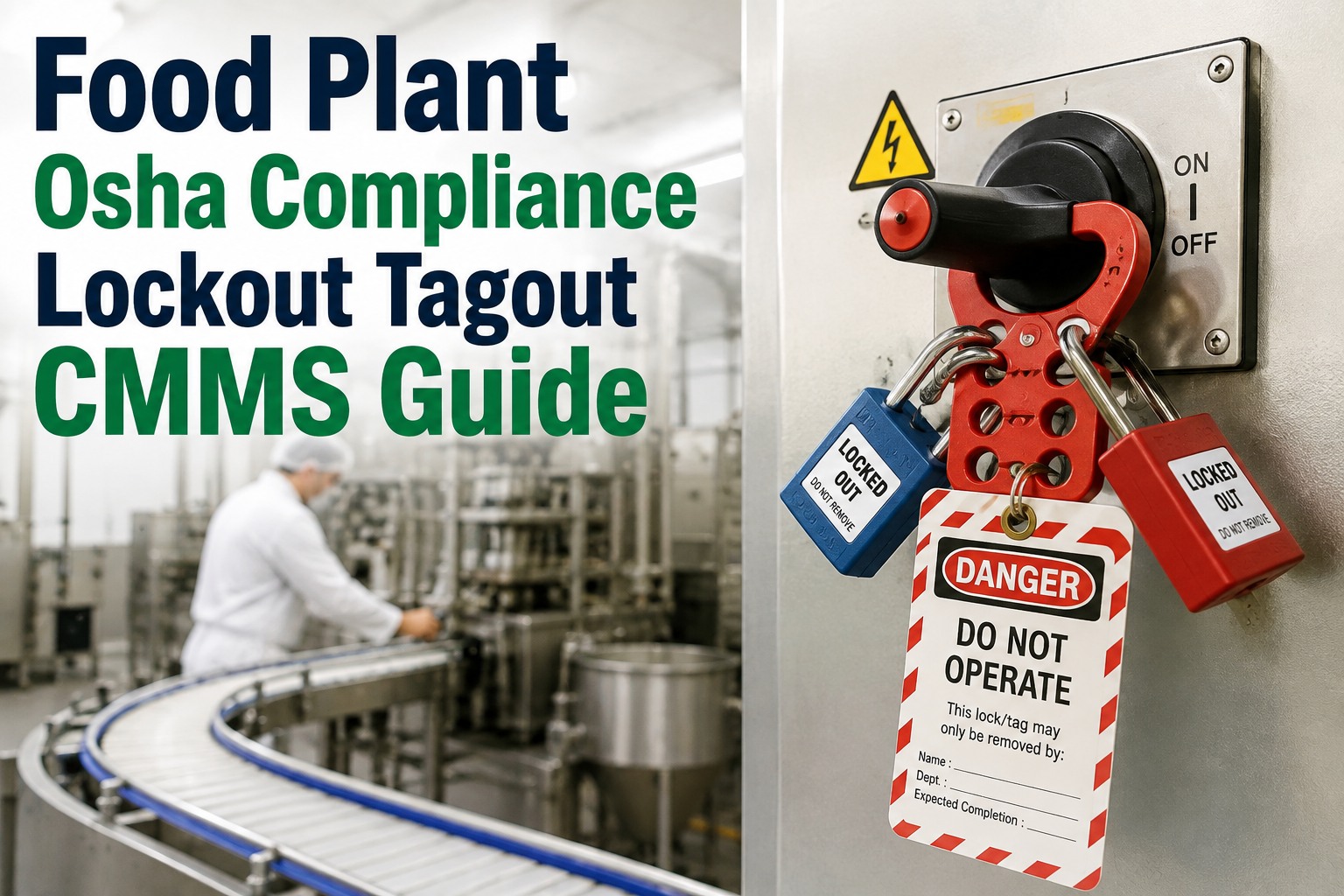
OSHA compliance in food plants converges hardest where sanitation crews and maintenance technicians share the same equipment, the same windows, and the same chemical hazards. A single overlooked lockout step during a washdown can trigger a catastrophic injury, a six-figure OSHA citation, and a production halt that costs upward of $30,000 per hour. This guide maps the four overlapping compliance zones—hazard communication, LOTO discipline, machine guarding verification, and wet-environment safety—and shows how a CMMS like OxMaint makes your OSHA compliance program defensible, auditable, and ready for OSHA 2026 enforcement priorities. Ready to digitize your safety program? Start Free Trial and see how work-order-linked LOTO transforms audit readiness in days, not months.
OSHA Guide 2026 · Food Plant Compliance
Can you prove your LOTO procedures were followed during last night's sanitation shift?
When sanitation and maintenance overlap, paper logs and verbal handoffs are not a defensible OSHA compliance strategy. A CMMS-built safety program links every lockout point to the work order, timestamps every step, and gives you an audit-ready trail before the inspector finishes their first question.
The Overlap Risk
Why food plant OSHA compliance breaks at the sanitation-maintenance boundary
In a typical food plant, maintenance completes a repair at 2:00 AM and sanitation begins a full chemical washdown at 2:15 AM on the same line. OSHA cites food manufacturers under multiple standards simultaneously because the hazards compound: 29 CFR 1910.147 (LOTO), 1910.1200 (HazCom), 1910.212 (machine guarding), and 1910.146 (confined space). When these functions operate in silos—maintenance on a CMMS, sanitation on clipboards—nobody owns the handoff, and that gap is where 60% of serious incidents occur.
Chemical Exposure During Maintenance
Sanitation chemicals (CIP acids, caustics, quat sanitizers) are often present while maintenance works on nearby equipment. OSHA HazCom requires every technician to have access to current SDS and know the chemical state of the line they are touching.
LOTO Discipline Across Shifts
A maintenance tech applies a lock at 1:00 AM; sanitation arrives at 3:00 AM and bypasses it to power-wash. Without a CMMS-enforced LOTO log tied to the work order, group lockout breaks down and the line energizes with personnel inside.
Machine Guarding Reassembly
Maintenance removes a guard to replace a bearing; sanitation removes it again to clean behind it. If it goes back on loose or missing, the next startup is an amputation risk. OSHA 1910.212 requires verification that guards are reinstalled before energization.
Wet Environment Electrical Safety
High-pressure washdown creates conductive spray paths. Maintenance must verify GFCI protection, sealed enclosures (IP66 minimum), and de-energized circuits before sanitation begins—and re-verify before the line restarts.
LOTO CMMS Guide
How to build an OSHA-defensible lockout/tagout program with a CMMS
A defensible LOTO program is not a binder of procedures—it is a real-time, verified record that proves every energy source was isolated, every lock was applied by a named individual, and every step was completed before equipment was released. A CMMS like OxMaint enforces this sequence at the work-order level, so compliance is a byproduct of doing the work, not a separate administrative task. Here is the step-by-step discipline that satisfies OSHA 1910.147 and holds up under a post-incident investigation.
Map every energy source to the asset record
In OxMaint, each asset card stores its specific energy-isolation points: electrical disconnects, pneumatic bleeds, hydraulic reliefs, steam valves, and gravity hazards. This replaces the generic LOTO binder with machine-specific procedures accessible on the technician's mobile device the moment the work order opens.
Enforce LOTO as a mandatory work-order gate
The technician cannot advance the work order past the "Ready to Start" phase until they have confirmed each isolation point in the OxMaint mobile checklist. If a lock is missing or a step is skipped, the work order is blocked and the supervisor receives an instant alert—before the hazard, not after.
Coordinate the sanitation-to-maintenance handoff
OxMaint's shift-handoff module requires the outgoing maintenance lead to electronically release the line to sanitation with a timestamped record of energy state, chemical application status, and guard position. Sanitation signs onto the same work order, closing the accountability loop that paper logs leave open.
Generate the audit trail automatically
Every LOTO event—who locked what, when, and who verified release—is logged immutably in OxMaint. When OSHA arrives, you export the complete LOTO history for any asset, any shift, any date range in under 60 seconds. No reconstruction, no gaps, no discrepancies.
CMMS Machine Guarding Food
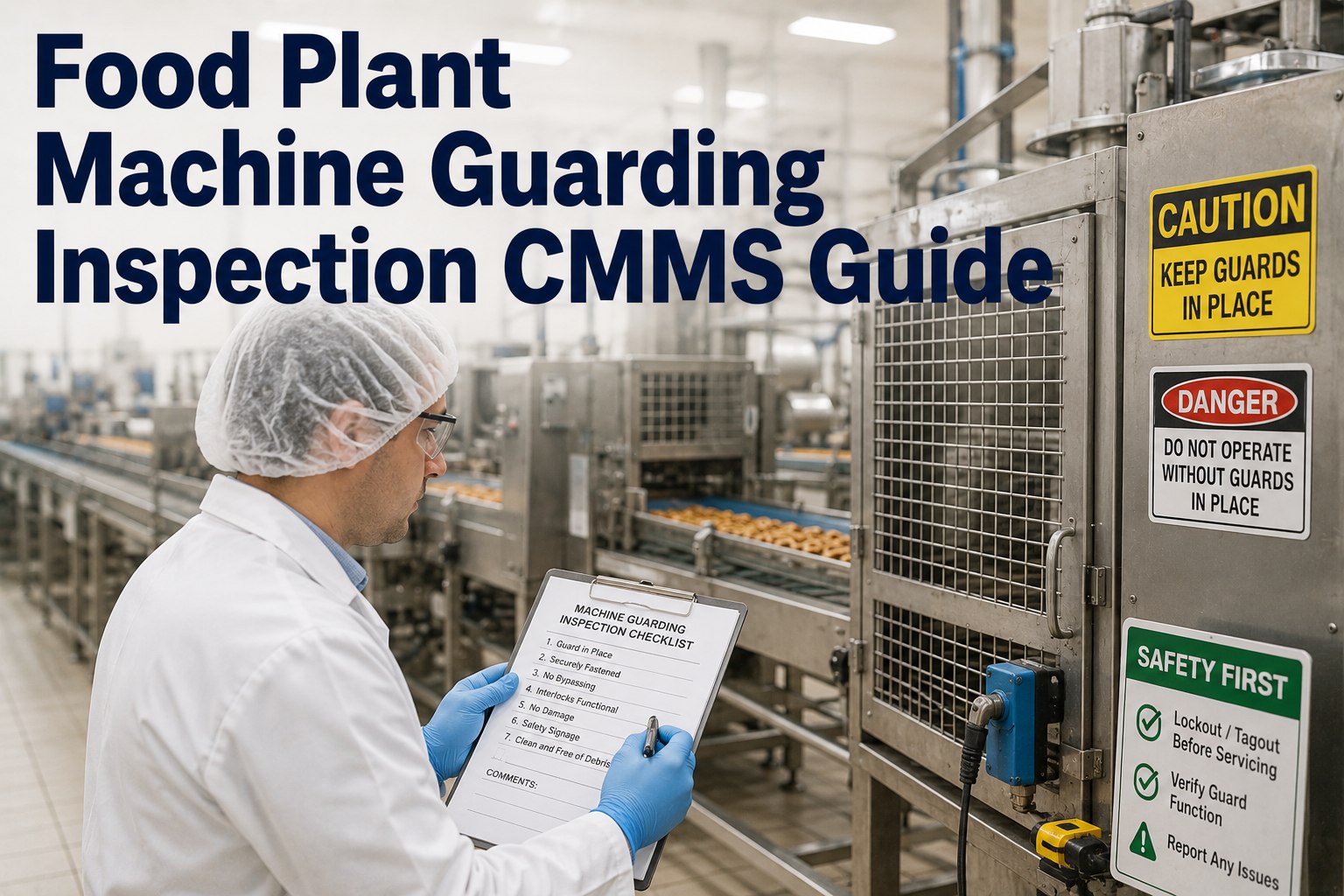
Machine guarding verification checklist for food plant maintenance
OSHA's 1910.212 machine guarding standard is one of the top five most-cited violations in food manufacturing, driven largely by guards removed during sanitation and not properly reinstalled. This checklist—designed to be built directly into OxMaint work orders as mandatory verification steps—covers the points inspectors examine first. Every item below should be a required field, not a suggestion.
Pre-Sanitation (Maintenance Handoff)
- All guards documented as removed in the OxMaint work order with reason code
- Interlock circuits verified de-energized and locked out by maintenance
- Photo-eyes and light curtains flagged as "removed for washdown" in CMMS
- Sanitation crew briefed on which guards are off and which are still in place
Post-Sanitation (Reassembly Verification)
- Every guard physically reinstalled and torque-verified to spec
- Interlocks function-tested with a documented pass/fail in the work order
- Light curtains alignment-checked and beam-break tested
- E-stops physically pressed and confirmed in the CMMS before line release
- Supervisor electronic sign-off recorded in OxMaint authorizing energization
| Hazard Zone | OSHA Standard | Common Citation Trigger | CMMS Control in OxMaint |
|---|---|---|---|
| Lockout/Tagout | 1910.147 | No energy-isolation verification before service | Mandatory LOTO checklist gate on every work order |
| Machine Guarding | 1910.212 | Guard removed for cleaning, not reinstalled | Post-sanitation guard verification + supervisor sign-off |
| Hazard Communication | 1910.1200 | SDS not accessible; unlabeled secondary containers | Chemical inventory module with SDS links per asset |
| Confined Space | 1910.146 | Entry permit not completed for silo/vat work | Confined-space permit template triggered by asset type |
| Walking-Working Surfaces | 1910.22 | Wet floors during maintenance-sanitation overlap | Wet-floor condition flag in work-order safety section |
How OxMaint Helps
How OxMaint makes OSHA compliance in food plants auditable and automatic
OxMaint was built for the realities of food plant maintenance—where sanitation chemistry, wet environments, and rapid changeovers make standard LOTO procedures insufficient. These four capabilities map directly to the compliance gaps that drive OSHA citations and workplace injuries in food manufacturing. Each one replaces a manual, error-prone process with a system-enforced workflow that produces documentation as a natural output of the work itself.
Work-Order-Linked LOTO
Every lockout point is tied to the specific asset and work order. Technicians cannot proceed until each isolation is confirmed on their mobile device, eliminating the "I thought someone else locked it out" failure mode that causes 70% of LOTO incidents.
Outcome: Zero LOTO procedural violations in your next OSHA inspection.
Automated Compliance Audit Trail
Every action—lock applied, guard verified, SDS acknowledged, permit issued—is timestamped, geo-tagged, and tied to the named technician. Export a complete compliance history for any asset, shift, or date range in under 60 seconds when OSHA arrives unannounced.
Outcome: Audit preparation time cut from 3 days to under 1 hour.
HazCom + Chemical Inventory Integration
OxMaint's spare-parts and chemical inventory module links every SDS directly to the assets where those chemicals are used. Sanitation and maintenance teams see the active chemical state and SDS on the same screen, satisfying 1910.1200 without maintaining a separate system.
Outcome: 100% SDS accessibility across both teams, zero HazCom citations.
Predictive Maintenance for Safety-Critical Assets
OxMaint's AI-driven predictive analytics flag degrading bearings, motors, and guarding components before they fail catastrophically—reducing the emergency interventions that bypass LOTO procedures and create the highest injury risk during overlapping sanitation windows.
Outcome: 30–50% fewer emergency work orders, drastically reducing high-risk LOTO events.
A 180-asset poultry processing plant in Arkansas was spending $42,000 annually on manual compliance documentation, plus one near-miss LOTO incident every quarter during the sanitation-maintenance handoff window. After implementing OxMaint, LOTO verification became a mandatory work-order gate, the audit trail generated automatically, and the plant's first OSHA inspection post-implementation produced zero citations. The plant recovered the full OxMaint subscription cost in 4.2 months through eliminated documentation labor and avoided downtime from near-miss investigations.
See OxMaint enforce LOTO on your assets — book a 30-minute demo
Walk through a real sanitation-to-maintenance handoff in OxMaint and watch every OSHA compliance step generate its own audit trail, automatically.
FAQ
OSHA compliance and CMMS in food plants: your questions answered
Does OSHA require a CMMS for lockout/tagout compliance in food plants?
OSHA does not mandate a CMMS specifically, but 29 CFR 1910.147 requires that energy-control procedures be documented, specific to each machine, and verifiable. A CMMS like OxMaint is the most reliable way to meet that standard because it ties LOTO procedures to individual asset records, enforces step-by-step verification on mobile devices, and produces the audit trail inspectors expect. Plants using paper-based LOTO systems are far more likely to receive citations for incomplete or generic procedures.
How does a CMMS improve OSHA compliance where sanitation and maintenance overlap?
A CMMS creates a single shared work-order record that both maintenance and sanitation teams interact with, eliminating the accountability gap that occurs at shift handoffs. OxMaint enforces LOTO verification before work begins, documents guard removal and reinstallation, links SDS to the chemicals in use, and timestamps every action. This means the compliance documentation is created as a byproduct of doing the work, not as a separate administrative task. You can Start Free Trial to test this workflow on your assets today.
What are the most common OSHA citations in food manufacturing maintenance?
The top citations are lockout/tagout (1910.147), machine guarding (1910.212), hazard communication (1910.1200), and powered industrial trucks (1910.178). In food plants specifically, LOTO and machine guarding violations spike because sanitation crews remove guards and bypass interlocks during washdown, and those components are not always verified before the line restarts. A CMMS with mandatory reassembly checklists directly addresses both failure modes.
How long does it take to implement a CMMS for OSHA compliance in a food plant?
A focused implementation for OSHA compliance—asset hierarchy setup, LOTO procedure import, guard-verification checklists, and HazCom chemical inventory—typically takes 3 to 6 weeks for a mid-size food plant. OxMaint's onboarding team handles data migration from spreadsheets or legacy systems, and most plants see active LOTO enforcement on their first assets within the first week. Full rollout across all assets and both maintenance and sanitation teams generally completes within one quarter.
Can OxMaint help with OSHA 2026 enforcement priorities for food plants?
Yes. OSHA's 2026 emphasis programs target chemical exposure, heat stress, and machine safety in food processing—all areas where sanitation and maintenance overlap. OxMaint addresses each: chemical inventory with SDS access supports HazCom, predictive maintenance reduces emergency interventions that expose workers to uncontrolled hazards, and work-order-linked LOTO with guard verification directly targets the machine-safety citations OSHA is prioritizing. The platform's audit-trail export ensures you can demonstrate compliance on demand.
Stop hoping your paper logs will hold up. Start building a defensible OSHA compliance program.
Join the food plants using OxMaint to enforce LOTO, verify machine guarding, and generate audit-ready compliance trails automatically—every shift, every asset, every time.
Free 14-day trial · No credit card


-procedure-checklist.png)
