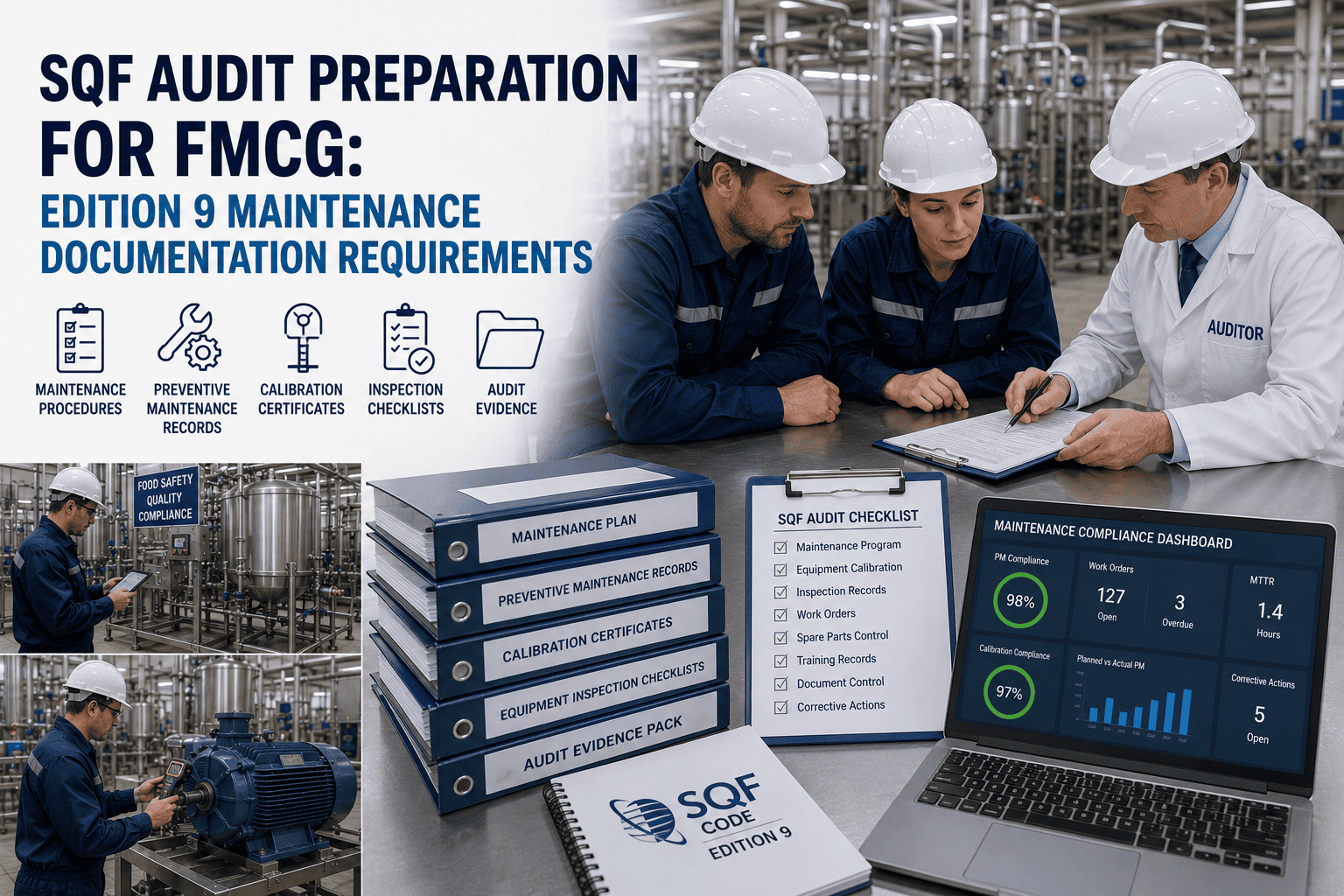
SQF Edition 9 treats the maintenance programme as a foundational prerequisite — not an afterthought. Module 11.2.9 (Manufacturing) and the corresponding clauses in Module 2 (SQF Fundamentals) require a documented, risk-based preventive maintenance programme that covers every piece of equipment affecting food safety, quality, and product integrity. Where BRCGS audits frequently surface maintenance gaps as Major non-conformances, SQF auditors score maintenance programme deficiencies against a three-tier system — Critical, Major, and Minor — where a single Critical finding on a food-safety-related maintenance failure can result in suspension of SQF certification and immediate loss of retailer shelf access. The FMCG plants that consistently hold SQF Level 3 certification — the highest assurance level, requiring both food safety and food quality management — maintain one operating discipline: every PM completion, every calibration certificate, every corrective work order, and every post-maintenance sanitation sign-off produces a timestamped, operator-signed digital record inside a single CMMS that auditors can trace from schedule through execution to close-out in under 60 seconds. Start a free trial on Oxmaint to build that evidence chain across your FMCG lines, or book a demo and walk through your specific SQF module gaps with a maintenance compliance specialist.
SQF EDITION 9 MAINTENANCE COMPLIANCE
Build an SQF Level 3 Maintenance Programme That Survives Unannounced Audits
See how FMCG plants holding SQF Level 3 certification structure their maintenance evidence trail — and replicate it in your facility before the next audit cycle.
11.2.9
SQF Module clause governing plant and equipment maintenance programmes
Level 3
highest SQF certification — requires both food safety and food quality management systems
72 hr
unannounced audit notification window — maintenance records must be audit-ready at all times
4.8X
cost of emergency equipment failure vs. planned PM — the financial case auditors use to justify maintenance findings
What SQF Edition 9 Requires From FMCG Maintenance Programmes
SQF Edition 9 Module 11.2.9 mandates that the site shall have a documented preventive maintenance programme for all equipment and building services that affect product safety and quality. The programme must include: a schedule of planned maintenance activities identifying the equipment, frequency, and method; documented records of all maintenance activities completed; a system for reporting, recording, and actioning equipment breakdowns and defects; and evidence that temporary repairs are controlled with documented risk assessments and scheduled permanent corrections. Calibration of monitoring and measuring equipment (Module 11.2.10) must be traceable to national or international standards, with certificates linked to specific equipment.
SQF auditors apply a structured scoring methodology: each element of 11.2.9 is assessed for conformance and effectiveness. A maintenance programme that exists on paper but cannot demonstrate consistent execution — completion rates below 85%, calibration certificates disconnected from assets, corrective work orders without close-out evidence — will score as Major regardless of the quality of the written procedure. The audit trail must flow from schedule to execution to close-out without breaks. Start a free trial on Oxmaint to structure this trail, or book a demo for a module-by-module walkthrough.
SQF Level 3 certification requires both food safety and food quality management — a maintenance programme gap in either system is an audit finding.
8 SQF Maintenance Evidence Elements Auditors Score
SQF auditors score each element for both conformance (does the documentation exist) and effectiveness (does the system actually work in practice). Oxmaint captures all eight elements by default.
Documented PM Schedule
Written schedule identifying each piece of equipment, PM frequency, method, and responsible person. Must demonstrate risk-based prioritisation of food-safety-critical assets.
PM Completion Records
Timestamped, signed completion records for every PM activity. SQF auditors sample 5-10 assets and trace the full PM cycle — schedule, execution, sign-off, any findings.
Breakdown and Defect Reporting
System for reporting, recording, and actioning equipment breakdowns. Every defect must generate a corrective work order with assigned technician, target date, and resolution evidence.
Temporary Repair Controls
Temporary repairs documented with risk assessment, date applied, and scheduled permanent correction. Undocumented or lingering temporary repairs are a direct Major finding.
Calibration Programme
Calibration records for all monitoring and measuring equipment traceable to national or international standards. Certificates must be linked to specific assets with in-date status at time of audit.
Post-Maintenance Sanitation
Documented sanitation clearance after every maintenance intervention on food-contact equipment. SQF auditors trace maintenance-to-sanitation-to-production-restart as a single workflow.
Contractor and Supplier Controls
External maintenance contractor records — scope of work, hygiene induction, service reports, and sign-off — must be accessible and linked to the affected equipment. GEA, Multivac, Ishida, Bosch, Tetra Pak service visits must all be documented.
Programme Verification and Review
Annual review of the maintenance programme with documented evidence of review outcomes, corrective actions, and any schedule modifications. Trend data (PM completion rates, MTTR, MTBF) expected at Level 3.
SQF auditors sample 5-10 assets and trace the full PM lifecycle — schedule to execution to close-out. One break in the chain is a finding.
6 Maintenance Documentation Failures That Cost SQF Certification
These are the six failure patterns SQF auditors find most consistently in FMCG plants operating on paper or spreadsheet maintenance systems. Each one maps to a specific SQF module clause — start a free trial to close these gaps before the next audit window.
11.2.9.1
PM Completion Rate Below 85%
A documented PM schedule that demonstrates less than 85% on-time completion is scored as ineffective regardless of the quality of the written programme. Oxmaint dashboards show real-time completion rates per asset class, line, and plant — surfacing overdue PMs before they become audit findings.
11.2.10
Calibration Certificates Not Traceable to Assets
A valid certificate in a filing cabinet that cannot be matched to the specific checkweigher, metal detector, or thermometer the auditor is standing in front of is scored as non-conforming. Oxmaint stores certificates against the asset record with expiry alerts and instant retrieval.
11.2.9.4
Undocumented Temporary Repairs
Any temporary repair without a documented risk assessment and scheduled permanent correction date is a Major finding under SQF. Oxmaint enforces mandatory risk-assessment fields and auto-generates follow-up WOs with target close-out dates on every temporary repair.
11.2.9.5
Missing Post-Maintenance Sanitation Records
Equipment returned to food production after maintenance without documented sanitation clearance is a food safety gap that SQF auditors actively seek. Oxmaint embeds sanitation sign-off as a mandatory WO close-out gate on all food-contact equipment.
11.2.9.3
Corrective Work Orders Without Close-Out Evidence
A defect reported without a corresponding corrective WO — or a WO raised but showing no resolution evidence — is scored as a systematic programme failure. Oxmaint requires technician sign-off, parts used, and root-cause fields before any corrective WO can be closed.
2.5.3
No Annual Programme Review Evidence
SQF Level 3 expects the maintenance programme to be formally reviewed annually with documented trend analysis — PM completion rates, MTTR, MTBF, and corrective action effectiveness. Oxmaint produces a one-click annual review report with all required metrics.
How Oxmaint Builds SQF Module 11.2.9 Compliance Systematically
Six Oxmaint modules map directly to SQF Edition 9 maintenance requirements — from PM scheduling through calibration management to annual programme review. Each module produces the specific evidence format SQF auditors expect. Book a demo to see each module mapped to your specific SQF clauses.
Build SQF-compliant PM schedules with frequency, responsible person, food-safety risk rating, and method per asset. Completion rates tracked in real time against 85%+ threshold.
Upload certificates to the asset record with calibration date, standard used, as-found/as-left values, and next-due date. 30-day and 7-day expiry alerts eliminate lapses.
Every defect generates a WO requiring assigned technician, parts used, root cause, and supervisor sign-off before close-out. No orphan defects, no open WOs without status.
Food-contact equipment WOs include a mandatory sanitation clearance step. The WO cannot close until a supervisor confirms the equipment has been cleaned and released for production.
Log every OEM and third-party service visit — GEA, Multivac, Ishida, Bosch, Mettler-Toledo — with induction confirmation, scope, and sign-off linked to the affected asset.
One-click annual review report: PM completion rates, MTTR, MTBF, calibration status, open corrective actions, and trend analysis — the evidence pack SQF Level 3 auditors expect.
FMCG plants using structured CMMS for SQF maintenance evidence consistently achieve Level 3 certification on first attempt — and reduce audit preparation from days to minutes.
Spreadsheet Maintenance vs. Oxmaint SQF-Ready Programme
The gap between a Major non-conformance and SQF Level 3 certification is structured evidence in one system every auditor can trace.
| SQF Evidence Requirement | Paper / Spreadsheet Programme | Oxmaint SQF-Ready Programme |
|---|
| PM Schedule (11.2.9.1) | Excel file, often outdated, no risk ranking | Live per-asset schedule, risk-rated, real-time |
| PM Completion (11.2.9.2) | Paper sign-off, frequently incomplete | Timestamped digital, operator-signed on mobile |
| Defect Reporting (11.2.9.3) | Whiteboard or verbal, no close-out trail | Mandatory WO with technician sign-off + root cause |
| Temporary Repairs (11.2.9.4) | Undocumented or sticky-note tracked | Mandatory risk assessment + scheduled follow-up |
| Sanitation Clearance (11.2.9.5) | Verbal confirmation, no record | WO close-out gate with supervisor signature |
| Calibration (11.2.10) | Filing cabinet, not asset-linked | Asset-linked, expiry-alerted, instant retrieval |
| Contractor Records (2.4.4) | Service receipts in folder, incomplete | Linked to asset, induction + scope documented |
| Programme Review (2.5.3) | Meeting notes if held | One-click report: MTTR, MTBF, completion rates |
ROI and Outcomes From an SQF-Ready Maintenance Programme
Measurable outcomes FMCG sites achieve within 12 months of deploying Oxmaint aligned to SQF Edition 9 — start a free trial or book a demo to map these to your plant.
95%+
PM completion rate
Well above the 85% threshold SQF auditors use as the effectiveness benchmark
Level 3
certification achievable
Complete food safety + food quality maintenance evidence in a single system
-42%
reactive maintenance cost
Structured PM reduces emergency repairs within 12 months of deployment
100%
calibration traceability
Every certificate linked to specific equipment, expiry-alerted, instantly retrievable
-80%
audit preparation time
Evidence exportable in minutes — no multi-day reconstruction before audit
30 days
to audit-ready records
Oxmaint sites generate complete SQF-ready evidence within 30 days of go-live
SQF Edition 9 Maintenance Audit FAQ
What is the difference between SQF Level 2 and Level 3 maintenance requirements
SQF Level 2 covers food safety fundamentals including the basic preventive maintenance programme under Module 11.2.9. Level 3 adds food quality management — meaning the maintenance programme must also demonstrate that equipment is maintained to product quality specifications (texture, appearance, weight, organoleptic standards), not just food safety parameters. In practice, Level 3 requires maintenance trend data (MTTR, MTBF, OEE correlation) and evidence that the programme is continuously improving. Oxmaint produces both the food-safety PM evidence required at Level 2 and the quality-management trend analysis expected at Level 3.
How do SQF auditors score maintenance programme effectiveness versus conformance
SQF auditors assess each clause for both conformance (does the documented programme exist and does it cover the required elements) and effectiveness (does the programme actually work in practice). A facility can have a beautifully written maintenance SOP and still receive a Major finding if PM completion rates are below 85%, if calibration certificates have lapsed, or if corrective work orders show no close-out evidence. Oxmaint ensures effectiveness by enforcing mandatory fields on every PM completion, calibration record, and corrective WO — the system does not allow incomplete records.
What OEM equipment service visits need to be documented for SQF Module 2.4.4
Every external maintenance visit — whether from equipment OEMs like GEA, Multivac, Ishida, Bosch Packaging, Mettler-Toledo, Heat and Control, or JBT, or from third-party service contractors — must have documented scope of work, hygiene induction confirmation, service report, and sign-off linked to the specific equipment serviced. SQF auditors verify that contractor controls are consistent across all external service providers. Oxmaint logs every external visit against the affected asset with all required fields.
How long does Oxmaint deployment take for SQF compliance at an FMCG site
A single FMCG site is typically live in 10-14 working days using Oxmaint pre-built food manufacturing templates aligned to SQF Edition 9 module structure. Asset register and PM schedules populated in week one, first PM completion records generated in week two, full SQF-ready evidence trail producing within 30-45 days. Multi-site portfolio rollout follows a phased approach with template replication across facilities.
SQF EDITION 9 READINESS
Stop Losing SQF Certification to Maintenance Evidence Gaps
Turn every PM, calibration, corrective repair, and sanitation clearance into an auditor-ready evidence trail with Oxmaint. Used by FMCG operations teams managing 10,000+ assets.
SQF Module 11.2.9 compliant
Level 3 certification ready
Multi-site portfolio rollup
No heavy implementation. Live in days, not months. Works across multi-site FMCG portfolios. See measurable results in the first 30 days.