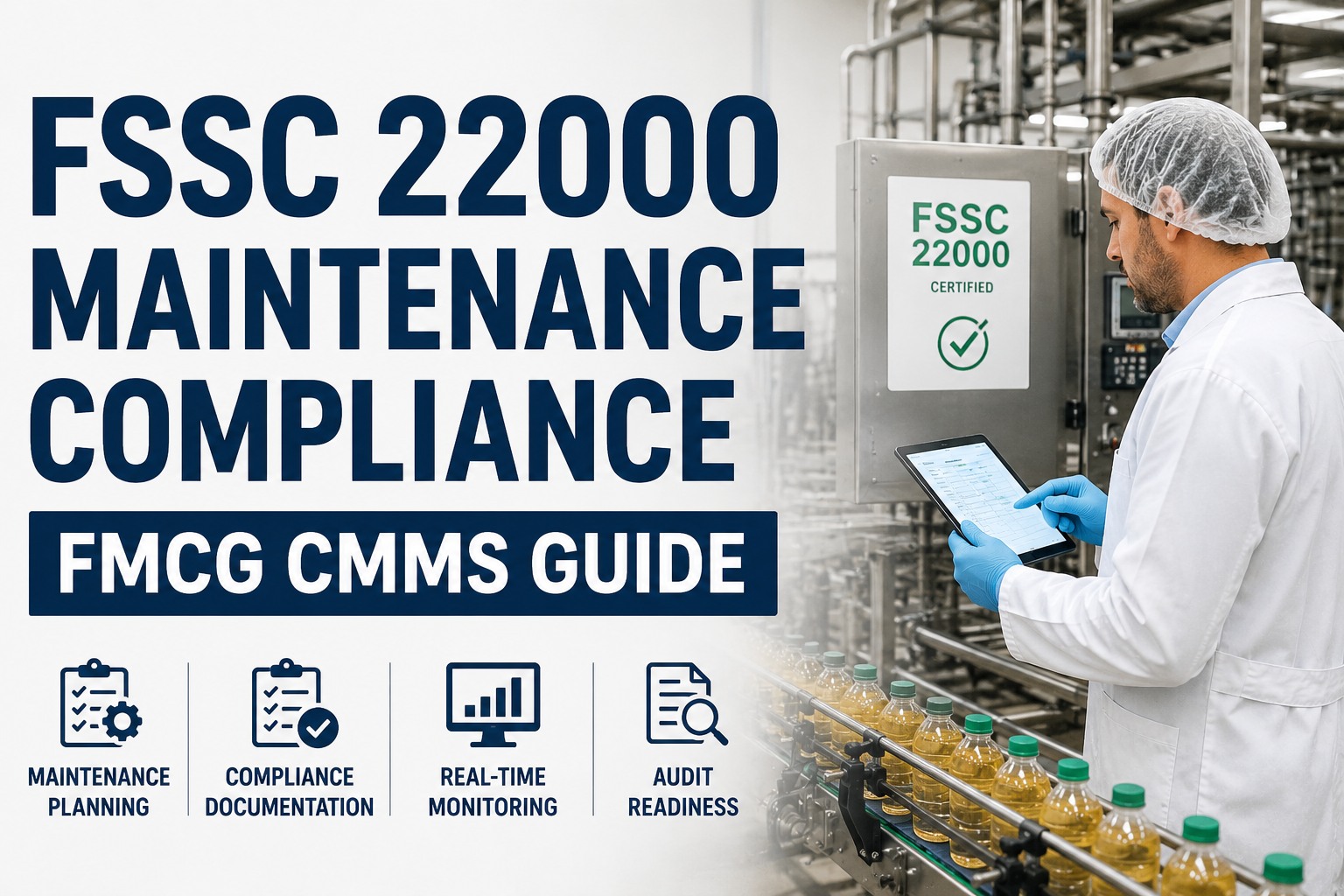
FSSC 22000 Version 6 is the most structurally rigorous GFSI-benchmarked certification scheme for food manufacturing — built on the ISO 22000 framework and supplemented by sector-specific PRPs that translate directly into maintenance programme requirements. Where BRCGS and SQF audit maintenance under a single chapter, FSSC 22000 distributes maintenance obligations across three interconnected layers: ISO 22000 Clause 8 (operational planning), ISO/TS 22002-1 PRPs (covering equipment maintenance, calibration, and facility upkeep), and FSSC 22000 Additional Requirements (covering food defence, food fraud, and environmental monitoring infrastructure). A maintenance programme that satisfies one layer but not the others produces a non-conformance — and under FSSC 22000 V6, a Critical non-conformance on a food safety prerequisite results in suspension of certification with immediate supply-chain impact. The FMCG plants that hold FSSC 22000 certification across Nestlé, Unilever, Danone, PepsiCo, and Mars supply chains maintain one operating principle: every PM, every calibration, every corrective repair produces a timestamped, ISO-compliant digital record inside a single CMMS. Start a free trial on Oxmaint to build that three-layer evidence trail, or book a demo with a compliance specialist to walk through your specific PRP gaps.
FSSC 22000 V6 MAINTENANCE COMPLIANCE
Build a Three-Layer FSSC 22000 Maintenance Evidence Trail
See how FMCG plants supplying Nestlé, Unilever, and PepsiCo structure their ISO 22000 + PRP + Additional Requirements maintenance programme.
3
compliance layers auditors trace through your maintenance programme
FSSC 22000 V6 AUDIT REALITY
Four Numbers Every FMCG Compliance Manager Tracks
foundation framework — Clause 8 operational planning covers maintenance programme requirements
sector-specific PRPs — Clause 8.5 covers equipment maintenance, and Clause 8.7 covers calibration
FSSC Additional Requirements — food defence, food fraud, and environmental monitoring infrastructure
cost of emergency equipment failure vs. planned PM — the financial case behind every audit finding
ISO/TS 22002-1 CLAUSE 8.5
What FSSC 22000 V6 Requires From Maintenance Programmes
ISO/TS 22002-1 Clause 8.5 requires the organisation to establish and implement a system of planned preventive maintenance for all equipment used in the production environment. The system must include: a schedule of maintenance activities, specified materials used during maintenance (food-grade lubricants, chemicals), a procedure for releasing maintained equipment back to production (sanitation clearance), and documented records of all maintenance activities. Clause 8.7 adds calibration requirements: all monitoring and measuring equipment must be calibrated against recognised standards at defined intervals, with traceable records linked to specific devices.
FSSC 22000 V6 Additional Requirements extend this further — environmental monitoring infrastructure (air handling, water systems, drainage) must be maintained as part of the PRP programme, and food defence infrastructure (CCTV, access control, perimeter lighting) carries its own maintenance documentation requirement. Auditors trace all three layers through the same CMMS. Start a free trial to structure this trail, or book a demo for a PRP-by-PRP walkthrough.
FSSC 22000 distributes maintenance across three compliance layers — a programme that satisfies one but not the others produces a non-conformance.
8 FSSC 22000 Maintenance Evidence Elements Auditors Trace
Each element maps to a specific clause across the three-layer structure. Oxmaint captures all eight by default — no manual configuration required.
01
TS 8.5.1
Planned PM Schedule
Written schedule with equipment ID, frequency, method, responsible person. Risk-based prioritisation of food-safety-critical assets.
02
TS 8.5.2
PM Completion Records
Timestamped, signed records per activity. Auditors sample 5-10 assets and trace schedule-to-execution-to-close-out.
03
TS 8.5.3
Maintenance Material Controls
Food-grade lubricants (H1/NSF), chemicals, and spare parts documented per intervention. Non-food-grade material on food-contact equipment is a Critical finding.
04
TS 8.5.4
Post-Maintenance Release
Documented sanitation clearance before equipment returns to production. The maintenance-to-sanitation-to-production workflow must be traceable.
05
TS 8.5.5
Temporary Repair Controls
Risk assessment, date applied, scheduled permanent correction. Auditors specifically look for temporary repairs that have exceeded their scheduled correction date.
06
TS 8.7
Calibration Programme
Calibration records for all CCP and OPRP monitoring equipment traceable to international standards. Certificates linked to specific assets with as-found/as-left values.
07
V6 2.5.6
Environmental Infrastructure PM
Air handling, water treatment, drainage, and HVAC systems maintained as documented PRPs. Filter replacement, water testing, and drain cleaning on schedule.
08
V6 2.5.4
Food Defence Infrastructure PM
CCTV cameras, access-control systems, perimeter lighting, and intrusion detection maintained with documented PM records. Required under FSSC V6 Additional Requirements.
ISO/TS 22002-1 requires food-grade lubricant traceability per maintenance intervention — a standard industrial grease on a GEA homogeniser is a Critical finding.
6 Maintenance Failures That Cost FSSC 22000 Certification
These six failure patterns produce non-conformances across the three compliance layers — start a free trial to close these gaps before the next audit window.
01
TS 8.5.3
Non-Food-Grade Lubricant on CCP Equipment
Standard industrial lubricant on a Tetra Pak filler, GEA homogeniser, or Multivac thermoformer chain is a Critical finding under TS 8.5.3. Oxmaint tags every spare part and lubricant as food-grade (H1/NSF) and flags non-compliant selections before WO execution.
02
TS 8.5.4
Missing Post-Maintenance Sanitation Release
Equipment returned to production without documented sanitation clearance violates TS 8.5.4. Oxmaint embeds a mandatory sanitation sign-off gate — the WO cannot close until a supervisor confirms the equipment is cleaned and released.
03
TS 8.7
Calibration Certificates Not Asset-Linked
A valid certificate that cannot be matched to the specific Mettler-Toledo checkweigher or Ishida multi-head weigher is scored as non-conforming. Oxmaint stores every certificate against the asset record with expiry alerts.
04
TS 8.5.5
Undocumented Temporary Repairs
Temporary repairs without risk assessment and scheduled correction date are a Major finding. Oxmaint enforces mandatory risk-assessment fields and auto-escalates overdue temporary repairs past their correction deadline.
05
V6 2.5.6
Environmental Infrastructure PM Gaps
Air-handling filter replacement, water treatment dosing, and drain maintenance not documented as PRPs. FSSC V6 Additional Requirements treat environmental infrastructure as a food-safety prerequisite.
06
V6 2.5.4
Food Defence Infrastructure Not Maintained
CCTV cameras offline, access-control batteries dead, perimeter lighting out — all are food defence gaps under FSSC V6 that auditors increasingly verify through maintenance records.
How Oxmaint Builds FSSC 22000 V6 Compliance Across All Three Layers
Six Oxmaint modules map directly to ISO 22000, ISO/TS 22002-1, and FSSC V6 Additional Requirements — book a demo for a PRP-by-PRP walkthrough.
01TS 8.5
PM schedules with PRP risk classification per asset. CCP and OPRP equipment prioritised with shorter intervals. Real-time completion rate dashboards.
02TS 8.7
Certificates uploaded to asset records with traceable standards, as-found/as-left values, and next-due dates. 30-day and 7-day expiry alerts eliminate lapses.
03TS 8.5.3
Lubricants, gaskets, and spare parts tagged food-grade (H1/NSF) in Oxmaint inventory. Non-compliant material flagged before WO execution. Full traceability per intervention.
04TS 8.5.4
Mandatory sanitation clearance step on all food-contact WOs. WO cannot close until supervisor confirms equipment cleaned and released for production.
05V6 2.5
Air handling, water treatment, drainage, CCTV, access control, and perimeter lighting maintained as documented PRPs with their own PM schedules and completion records.
06ISO 9.3
One-click annual review: PM completion rates, MTTR, MTBF, calibration status, PRP compliance, and trend analysis for ISO 22000 management review input.
FMCG plants using structured CMMS for FSSC 22000 maintenance evidence consistently achieve certification on first attempt — and reduce audit preparation from days to minutes.
Spreadsheet Maintenance vs. Oxmaint FSSC 22000-Ready Programme
The gap between a non-conformance and a clean audit is structured evidence across all three compliance layers in one system.
| FSSC 22000 Requirement | Paper / Spreadsheet Programme | Oxmaint FSSC-Ready Programme |
|---|
| PM Schedule (TS 8.5.1) | Excel, no PRP risk classification | Live per-asset, PRP-risk-rated, real-time |
| PM Records (TS 8.5.2) | Paper sign-off, gaps common | Timestamped, operator-signed, gap-free |
| Material Traceability (TS 8.5.3) | No lubricant-grade tracking | Food-grade tagged, non-compliant flagged |
| Sanitation Release (TS 8.5.4) | Verbal, no documentation | Mandatory WO gate, supervisor-signed |
| Temporary Repairs (TS 8.5.5) | Undocumented | Risk assessment + auto-escalation |
| Calibration (TS 8.7) | Filing cabinet, not asset-linked | Asset-linked, expiry-alerted, instant |
| Environmental PRPs (V6 2.5.6) | Not tracked as maintenance | Dedicated PRP PM schedules |
| Food Defence PM (V6 2.5.4) | Not tracked | CCTV, access, lighting on PM schedule |
ROI and Outcomes From an FSSC 22000-Ready Programme
Measurable outcomes within 12 months — start a free trial or book a demo.
0
Critical findings
Complete three-layer evidence eliminates Critical risk
-42%
reactive cost
PRP-based PM reduces emergency repairs
100%
calibration compliance
Expiry alerts eliminate certificate lapses
100%
material traceability
Every lubricant H1-verified per intervention
-80%
audit prep time
Three-layer evidence export in minutes
30 days
to audit-ready
FSSC-ready evidence within 30 days
FSSC 22000 V6 Maintenance FAQ
What is the three-layer compliance structure of FSSC 22000 and how does it affect maintenance
FSSC 22000 combines ISO 22000 (management system framework), ISO/TS 22002-1 (sector-specific PRPs including equipment maintenance under Clause 8.5 and calibration under Clause 8.7), and FSSC 22000 Additional Requirements (food defence, food fraud, environmental monitoring). A maintenance programme must satisfy all three layers — auditors trace evidence across the full structure. Oxmaint maps PM schedules, calibration records, and corrective WOs to each layer automatically.
How does ISO/TS 22002-1 Clause 8.5.3 maintenance material traceability work in practice
Clause 8.5.3 requires documented evidence that all materials used during maintenance on food-contact surfaces — lubricants, greases, gaskets, chemicals — are food-grade (H1 classification or equivalent) and traceable per intervention. Auditors select a recently-maintained piece of food-contact equipment — a Tetra Pak filler, GEA separator, or Multivac thermoformer — and verify that the lubricant and spare parts documented in the WO are food-grade. Oxmaint tags every inventory item with food-grade classification and flags non-compliant selections at the WO stage.
What environmental and food defence infrastructure requires documented maintenance PM
FSSC V6 Additional Requirements treat environmental monitoring infrastructure (air-handling units, HEPA filters, water treatment systems, drainage) and food defence infrastructure (CCTV cameras, access-control systems, perimeter lighting, intrusion detection) as prerequisites requiring documented maintenance. Oxmaint creates dedicated PM schedules for each infrastructure category with their own inspection checklists, completion records, and corrective WO workflows.
How long does Oxmaint deployment take for FSSC 22000 compliance at an FMCG site
A single FMCG site is typically live in 10-14 working days using Oxmaint pre-built food manufacturing templates aligned to ISO/TS 22002-1 PRP structure. Asset register and PM schedules populated in week one, first completion records generated in week two, full three-layer FSSC-ready evidence trail within 30-45 days. Multi-site portfolio rollout follows a phased template-replication approach.
ISO 22000
TS 22002-1
V6 Additional
FSSC 22000 V6 READINESS
Stop Losing FSSC Certification to Three-Layer Evidence Gaps
Turn every PM, calibration, corrective repair, and PRP maintenance activity into an ISO-compliant evidence trail with Oxmaint. Used by FMCG teams supplying Nestlé, Unilever, PepsiCo, and Mars.
No heavy implementation. Live in days. Multi-site FMCG portfolios. Measurable results in 30 days. Used by teams managing 10,000+ assets.