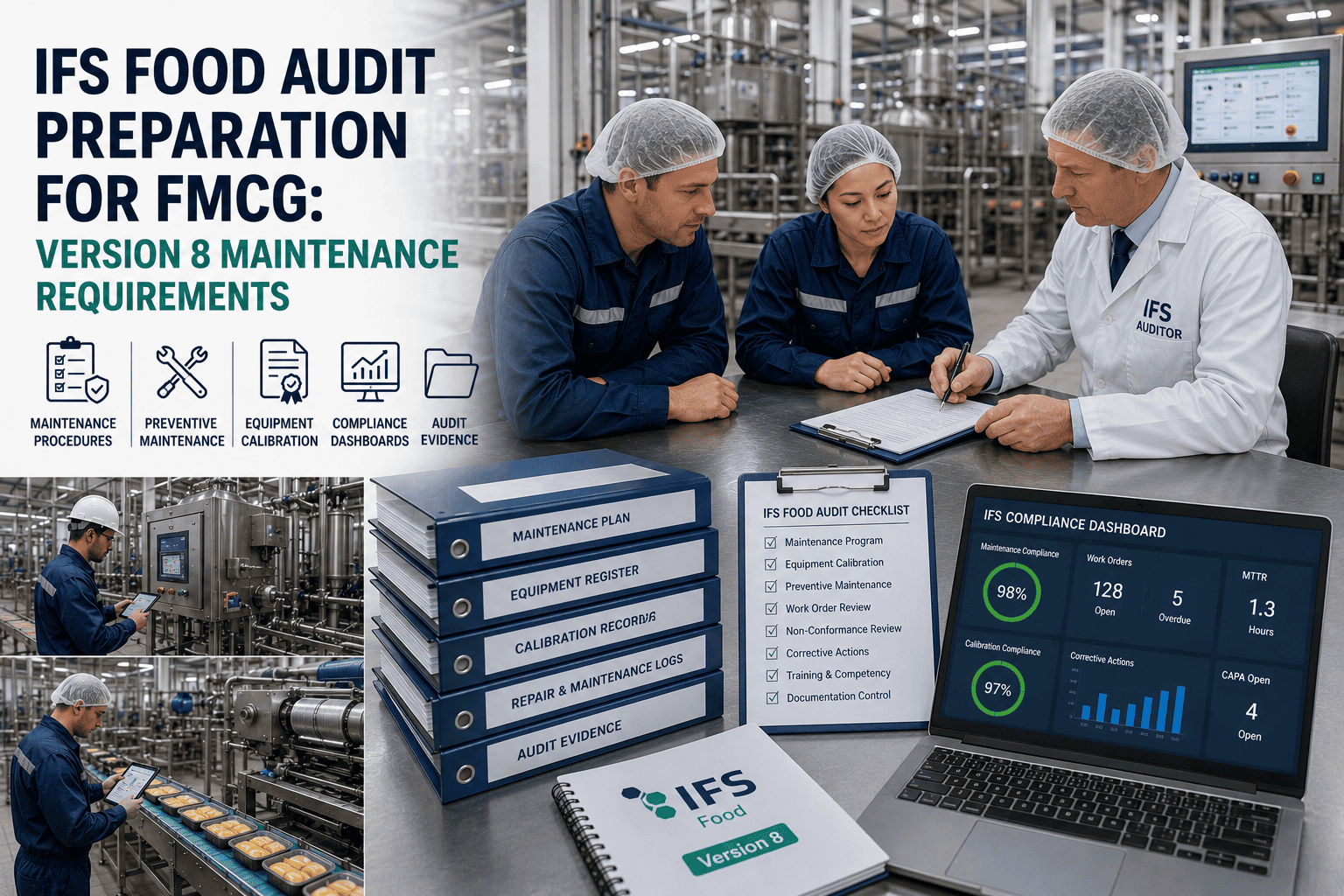
IFS Food Audit Preparation for FMCG: Version 8 Maintenance Requirements
By Jack Edwards on May 22, 2026
IFS Food Version 8 treats maintenance as a structural pillar of food safety management — not an operational afterthought. Chapter 4.12 (Maintenance and Repairs) requires a documented maintenance system that covers all equipment and building services critical to product safety, quality, and legality, with specific clauses addressing planned maintenance schedules, post-maintenance hygiene clearance, temporary repair controls, and maintenance material traceability. Where BRCGS and SQF allow some flexibility in programme structure, IFS Food V8 is prescriptive: auditors score each sub-clause on a scale from A (full conformity) to D (non-conformity), and a single D score on a KO (knock-out) requirement — including elements of Chapter 4.12 that affect food safety — results in immediate audit failure regardless of the overall score. The FMCG plants that consistently achieve IFS Higher Level certification — the designation required by major European retailers including Lidl, Aldi, Carrefour, and Metro — maintain one operating principle: every PM completion, every corrective repair, every calibration certificate, and every post-maintenance sanitation sign-off produces a timestamped, operator-signed, auditor-traceable record inside a single CMMS. Start a free trial on Oxmaint to build that IFS-ready evidence trail across your FMCG lines, or book a demo with a compliance specialist to walk through your specific Chapter 4.12 gaps.
IFS FOOD VERSION 8 COMPLIANCE
Close Your IFS Chapter 4.12 Gaps Before the Next Audit Cycle
See how FMCG plants achieving IFS Higher Level structure their maintenance evidence — and replicate it in your facility in days, not months.
IFS Food chapter governing maintenance and repairs — the most prescriptive maintenance clause across all GFSI schemes
A-B-C-D
IFS scoring scale per sub-clause — a single D on a KO requirement fails the entire audit regardless of overall score
Higher
IFS certification level required by Lidl, Aldi, Carrefour, Metro, and most major European FMCG retailers
4.8X
cost of emergency equipment failure vs. planned PM — the financial case that underpins every IFS maintenance finding
What IFS Food Version 8 Chapter 4.12 Requires From Maintenance
IFS Food V8 Chapter 4.12 mandates a documented maintenance system covering all plant, equipment, and building services that could affect product safety, quality, and legality. Sub-clauses require: a planned maintenance schedule with frequencies based on risk assessment (4.12.1), documented records of all maintenance activities (4.12.2), procedures ensuring maintenance does not compromise food safety during or after intervention (4.12.3), traceability of maintenance materials — lubricants, chemicals, and spare parts — used on food-contact equipment (4.12.4), and documented hygiene clearance before equipment returns to production (4.12.5).
IFS auditors apply a more granular scoring methodology than BRCGS or SQF. Each sub-clause of 4.12 is individually scored A through D, and the scores contribute to the overall percentage that determines Foundation versus Higher Level certification. A facility achieving 95%+ overall — with no D scores and limited C scores — earns Higher Level. Maintenance programme gaps that produce multiple C scores can push a facility below the 95% threshold even when food safety controls are strong. Start a free trial to structure your Chapter 4.12 evidence, or book a demo for a clause-by-clause walkthrough.
KEY THRESHOLD
95%
overall audit score required for IFS Higher Level — maintenance C/D scores directly erode this percentage
IFS auditors score every sub-clause of Chapter 4.12 individually — a single D on a KO requirement fails the entire audit regardless of overall performance.
8 IFS Maintenance Evidence Elements Auditors Score Clause by Clause
IFS Food V8 auditors walk through each element below and assign an individual A-D score. Oxmaint captures all eight elements as default system behaviour — no manual configuration required.
014.12.1
Risk-Based PM Schedule
Written schedule identifying equipment, PM frequency, method, responsible person, and risk classification. IFS expects frequencies to reflect actual operating conditions — not just OEM defaults.
024.12.2
PM Completion Records
Timestamped, signed completion records for every PM activity. IFS auditors specifically verify that completion records match the schedule — gaps between scheduled and documented PMs produce C scores. Sample-based verification: auditors select 5-10 assets and trace the full cycle.
034.12.3
Maintenance Hygiene Controls
Procedures ensuring maintenance activities do not introduce food safety hazards — including documented sanitation clearance after every intervention on food-contact equipment.
044.12.4
Maintenance Material Traceability
Lubricants, cleaning chemicals, gaskets, and spare parts used on food-contact equipment must be food-grade and traceable. IFS requires evidence that non-food-grade materials are excluded.
054.12.5
Temporary Repair Documentation
Every temporary repair must be documented with risk assessment, date applied, responsible person, and scheduled permanent correction date. IFS V8 is explicit: undocumented temporary repairs are a Major non-conformance. Auditors check for lingering temporary fixes that have exceeded their scheduled correction date — a strong indicator of poor programme management.
065.3.1
Calibration Programme
Calibration records for monitoring and measuring equipment traceable to national/international standards. Certificates linked to specific assets with as-found/as-left values documented.
073.2.1
Contractor and External Service Controls
External maintenance provider documentation — GEA, Multivac, Ishida, Bosch, Mettler-Toledo — must include scope, hygiene induction, service report, and sign-off linked to specific equipment.
081.4
Management Review Evidence
Annual review of the maintenance programme with documented trend analysis — PM completion rates, MTTR, MTBF, corrective action effectiveness. Required input for IFS management review.
IFS Food V8 is the most prescriptive GFSI scheme on maintenance material traceability — lubricants and spare parts on food-contact equipment must be demonstrably food-grade.
6 Maintenance Failures That Cost IFS Certification
These six failure patterns produce C and D scores on Chapter 4.12 sub-clauses — directly eroding the overall percentage needed for Higher Level. Each maps to a specific IFS V8 clause — start a free trial to close these gaps.
01
4.12.1
PM Schedule Not Risk-Based
A PM schedule using only OEM-default frequencies without documented risk assessment per asset class produces a C score. IFS expects frequencies to reflect actual product-risk exposure — CCP-adjacent equipment must have shorter PM intervals than non-critical utilities. Oxmaint assigns food-safety risk ratings per asset with PM cadence scaled accordingly.
02
4.12.2
PM Completion Gaps Visible in Sample
IFS auditors sample 5-10 assets and trace PM schedule against completion records. A single gap — a scheduled PM with no corresponding completion record — produces a C score on 4.12.2. Three or more gaps escalate to D. Oxmaint prevents this with mandatory digital sign-off on every PM completion.
03
4.12.4
Non-Food-Grade Lubricant on Food-Contact Equipment
IFS V8 requires documented evidence that lubricants, greases, and chemicals used during maintenance on food-contact surfaces are food-grade (H1 or equivalent). A standard industrial grease on a Multivac thermoformer chain is a potential D score. Oxmaint's spare-parts module tags food-grade materials and flags non-compliant selections before the WO is executed.
04
4.12.3
Missing Post-Maintenance Sanitation Clearance
Equipment returned to production after maintenance without documented sanitation clearance is a food safety gap under 4.12.3. IFS auditors trace the maintenance-to-sanitation-to-production workflow. Oxmaint embeds sanitation sign-off as a mandatory WO close-out gate.
05
4.12.5
Undocumented Temporary Repairs
IFS V8 is explicit: temporary repairs require documented risk assessment and scheduled permanent correction. Lingering temporary fixes that exceed their correction date are a strong indicator of systematic programme failure. Oxmaint enforces mandatory fields and auto-escalates overdue temporary repairs.
06
5.3.1
Calibration Certificates Not Asset-Linked
A valid certificate that cannot be matched to the specific Mettler-Toledo checkweigher or Ishida multi-head weigher the auditor is inspecting scores as non-conforming. Oxmaint stores every certificate against the asset record with 30-day and 7-day expiry alerts.
How Oxmaint Builds IFS Chapter 4.12 Compliance Systematically
Six Oxmaint modules map directly to IFS Food V8 maintenance requirements — each producing the specific evidence format IFS auditors score. Book a demo for a clause-by-clause walkthrough.
PM schedules with food-safety risk classification per asset. Completion rates tracked real-time against IFS auditor expectations. Frequencies scaled to actual operating conditions.
Certificates uploaded to asset records with calibration date, standard, as-found/as-left values, next-due date. 30-day and 7-day expiry alerts. Instant retrieval during audit.
Mandatory sanitation clearance step on all food-contact equipment WOs. WO cannot close until supervisor confirms equipment cleaned and released for production.
Spare parts and lubricants tagged as food-grade (H1/NSF) in Oxmaint inventory. Non-compliant material selection flagged before WO execution. Full traceability per intervention.
Mandatory risk assessment, responsible person, and scheduled correction date on every temporary repair WO. Auto-escalation when correction date is exceeded.
FMCG plants using structured CMMS for IFS maintenance evidence consistently achieve Higher Level on first attempt — and reduce audit preparation from days to minutes.
Spreadsheet Maintenance vs. Oxmaint IFS-Ready Programme
The gap between a C/D score and an A score on every Chapter 4.12 sub-clause is structured evidence in one auditor-traceable system.
IFS V8 Clause
Paper / Spreadsheet Programme
Oxmaint IFS-Ready Programme
PM Schedule (4.12.1)
Excel, no risk classification
Live per-asset schedule, food-safety risk-rated
PM Records (4.12.2)
Paper sign-off, gaps common
Timestamped, operator-signed, gap-free
Hygiene Clearance (4.12.3)
Verbal, no documentation
Mandatory WO gate, supervisor-signed
Material Traceability (4.12.4)
No tracking of lubricant grade
Food-grade tagged, non-compliant flagged
Temporary Repairs (4.12.5)
Undocumented or sticky notes
Risk assessment + auto-escalation on overdue
Calibration (5.3.1)
Filing cabinet, not asset-linked
Asset-linked, expiry-alerted, instant
Contractor Records (3.2.1)
Service receipts, incomplete
Linked to asset, induction + scope documented
Management Review (1.4)
Meeting notes if held
One-click: MTTR, MTBF, completion rates
ROI and Outcomes From an IFS-Ready Maintenance Programme
Measurable outcomes within 12 months of Oxmaint deployment aligned to IFS Food V8 — start a free trial or book a demo.
Higher
IFS certification level achievable
95%+ overall score with A scores across all Chapter 4.12 sub-clauses
0
D scores on maintenance clauses
Complete evidence chain eliminates D-score risk on KO requirements
-42%
reactive maintenance cost
Risk-based PM reduces emergency repairs within 12 months
100%
material traceability
Every lubricant and spare part food-grade verified per intervention
-80%
audit preparation time
Chapter 4.12 evidence exportable in minutes, not reconstructed over days
30 days
to audit-ready records
Oxmaint plants produce IFS-ready evidence within 30 days of go-live
IFS Food Version 8 Maintenance FAQ
What is the difference between IFS Foundation Level and Higher Level maintenance requirements
IFS Foundation Level requires a documented maintenance programme that covers the basic requirements of Chapter 4.12 — PM schedule, completion records, hygiene controls. Higher Level requires the same programme to demonstrate measurable effectiveness through trend data (MTTR, MTBF, PM completion rates), continuous improvement evidence, and full integration with the broader food safety management system. In practice, Higher Level auditors expect to see a CMMS producing real-time compliance dashboards — not static documentation.
How does IFS V8 Chapter 4.12.4 maintenance material traceability work in practice
Chapter 4.12.4 requires that all materials used during maintenance on food-contact equipment — lubricants, greases, gaskets, O-rings, adhesives, and cleaning chemicals — are food-grade (H1 classification or equivalent) and traceable. In practice, auditors will select a piece of food-contact equipment that was recently maintained, ask to see the WO, and verify that the lubricant or spare part used is documented as food-grade. Oxmaint tags every inventory item with food-grade classification and flags non-compliant material selection at the WO stage before the technician executes the work.
Which OEM equipment service visits need to be documented for IFS Chapter 3.2.1
Every external maintenance visit — GEA, Multivac, Ishida, Bosch Packaging, Mettler-Toledo, JBT, Heat and Control, Tetra Pak, or third-party service contractors — must have documented scope of work, hygiene induction confirmation, service report, and sign-off linked to the specific equipment. IFS auditors verify that contractor controls are consistent across all service providers. Oxmaint logs every external visit against the affected asset with all required fields.
How long does Oxmaint deployment take for IFS compliance at an FMCG site
A single FMCG site is typically live in 10-14 working days using Oxmaint pre-built food manufacturing templates aligned to IFS Food V8 chapter structure. Asset register and PM schedules populated in week one, first PM completion records generated in week two, full IFS-ready evidence trail within 30-45 days. Multi-site rollout follows a phased approach with template replication.
Stop Losing IFS Scores to Maintenance Evidence Gaps
Turn every PM, calibration, corrective repair, and sanitation clearance into an auditor-scoreable evidence trail with Oxmaint. Used by FMCG teams managing 10,000+ assets across European retailer supply chains.
No heavy implementation. Live in days, not months. Works across multi-site FMCG portfolios. See measurable results in the first 30 days.