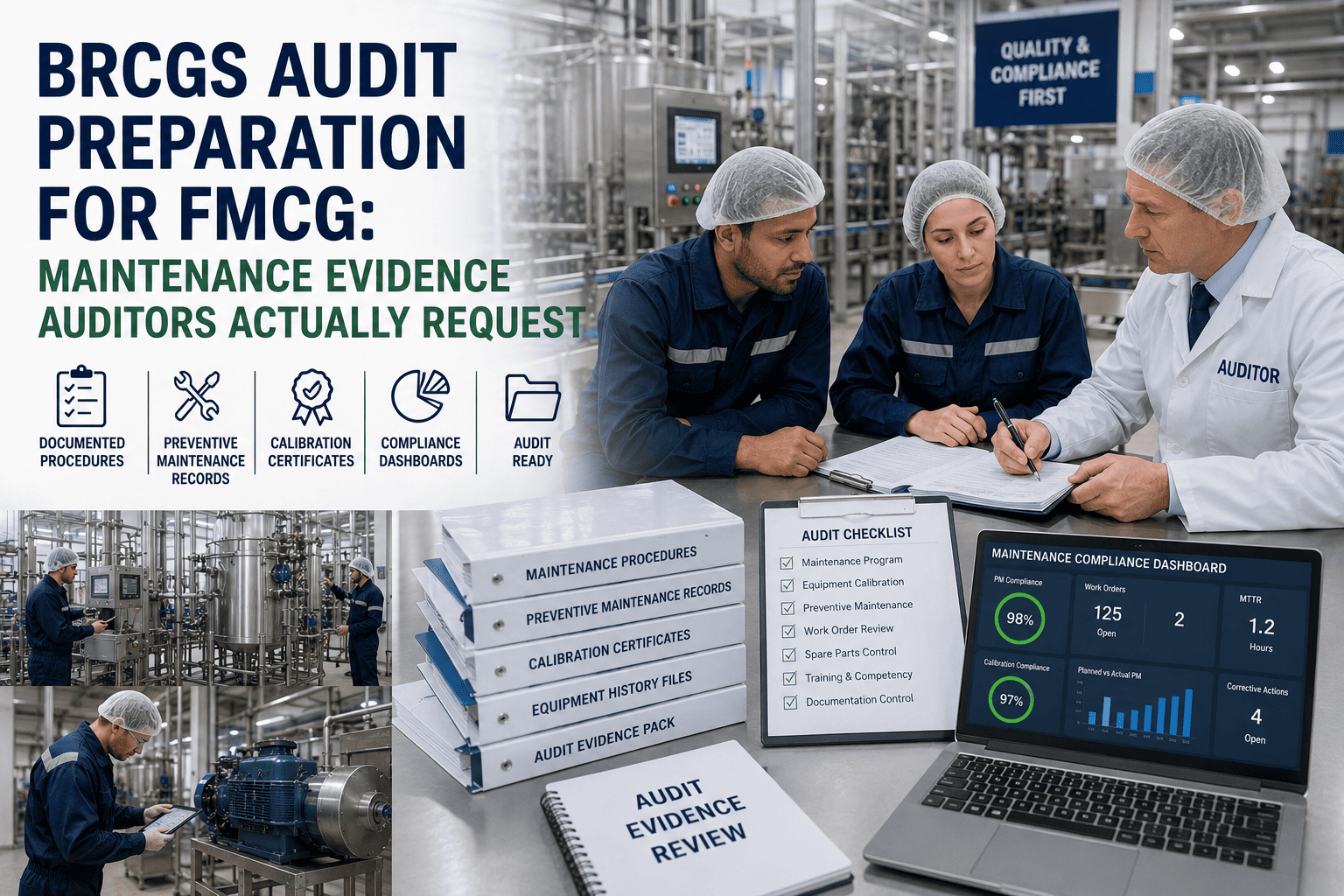
BRCGS Audit Preparation for FMCG: Maintenance Evidence Auditors Actually Request
By Jack Edwards on May 22, 2026
BRCGS Issue 9 audits — announced and unannounced — are the compliance event that most FMCG maintenance directors dread most, and for good reason: the standard scores maintenance programme gaps as Major or Critical non-conformances that can trigger a grade reduction or suspension of certification. The common failure is not that facilities are not doing the work. It is that the evidence is incomplete, scattered, or impossible to reconstruct on the day an auditor walks through the door. Calibration certificates in a filing cabinet. PM records in spreadsheets no-one has updated. Corrective work orders raised in one system and closed in another. The plants that consistently achieve AA and A grades against BRCGS Clause 4.7 maintain one operating principle: every maintenance activity — PM, inspection, corrective repair, calibration — creates a timestamped, signed, auditor-ready digital record the moment it is completed. Start a free trial on Oxmaint to see how that record trail builds automatically, or book a demo and walk through your specific BRCGS clause gaps.
BRCGS ISSUE 9 COMPLIANCE
Close Your BRCGS Clause 4.7 Gaps Before the Next Audit
See how maintenance teams achieving AA grades structure their evidence trail — and replicate it in your plant in days, not months.
BRCGS Clause covering maintenance — the most-cited source of Major non-conformances in FMCG audits
38%
of BRCGS Major findings in FMCG relate to incomplete or unavailable maintenance records (BRCGS Global Markets data)
4.8X
cost of emergency equipment failure vs. planned preventive maintenance — the financial case for structured PM programmes
72 hr
typical window for unannounced BRCGS audit notification — records must be retrievable immediately, not reconstructed
What BRCGS Clause 4.7 Actually Requires From Maintenance
BRCGS Issue 9 Clause 4.7 — Maintenance — mandates a documented, risk-based maintenance programme covering all equipment that affects product safety, legality, and quality. The clause requires a planned preventive maintenance schedule, documented completion records for every activity, a system for raising and tracking corrective maintenance, and calibration records for monitoring and measuring equipment. Critically, the programme must be reviewed at least annually and updated when equipment changes.
What auditors look for in practice goes beyond the written procedure. They trace a random sample of equipment through the full evidence chain: Is the PM scheduled? Was it completed on time? Who signed it off? Were any defects found? If so, was a corrective work order raised, and is it closed? Can you show the calibration certificate for that checkweigher, linked to the asset record? Facilities that answer every step with one click — rather than hunting through three systems and a filing cabinet — consistently outperform on grade. Start a free trial to see that evidence chain in action, or book a demo for a walkthrough of your specific clause requirements.
Most FMCG facilities lose their BRCGS grade not from unsafe practices — but from incomplete maintenance documentation auditors cannot verify on the day.
Every BRCGS Clause 4.7 audit traces evidence across these eight categories. A gap in any one of them is a finding. Oxmaint structures evidence capture around each category by default.
01
PM Schedule Documentation
A written, risk-based schedule listing every item of equipment, PM frequency, responsible person, and last/next due date. Must be retrievable on demand.
02
PM Completion Records
Timestamped, signed-off records for every completed PM showing what was done, by whom, and on what date. Verbal or batch-signed spreadsheets are not sufficient.
03
Corrective Work Order Trail
Every defect found during PM or breakdown must generate a corrective work order with assigned technician, target date, and close-out evidence.
04
Calibration Records
Valid calibration certificates for all monitoring and measuring equipment linked to the asset and in-date at time of audit.
05
Temporary Repair Controls
Any temporary fix must be documented with the date applied, risk assessment, and a scheduled date for permanent repair.
06
Hygiene-Risk Engineering Controls
Post-maintenance hygiene sign-off confirming no tools, parts, or materials were left in product zones before equipment returns to production.
07
Contractor and External Service Records
Documentation of all work carried out by external contractors including scope, date, technician identity, sign-off, and hygiene induction.
08
Annual Programme Review
Evidence that the maintenance programme has been formally reviewed within the past 12 months, with any changes documented and approved.
Emergency repairs cost 4.8x more than planned maintenance — and every reactive breakdown is also a potential BRCGS finding waiting to be documented.
6 Maintenance Documentation Gaps That Trigger BRCGS Findings
These are the six failure patterns auditors find most consistently in FMCG facilities operating on paper-based or spreadsheet maintenance programmes — start a free trial on Oxmaint to eliminate them before the next audit cycle.
Overdue PMs With No Documented Justification
A PM that slipped past its due date without a documented reason is a Minor finding. Overdue by more than one interval escalates to Major. Oxmaint flags overdue PMs and requires sign-off justification for any deferral.
Calibration Certificates Not Linked to Equipment
A valid cert in a filing cabinet that cannot be instantly retrieved and matched to the asset is treated as missing. Oxmaint stores calibration documents against the asset record with expiry alerts.
Temporary Repairs With No Risk Assessment
Any repair marked "temporary" with no risk assessment, no close-out date, and no follow-up evidence is a direct Clause 4.7.4 Major finding. Oxmaint enforces mandatory fields on all temporary repair WOs.
No Post-Maintenance Hygiene Sign-Off
Equipment returned to production without documented hygiene clearance is a food safety risk and a Clause 4.7.5 finding. Oxmaint embeds hygiene sign-off as a mandatory final step.
No Annual Programme Review Evidence
BRCGS requires a documented annual review. Facilities that cannot show meeting minutes or a formal review record fail this clause regardless of how well individual PMs are documented.
Contractor Records Missing or Incomplete
External contractors must have documented hygiene inductions, signed service reports, and scope-of-work documentation. Missing records are a consistent Minor-to-Major finding in multi-site audits.
How Oxmaint Closes BRCGS Clause 4.7 Gaps Systematically
Build your BRCGS-compliant PM schedule with frequency, responsible person, and food-safety risk rating per asset. Every PM generates a timestamped, signed completion record.
Upload calibration certificates directly to the asset record with expiry dates. Oxmaint alerts 30 and 7 days before expiry and surfaces the current cert instantly.
Every defect requires assigned technician, target close-out date, and root cause before the WO can be marked complete. Temporary repairs trigger mandatory risk assessment.
Log every external visit with contractor identity, induction confirmation, scope of work, and sign-off. Records link to affected assets and are retrievable in seconds.
Evidence retrievable in minutes instead of days of manual reconstruction
AA
grade achievement rate
Sites with structured CMMS programmes consistently achieve AA and A BRCGS grades
-42%
reactive maintenance cost
Structured PM programmes reduce emergency repairs within 12 months
100%
calibration compliance
Expiry alerts eliminate the risk of out-of-date certificates during audit
30 days
to audit-ready records
Oxmaint plants generate complete BRCGS-ready evidence trails within 30 days
0
Major findings target
Achievable within two audit cycles with complete Clause 4.7 evidence chains
BRCGS Maintenance Audit FAQ
What does BRCGS Issue 9 Clause 4.7 specifically require from a maintenance programme
Clause 4.7 requires a documented, risk-based planned maintenance programme covering all equipment that affects product safety, quality, and legality. This includes a written schedule with frequencies, documented completion records for every PM activity, a system for raising and tracking corrective maintenance, calibration records for measuring equipment, documented controls for temporary repairs, post-maintenance hygiene clearance for food-contact equipment, and evidence of annual programme review. All records must be available to auditors on request.
How does BRCGS classify maintenance non-conformances and what is the impact on grade
BRCGS classifies maintenance non-conformances as Minor, Major, or Critical. A single Critical results in a failed audit and loss of certification. Three or more Major findings result in a failed audit. Common Major findings include: PM records incomplete or unavailable, calibration certificates missing or out of date, undocumented temporary repairs, and no evidence of annual programme review. Minor findings reduce the overall score — accumulating Minors risks grade reduction.
How should temporary repairs be documented to satisfy BRCGS Clause 4.7.4
Clause 4.7.4 requires that temporary repairs are documented with the date applied, a risk assessment confirming no food safety risk, a scheduled date for permanent repair, and evidence that the permanent repair was completed and signed off. In Oxmaint, temporary repair WOs include mandatory fields for each element — the WO cannot close without them. Auditors specifically look for whether temporary repairs have lingered beyond their scheduled close-out date.
What calibration records does BRCGS require and how should they be stored
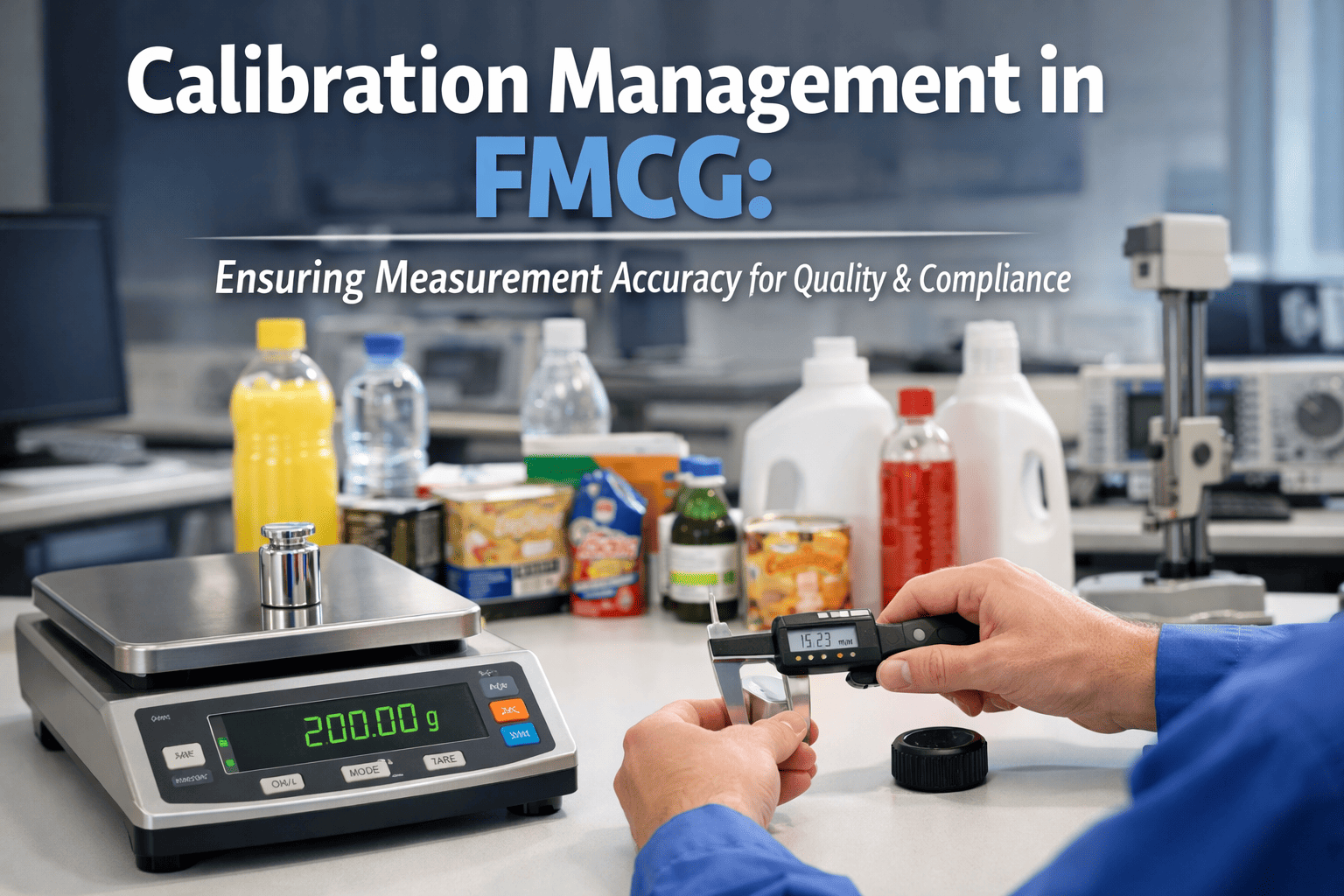
BRCGS requires valid calibration certificates for all monitoring and measuring equipment — checkweighers, thermometers, pressure gauges, metal detectors, pH meters, and scales. Certificates must show calibration date, standard used, as-found/as-left values, next due date, and calibrating party identity. Auditors check that certificates are in-date, linked to the specific equipment, and calibration frequency matches the risk assessment. Storing in Oxmaint against the asset record with automated expiry alerts eliminates the risk of presenting out-of-date or mismatched certificates.
BRCGS ISSUE 9 READINESS
Stop Losing BRCGS Grades to Maintenance Evidence Gaps
Turn every PM, calibration, and corrective repair into an auditor-ready evidence trail with Oxmaint. Used by FMCG operations teams managing 10,000+ assets across multi-site portfolios.
Real-time PM compliance visibility across every line and asset
Calibration expiry alerts and instant certificate retrieval
BRCGS-ready audit export in one click — no reconstruction required
No heavy implementation required. Live in days, not months. Works across multi-site FMCG portfolios. See measurable results in the first 30 days.