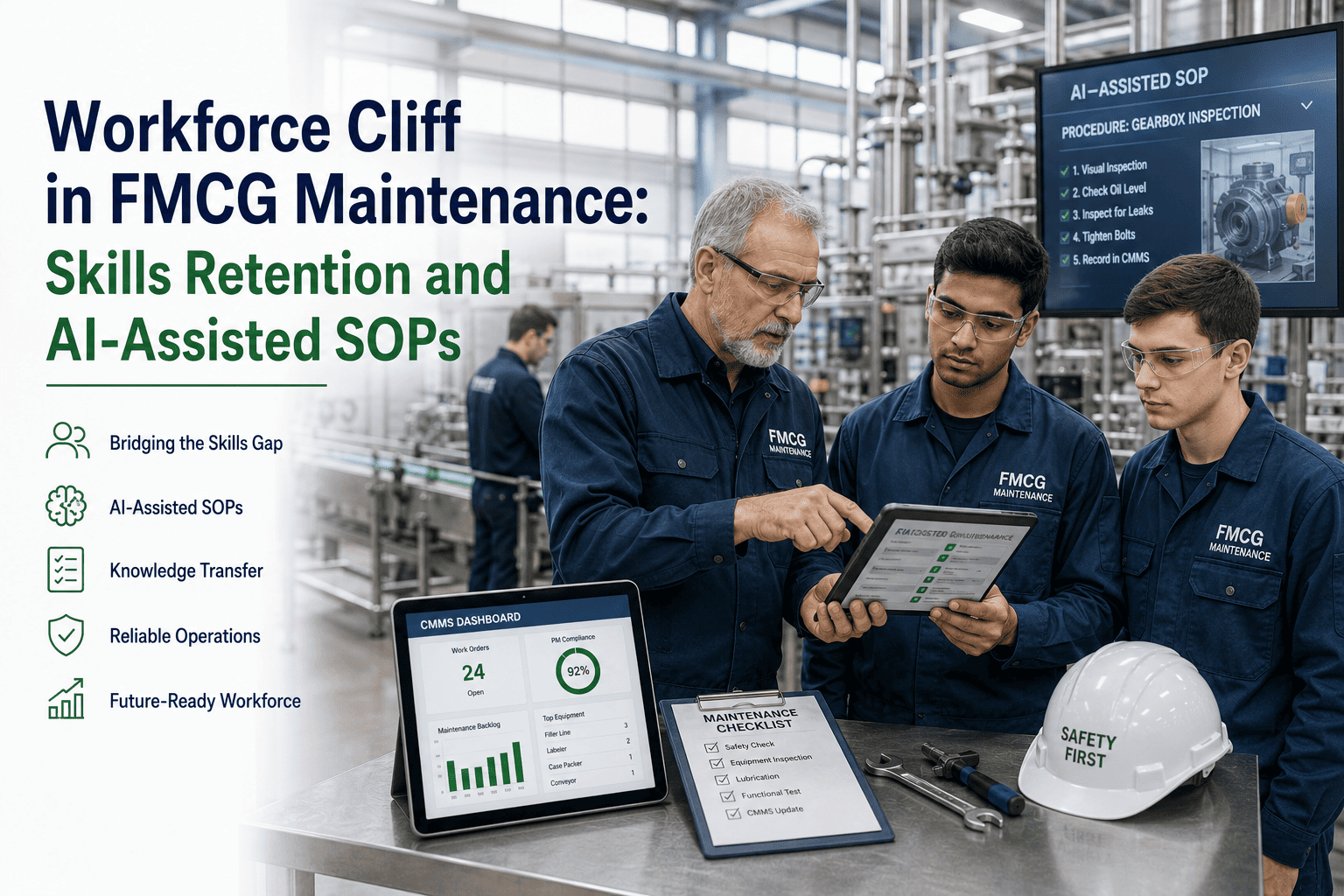
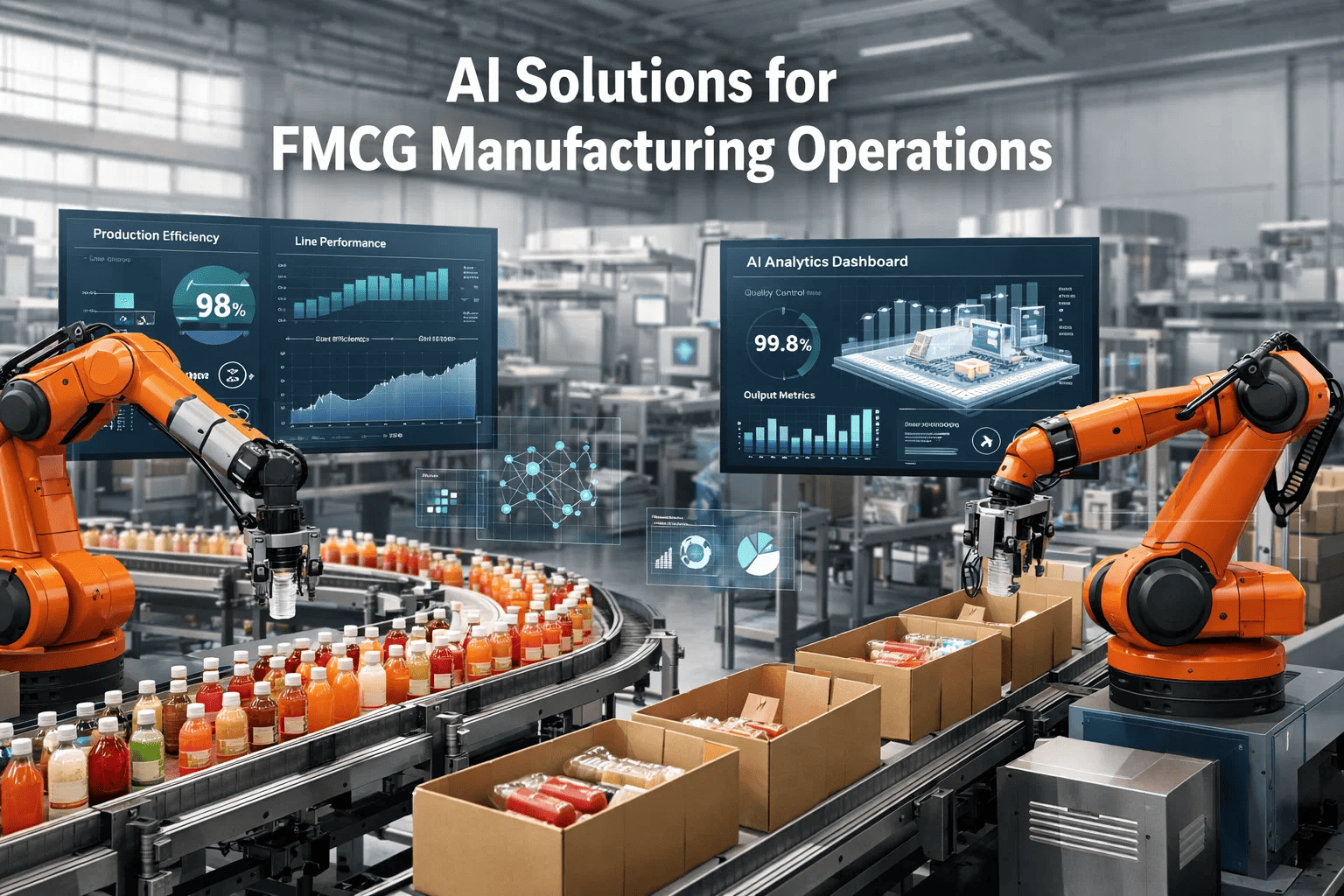
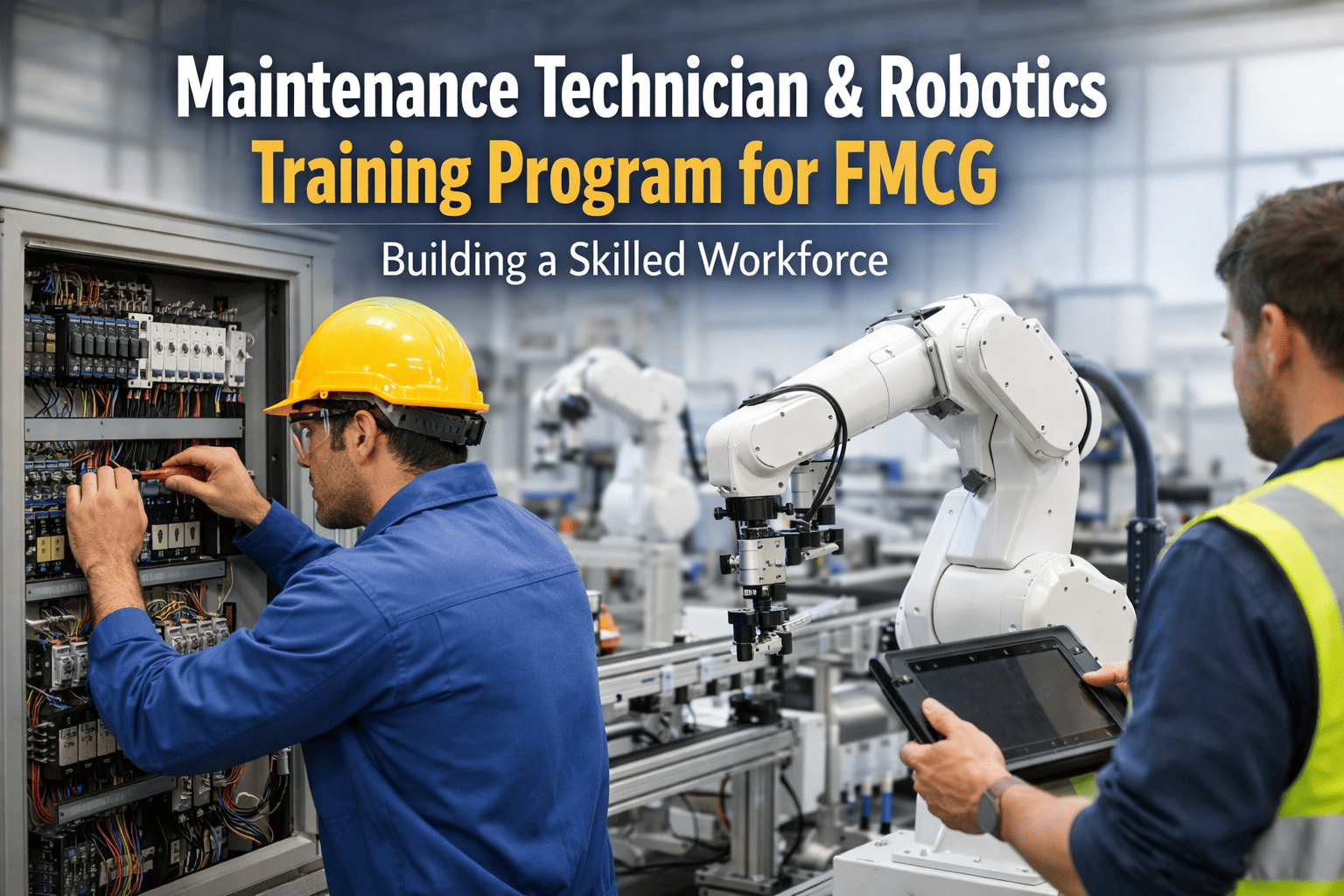
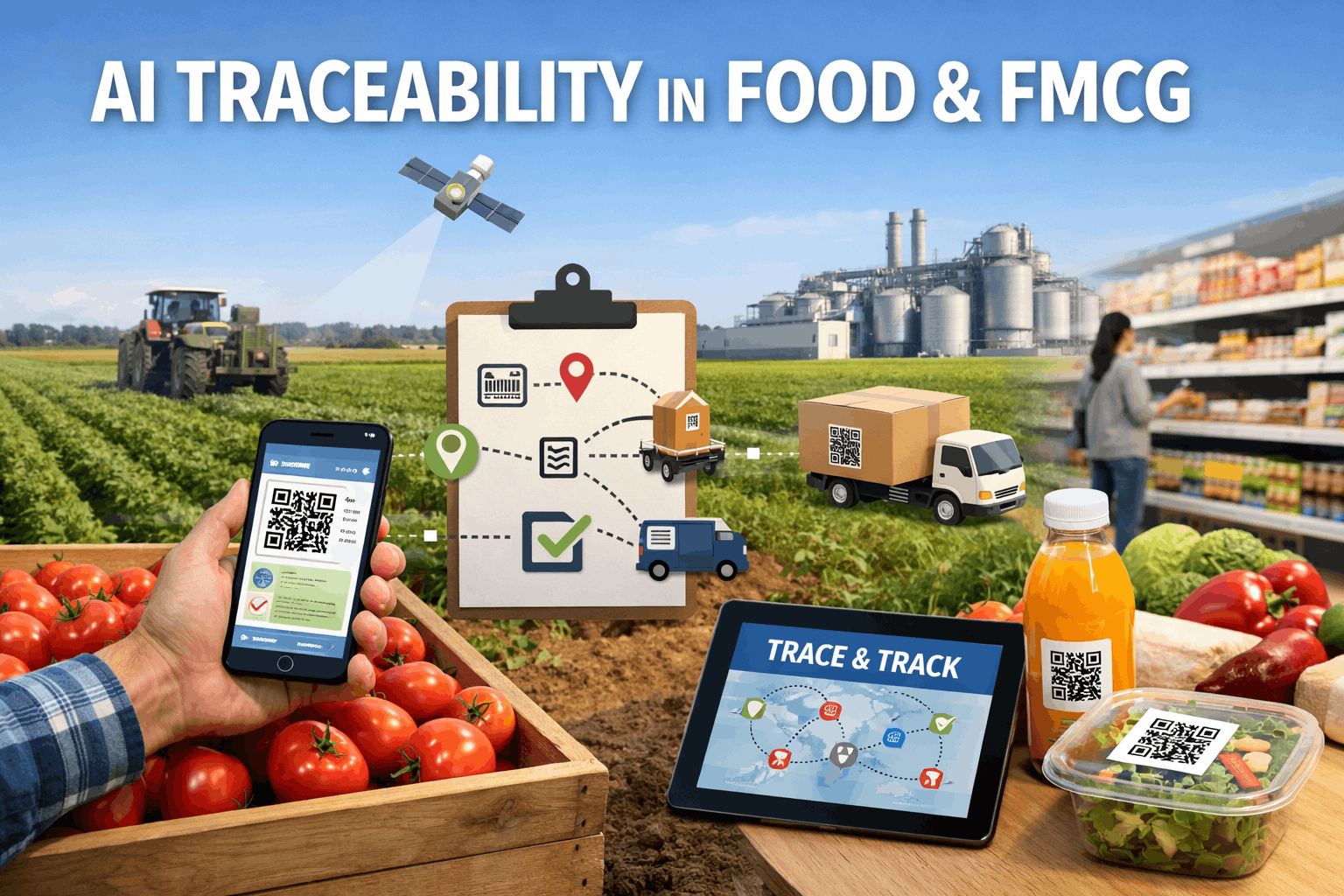
The FMCG maintenance skills gap is not a hiring problem — it is a structural crisis driven by an aging technical workforce, accelerating equipment complexity, and a training pipeline that cannot keep pace with demand. As of 2024, food manufacturing reported 74,000 open jobs in the sector specifically, and across all manufacturing, 622,000 roles were unfilled. The hardest positions to close are maintenance technicians, QA leads, and sanitation supervisors — the exact roles that determine whether FMCG production lines run safely and audit-ready. Waiting for the talent market to self-correct is not a strategy. The FMCG facilities gaining ground are those using automation, AI diagnostics, and smart maintenance workflows to make every technician they have dramatically more effective — turning a team of three into the operational output of five. Start a free trial to see how Oxmaint amplifies your existing maintenance team through intelligent workflow automation, or book a demo to explore the workforce multiplier approach.
Make Every Technician You Have Do the Work of Two — Without Burning Them Out
Oxmaint's AI-assisted workflows automate scheduling, task assignment, and knowledge delivery so your maintenance team operates at full capacity regardless of headcount — and captures every repair insight before it walks out the door.
What Is the FMCG Maintenance Skills Gap?
The FMCG maintenance skills gap is the widening mismatch between the technical expertise required to maintain modern food production equipment and the supply of qualified technicians available to do that work. It operates across three dimensions simultaneously: a quantity gap (not enough technicians to fill open positions), a quality gap (available candidates who lack the specific technical or food-safety competencies the role requires), and a knowledge gap (institutional expertise held by retiring veterans that is not being transferred to the next generation of maintainers).
The structural drivers are well-documented. BLS data shows a significant share of food manufacturing production workers are aged 55 or older — meaning retirements will continue draining technical expertise for at least the next decade. Meanwhile, equipment complexity is increasing: modern FMCG lines integrate servo drives, PLCs, vision systems, IoT sensors, and automated CIP systems that require mechatronics competency — not just mechanical skills. The pace of technology adoption has outrun the pace of workforce development, and the gap is widening.
Critically, this is not a problem that can be solved by hiring alone. Even if every unemployed worker in the labor market filled an open manufacturing role, positions would still go unfilled. The answer is not more people — it is making the people you have capable of doing more, and preserving the knowledge they carry, with automation and digital tools that amplify individual output. Book a demo to see exactly how Oxmaint delivers that amplification across FMCG maintenance operations.
The Six Dimensions of the FMCG Maintenance Skills Gap
Mechatronics Shortage
Finding technicians trained in both PLCs and sanitary equipment design is rare. FPSA identifies mechatronics as the hardest-to-fill maintenance role in FMCG — directly impacting automated line uptime.
Food Safety Knowledge Deficit
Maintenance technicians without HACCP and GMP awareness create food safety risk during repairs. Audit non-conformances directly increase when maintenance roles are vacant or filled by undertrained personnel.
Retiring Veteran Knowledge Loss
The average FMCG facility has 2–3 technicians who carry decades of equipment-specific knowledge. When they retire, that expertise — failure patterns, calibration quirks, repair workarounds — leaves permanently without digital capture systems.
Predictive Technology Readiness
IoT sensors, vibration analyzers, and AI diagnostics are increasingly standard in FMCG plants — but most maintenance teams lack the training to interpret and act on condition monitoring data effectively.
Burnout From Reactive Culture
Shorthanded teams default to firefighting — emergency callouts at 11pm are the primary driver of burnout and turnover in FMCG maintenance. Reactive cultures repel the qualified candidates facilities most need to retain.
Multi-Shift Knowledge Inconsistency
Across three 24-hour shifts, FMCG plants see wide variation in how maintenance tasks are executed, documented, and escalated — creating audit exposure and inconsistent production outcomes that compound the skills gap effect.
How the Skills Gap Damages FMCG Operations
Extended Breakdown Resolution Times
Less experienced technicians take 2–3x longer to diagnose and resolve equipment failures. Deloitte 2024 data shows AI-assisted fault diagnosis cuts mean time to repair by up to 30 minutes per incident — recoverable time that compounds across every shift.
Audit Non-Conformance Risk
Vacancies in QA and maintenance roles drive higher GFSI, SQF, and USDA/FDA audit non-conformance rates — because tasks are completed by undertrained personnel or not completed at all, with documentation gaps that auditors find immediately.
4.8x Emergency Repair Cost Premium
Shorthanded maintenance teams running reactively pay 4.8x more per repair event than planned maintenance costs. On FMCG lines running 24/7, even a 10% shift toward reactive maintenance erodes margins significantly across a production year.
OEE Erosion and Throughput Loss
FPSA research links maintenance skills gaps directly to OEE decline — facilities with structured maintenance academies target OEE above 85%, while reactive-only operations typically see 68–75%. That gap represents millions in lost annual production capacity.
Operations teams that deploy AI-assisted maintenance tools to amplify their existing workforce recover measurable capacity within the first quarter — start a free trial to quantify what that recovery looks like on your lines, or book a demo to see the workforce multiplier approach in action.
How Automation and AI Solve the FMCG Maintenance Skills Gap
Eliminate Manual Scheduling — AI Builds the Queue
Oxmaint's AI engine analyzes equipment condition signals, PM intervals, and production schedules to create, assign, and prioritize work orders automatically. Technicians arrive for shifts knowing exactly what to do and in what order — without a supervisor spending an hour assembling the list. Work order backlogs fell 32% at AI-pilot sites (Deloitte 2024).
Cut Diagnosis Time by 30 Minutes Per Incident
When equipment fails, Oxmaint surfaces the most likely root causes based on the asset's full maintenance history, recent events, and pattern matches from similar failure signatures. A technician who might spend 45 minutes on unfamiliar fault diagnosis resolves it in 15 minutes with AI guidance — reducing MTTR across every skill level on your team.
Preserve Expertise Before It Walks Out the Door
Every repair note, observed failure pattern, and equipment-specific workaround recorded in Oxmaint becomes searchable institutional knowledge. When a veteran technician retires, their knowledge stays — accessible to every technician on every shift rather than disappearing with the individual who built it.
58 Minutes Recovered Daily Per Technician
Mobile-first workflows deliver tasks, asset history, parts lists, and step-by-step instructions directly to technician phones. Checklists completed at the machine. Photos uploaded in real time. Documentation takes seconds instead of 20–30 minutes per shift — recovering 58 minutes of productive maintenance time daily per technician.
AI Detects Failure 3–5 Months Before Breakdown
Connecting IoT sensors to Oxmaint lets AI flag asset degradation patterns 3–5 months ahead of functional failure — turning emergency repairs into planned events. Shorthanded teams stop firefighting and start preventing, which directly reduces the emergency callout burnout that drives skilled technician turnover.
Live Dashboard: Who, What, and Which Assets Are at Risk
Real-time visibility into technician availability, asset risk status, and work order completion gives maintenance supervisors the data to make staffing and task decisions on evidence, not gut feel — maximizing output from every available hour on every available technician.
Reactive Firefighting vs. Automation-Supported Operations
| Operational Dimension | Shorthanded Reactive Team | Automation-Amplified Team |
|---|---|---|
| Work Order Scheduling | Supervisor manually builds task list each morning — 30–60 min lost daily | AI auto-creates, assigns, and prioritizes — zero manual coordination overhead |
| Fault Diagnosis | 45+ minutes per unfamiliar fault — inexperienced techs work without history context | AI surfaces root cause matches from asset history — 15 min average resolution |
| Knowledge Retention | Exits with retiring technician — next hire starts from zero | Permanently captured in CMMS — searchable by every technician on every shift |
| Failure Detection | Detected at breakdown — emergency repair at 4.8x planned cost | AI IoT flags degradation 3–5 months ahead — planned intervention, no emergency |
| Documentation Time | 20–30 min per shift on paper — records incomplete, often lost | Seconds on mobile — real-time, complete, audit-ready automatically |
| Technician Burnout | Emergency callouts, no planning visibility — primary driver of turnover | Planned work, clear priorities — technicians work effectively without constant crisis |
ROI When Automation Closes the Skills Gap
The skills gap is structural — it will not resolve itself in your hiring cycle. But the operations teams that are winning now have stopped waiting for more headcount and started amplifying the team they have. Start a free trial to see measurable results in the first 30 days.
Frequently Asked Questions
How does automation address the FMCG maintenance skills gap without replacing technicians?
Automation addresses the skills gap by amplifying individual technician output — not replacing people. AI work order scheduling eliminates the time supervisors and technicians spend coordinating tasks manually. AI fault diagnostics reduces the time inexperienced technicians spend diagnosing unfamiliar failures. Mobile workflows eliminate documentation burden. Knowledge capture preserves expertise that would otherwise be lost. The result is a team of three producing the output of five — not three people replaced by machines. Start a free trial to see the amplification in practice.
What is the fastest ROI from digital maintenance tools in a shorthanded FMCG team?
The fastest ROI typically comes from three sources: first, mobile workflow adoption recovers 58 minutes per technician daily from eliminated documentation time — immediately increasing productive maintenance hours without new hires. Second, AI-assisted fault diagnostics cuts mean time to repair, directly reducing production downtime on lines running 24/7. Third, automated PM scheduling ensures preventive tasks do not fall through the cracks when teams are stretched — preventing the reactive breakdowns that cost 4.8x more than planned maintenance. Most Oxmaint FMCG deployments see measurable backlog reduction within the first 30 days. Book a demo to walk through the ROI model for your operation.
How does AI diagnostics help less experienced technicians work at a higher level?
AI diagnostic support works by contextualizing current fault symptoms against the asset's full maintenance history, recent maintenance events, and pattern matches from similar failure signatures across the Oxmaint fleet database. When a technician who has never encountered a specific failure arrives at the machine, they receive guided root cause hypotheses ranked by probability — rather than starting from scratch. The result is diagnosis in 15 minutes rather than 45, regardless of the technician's individual experience level with that specific equipment. This capability is particularly high-impact for FMCG teams where experienced technicians are retiring faster than replacements can be trained.
How do we prevent knowledge loss when experienced FMCG maintenance technicians retire?
Preventing knowledge loss requires systematic capture of expertise during normal operations — not a rushed documentation project when someone announces their retirement. Oxmaint captures knowledge continuously through work orders: every repair note, observed failure pattern, equipment-specific workaround, and calibration insight is timestamped and searchable. Additionally, Oxmaint's structured PM task templates and asset profiles encode the specific procedures, tolerances, and parts requirements that veteran technicians carry in their heads — making that knowledge available to every technician on every shift. The State of Industrial Maintenance 2025 survey found 39% of maintenance leaders now cite knowledge capture as the most valuable AI use case — because the demographic math on retirements makes this problem urgent at every FMCG facility.
Stop Letting Headcount Shortages Define Your Maintenance Capacity
Oxmaint gives your existing maintenance team AI-assisted scheduling, fault diagnostics, mobile task execution, and knowledge capture — turning every technician you have into a significantly more effective one. See measurable results in your first 30 days.
- AI work order automation — zero manual scheduling overhead
- Predictive failure detection 3–5 months ahead of breakdown
- Knowledge capture that outlasts every technician retirement
Used by operations teams managing 10,000+ assets across multi-site FMCG portfolios.