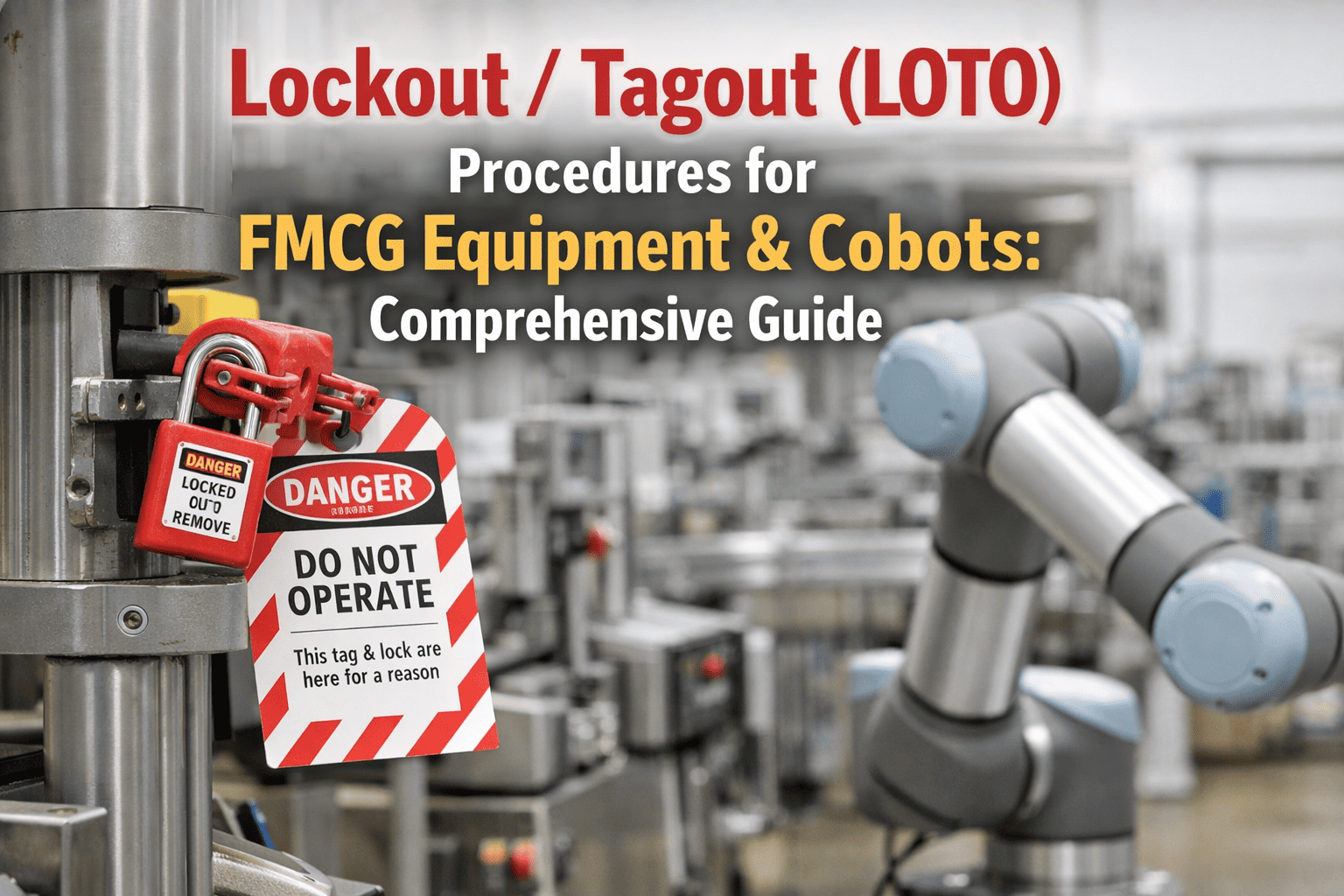
Every year, OSHA records over 3,000 injuries from inadequate energy control procedures in manufacturing — and FMCG facilities, with their dense networks of conveyors, packaging lines, mixers, and increasingly collaborative robots, account for a disproportionate share. Lockout/Tagout failures cost facilities an average of $150,000 per incident in direct costs alone, not counting lost production, regulatory penalties, and reputational damage. The shift toward cobots and automated packaging systems has made energy isolation more complex — yet many facilities still operate on paper-based LOTO programs that haven't been updated in years. Start a free trial to see how Oxmaint digitizes and enforces LOTO procedures across every asset in your FMCG facility, or book a demo and we'll walk through your specific equipment structure.
01 — Foundation
What Is Lockout Tagout in FMCG Manufacturing?
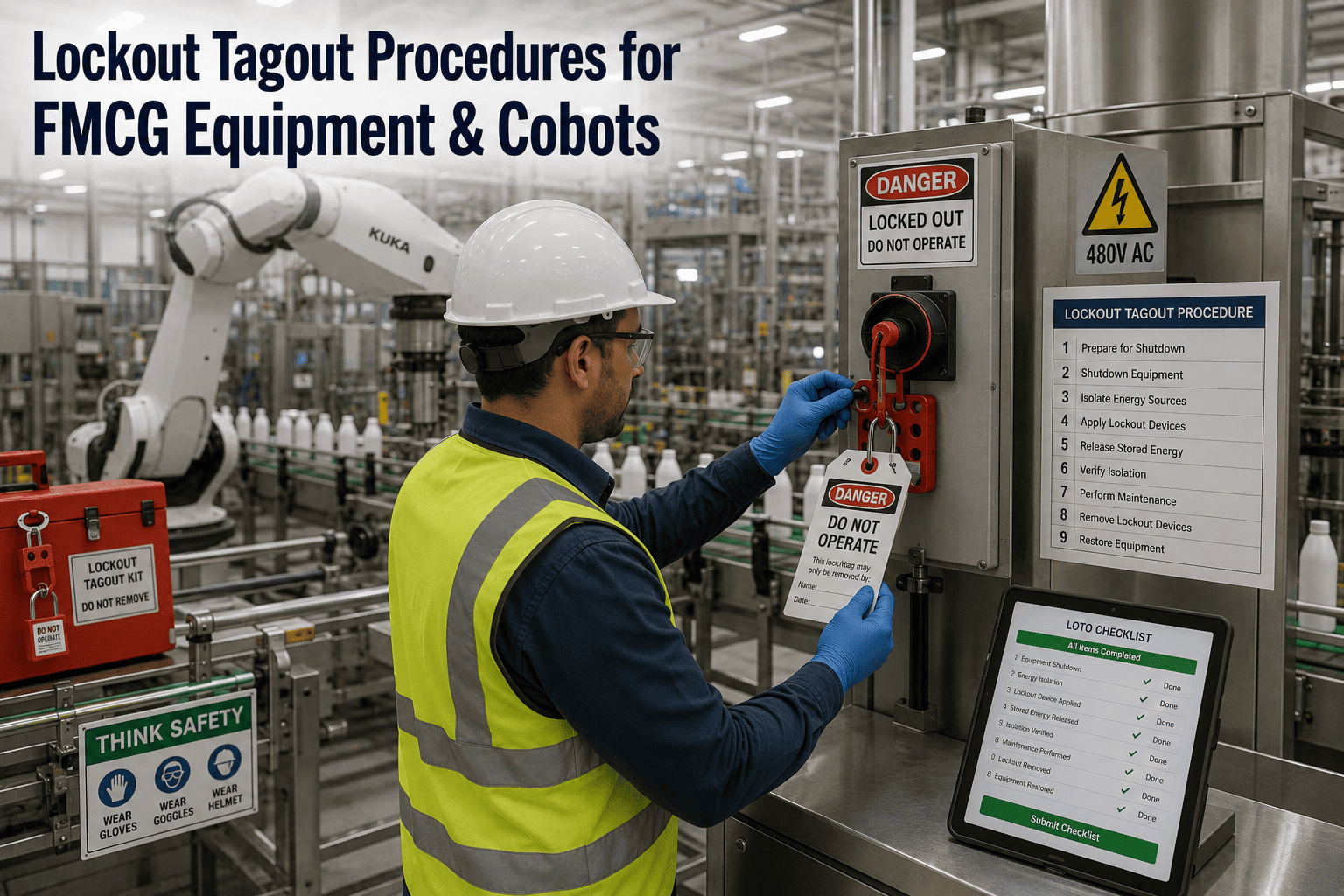
Lockout/Tagout (LOTO) is a formal safety procedure mandated by OSHA 29 CFR 1910.147 that requires the isolation and de-energization of all hazardous energy sources before any maintenance, repair, or servicing of equipment. In FMCG environments, this means controlling electrical, pneumatic, hydraulic, mechanical, thermal, and gravitational energy across a wide range of interconnected systems — from simple conveyor belts to complex multi-axis robotic packaging cells.
The core principle is simple: no worker should ever service equipment that could unexpectedly energize, start, or release stored energy. In practice, FMCG facilities face unique complexity because equipment is often interlocked, shared between shifts, and increasingly integrated with cobots that have their own energy states and safety modes requiring specialized isolation protocols. Most facilities running paper-based LOTO programs are unknowingly creating compliance gaps — start a free trial to see how Oxmaint closes those gaps with digital procedure enforcement and audit trails.
Globally, equivalent standards include CSA Z460 in Canada, BSEN ISO 50001 in the UK, and AS/NZS 4024 in Australia. The UAE's OSHAD-SF and Germany's TRBS 2111 carry similar requirements. Regardless of jurisdiction, the financial and human cost of non-compliance is severe — and the operational case for a robust digital LOTO program has never been stronger.
▲
OSHA cites LOTO violations as a top-10 most frequently cited standard every single year — is your FMCG facility fully protected?
02 — Framework
6 Core Components of an Effective FMCG LOTO Program
A compliant LOTO program is more than a padlock on a breaker. It requires documented procedures, trained personnel, the right hardware, and a system for verifying compliance across every asset and every shift.
01
Energy Control Procedures (ECPs)
Machine-specific written procedures identifying every energy source, isolation point, and release method. Required for all equipment with unexpected startup potential.
02
Authorized vs. Affected Employee Training
Authorized employees perform LOTO; affected employees work near locked-out equipment. Both require documented, role-specific training with periodic revalidation.
03
Hardware & Device Standards
Standardized locks, tags, hasps, valve lockouts, and pneumatic lockout devices. Each authorized employee must have a uniquely keyed personal lock that only they control.
04
Group LOTO Coordination
When multiple workers service the same equipment, each applies their own lock to a group hasp. The equipment cannot be re-energized until all locks are removed — protecting every worker independently.
05
Annual Program Audits
OSHA requires annual documented review of every energy control procedure, verified by a third-party observer. Digital audit trails eliminate the paper chase during inspections.
06
Cobot & Automation-Specific Protocols
Collaborative robots require teach-mode isolation, brake verification, and software disable confirmation in addition to physical lockout. Standard LOTO procedures are insufficient without cobot-specific addenda.
03 — Pain Points
Why FMCG LOTO Programs Fail in Practice
Most FMCG facilities have a LOTO program on paper. What they often lack is consistent execution — especially as equipment changes, cobots are introduced, and maintenance teams face pressure to minimize downtime. The gaps between policy and practice are where injuries happen.
⚠
Outdated Paper Procedures
When equipment is modified or relocated, paper ECPs rarely get updated. Technicians follow procedures that no longer match the actual energy sources on the machine — creating invisible exposure.
⚠
Cobot Energy State Complexity
Collaborative robots can have multiple partially-energized safety modes (reduced speed, restricted torque) that create false confidence. Without cobot-specific LOTO addenda, technicians may enter work zones assuming safe conditions that don't exist.
⚠
Zero Shift-to-Shift Visibility
Equipment locked out on the day shift may be re-energized by the night shift without verifying all workers are clear. Without digital status tracking, no one knows the real energy state of equipment at shift change.
⚠
Pressure to Skip Steps Under Downtime Pressure
Production downtime creates intense pressure to restore equipment quickly. Short-circuiting LOTO steps — especially on "quick fixes" — is how most incidents happen. Facilities without digital enforcement have no way to detect or prevent it.
⚠
Inadequate Stored Energy Identification
Pneumatic lines, hydraulic accumulators, capacitors, and gravity-loaded components retain hazardous energy after electrical disconnection. Many ECPs fail to identify all stored energy sources, leaving technicians exposed during servicing.
⚠
Contractor & Visitor LOTO Gaps
Third-party contractors bring their own locks and may not follow facility-specific procedures. Without a contractor LOTO coordination protocol tied to your asset management system, every external service visit is an uncontrolled risk.
Facilities that digitize their LOTO programs — with mobile procedure delivery, digital sign-off, and real-time energy state tracking — see up to 50% fewer LOTO-related near-misses in the first year. Start a free trial to bring that level of control to your FMCG operation, or book a demo to see it mapped to your equipment hierarchy.
▲
Most FMCG facilities cannot produce a complete audit trail for every LOTO event in the past 12 months — can yours?
04 — Solution
How Oxmaint Enforces LOTO Compliance Across Every Asset
Oxmaint connects your LOTO procedures directly to your asset registry — so every work order requiring energy isolation automatically surfaces the correct, up-to-date ECP, captures digital sign-off, and creates an immutable audit trail. No paper, no gaps, no guesswork.
Digital ECP Library
Store machine-specific energy control procedures against each asset in your registry. When equipment changes, procedures update instantly — no paper re-printing, no outdated instructions in the field.
Mobile LOTO Execution
Technicians access step-by-step LOTO procedures on mobile, confirm each isolation point with a digital checkmark, and capture photos of applied locks. Every step is timestamped and tied to their user ID.
Cobot-Specific Procedure Templates
Pre-built cobot LOTO templates covering teach-mode isolation, brake verification, and software disable confirmation — compliant with ISO/TS 15066 and UR e-Series safety guidelines.
Real-Time Energy State Dashboard
See which assets are currently locked out, who holds active locks, and which equipment is cleared for re-energization — across all sites, all shifts, in real time.
Automatic Audit Trail Generation
Every LOTO event generates a timestamped, immutable record covering procedure version, employee identity, isolation confirmation, and release authorization — ready for OSHA inspection in seconds.
Annual Audit Workflow
Built-in annual procedure review workflow assigns ECPs for verification, captures observer sign-off, and flags procedures that haven't been reviewed — eliminating the manual compliance chase.
05 — Comparison
Paper-Based LOTO vs. Digital LOTO: Real-World Differences
The gap between a paper LOTO program and a digital one isn't just operational convenience — it's the difference between auditability and exposure, between enforced compliance and assumed compliance.
| Dimension |
Paper-Based LOTO |
Digital LOTO with Oxmaint |
| Procedure Access |
Binder at equipment, may be outdated |
Latest version on mobile, auto-updated |
| Step Verification |
No enforcement — assumed complete |
Digital sign-off required at each step |
| Audit Trail |
Paper logs, often incomplete or missing |
Immutable digital record, always complete |
| Equipment Change Management |
Manual re-print and redistribution required |
Update once, instantly available at asset |
| Cobot LOTO Coverage |
Rarely included in standard procedures |
Built-in cobot-specific templates |
| Shift Handover Visibility |
No real-time energy state visibility |
Live dashboard of all active lockouts |
| Contractor Coordination |
Verbal briefing, no documented sign-off |
Digital procedure delivery with contractor ID capture |
| OSHA Inspection Readiness |
Hours to compile required documentation |
Full LOTO history exportable in minutes |
06 — ROI
The Financial Case for Digital LOTO Compliance
LOTO compliance isn't just a safety obligation — it's a financial lever. OSHA penalties, incident costs, production losses from injuries, and insurance premium impacts all create a measurable ROI for facilities that move from paper-based to digital enforcement. Teams that make the switch to structured CMMS-integrated LOTO programs see compounding returns across safety, compliance, and operational efficiency — start a free trial to begin building that return today, or book a demo to see the numbers modeled against your facility.
$156K
Average OSHA Penalty Per Willful LOTO Violation
Per-violation maximum; repeat violations can trigger facility-wide inspection and multi-million-dollar penalties across all citations.
50%
Reduction in LOTO Near-Misses with Digital Programs
Facilities that enforce step-by-step digital sign-off report significant near-miss reductions in the first year versus paper-based programs.
4.8×
Higher Cost of Reactive Incident vs. Prevention
Every uncontrolled energy incident costs 4.8× more than the investment in prevention — medical, legal, downtime, and reputational costs combined.
30 days
Time to Full Digital LOTO Compliance with Oxmaint
No heavy implementation. Asset hierarchy loads in days. LOTO procedures built from templates, customized to your equipment, live within weeks.
07 — FAQ
Lockout Tagout Questions for FMCG Facilities
Do cobots require a different LOTO procedure than standard industrial robots?
Yes — collaborative robots introduce energy states that don't exist in traditional robotics. A cobot in "reduced speed" or "safety-rated monitored stop" mode is still energized and can cause injury. Effective cobot LOTO must include physical disconnection of power, verification that all brakes are engaged, confirmation that the robot controller is in a de-energized state, and a documented check that no residual torque or gravity-loaded axis can move. ISO/TS 15066 provides guidance specific to collaborative robot safety; your LOTO procedures must reference this standard and be reviewed whenever the cobot's payload, reach, or task configuration changes.
What is the difference between lockout and tagout — and when is tagout acceptable?
Lockout physically prevents re-energization using a device that requires the authorized employee's key to remove. Tagout uses a warning tag to indicate the equipment must not be energized — but provides no physical barrier. OSHA requires lockout as the default; tagout is only permissible when the equipment design makes lockout impossible (older machinery without lockable energy isolation points). In FMCG environments, this exception is increasingly rare as modern equipment is designed with lockout provisions. If you're relying on tagout where lockout is possible, you have a compliance gap that needs to be addressed immediately.
How should LOTO procedures handle multi-energy-source equipment like packaging lines?
Packaging lines typically have electrical (motors, controls), pneumatic (actuators, cylinders), hydraulic (where applicable), and sometimes thermal (heat sealers, dryers) energy sources — all requiring isolation before servicing. The Energy Control Procedure must enumerate every source in the sequence they must be isolated, including stored energy release steps (bleeding pneumatics, capacitor discharge, spring-loaded component restraint). Complex lines may need a system diagram embedded in the ECP so technicians can visually confirm all isolation points are located and applied. A single missed stored-energy source is enough to cause a fatality.
How does Oxmaint integrate LOTO with preventive maintenance work orders?
In Oxmaint, every work order for an asset that has energy sources automatically surfaces the associated Energy Control Procedure as a mandatory prerequisite step. Technicians cannot mark a work order as in-progress until LOTO sign-off is captured. Upon work completion, the system prompts for LOTO release verification — ensuring equipment is fully re-energized only after all workers are confirmed clear. This creates a closed-loop compliance workflow where LOTO is never a manual afterthought but an enforced part of every maintenance event, with a full digital audit trail linked directly to the work order and asset history.
LOTO Compliance Platform for FMCG
Stop Leaving LOTO Compliance to Chance
Turn every energy isolation event into an auditable, enforced, step-by-step workflow — across every conveyor, packaging line, and cobot in your FMCG facility.
✔ Digital ECP library linked to every asset
✔ Mobile step-by-step LOTO execution with photo capture
✔ Instant OSHA audit trail — no paper chase
Used by operations teams managing 10,000+ assets · Live in days, not months · No heavy implementation required
See measurable compliance results in the first 30 days — limited onboarding slots available this quarter.