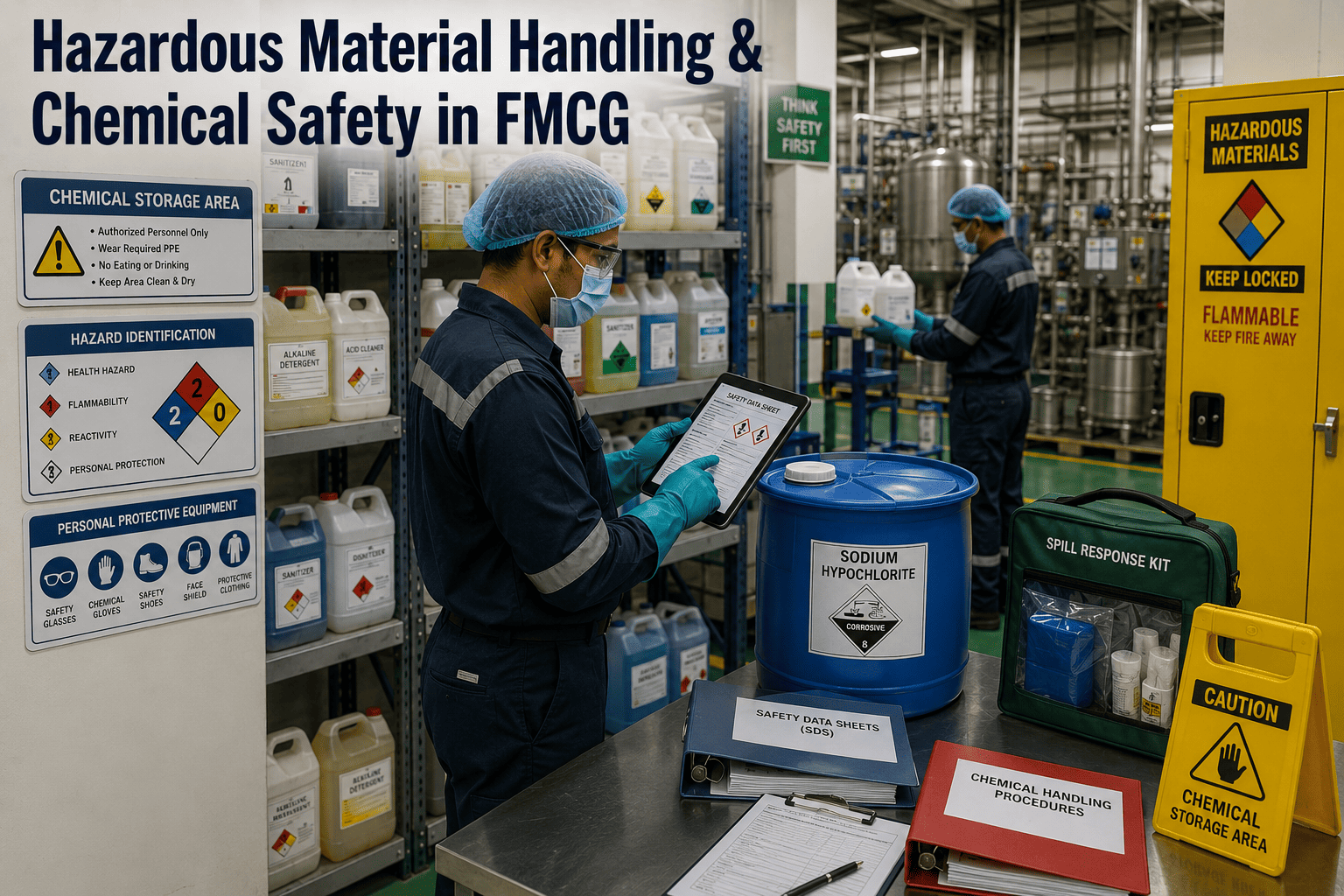
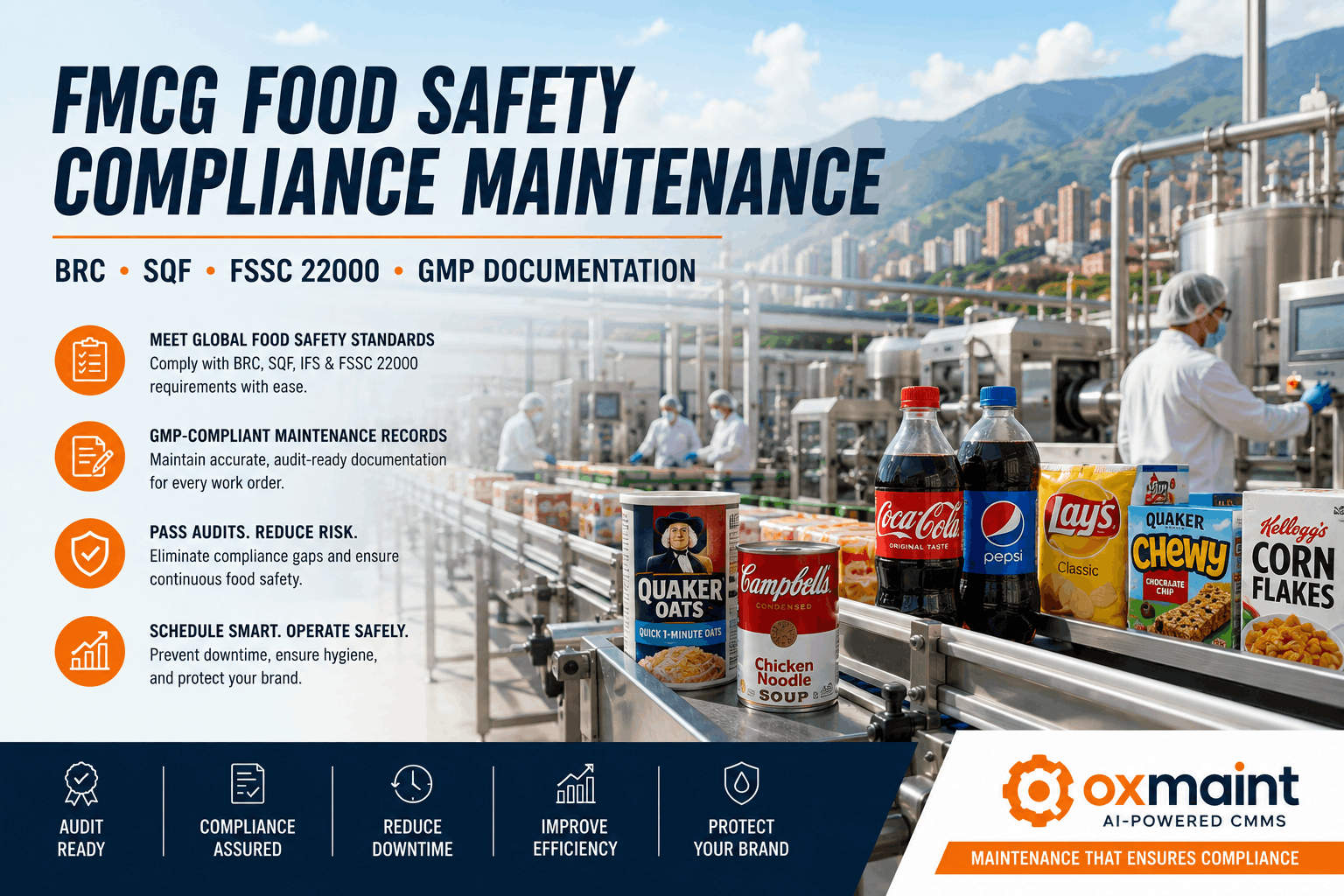
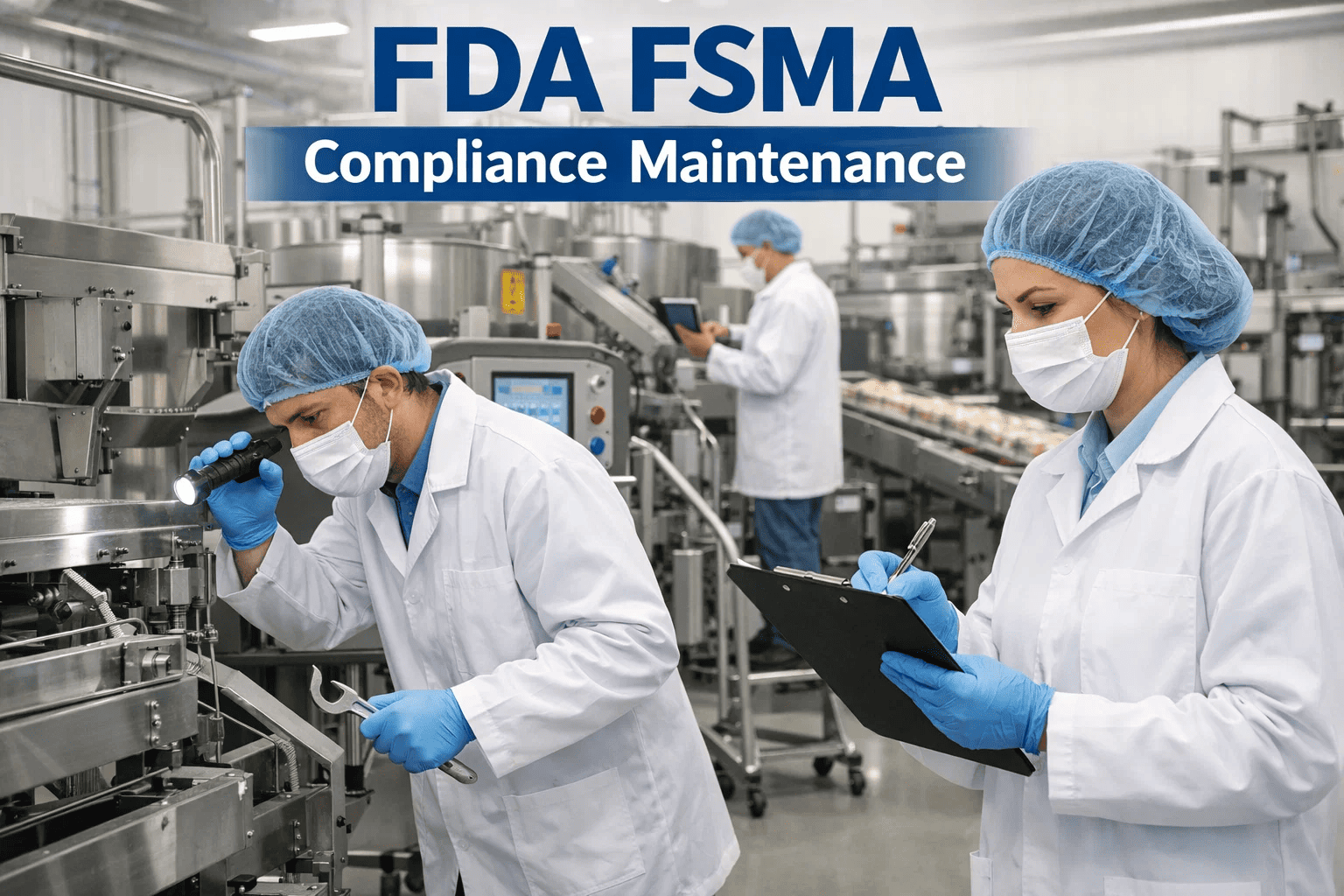
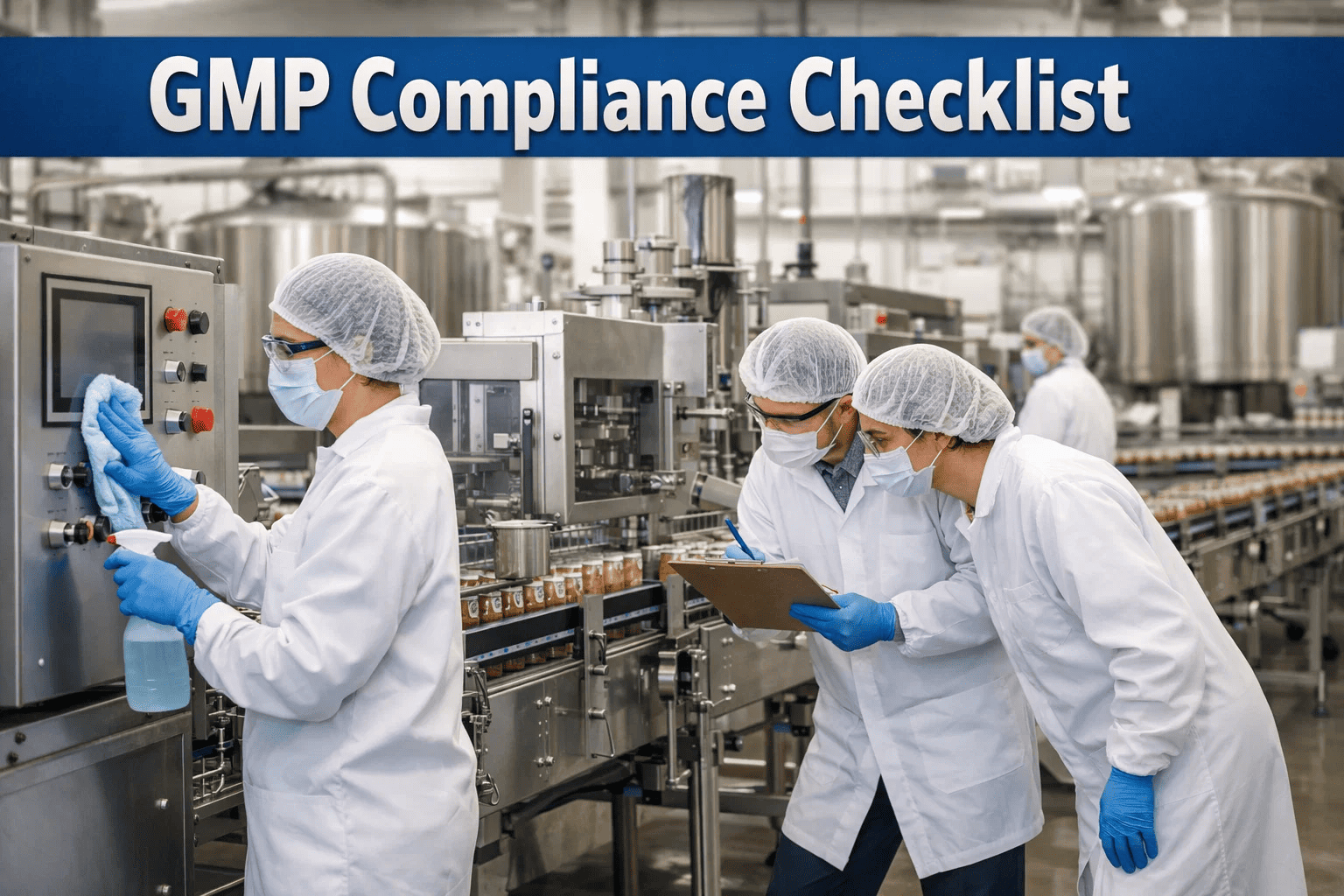
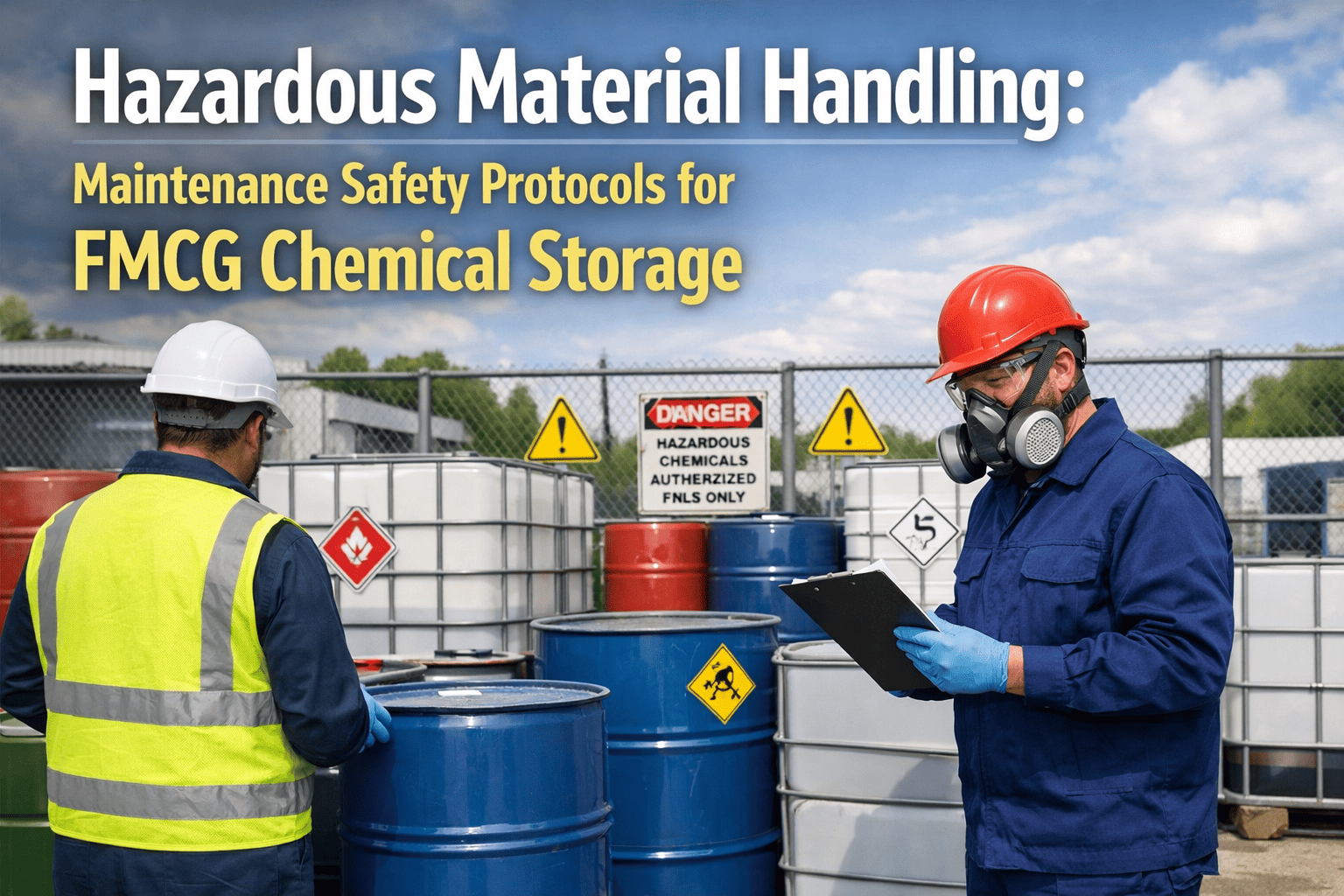
FMCG manufacturing plants handle more hazardous chemicals per square meter than most people realize — industrial-strength cleaning agents, caustic sanitizers, ammonia refrigerants, lubricants, fuel, and process chemicals all coexist with food-grade production. The consequences of poor chemical management are severe: the U.S. Chemical Safety Board investigates dozens of FMCG-sector incidents annually, OSHA's Hazard Communication Standard (HazCom) generates over 4,000 citations per year, and a single uncontrolled chemical release can halt production for days while triggering regulatory investigations costing hundreds of thousands of dollars. Facilities that treat chemical safety as a compliance checkbox — rather than a managed system — are one spill or exposure event away from a catastrophic operational and legal crisis. Start a free trial to see how Oxmaint integrates chemical hazard management into your maintenance and inspection workflows, or book a demo and we will map it to your facility's chemical inventory.
01 — Overview
What Is Hazardous Material Handling in FMCG?
Hazardous material handling in FMCG manufacturing encompasses every process by which employees receive, store, use, and dispose of chemicals that present health, physical, or environmental hazards. This includes cleaning chemicals (caustic soda, chlorinated compounds, quaternary ammonium), sanitizers (peracetic acid, hydrogen peroxide blends), refrigerants (anhydrous ammonia, HFCs), lubricants, boiler water treatment chemicals, and any raw material inputs that carry GHS hazard classifications.
In FMCG specifically, the challenge is compounded by the proximity of hazardous chemicals to food-contact surfaces and personnel who move fluidly between chemical handling and production areas. Regulatory oversight comes from multiple directions simultaneously — OSHA HazCom and PSM standards, EPA RMP requirements for facilities with threshold quantities of regulated substances, FDA food safety requirements around chemical contamination, and local fire marshal regulations for chemical storage. Missing any one of these creates exposure. Facilities that digitize their chemical inventory management and SDS workflows dramatically reduce that exposure — start a free trial to see how, or book a demo for a guided walkthrough of Oxmaint's chemical safety module.
The GHS-aligned Safety Data Sheet is the cornerstone of hazardous chemical management — a standardized 16-section document providing hazard identification, safe handling requirements, PPE specifications, spill response procedures, and disposal guidance. OSHA requires that current SDS documents be accessible to employees at all times during their work shifts. In facilities managing hundreds of chemical products across multiple storage areas, paper-based SDS binders are a compliance liability — not a solution.
▲
Most FMCG facilities manage 200–500 chemical products — yet fewer than 30% can confirm every SDS is current and accessible at point of use.
02 — Framework
8 Pillars of FMCG Chemical Safety Management
Effective chemical safety in FMCG isn't a single program — it's a system of interconnected controls that together eliminate the gaps where incidents occur. Each pillar must be active and verified, not assumed.
01
Chemical Inventory Management
Complete register of every hazardous chemical on-site, with quantity, location, supplier, SDS version, and review date. The inventory is the foundation — without it, nothing else can be managed.
02
SDS Accessibility & Version Control
Current 16-section GHS-compliant SDS accessible at every point of chemical use. Digital SDS libraries eliminate outdated paper versions and ensure employees always reference the latest hazard data.
03
Segregated Chemical Storage
Incompatible chemicals stored separately to prevent reactive incidents. Oxidizers away from flammables, acids away from bases, food-safe products segregated from industrial chemicals at all times.
04
PPE Selection & Enforcement
Task-specific PPE requirements derived from SDS Section 8 — gloves, eye protection, respirators, and body protection matched to chemical hazard class and exposure route for each handling task.
05
Spill Prevention & Response Plans
Written spill response procedures for each chemical class, with appropriate spill kits at point of use, trained first responders, and documented containment and disposal procedures for every hazard category.
06
Chemical Labeling Compliance
All containers — including secondary containers, diluted working solutions, and temporary vessels — labeled with GHS-compliant labels showing product identifier, pictograms, signal word, and hazard statements.
07
Employee Training & Competency Verification
HazCom training for all employees before initial chemical exposure, with documented competency verification. Role-specific training for handlers of high-hazard chemicals (ammonia, concentrated acids, peroxides).
08
Audit & Continuous Improvement
Regular chemical safety audits verifying inventory accuracy, SDS currency, storage compliance, PPE availability, and training records — with corrective action tracking to closure, not just identification.
03 — Pain Points
Where FMCG Chemical Safety Programs Break Down
Chemical safety failures in FMCG facilities rarely result from ignorance of the regulations — they result from operational realities that overwhelm manual compliance systems. Understanding the failure modes is the first step to engineering them out.
⚠
SDS Version Drift
Suppliers update SDS documents regularly as new hazard data emerges. Facilities with paper binders or email-based SDS management routinely operate with outdated documents — meaning employees may be unaware of newly identified hazards, changed PPE requirements, or updated emergency response procedures.
⚠
Unlabeled Secondary Containers
Working solutions diluted from concentrates, chemicals transferred to spray bottles, and temporary vessels during production changeovers are among the most consistently cited OSHA labeling violations. The pressure to move quickly during sanitation windows creates systematic labeling shortcuts that accumulate into serious exposure risk.
⚠
Incompatible Chemical Co-Storage
Chlorinated sanitizers stored near ammonia refrigerant lines, oxidizing agents adjacent to lubricants, and cleaning acids in the same cabinet as alkaline degreasers — storage segregation failures are among the most dangerous and most common chemical safety gaps in FMCG facilities.
⚠
No Contractor Chemical Visibility
Third-party sanitation contractors, pest control operators, and maintenance vendors bring their own chemical products onto site — often without disclosing the full hazard profile or providing SDS documents. Facilities have legal HazCom obligations for every chemical on their premises, including contractor-supplied products.
⚠
Training Records That Don't Reflect Reality
Chemical training records in spreadsheets or paper binders often reflect initial hire training only — not refresher training after chemical substitutions, process changes, or new product introductions. During an OSHA inspection, the inability to demonstrate current, role-specific training for all exposed employees is an immediate serious citation.
⚠
Spill Response Equipment Not at Point of Use
Spill kits stored in a central maintenance room are useless during an immediate release in a production area 200 meters away. Point-of-use spill response equipment — matched to the specific chemicals stored in each area — is a requirement that many facilities address on paper but not in practice.
Operations teams that move from manual chemical tracking to a digitally enforced system reduce citation exposure dramatically and build the audit-ready documentation that protects the facility during inspections — start a free trial to see Oxmaint's chemical compliance module in action, or book a demo and see it applied to your chemical inventory.
▲
A single ammonia refrigerant release in an FMCG facility can trigger simultaneous OSHA, EPA, and FDA investigations — with total incident costs exceeding $2 million.
04 — Solution
How Oxmaint Manages Chemical Safety Across Your FMCG Facility
Oxmaint integrates chemical hazard management directly into your asset and maintenance workflows — so SDS documents, PPE requirements, spill response procedures, and training records are linked to the equipment and locations where chemicals are actually used, not buried in a binder no one can find during an emergency.
Digital SDS Library with Version Control
Upload and manage all SDS documents centrally. Automatic version tracking flags outdated documents and notifies relevant personnel when suppliers issue updated SDS versions. Accessible on mobile at point of use.
Chemical Inventory Linked to Asset Hierarchy
Each chemical in your inventory is linked to its storage location and associated equipment within the Portfolio → Property → System → Asset hierarchy. Instantly see every chemical associated with any asset or area.
PPE Requirements on Every Work Order
Chemical hazard data from SDS Section 8 populates automatic PPE requirements on any work order involving chemical handling — technicians see required protection before they begin, every time, with no manual lookups.
Spill Response Procedure Integration
Chemical-specific spill response procedures attached to storage location records. Mobile access during an incident means responders have the correct containment and disposal steps immediately — not after locating a paper binder.
Training Record Management
Track HazCom and chemical-specific training completions per employee, per chemical category. Automated alerts when training expires or when a new chemical introduction requires role-specific training for exposed personnel.
Chemical Audit Checklists & Corrective Actions
Scheduled chemical safety audits with mobile checklists covering storage segregation, labeling compliance, SDS currency, spill kit status, and PPE availability — with direct corrective action work order generation for any findings.
05 — Comparison
Manual Chemical Management vs. Digital Chemical Safety System
The operational difference between paper-based chemical management and a digitally integrated system becomes most visible during two scenarios: a routine OSHA inspection and an actual chemical incident. In both cases, the facility that cannot produce current, complete documentation in minutes faces the worst outcomes.
| Capability |
Manual / Paper-Based |
Digital with Oxmaint |
| SDS Currency |
Unknown — last update may be years ago |
Version-controlled, auto-flagged when outdated |
| Point-of-Use SDS Access |
Paper binder, often not at workstation |
Mobile access at any location, any shift |
| Chemical Inventory Accuracy |
Spreadsheet, rarely current |
Live inventory linked to asset locations |
| PPE Specification at Task Level |
Technician looks up SDS manually — or doesn't |
Auto-populated on every chemical work order |
| Spill Response Access |
Emergency response plan binder, often off-site |
Chemical-specific procedures on mobile, at location |
| Training Compliance Visibility |
Spreadsheet by hire date — no role or chemical linkage |
Per-employee, per-chemical, with expiry alerts |
| OSHA Inspection Readiness |
Hours or days to compile documentation |
Full chemical compliance history exportable instantly |
| Audit Findings Closure |
Noted in report — no tracked follow-through |
Direct work order generation with closure tracking |
06 — ROI
The Cost of Chemical Safety Failures — and the Return on Getting It Right
Chemical safety investment is measured against two types of cost: the direct financial penalties of non-compliance, and the catastrophic costs of an actual incident. Facilities that build robust digital chemical management programs recover their investment many times over in avoided citations, reduced insurance premiums, and the elimination of production disruptions from chemical incidents. Teams that make that shift see measurable compliance improvements within 30 days — start a free trial to begin building that return, or book a demo and see the ROI modeled against your facility's chemical footprint.
$156K
Max Penalty Per Willful HazCom Violation
Repeat violations or willful non-compliance attract the highest OSHA penalty tier. A multi-citation inspection can reach seven figures across related violations.
$2M+
Average Total Cost of Major Chemical Incident in FMCG
Medical costs, lost production, regulatory response, legal exposure, facility remediation, and brand damage combined across documented FMCG sector incidents.
40%
Reduction in Chemical-Related Near-Misses with Digital Programs
Facilities with digitally enforced SDS access, PPE requirements, and training tracking report significant near-miss reductions in year one versus manual programs.
Days
Time to Full Digital Chemical Compliance with Oxmaint
No complex implementation. SDS library uploads, chemical inventory links to existing asset hierarchy, and inspection workflows go live within days — not months.
07 — FAQ
FMCG Chemical Safety Questions
What chemicals in FMCG facilities are most commonly cited by OSHA?
The most frequently cited chemical hazards in FMCG manufacturing inspections include chlorinated cleaning compounds (often missing adequate ventilation requirements in SDS), peracetic acid sanitizers (PPE specifications frequently not enforced at point of use), anhydrous ammonia in refrigeration systems (requiring PSM/RMP compliance at threshold quantities), sodium hydroxide (caustic soda) used in Clean-In-Place systems, and lubricants stored near food-contact equipment without adequate segregation documentation. The common thread across citations is not that facilities are unaware of these chemicals — it is that the compliance documentation (SDS currency, training records, storage inspection logs) cannot be produced to the inspector's satisfaction during an unannounced visit.
Does OSHA's HazCom Standard apply to cleaning chemicals used in FMCG sanitation?
Yes, fully. OSHA 29 CFR 1910.1200 applies to all hazardous chemicals in the workplace, including cleaning and sanitizing agents used in routine FMCG sanitation programs. This means every product used by your sanitation team — whether applied by your employees or a third-party contractor — must have a current SDS accessible to exposed workers, must be properly labeled (including secondary containers and diluted working solutions), and must be covered in HazCom training for all employees who may be exposed. Facilities often incorrectly assume that "food-grade" or "safe when diluted" chemicals are exempt from HazCom requirements. They are not — if the concentrated product is hazardous, all HazCom requirements apply.
How often do SDS documents need to be updated in FMCG facilities?
OSHA requires that you maintain current SDS documents — meaning the most recent version provided by your supplier. There is no fixed calendar interval for SDS review; the obligation is to obtain and deploy updated documents whenever a supplier issues a revision. In practice, this means your SDS management system needs to track the version date of every document and have a process for detecting when suppliers publish new versions. Suppliers are legally required to provide updated SDS documents within three months of becoming aware of new significant information about a chemical's hazards. Proactive facilities request SDS confirmation annually from all chemical suppliers and flag any version discrepancies for immediate replacement.
What are the FMCG-specific requirements for ammonia refrigerant chemical safety?
Anhydrous ammonia in refrigeration systems triggers multiple overlapping compliance obligations in FMCG facilities. If your facility has 10,000 pounds or more of anhydrous ammonia, you are subject to OSHA's Process Safety Management standard (29 CFR 1910.119) and EPA's Risk Management Program (40 CFR Part 68) — both requiring comprehensive written process hazard analyses, mechanical integrity programs, management of change procedures, and emergency response plans. Below threshold quantities, standard HazCom requirements still apply. Additionally, the International Institute of Ammonia Refrigeration (IIAR) publishes industry standards (IIAR-2, IIAR-9) that are referenced by OSHA as the recognized practice for ammonia refrigeration systems. Facilities managing ammonia systems without a current Process Safety Management program and mechanical integrity inspection schedule are among the highest-risk operations in the FMCG sector.
Chemical Safety Platform for FMCG
Stop Managing Chemical Compliance from a Binder
Give every employee, every work order, and every audit instant access to current SDS data, PPE requirements, and spill response procedures — across every chemical in your FMCG facility.
✔ Version-controlled SDS library accessible on mobile
✔ PPE auto-populated on every chemical work order
✔ Instant OSHA audit-ready documentation
Used by operations teams managing 10,000+ assets · Works across multi-site portfolios · Live in days, not months
See measurable compliance improvements in the first 30 days — limited onboarding slots available this quarter.