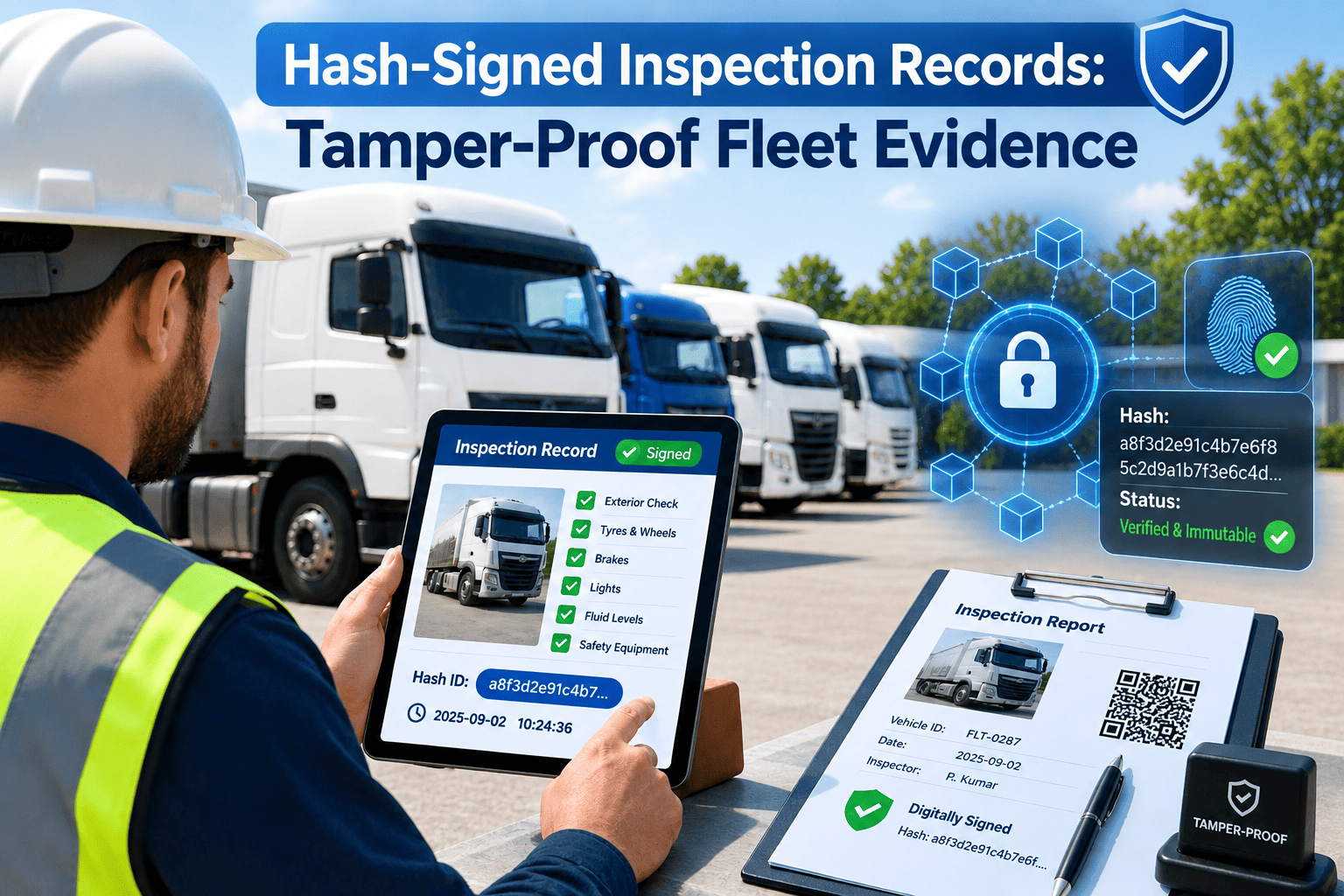
When a DOT auditor, an insurance adjuster, or opposing counsel asks whether a fleet inspection record has been altered since it was created, most digital DVIR systems cannot answer with mathematical certainty — they can only show a screen that once displayed a checkmark. A hash-signed inspection record closes that gap. The moment a driver or technician submits an inspection, the system generates a SHA-256 fingerprint of the exact data captured, seals it to a verified signer and timestamp, and locks it into a chain where altering even one character breaks the fingerprint and exposes the change. Fleets running higher-risk operations — hazmat, passenger transport, heavy haul, last-mile delivery — are moving to hash-signed inspection logs specifically because edited or pencil-whipped DVIRs remain the single weakness auditors and plaintiff attorneys exploit most often. See how hash-signed inspection records work inside Oxmaint, free to start.
Hash-Signed Inspection Records: Tamper-Proof Fleet Evidence
Every DVIR, safety check, and maintenance sign-off gets a SHA-256 fingerprint the instant it is submitted — so no auditor, insurer, or court ever has to take your word for it, only the mathematics.
Why Standard Digital DVIRs Still Get Challenged in Court and Audits
Digitising a paper inspection form does not automatically make it trustworthy. Most fleet software stores a DVIR as an editable database row — which means a record can be opened, changed, and re-saved with a new "last modified" date and nobody outside the software vendor can prove otherwise. Auditors know this. Plaintiff attorneys know this. It is why a growing share of DVIR-related disputes now hinge on a single question: can you prove the record in front of us today is identical to the one created at the moment of inspection. A signature and a screenshot answer that question with a story. A cryptographic fingerprint answers it with mathematics, and mathematics does not change its testimony under cross-examination.
This is not a theoretical concern reserved for major carriers. Any fleet that has ever had a driver quietly resubmit a form, a manager edit a defect note after the fact to smooth over a dispatch delay, or a support technician correct a typo directly in the database has already created a record with an unverifiable history. None of those edits are necessarily malicious. But when the same unverifiable record later becomes the centrepiece of a DOT audit, an insurance denial, or a wrongful-death claim, the absence of a fingerprint turns an innocent explanation into a credibility problem the fleet cannot easily escape.
Small and mid-size fleets are often the most exposed here, precisely because they run leaner back-office teams and rely more heavily on whatever the software vendor's default database behaviour happens to be. Larger carriers with dedicated compliance departments have started asking vendors pointed questions about record immutability during procurement; smaller fleets frequently discover the gap for the first time only after a claim is already in dispute, which is the most expensive possible moment to learn that a record cannot defend itself.
Five Steps From Inspection to Cryptographic Proof
Hash-signing is not a separate compliance task bolted onto an inspection workflow — it happens automatically, in the background, every time a driver or technician completes a form. Here is exactly what happens between a tap on a phone and a permanently sealed evidence record, and why each step matters on its own.
Because the SHA-256 algorithm produces a completely different output for even a single altered character, this whole process is what forensic examiners call the avalanche effect — and it is the same property that makes hashing the accepted standard for digital evidence integrity across law enforcement, financial auditing, and healthcare recordkeeping, not just fleet compliance.
What a Hash-Signed Inspection Record Actually Contains
A hash is only as useful as what it protects. Oxmaint seals the complete inspection context — not just a signature line — so that a single fingerprint verifies the entire evidentiary picture at once, from what was inspected to who inspected it and where they stood when they did. Leave any one of these elements outside the hash and it becomes the weak link an opposing party will target first.
Taken together, these six elements mean a hash-signed record does more than prove a document was not edited — it proves the entire circumstance of the inspection, physical presence included. That distinction matters in practice: a savvy investigator does not usually challenge whether a checkbox was ticked, they challenge whether the checkbox reflects a real inspection that actually happened, at the vehicle, on that date. A record that seals location, identity, and time together answers that harder question before it is even asked.
What Changes When Every Inspection Record Is Cryptographically Sealed
The gap between an ordinary digital DVIR and a hash-signed one rarely shows up in daily operations — it shows up the moment a record is challenged. That is precisely the moment it matters most, and it is exactly the moment a fleet cannot afford to be building its defence for the first time.
Five Moments a Hash-Signed Record Becomes the Deciding Factor
Fingerprinted inspection records are not built for a hypothetical scenario — they earn their value in specific, recurring moments where a fleet's credibility is directly on the line, often with real financial and legal consequences attached. The table below walks through the most common ones, along with the exact mechanism that resolves each challenge before it becomes a prolonged dispute.
| Moment | What Gets Challenged | How the Hash Chain Responds | Outcome |
|---|---|---|---|
| DOT Compliance Review | Whether the DVIR on file was the original one filed by the driver that day, unedited | Recalculated hash is compared to the sealed fingerprint in seconds, in front of the auditor | Record accepted without dispute |
| Post-Accident Investigation | Whether a known defect was documented before the vehicle was dispatched that morning | Server-verified timestamp bound inside the hash proves exactly when the defect was logged | Timeline established with certainty |
| Insurance Claim Dispute | Whether maintenance records were altered after a claim was filed | Any post-claim edit breaks the fingerprint and is flagged automatically | Claim supported by verifiable data |
| Litigation and Discovery | Whether the produced record matches what existed at the time of the incident | Hash chain provides mathematical, Daubert-compatible proof of integrity | Evidence withstands expert cross-examination |
| Internal Safety Audit | Whether pencil-whipped inspections are slipping through unnoticed | Broken or missing chain links surface immediately in the dashboard | Gaps caught before they become incidents |
Scroll horizontally on smaller screens to view every column
Frequently Asked Questions on Hash-Signed Inspection Records
Fleet managers evaluating hash-signed inspection records tend to ask the same handful of practical questions before they commit to switching. Here are the direct answers.
None of this requires a fleet to understand cryptography, run its own servers, or manage certificates. The hashing, signing, and chain-building happen automatically inside the inspection workflow drivers already use every day — the only difference is that every record now carries its own proof. For fleets operating hazmat, passenger, or heavy-haul routes, where a single disputed inspection can carry six or seven figures of exposure, that proof is no longer a nice-to-have feature buried in a compliance menu. It is quickly becoming the baseline expectation from insurers, safety auditors, and courts alike, and the fleets that adopt it early are the ones setting that expectation rather than scrambling to meet it after an incident forces the question.
Give your inspection records proof they cannot argue with
Oxmaint fingerprints every DVIR, defect report, and repair sign-off the moment it is created, chains it to the record before it, and makes verification a 60-second task instead of a courtroom debate.