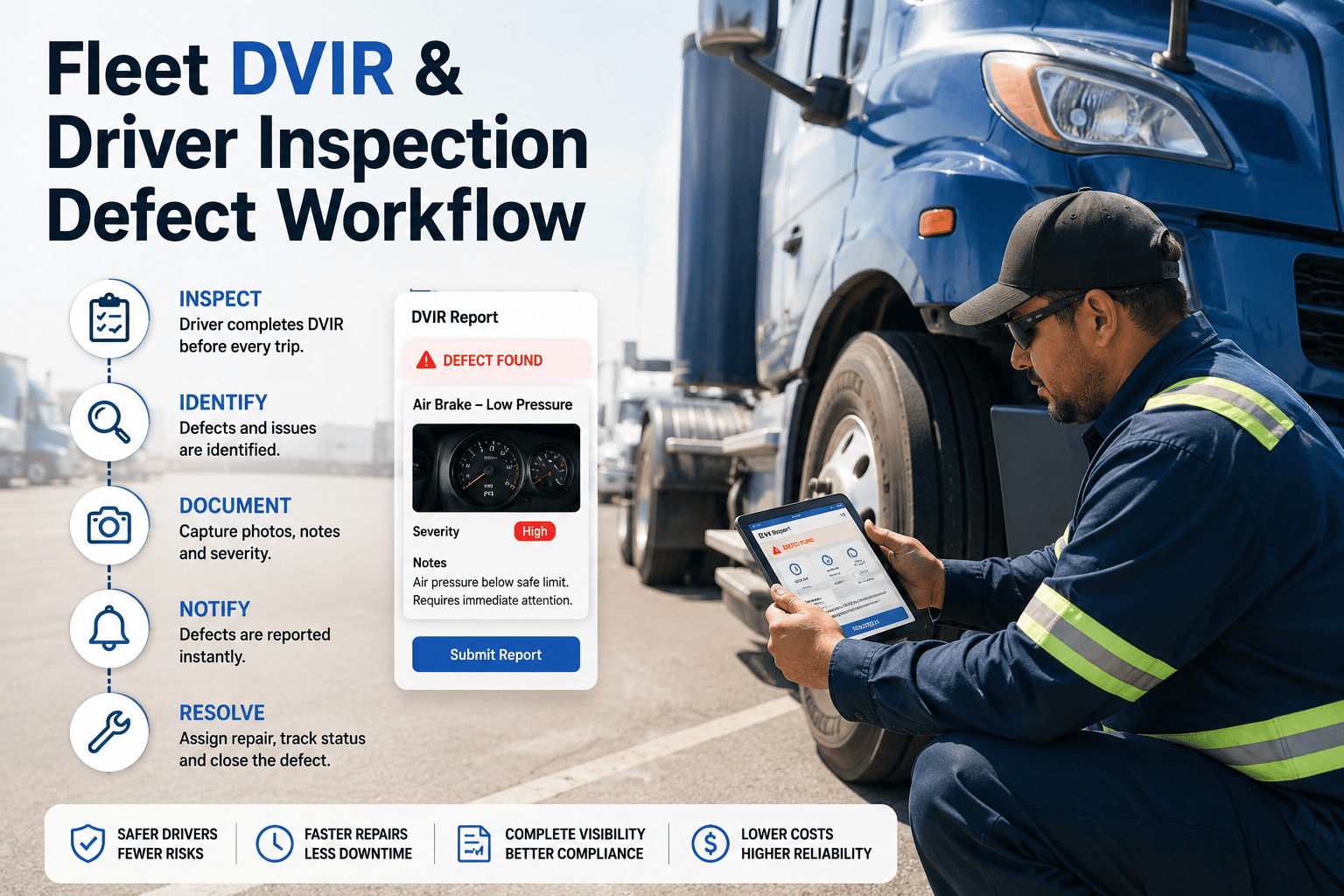
A driver finds a cracked brake line during a post-trip walk-around and writes it on a paper DVIR clipped to the visor. The truck sits in the yard overnight. The paper sits with it. By the time the shift supervisor finds the form the next afternoon, the truck has already been dispatched twice. This is not a rare failure — FMCSA data shows only 7% of motor carriers pass a focused compliance review without a single DVIR-related violation, and DVIR records are examined in the vast majority of audits. A defect found on paper can sit unseen for days; a defect found on a digital DVIR triggers a work order before the driver has walked back to the cab.
Digital DVIR Compliance
Close the Defect-to-Shop Gap From Days to Minutes
Guided inspections, instant defect routing, and an automated three-signature chain — built for the FMCSA rules that govern every DVIR you file.
7%
of carriers pass a focused DOT compliance review without a single DVIR violation
14,000
accidents FMCSA estimates are prevented every year through early defect identification
$19,277
maximum fine for dispatching a vehicle that was never certified as repaired
Why the Gap Between "Defect Found" and "Defect Fixed" Matters
Every DVIR is really two documents pretending to be one: a safety record and a maintenance trigger. Paper forms are decent at the first job and terrible at the second — a clipboard cannot page a mechanic, and a filed folder cannot stop a dispatcher from sending out an unrepaired truck. The rules below explain exactly where that gap opens, and what closes it.
Paper DVIR
Defect discovered, form filled by hand
The driver notes the defect on a paper form and clips it to the dash or drops it in a box at the yard. Nobody in maintenance is notified until someone physically reads the sheet — often the next business day.
Paper DVIR
Repair certification, easy to lose
Under 49 CFR 396.13, a mechanic or carrier official must certify the repair before redispatch, and the next driver must sign the same form. In a paper system this is the step most often skipped — wrong copy signed, form misplaced, or simply forgotten.
Digital DVIR
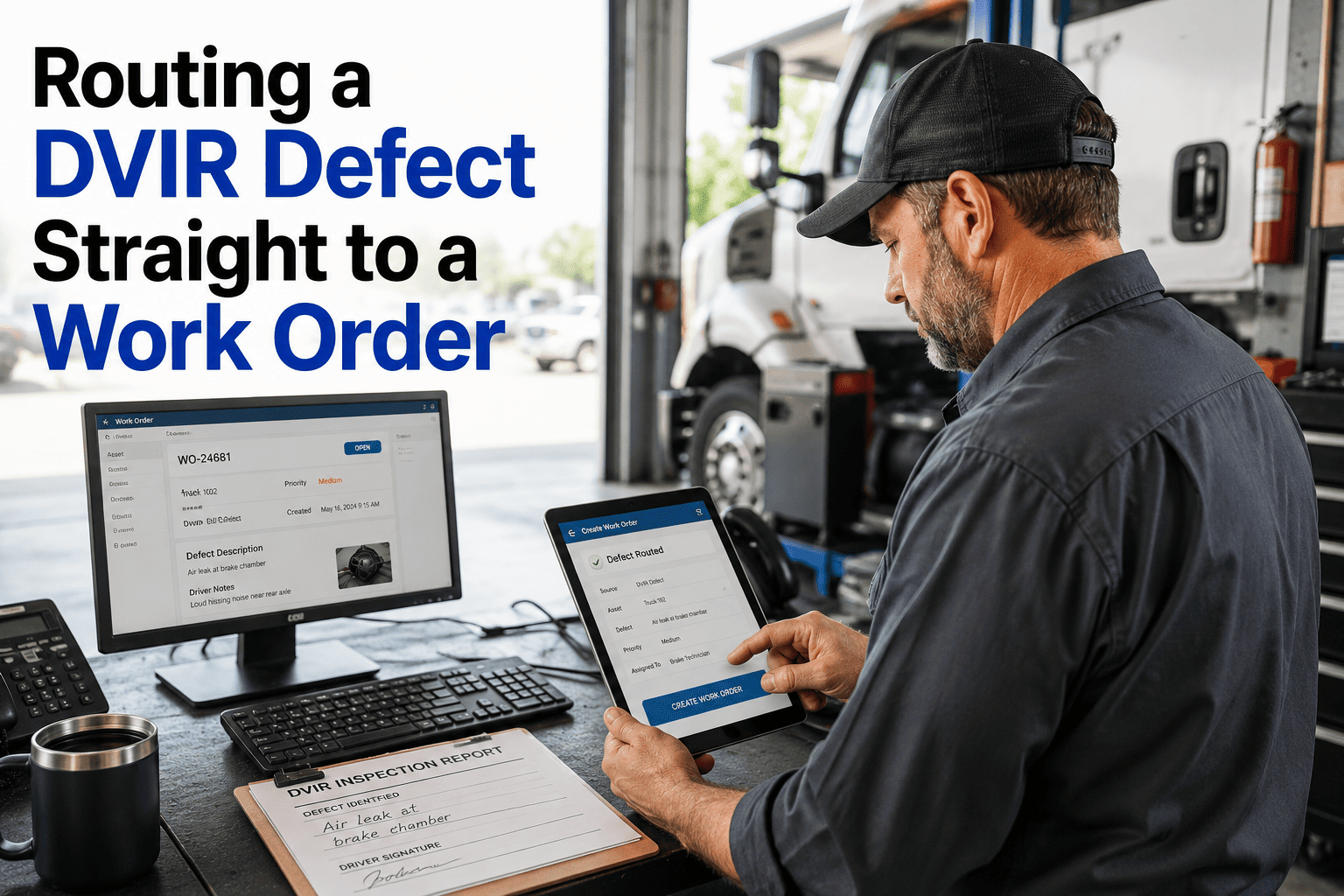
Defect discovered, work order created instantly
The driver logs the defect with a photo on a mobile device. A work order is generated automatically and routed to the maintenance team in the same minute — no clipboard, no delay, no missed handoff.
Digital DVIR
Three-signature chain enforced automatically
The system will not let the next driver start a trip without reviewing the prior DVIR and confirming repair status. The chain required under 396.11 and 396.13 is completed electronically, timestamped, and stored — every link accounted for.
Fleet Inspection Software
One Missed Signature Can Cost $12,700 in Falsification Penalties Alone
See how a guided digital inspection closes every link in the DVIR chain — before an auditor ever asks to see it.
What Every DVIR Has to Cover
A compliant DVIR is not a free-form note — it has to walk through the parts and accessories that affect safe operation, harmonized with the pre-trip checklist drivers already run under 392.7. A well-built digital checklist keeps every inspection consistent, regardless of which driver or which yard is running it.
01
Service brakes, trailer brake connections, and parking brake
02
Steering mechanism and coupling devices
03
Lighting, reflectors, and signal devices
04
Tires, wheels, and rims
05
Horn, windshield wipers, and rear vision mirrors
06
Emergency equipment and any other safety-affecting component
From Walk-Around to Work Order: The Digital DVIR Flow
The difference between a paper process and a digital one is not the checklist — it's what happens the second a defect is logged. Here is the path a single defect takes inside a connected DVIR system.
1
Guided Walk-Around
Driver completes the inspection on a mobile device, working through every required component in order — nothing skipped, nothing assumed.
2
Defect Logged With Photo Evidence
Any issue is captured with a photo and severity note, timestamped and GPS-tagged — evidence that holds up in an audit or a claim.
3
Work Order Auto-Generated
Maintenance is alerted the moment the defect is filed, with a work order already carrying the vehicle ID, defect details, and photos attached.
4
Repair Certified Digitally
The mechanic certifies the repair — or confirms none was needed — directly against the same record, satisfying the 396.13 certification requirement.
5
Next Driver Reviews and Signs
Before the vehicle can be dispatched again, the next driver is shown the prior DVIR and repair status and must sign off — the chain of custody closes automatically.
The DVIR Chain of Custody — Who Signs What
Every DVIR violation traces back to one broken link in a four-party chain. Knowing exactly who is responsible for each signature is the fastest way to stop the most common audit citations before they happen.
Party
Responsibility
Governing Rule
Digital Enforcement
Driver (Day 1)
Files the DVIR listing any defects found or reported during the shift
49 CFR 396.11
Guided checklist, cannot submit incomplete
Carrier or Mechanic
Certifies the defect was repaired, or that repair was unnecessary
49 CFR 396.13
Work order must be closed before dispatch flag clears
Driver (Day 2)
Reviews the prior DVIR and repair status, signs before operating
49 CFR 396.13
Prior DVIR auto-presented at next pre-trip login
Compliance / Auditor
Retains and produces records on request during reviews
Minimum 3-month retention
Instant search by vehicle, driver, date, or defect type
Paper DVIRs vs. Digital DVIRs, Side by Side
Paper DVIR Process
Defect-to-work-order time
Hours to days
Signature chain visibility
Manual, easy to lose
Roadside record retrieval
Search a filing box
Audit preparation time
Days of manual sorting
Digital DVIR Process
Defect-to-work-order time
Under 1 minute
Signature chain visibility
Enforced, cannot skip
Roadside record retrieval
Instant, on a phone screen
Audit preparation time
Filtered export in minutes
Before we went digital, a brake defect could sit on a clipboard for a full shift before anyone in the shop knew about it. Now the work order lands on the mechanic's tablet before the driver has finished parking. Our last audit closed with zero DVIR citations for the first time in years.
Fleet Safety Manager, regional carrier running 210 tractors
What Powers a Digital DVIR Program
Guided Mobile Inspections
Drivers work through every required component in a fixed order on a phone or tablet, with defect notes and severity built into the flow rather than left blank.
Photo and GPS Verification
Every defect is backed by a timestamped, geo-tagged photo — evidence that stands up during an audit, an insurance claim, or a roadside inspection.
Automated Work Order Routing
Defects convert straight into maintenance work orders, carrying vehicle ID, description, and photos so nothing gets re-typed or re-explained.
Enforced Signature Chain
The system blocks dispatch until the repair is certified and the next driver reviews and signs — the full 396.11 and 396.13 chain, closed automatically.
Frequently Asked Questions
Is a fully electronic DVIR legally compliant?
Yes. Electronic DVIRs have been permitted since 2018, and current FMCSA rulemaking adds explicit electronic-DVIR language directly into the regulations, removing any remaining ambiguity for carriers moving off paper. You can see how a compliant digital workflow is configured at
app.oxmaint.ai.
Does every driver have to file a DVIR every single day?
For property-carrying vehicles, a DVIR is only required when a defect is found or reported. Passenger-carrying vehicles require one daily regardless. Many fleets still file a "no defect" report daily as a documented compliance habit.
How long do DVIR records need to be kept?
The federal minimum is three months, but most compliance teams retain records far longer since litigation and insurance disputes can surface years later. Digital storage removes the cost pressure to purge early.
What happens if a vehicle is dispatched without a certified repair?
Dispatching a vehicle with an uncertified defect is a serious violation carrying significant fines, and it breaks the accountability chain auditors look for first. A digital system can block dispatch automatically until certification is complete — worth seeing on a
live walkthrough.
Can a digital DVIR system handle drop-and-hook trailers and multiple power units?
Yes — each operated tractor and each dropped trailer needs its own DVIR, and a digital system tracks them as separate assets automatically instead of relying on a driver to remember which form goes with which unit.
Fleet DVIR Compliance — OxMaint
Turn Every Inspection Into an Audit-Ready Record
Guided checklists, instant defect routing, and an enforced signature chain — configured for your fleet in days, not months.