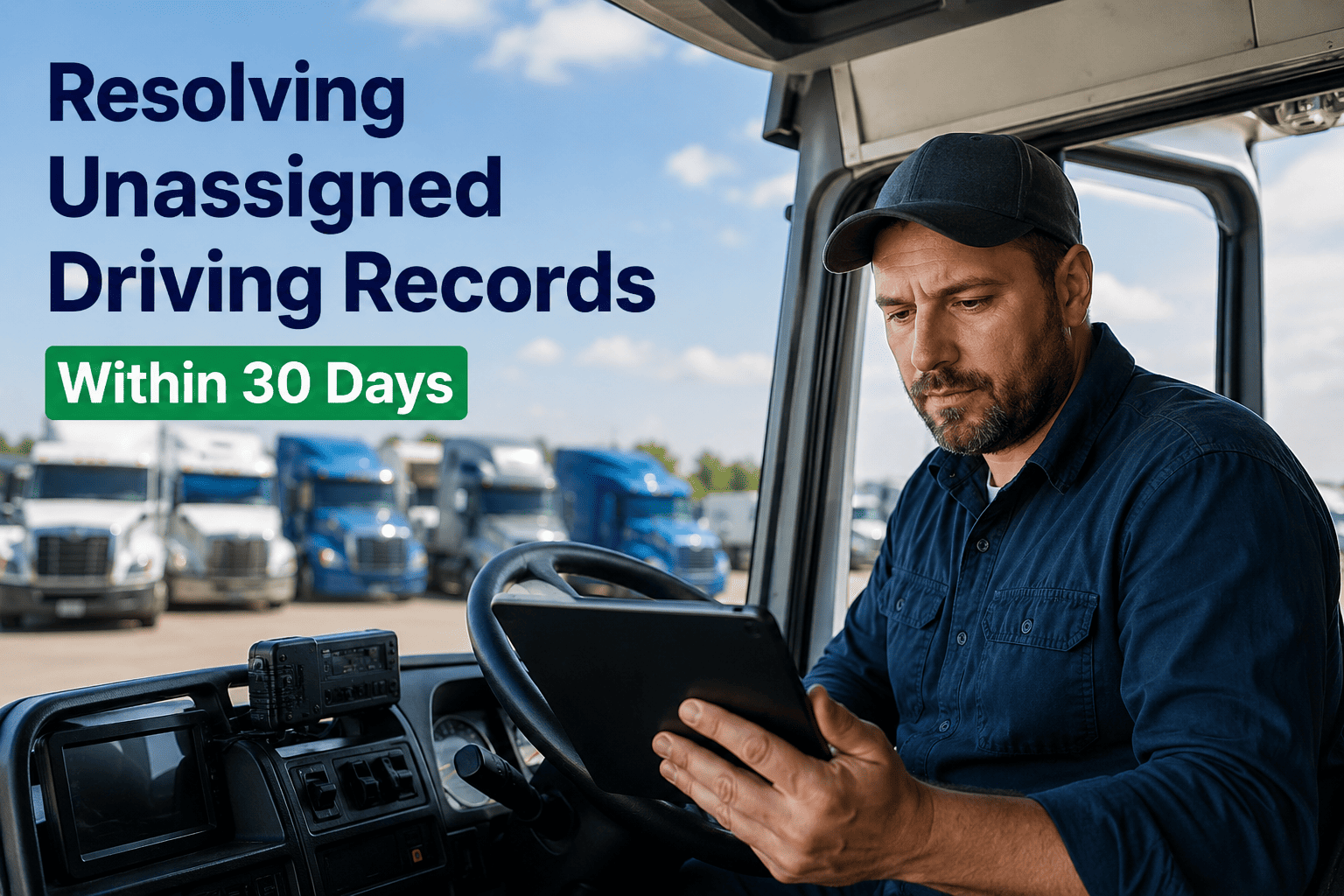
Unassigned driving records are ELD-captured driving events that occur when no driver is logged into the device, and federal regulations require fleets to resolve them within 30 days. Under 49 CFR 395.32, carriers must systematically review these records, assign them to the correct driver, or annotate them with a legitimate exception like a yard move or mechanic test. Failing to document this resolution process leaves your fleet exposed to HOS BASIC violations and costly CSA score penalties during compliance audits. This guide breaks down the exact workflow needed for 30-day resolution and shows how digitizing your fleet record resolution process protects your compliance standing. Ready to modernize your maintenance and compliance tracking? Start Free Trial today.
ELD COMPLIANCE GUIDE 2026
Are unassigned driving records silently destroying your fleet's CSA score?
Every truck movement without a logged driver creates a compliance liability. Most auditors expect ELD unassigned fleet records resolved within 30 days — otherwise they escalate into HOS BASIC violations that drag down your safety rating and trigger targeted interventions.
30
DAYS MAXIMUM
TO RESOLVE RECORDS
FLEET ELD UNASSIGNED GUIDE
What causes unassigned driving records in fleet ELD systems?
An ELD unassigned guide begins with understanding the root causes. Unassigned driving records happen whenever a commercial vehicle is in motion and the telematics device cannot attribute the driving time to a specific driver profile. The FMCSA mandates resolution of these events, making it critical to understand exactly how they originate so you can prevent them from accumulating in your compliance backlog.
01
Skipped ELD Login
A driver operates the truck without logging into the ELD, intentionally or accidentally bypassing the identification process. The vehicle moves, but the system has no driver profile attached to the driving event.
02
Unlogged Yard Moves
A mechanic or yard worker moves the truck intra-facility without selecting the yard-move exception status, causing the ELD to register the movement as unassigned driving rather than a documented operational maneuver.
03
Unidentified Driver Access
Another driver uses the equipment without properly assigning themselves in the ELD, often during relay handoffs or shared equipment transitions where login protocols break down.
ELD RESOLUTION GUIDE
The 30-day resolution workflow for unassigned driving records
To maintain a clean compliance profile, unassigned driving fleet records must be processed through a structured workflow. Under 49 CFR 395.32, carriers are required to review unassigned records and either assign them to the correct driver or annotate them with a valid exception. Most DOT auditors expect this resolution to occur within 30 days.
ELD Flags the Record
The ELD automatically pushes any unassigned driving event to the compliance dashboard, flagging the vehicle's VIN, the exact time, and GPS location of the movement for review.
Cross-Reference Data Sources
The compliance officer reviews the record against dispatch logs, geofence entries, fuel card transactions, and driver check-in data to identify who was operating the vehicle.
Assign or Annotate the Record
If a driver is identified, the record is attached to their ELD profile via the administrative function. If it was a legitimate yard move or mechanic test, the record is annotated with the specific exception explanation.
Lock the Audit Trail
The resolution action is time-stamped and permanently attached to the driver's record of duty status, creating a demonstrable audit trail proving 30-day resolution compliance.
COMPLIANCE IMPACT
The real cost of ignoring unassigned records 2026 regulations
When fleet record resolution is delayed beyond the expected 30-day window, the consequences extend far beyond a simple paperwork error. Unresolved ELD unassigned fleet records directly inflate your Hours-of-Service (HOS) Behavior Analysis and Safety Improvement Categories (BASIC) scores. A higher BASIC score triggers DOT audits, limits your insurance options, and damages your fleet's safety reputation with shippers and brokers.
$5,000+
Average fine per unresolved ELD violation during a DOT audit
+25%
HOS BASIC score increase from a backlog of unassigned records 2026
48 hrs
Time lost per audit manually reconstructing unassigned driving logs
REAL-WORLD SCENARIO
A 120-truck regional carrier ignored its ELD unassigned driving records for 60 days. During a compliance review, 340 unassigned events were flagged as HOS violations. The fleet faced $18,500 in immediate fines, a conditional safety rating, and lost two prime shipper contracts — all because a structured 30-day resolution workflow was never implemented.
Stop chasing unassigned driving records across disconnected systems
Consolidate your ELD compliance and fleet maintenance into one AI-powered platform. Book a 30-minute demo to see how OxMaint surfaces and resolves exceptions fast.
PREVENTION CHECKLIST
How to prevent unassigned driving records before they happen
Structured management prevents unassigned records from accumulating in the ELD backlog. Use this fleet unassigned driving guide checklist to enforce driver habits that stop unassigned events at the source.
Enforce Yard-Move Status
Train all yard workers and mechanics to activate the yard-move exception before moving any truck intra-facility, preventing the ELD from logging it as unassigned driving.
Mandatory Login Protocols
Require drivers to log into the ELD before turning the ignition. Disable vehicle starts via telematics integration if an active driver profile is not detected.
Standardize Relay Handoffs
Implement a strict two-step login verification during driver relays or shared equipment transitions so the outgoing driver logs out before the incoming driver takes control.
Weekly Backlog Audits
Assign a compliance officer to review the ELD unassigned dashboard every week, ensuring no record approaches the 30-day resolution deadline.
SOFTWARE SOLUTION
How OxMaint streamlines ELD record resolution for fleets
OxMaint is an AI-powered CMMS and EAM platform that bridges the gap between fleet maintenance and compliance. When unassigned driving records surface, OxMaint cross-references the data automatically and attaches the resolution workflow to specific driver and asset records with a permanent audit trail.
Automated Compliance Dashboard
Unassigned driving records surface instantly in a central dashboard with cross-references to dispatch and geofence data, cutting manual review time by up to 70%.
Permanent Audit Trails
Every assignment or annotation is time-stamped and locked to the asset's maintenance history, ensuring you are 100% audit-ready for FMCSA and DOT reviews.
Predictive Maintenance Alerts
Identify assets that frequently generate unassigned records due to ELD hardware faults, allowing your maintenance team to resolve telematics issues before they cause compliance violations.
Unified Work Orders
Link compliance exceptions directly to corrective work orders, eliminating paper trails and ensuring yard-move ELD issues are fixed without delaying fleet operations.
FAQ
Frequently asked questions about unassigned driving records
What is an unassigned driving record in an ELD system?
An unassigned driving record is a driving event captured by the ELD when the vehicle is in motion but no driver is logged into the device. It commonly occurs when a driver skips login, a mechanic moves the truck without using a yard-move exception, or a relay driver fails to identify themselves. Carriers must review and resolve these records within 30 days.
How long do fleets have to resolve unassigned driving records?
Under FMCSA regulations (49 CFR 395.32), carriers must review unassigned driving records and either assign them to the correct driver or annotate them with a legitimate explanation. While the rule states a reasonable period, most auditors expect resolution within 30 days to avoid HOS BASIC violations.
What happens if unassigned records are not resolved within 30 days?
Records aged past 30 days without resolution appear as Hours-of-Service (HOS) BASIC violations in your CSA scoring. This can trigger DOT audits, impose thousands in fines, and damage your fleet's safety rating. Using a centralized system like OxMaint prevents backlogs — Book a Demo to see how.
How do you annotate an unassigned driving record?
To annotate a record, the compliance officer uses the ELD administrative function to add a written explanation, such as yard moves, mechanic testing, or other legitimate reasons. The annotation must be permanently attached to the record with a time-stamp to satisfy DOT audit requirements.
Can CMMS software help with ELD compliance and fleet record resolution?
Yes. An AI-powered CMMS like OxMaint surfaces unassigned driving records in a compliance dashboard, cross-references asset data for easy matching, and attaches resolutions to permanent audit trails. This eliminates manual tracking and ensures your fleet remains 100% audit-ready at all times.
Resolve your first unassigned driving record today with OxMaint
See how AI-powered maintenance and compliance tracking eliminates ELD backlogs, protects your CSA score, and keeps your fleet audit-ready.
Free 14-day trial · No credit card required