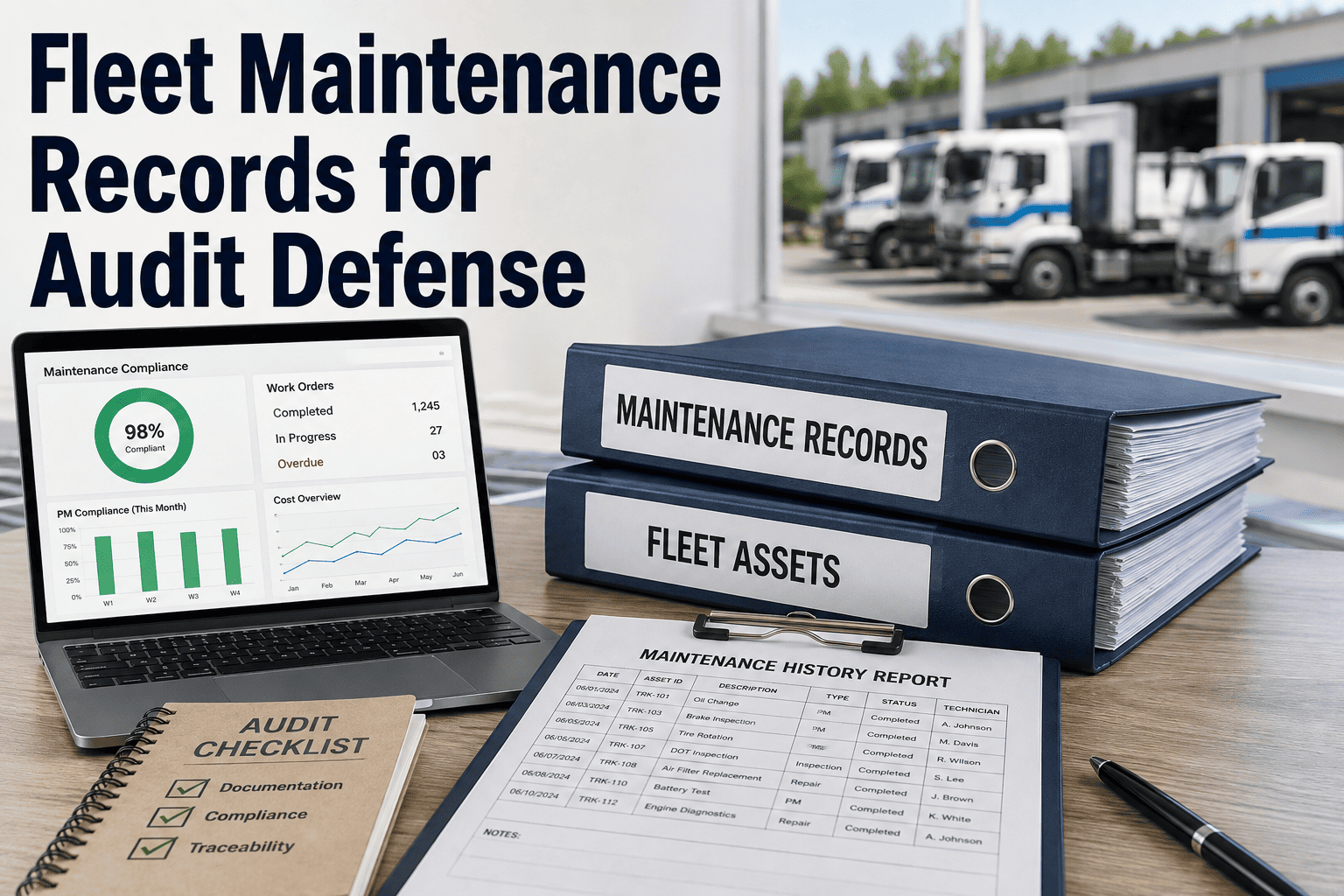
A perfectly maintained truck means nothing to an auditor who cannot see proof of it. When FMCSA compliance reviews arrive with as little as 48 hours' notice, the carriers who fail are rarely the ones with bad wrenching — they are the ones whose repair history lives in a filing cabinet, a mechanic's memory, or three different spreadsheets that do not agree with each other. Offsite audits have climbed sharply in recent years, and the gap between "we fixed it" and "we can prove we fixed it, on this date, for this vehicle, with this signature" is exactly where citations happen. This guide breaks down what an audit-ready maintenance record actually looks like, system by system, and how a structured digital record closes that gap before an auditor ever asks for it.
FLEET COMPLIANCE · MAINTENANCE RECORDS · 2026
Fleet Maintenance Records: The Audit-Ready Documentation Guide
Every repair your shop performs is either a defensible record or a liability waiting for an audit. Here is the documentation model that keeps it on the right side of that line — across DVIRs, repair certifications, annual inspections, and the retention clock that governs each one.
400%
rise in offsite audits
Carriers now get as little as 48 hours to produce records
89%
of reviews cite DVIR records
The single most-audited document category under Part 396
7%
of carriers pass cleanly
Most reviews find at least one missing signature or gap
6
record types, 6 retention clocks
Each governed by a different section of Part 396
Good Maintenance and Good Records Are Two Different Disciplines
A technician can torque every bolt correctly and still leave the fleet exposed if the work order never gets closed out, the DVIR signature chain breaks, or the retention period lapses before a claim or audit surfaces. Compliance reviewers do not ride along on repairs. They read files.
Compliance reviewers evaluate the paper trail, not the wrench work behind it.
That distinction matters because the two disciplines fail differently. Maintenance quality shows up in breakdown rates and out-of-service orders. Record quality shows up months later, when an auditor pulls ninety days of history for a random vehicle sample and traces every signature, date, and repair certification against the regulation that requires it.
Six Record Types Every Fleet Must Retain — And For How Long
Part 396 does not treat maintenance documentation as one bucket. It sets a distinct retention clock for each record type, and mixing them up is one of the most common findings in a compliance review.
| Record Type |
CFR Reference |
Retention Period |
Most Common Failure |
| Driver Vehicle Inspection Reports |
49 CFR 396.11 |
3 months (90 days) minimum |
Missing driver or mechanic signature in the chain |
| Repair Certifications |
49 CFR 396.13 |
3 months, tied to the DVIR it closes |
Defect logged but never certified as repaired |
| Systematic Maintenance Records |
49 CFR 396.3 |
Vehicle's service life plus 6 months after disposal |
Record does not identify the specific vehicle or unit |
| Annual Periodic Inspection Reports |
49 CFR 396.17 |
14 months from the inspection date |
Inspection overdue or report missing from the vehicle |
| Roadside Inspection Reports |
49 CFR 396.9 |
12 months from the inspection date |
No carrier signature acknowledging receipt |
| ELD / Hours of Service Records |
49 CFR 395.8 |
6 months |
Records not cross-referenced against maintenance downtime |
Why Retention Periods Are Set Per Record, Not Per Fleet
The gap between a 90-day DVIR window and a service-life-plus-six-months systematic maintenance record isn't arbitrary. Regulators built each retention period around how the record gets used: DVIRs support day-to-day dispatch decisions and are checked most often shortly after they're filed, while systematic maintenance records need to survive the entire life of the vehicle to support a warranty dispute, a resale inspection, or a litigation request years later.
Six record types. Six different retention clocks. One blanket policy almost always gets one of them wrong.
A fleet that treats every record the same way tends to make one of two mistakes — purging DVIRs too early because they get lumped in with longer-retention categories, or holding everything indefinitely and burying the records an auditor actually needs under years of low-value paperwork. Neither mistake shows up until the moment a record is requested and isn't there.
The Three-Signature Chain Auditors Actually Trace
1
Driver Reports the Defect
At the end of the day's work, the driver completes a DVIR noting any defect that would affect safety or cause a breakdown. This is signature one in the chain, and it is timestamped the moment it is filed.
2
Carrier Certifies the Repair
Before the vehicle returns to service, the carrier must certify that the defect was repaired or that repair was unnecessary. This is signature two, and it is the step most often skipped or delayed under Part 396.13.
3
Next Driver Acknowledges the Prior Report
The next driver to operate the vehicle must review the previous DVIR and the repair certification before the trip begins. This closing signature is the one auditors check first, because a missing third signature is a citable finding on its own.
One broken link anywhere in that chain — a defect logged without a certification, or a certification without the next driver's acknowledgment — is treated as an incomplete record, regardless of whether the repair itself was done correctly. Start a free trial to capture all three signatures digitally with a timestamp on each.
Where Documentation Actually Breaks Down
None of the six patterns below require bad maintenance work to occur. Every one of them can happen inside a fleet that repairs vehicles correctly and on time — the failure is entirely in how the proof of that work is captured, stored, and connected back to the vehicle it belongs to.
Most common
Signature Gaps
A defect is reported and repaired, but the closing signature from the next driver never gets captured because the paper DVIR never made it back to the vehicle.
Vehicle Misidentification
Maintenance records logged under a work order number instead of a VIN or unit number, making it impossible to reconstruct a single vehicle's full history on request.
Retention Mismatches
Shops apply one retention policy fleet-wide instead of the correct period per record type, purging DVIRs and annual inspections on the same schedule.
Split Systems of Record
DVIRs live in one system, work orders in another, and annual inspection reports in a filing cabinet — so no single export can answer an auditor's request.
Retrieval Delay
Records exist but take days to assemble by hand, well past the 48-hour window an offsite audit typically allows.
No Cross-Reference to Downtime
Maintenance records that don't tie back to HOS or dispatch data, leaving no way to explain a vehicle's out-of-service window if it's questioned later.
Paper Files vs. a Structured Digital Record
The comparison below isn't about technology preference. It's about what happens in the specific moment an auditor, an insurer, or a plaintiff's attorney asks for a record and expects it produced within hours, not the following week.
Retrieval for an audit request: days, not hours
Signature chain verified manually, page by page
Retention period tracked by memory or a wall calendar
Vehicle history scattered across shop folders
No alert when a signature or step is missing
Filtered export produced in minutes, any date range
Signature chain enforced at the point of entry
Retention clock applied automatically, per record type
Full history tied to one vehicle ID across every record
Incomplete chains flagged before the vehicle is dispatched
Why Retention Discipline Matters as Much as Repair Quality
A record purged one month early is functionally the same as a record that was never created — both leave a gap an auditor will find. Because Part 396 assigns different retention windows to DVIRs, repair certifications, annual inspections, and systematic maintenance records, a single blanket purge policy almost guarantees one category gets deleted too soon.
A record deleted one month early is indistinguishable from a record that was never filed.
The fix is not a longer retention period across the board. It is applying the correct period to each record type automatically, so nothing is deleted before its clock runs out and storage costs don't balloon by over-retaining everything indefinitely. Book a demo to see retention rules applied automatically by record type.
How Oxmaint Builds the Audit-Ready Record
None of this requires a separate compliance system bolted onto the maintenance workflow. The record is a byproduct of the work itself — captured as the DVIR is filed, as the repair is certified, and as the inspection is completed, rather than reconstructed afterward from memory and paper.
1
Digital DVIR Signature Chain
Driver, mechanic, and next-driver signatures are captured in sequence with a timestamp on each, so an incomplete chain is visible immediately instead of at audit time.
2
Repair Certification Tied to Every Defect
Every logged defect creates a work order that must be closed with a certification before the vehicle record shows it as resolved — no defect can silently disappear.
3
Per-Record Retention Rules
DVIRs, repair records, annual inspections, and roadside reports each carry their own retention clock, applied automatically by record type rather than a single fleet-wide policy.
4
Single Vehicle History by Unit ID
Every DVIR, work order, inspection, and repair certification rolls up to one vehicle identifier, so a full service history can be pulled without cross-referencing three systems.
5
Filtered Audit Export
Records filter by vehicle, date range, or record type and export in a structured format built for a compliance review, not a folder of scanned paper.
6
Gap Alerts Before Dispatch
A vehicle with an unresolved defect or a broken signature chain flags before it goes back on the road, not after an inspector finds it roadside.
Turn Every Repair Into a Defensible Record
Stop reconstructing history under a 48-hour deadline. Build the record as the work happens.
Building a 48-Hour Audit Response Playbook
Offsite compliance reviews rarely announce themselves far in advance. The window between notice and deadline has shrunk to roughly two days for many carriers, which means the response cannot start with "let's go find the files." It has to start with a system that already knows where every record lives.
A
Confirm the Vehicle Sample
Most reviews request a random sample of vehicle IDs rather than the full fleet. The first task is matching those IDs against your roster so nothing gets pulled for the wrong unit.
B
Pull DVIRs and Certifications First
Because DVIR records appear in the large majority of compliance reviews, they should be the first export generated, filtered to the requested date range for each sampled vehicle.
C
Attach Annual Inspection and Roadside History
Reviewers frequently cross-check DVIR gaps against the most recent annual inspection date and any roadside inspection reports on file for the same vehicle.
D
Package and Submit Before the Deadline
A structured export — organized by vehicle, then by record type, then chronologically — is what auditors expect. A folder of scanned paper in no particular order reads as disorganization even when nothing is technically missing.
Fleets that rehearse this sequence before an audit notice ever arrives consistently produce cleaner reviews, because the exercise itself surfaces gaps — a vehicle missing a recent annual inspection, a DVIR with no closing signature — while there is still time to fix them instead of explaining them.
Documentation ROI by the Numbers
Minutes
not days, to produce an audit export
Filtered by vehicle, date range, or record type
0
missing signatures at dispatch
Incomplete chains flag before the vehicle leaves the yard
6/6
record types on the correct retention clock
Applied automatically, no manual tracking required
1
system of record per vehicle
DVIRs, repairs, and inspections in a single history
Frequently Asked Questions
How long must DVIRs and repair certifications be retained?
Under 49 CFR 396.11, DVIRs and their associated repair certifications must be retained for at least three months from the date the report was prepared.
Start a free trial to apply this retention window automatically.
What makes a DVIR signature chain incomplete?
A chain is incomplete when any of the three required signatures is missing: the driver's initial defect report, the carrier's repair certification, or the next driver's acknowledgment of the prior report before departure.
Are electronic DVIRs accepted in a compliance review?
Yes. Electronic DVIRs are explicitly authorized under 49 CFR 396.11 and 396.13, with digital signatures carrying the same standing as wet-ink originals when timestamped and retained correctly.
How is a systematic maintenance record different from a DVIR?
A DVIR under 396.11 is a driver's daily post-trip report. A systematic maintenance record under 396.3 documents the carrier's ongoing inspection, repair, and maintenance program for each vehicle and is retained for the vehicle's service life plus six months.
What should a fleet produce first when an audit notice arrives?
Start with the record type most frequently cited: DVIRs and repair certifications for the vehicles in the requested sample.
Book a demo to see a filtered export built for exactly that request.
Build an Audit-Ready Record From the First Repair
Digital signature chains, per-record retention, and a filtered export ready before the next audit notice arrives.