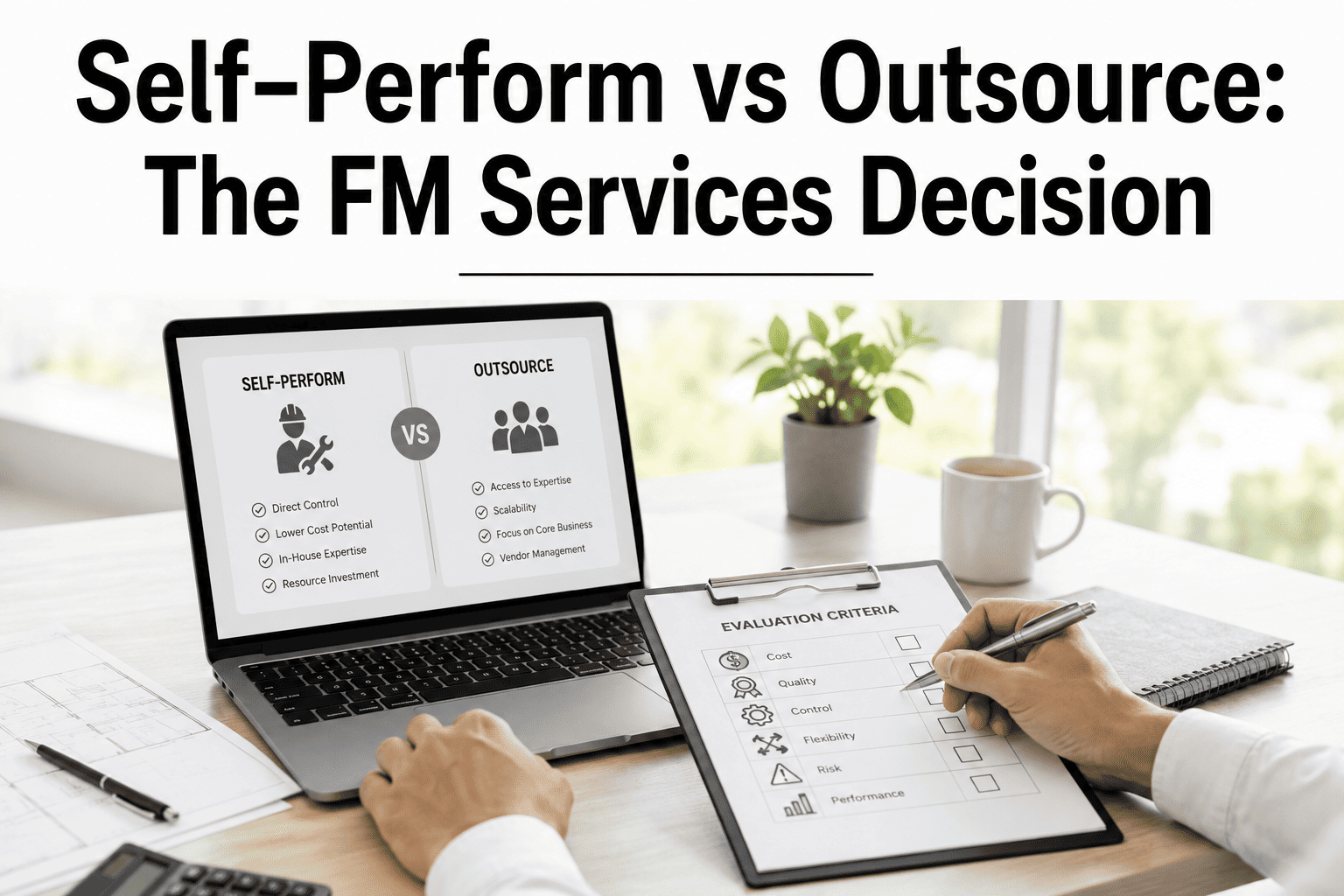
The self-perform vs outsource FM decision is rarely a single binary — it's a service-by-service sourcing strategy that depends on portfolio scale, market labor rates, asset criticality and compliance exposure. A 2023 IFMA benchmark found that portfolios blending in-house facility services with targeted outsourcing achieve 18–24% lower total cost of ownership than those locked into a single delivery model. This guide walks maintenance and reliability leaders through a practical decision framework for self-performing versus outsourcing facility services — covering cost modeling, quality trade-offs, and the facility outsourcing model that best fits each service line. When you're ready to operationalize whichever model you choose, you can Start Free Trial of OxMaint and see the difference immediately.
FM SOURCING DECISION FRAMEWORK
Self-Perform vs Outsource FM: Which Service Goes Where?
Every portfolio of 50+ sites has at least 12 service lines. Some are 30% cheaper in-house; others cost 40% more. The question is never "in-house or outsourced FM?" — it's which service, at which sites, under which contract structure. Build a defensible facility service delivery model in a single afternoon.
- ✕ 6+ vendors invoicing separately
- ✕ Reactive SLAs, 40% unplanned downtime
- ✕ No visibility into self-perform labor cost
- ✕ Compliance audits take 3–5 days
- ✕ Annual FM spend growth: 8–12%
- ✓ Unified work-order view across in-house + vendors
- ✓ PM compliance above 92%, downtime cut 30–50%
- ✓ Real-time labor hour-to-asset cost tracking
- ✓ Audit-ready logs in under 2 hours
- ✓ Annual FM spend flat or declining
COST MODELING
How to model in-house vs outsourced FM cost — line by line
A 2024 review of 140 FM portfolios found that 61% of self-perform vs outsource decisions are made on vendor day-rate alone — ignoring 35% of the true total cost of service delivery.
A common blind spot: burdened labor rate is 1.35–1.55× base wage. A $32/hr technician actually costs $43–$50/hr fully loaded.
Vendor re-bid cycles average 18 months and cost 4–7% of annual contract value in internal labor and legal review.
WORKED EXAMPLE
A 180-asset logistics portfolio spending $42K/yr on HVAC preventive maintenance self-performed this service line using two in-house technicians. Modeling revealed: fully-loaded labor $38.50/hr × 1,800 hrs = $69,300, plus $8,100 in specialized tooling and $4,200 in refrigerant certification — a true cost of $81,600/yr. An outsourced HVAC SLA was quoted at $74,000/yr with guaranteed 4-hour response. Outsourcing saved $7,600 and eliminated Saturday overtime risk. But for general repairs, in-house won by $11,200. The right answer was both — split by service line.
SERVICE-LINE DECISION MATRIX
Which facility services to self-perform vs outsource
Not every service line behaves the same. Use this matrix to match each service to the delivery model that minimizes cost and maximizes uptime across your portfolio.
| Service Line | Self-Perform Sweet Spot | Outsource Sweet Spot | Primary Cost Driver | Recommended Model |
|---|---|---|---|---|
| HVAC / Refrigeration | 3+ rooftop units per site | EPA 608-certified needs, low site density | Specialized labor rate | Outsource (specialized) |
| General / Preventive Repairs | High site density, 2+ techs | Remote or single-tech sites | Travel time + response speed | Self-Perform (core) |
| Janitorial / Custodial | Rarely cost-effective in-house | Standardized across 10+ sites | Labor volume + supervision | Outsource (commodity) |
| Fire / Life Safety Inspections | If internal team holds NICET III+ | Compliance liability, audit trails | Certification + liability | Outsource (compliance) |
| Grounds / Landscaping | Very large contiguous campuses | Dispersed portfolio, seasonal needs | Equipment utilization | Outsource (seasonal) |
| Asset / Equipment Maintenance | Core production-critical assets | Non-critical, OEM-warrantied | Downtime cost per hour | Self-Perform (core) |
Rule of thumb: if the fully-loaded hourly cost of your internal team is below 85% of the vendor's effective rate AND you can sustain a 90%+ PM compliance schedule, self-perform. Otherwise, outsource — and track both in OxMaint.
QUALITY & COMPLIANCE TRADE-OFFS
In-house facility services vs outsourcing: the hidden trade-offs
Cost is half the picture. A 2023 study of 220 facilities found that outsourced PM compliance averaged 76% — versus 84% for self-performing teams with CMMS tooling. The gap closes entirely when both operate inside a unified work-order system.
Self-Perform Advantages
- Faster response on critical assets — 45 min avg vs 3 hr SLA
- Institutional knowledge of site-specific quirks
- Direct control over PM schedule and prioritization
- No vendor markup on replacement parts
Self-Perform Risks
- Burdened labor cost 35–55% above base wage
- Skill gaps on specialized systems (chillers, BAS)
- Coverage gaps during PTO, sick leave, turnover
- Capital tied up in tools and diagnostic equipment
Outsource Advantages
- Access to certified specialists on demand (NICET, EPA)
- Variable cost scales with actual demand
- Shifts compliance liability to vendor SLA
- No capital investment in specialized tooling
Outsource Risks
- SLA response variability during peak season
- Vendor technician turnover disrupts continuity
- Hidden costs: trip charges, after-hours premiums
- Quality drift between contract renewals
Stop guessing. Model your FM sourcing with real data.
Book a 30-minute demo and see how OxMaint gives you the labor-hour, vendor-cost and compliance visibility to make the self-perform vs outsource call with confidence — across every site and every service line.
HOW OXMAINT HELPS
How OxMaint powers a hybrid self-delivery FM model
Whether you self-perform, outsource, or mix both by service line, OxMaint gives you a single source of truth for every work order, asset and dollar — so the decision is driven by data, not gut feel.
Unified Work-Order Management
Assign work orders to in-house technicians and external vendors in one system. Track status, SLA compliance and completion photos side by side. Portfolios report 25% faster average close times and elimination of paper work orders within 30 days.
Predictive Maintenance Analytics
AI-driven failure prediction on critical assets flags issues 7–21 days before breakdown. Self-perform teams schedule proactively; vendors get dispatched with full diagnostic context — cutting unplanned downtime 30–50%.
Real-Time Cost Tracking
Every labor hour and vendor invoice is tagged to the asset and service line. Run a true cost-of-service report in 3 clicks — the exact data you need to decide whether HVAC, plumbing or general repairs should flip delivery models next quarter.
Compliance & Audit Readiness
Automated PM schedules aligned to ISO 55000 and OSHA standards. Every inspection, cert and corrective action is logged with timestamps and attachments — turning 3-day audit scrambles into 2-hour report exports.
FM SOURCING STRATEGY
Building your facility service delivery model: a 4-step roadmap
Moving from ad-hoc vendor relationships to a deliberate facility outsourcing model takes 60–90 days. Here's the path maintenance leaders use to get there without disrupting service.
Audit current service spend & delivery
Pull 12 months of vendor invoices and internal labor hours by service line. Tag every cost to a site and asset category. Output: a baseline TCO matrix showing where spend actually goes — most leaders find 20% of costs misallocated.
Run the self-perform vs outsource formulas
Apply the TCO formulas above to each of your top 8–12 service lines. Factor in criticality, response-time requirements and compliance exposure. Output: a recommended delivery model per service line with 3-year projected savings.
Shift 2–3 service lines to the winning model
Don't boil the ocean. Move the 2–3 service lines with the clearest cost or quality gap first — typically HVAC outsourcing or bringing general repairs in-house. Use OxMaint to manage both streams in parallel with full audit trails.
Review quarterly and rebid annually
Market labor rates shift 4–8% annually. Re-run the model each quarter with live OxMaint cost data. If a vendor's effective rate drifts 15% above your self-perform TCO, it's time to flip that service line or renegotiate.
FAQ
Self-perform vs outsource FM: your questions answered
When should I self-perform facility services instead of outsourcing?
Self-perform when three conditions are met: your fully-loaded internal labor rate is below 85% of the vendor's effective rate, you can sustain 90%+ PM compliance with existing headcount, and the assets are critical enough that response-time control matters (typically production-critical equipment or life-safety systems). For commodity services like janitorial or seasonal landscaping, outsourcing almost always wins on cost. To see whether your current labor data supports self-performing, Start Free Trial and run a cost-of-service report in minutes.
What is the typical cost savings of outsourcing facility services?
Outsourcing commodity services (janitorial, landscaping, pest control) typically saves 12–20% versus in-house delivery due to labor pooling and specialized equipment. However, outsourcing specialized or critical maintenance (HVAC, production equipment) can cost 15–30% more than self-performing if you have sufficient volume. The savings depend entirely on service line, site density and contract structure — not on a blanket "outsourcing is cheaper" assumption.
How do I track both in-house and vendor work orders in one system?
A CMMS like OxMaint lets you assign work orders to internal technicians and external vendors in the same dashboard, with role-based access so vendors only see their assigned work. Each work order captures labor hours, parts cost, completion photos and SLA timestamps — giving you an apples-to-apples cost and quality comparison between self-performed and outsourced service lines. Book a Demo to see the unified vendor-management workflow.
What are the biggest risks of a fully outsourced FM model?
The three biggest risks are: (1) SLA response variability — vendors juggle multiple clients and may deprioritize you during peak season; (2) institutional knowledge loss — vendor technician turnover means site-specific knowledge walks out the door; and (3) hidden costs — trip charges, after-hours premiums and change orders can inflate invoices 15–25% above the quoted rate. A hybrid model with OxMaint tracking both streams mitigates all three.
How often should I re-evaluate my self-perform vs outsource decision?
Review your facility service delivery model quarterly using live cost data, and conduct a full rebid or re-evaluation annually. Market labor rates shift 4–8% per year, and a service line that was cheaper outsourced 18 months ago may now be cheaper in-house (or vice versa). The key is having real-time labor-hour and vendor-invoice data in a single system so the decision takes hours, not weeks.
See OxMaint on your assets — book a 30-min demo
Whether you self-perform, outsource, or run a hybrid model, OxMaint gives you the work-order, cost-tracking and predictive analytics to make every FM sourcing decision with data. See it live on your portfolio.
Free 14-day trial · No credit card