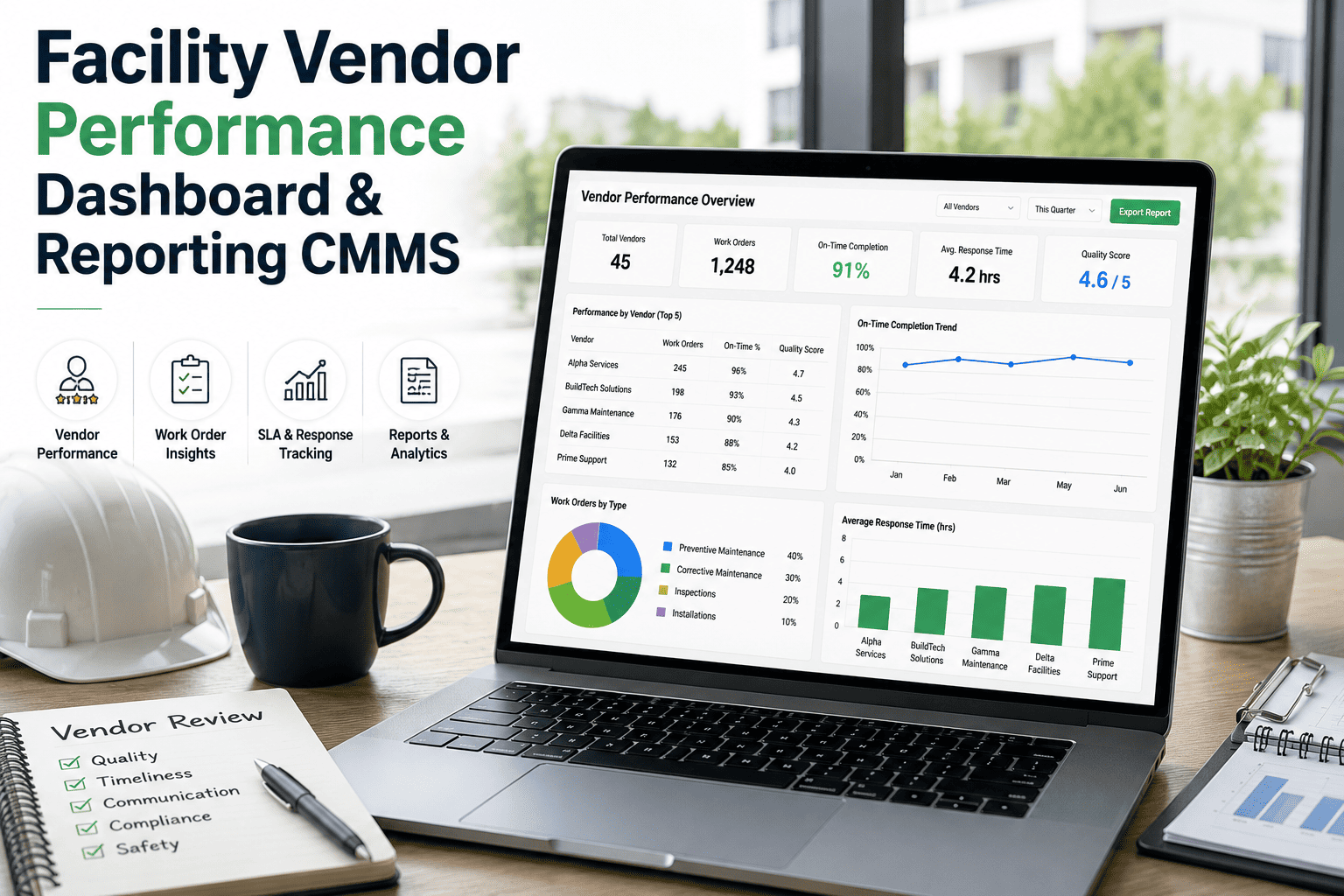
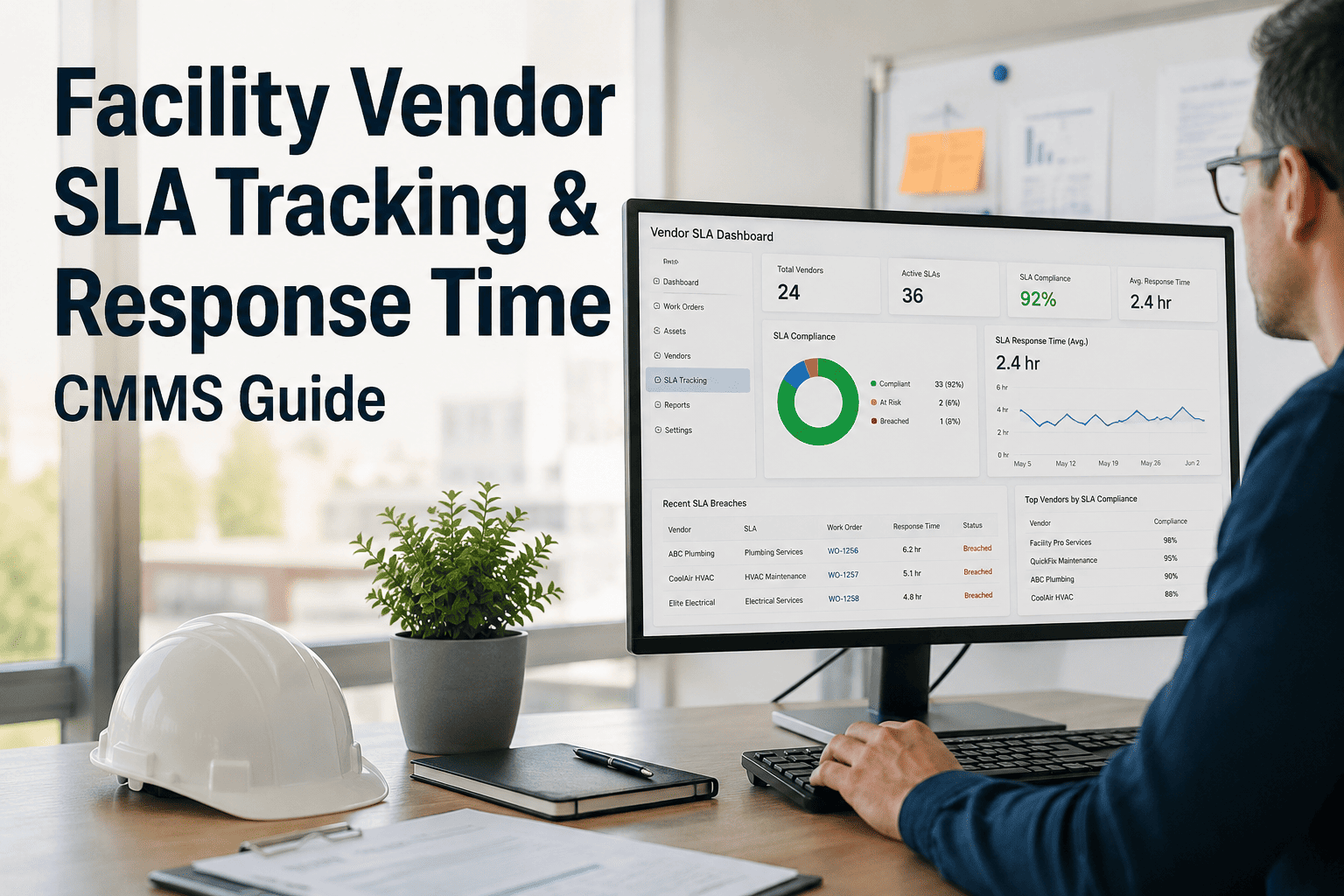
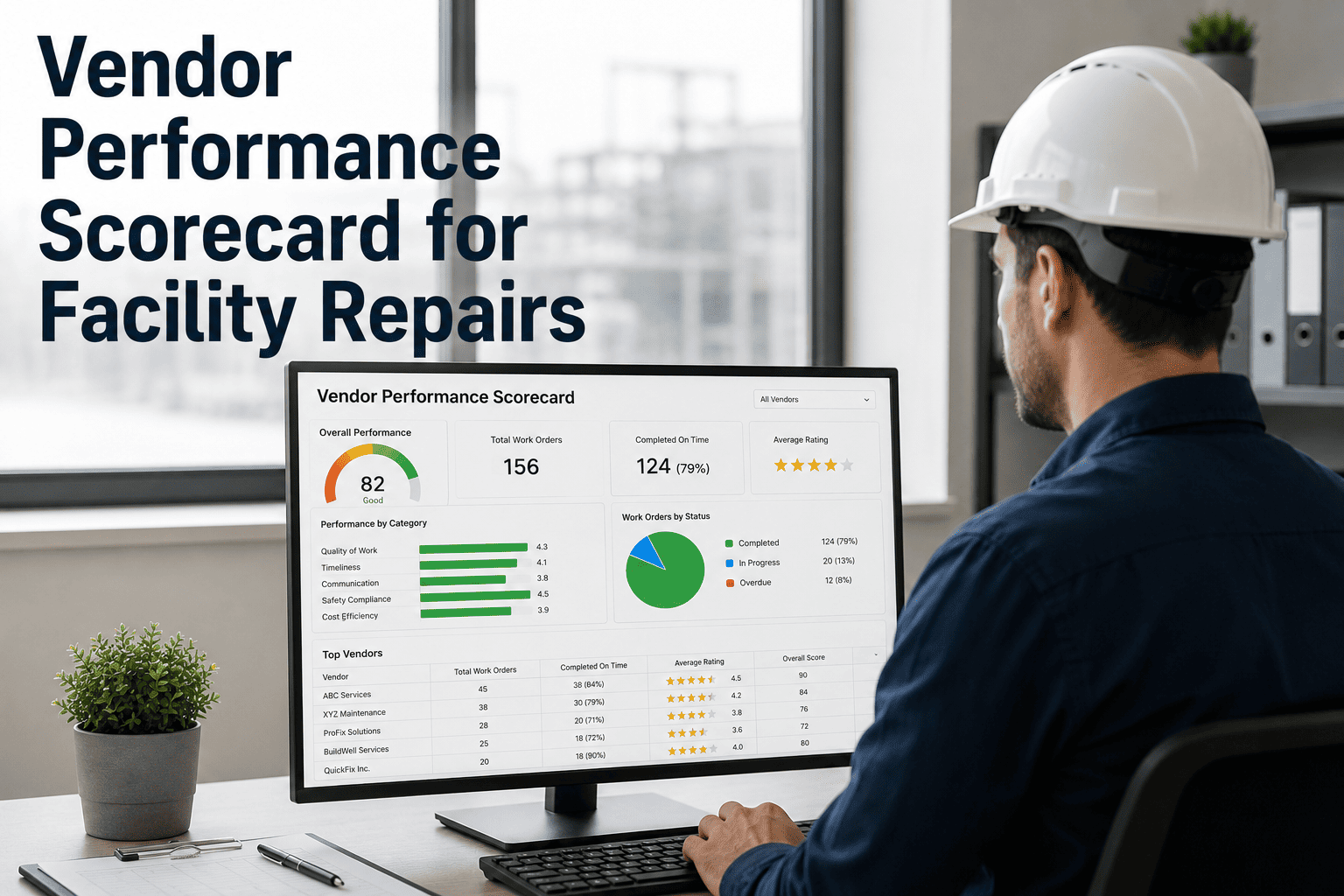
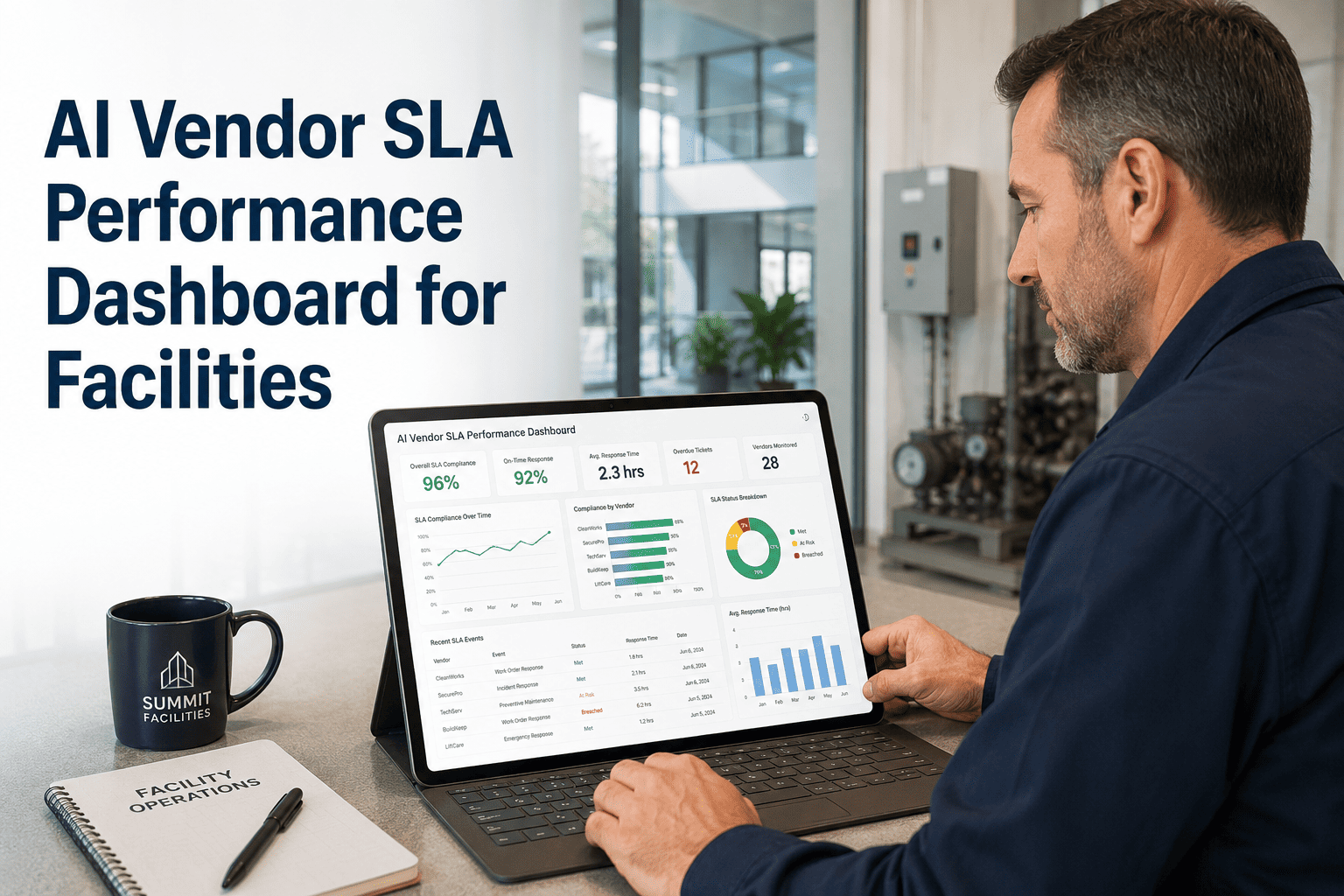
According to facility management outsourcing represents a $150+ billion market in North America alone, with 67% of commercial facility managers reporting limited or no formal vendor performance tracking outside of basic invoice approval. The gap between contractor promises and actual field performance costs facility owners an estimated $8,000 to $22,000 per vendor annually in undocumented rework, SLA credits not claimed, and compliance penalties from missed service intervals. Unlike direct-hire maintenance where performance metrics are standard, outsourced facility contracts often lack systematic scorecards — leaving facility managers to evaluate vendors by memory, emotion, or the most recent incident. OxMaint's Vendor Management Module provides automated contractor scorecards with KPIs for response time, first-time fix rate, safety compliance, cost variance, and completed work order quality — generating vendor performance trends and procurement recommendations without manual data collection. Book a demo to see how facility teams are reducing vendor-related rework by 34–52% while negotiating better contract terms with objective performance data.
01
Vendor Performance Scorecard for Facility Management Contractors
Contractor KPIs · Response tracking · Quality scoring · Compliance monitoring · Procurement analytics
67%Of facility managers lack formal vendor performance tracking
$8K–22KAnnual hidden cost per vendor from undocumented rework
34–52%Reduction in vendor-related rework with automated scorecards
The Cost of Unmanaged Vendor Performance
$150B+
North American facility management outsourcing market
Growing 7–9% annually
41%
Of facility contracts lack documented SLAs with performance tracking
Industry survey 2024
3–5%
Typical vendor cost savings from scorecard-based negotiation
Objective performance data drives contract terms
Five Vendor Performance Dimensions That Require Scorecard Tracking
01
Response Time — Emergency & Routine
Emergency response SLA (typically 2–4 hours) and routine response SLA (24–72 hours) are the most frequently missed contractor obligations. Without automated tracking, missed response times go undocumented — losing SLA credits averaging $150–500 per missed emergency dispatch. Scorecard tracks actual arrival time against SLA threshold across every dispatch.
02
First-Time Fix Rate
Repeat visits for the same work order indicate diagnostic error, inadequate repair, or parts shortage. Industry benchmark for facility maintenance first-time fix rate is 85–92%. Vendors below 80% increase your internal coordination cost by 2.5x per issue. Scorecard tracks return visits within 30 days of original completion — flagging chronic problem vendors.
03
Work Order Completion Quality
Post-maintenance inspections reveal undocumented defects, incomplete scope, and safety hazards. Without systematic quality scoring, vendors with low quality continue receiving work. Scorecard captures supervisor sign-off ratings (1–5) on completed work orders, trending quality over time and by technician or crew.
04
Safety & Compliance Performance
Contractor safety violations, missing JSA documentation, and expired certifications create liability risk for facility owners. Scorecard tracks safety observation results, permit compliance, and training currency — auto-flagging contractors with overdue certifications before they arrive on site.
05
Cost Variance & Invoice Compliance
Quoted vs. actual invoice variance exceeding 10% indicates change order abuse or inaccurate estimating. Scorecard compares estimate to final invoice, tracking vendors with chronic overruns. Also flags unbilled time, missing documentation attachments, and rate violations against master service agreement.
Vendor Scorecard Metrics — Monthly & Quarterly Review Template
01
Emergency Response Time Compliance
Track percentage of emergency dispatches arriving within SLA window (typically 2–4 hours). Vendors below 90% compliance trigger performance improvement plan or SLA credit recovery.
SLA credit recovery
02
Routine Response Time Compliance
Track percentage of routine work orders acknowledged and scheduled within SLA. Below 95% indicates dispatch process failure — often correctable with work order system integration.
Dispatch accountability
03
First-Time Fix Rate
Calculate percentage of work orders completed without return visit within 30 days. Below 80% requires technician training review or parts availability investigation.
Reduces repeat dispatches
04
Supervisor Quality Rating (1–5)
Facility supervisor rates each completed work order on workmanship, cleanup, documentation, and communication. Vendors averaging below 3.5 require corrective action plan.
Quality accountability
05
Safety Observation Score
Track safety violations per 1,000 work hours. Any observed violation triggers work order audit and possible vendor hold. Vendors with recurring patterns are escalated.
Liability reduction
06
Invoice Variance & Timeliness
Track quote-to-invoice variance and days from completion to invoice submission. Variance above 10% without approved change order flags estimating or billing issues.
Budget predictability
Vendor Scorecard Data Sources & Automation Level
| Scorecard Metric | Data Source | Collection Method | Reporting Frequency | Automation Level |
|---|
| Emergency Response Time | Work order dispatch and arrival timestamps | CMMS integration | Per dispatch + monthly | Fully automated |
| First-Time Fix Rate | Work order history — return visits within 30 days | CMMS integration | Monthly | Fully automated |
| Quality Rating | Supervisor sign-off form in CMMS | Mobile form entry | Per work order + quarterly | Automated collection |
| Safety Compliance | JSA documentation, observation logs, permit records | Mobile form + document upload | Per work order + quarterly | Semi-automated |
| Cost Variance | Purchase order vs. invoice comparison | ERP/AP integration | Monthly | Fully automated |
Source: OxMaint vendor management deployment data. Automation levels depend on existing system integration and mobile adoption.
ROI Impact at a Glance — Vendor Scorecard Program
34–52%
Reduction in vendor-related rework with scorecard tracking
OxMaint customer data
$15K–45K
Annual SLA credit recovery from documented missed responses
Portfolio of 15–20 vendor contracts
3–5%
Vendor cost reduction from scorecard-based negotiations
Annual contract renewals
"The facility managers who get the best performance from their outsourced vendors aren't the ones with the most aggressive contract language — they're the ones with the most systematic performance tracking. I've worked with over 200 facility organizations on vendor management. The ones without scorecards evaluate contractors by 'I feel like they do a good job' or 'that emergency last month took too long' — which is memory-based, emotion-driven, and useless for procurement decisions. The ones with automated scorecards evaluate by data: response time compliance over 12 months, first-time fix rate trending, safety observation frequency, and cost variance patterns. And here's what that data reveals: vendors who look identical on paper often have 20–30 point differences in first-time fix rate. The scorecard tells you which vendors to keep, which to restructure, and which to replace — before another year of underperformance. OxMaint gives facility teams that visibility without building spreadsheets or chasing paper records."
— Stephanie Okonkwo, CPSM, FMP · Strategic Sourcing Director — Global FM Procurement · 21 Years Vendor Management and Outsourced Maintenance · Certified Professional in Supply Management
Stop managing vendors by memory and emotion. Start tracking response time, fix rate, quality, and cost automatically.
Frequently Asked Questions
What KPIs should be included in a facility management vendor scorecard?
Essential KPIs for facility vendor scorecards include: emergency response time compliance (minutes from dispatch to arrival), routine response time compliance (hours/days to schedule), first-time fix rate (percentage of work orders completed without return visit within 30 days), supervisor quality rating (1–5 scale on workmanship and documentation), safety observation score (violations per work hour), cost variance (quote vs. actual invoice percentage), and administrative compliance (invoicing timeliness, documentation attachment rate). For specialized vendors, add trade-specific metrics: HVAC vendors — refrigerant tracking and delta-T; electrical vendors — arc flash documentation completion; plumbing — drain clearance and leak verification. OxMaint's scorecard builder allows custom KPI weighting per vendor type.
Sign in to configure your scorecard weightings.How often should vendor scorecards be reviewed and shared with contractors?
Scorecard review frequency should match contract type and spend volume. For strategic vendors with $1M+ annual spend, review monthly with formal quarterly business reviews. For tactical vendors ($250K–1M), review monthly with formal reviews semi-annually. For transactional vendors (under $250K), review quarterly. Share scorecard results with vendors monthly for response and fix rate metrics, quarterly for full scorecard including quality and safety. Leading practice: establish a 30-day improvement window for metrics below threshold, with escalation to performance improvement plan if not corrected. OxMaint automatically generates scorecard reports in PDF and Excel formats for vendor distribution — eliminating manual report creation.
Book a demo to see automated vendor reporting.Can OxMaint track vendor performance across multiple facilities or a national portfolio?
Yes. OxMaint's vendor management module supports multi-site and multi-region tracking. Each vendor is set up as a supplier record, with individual technicians or subcontractors as contacts under that vendor. Scorecards can be rolled up by vendor across all sites — showing national performance — or filtered by region, facility type, or trade. The system tracks performance differences between locations for the same vendor, identifying site-specific issues (local subcontractor performance) versus systemic vendor problems. For enterprise facility portfolios, OxMaint supports vendor comparison charts, spend-weighted scorecards, and automated procurement alerts when any vendor drops below threshold in two consecutive quarters.
Start a free trial to map your multi-site vendor portfolio.What should be included in a vendor performance improvement plan (PIP) triggered by scorecard?
A vendor PIP triggered by low scorecard performance should include: specific metrics below threshold (e.g., first-time fix rate at 72% vs. 85% target), root cause analysis submitted by vendor (within 10 days), corrective action plan with measurable milestones (e.g., technician training, parts stocking changes), interim monitoring frequency (daily or weekly for 30 days, then monthly), and contract consequences if thresholds not met after 90 days (SLA credit increases, work order redistribution to other vendors, or termination). OxMaint's PIP workflow auto-generates the improvement plan template, tracks milestone completion, and escalates to legal/procurement if metrics do not improve within the required window. The system also creates an audit trail documenting every vendor communication — essential for competitive rebidding or termination defense.
Book a demo to see PIP workflow automation.
VENDOR MANAGEMENT AI — OXMaint
Ready to turn vendor management from subjective memory to objective data — and negotiate from strength?
Automated scorecards track response time, fix rate, quality, safety, and cost variance across every vendor — with procurement alerts, SLA credit recovery, and performance improvement plan workflows built in.