The outsourcing versus in-house maintenance decision is rarely made once and held permanently. It is revisited every budget cycle, every time a key technician leaves, and every time a major regulatory inspection reveals a compliance gap that the current model failed to prevent. Most FM directors approach it as a binary choice when the operationally superior answer in 2026 is almost always a calibrated hybrid. The critical question is not whether to outsource, but which functions to outsource, at what service level, under what SLA structure, and with what CMMS integration to maintain visibility and accountability regardless of who executes the work. Start a free trial or book a demo to see how Oxmaint manages both in-house teams and outsourced contractors on one platform.
Manage In-House Teams and Outsourced Contractors on One Platform
Oxmaint's vendor management module tracks contractor SLA compliance, work order completion rates, and performance scores alongside in-house team PM delivery on one dashboard. Complete visibility regardless of who executes the work. Book a demo to see vendor management configured for your outsourced maintenance model.
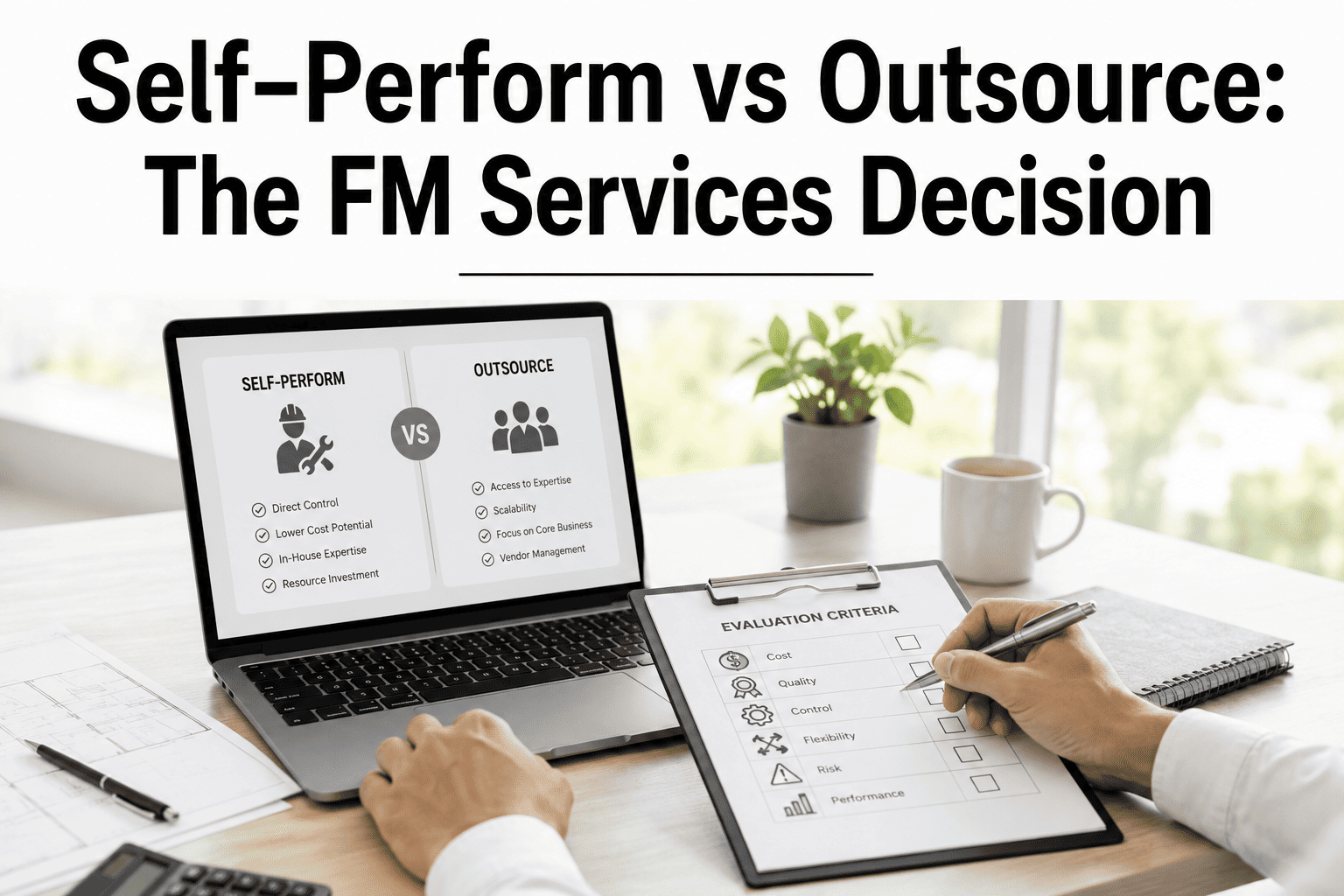
The Decision Framework: Six Dimensions That Determine the Right Model
No single outsourcing model is correct across all FM contexts. The six dimensions below determine where each facility sits on the outsource-insource spectrum and what hybrid configuration delivers the best operational and financial outcome.
| Decision Dimension | In-House Advantage | Outsource Advantage | Hybrid Configuration |
|---|---|---|---|
| Asset criticality | High-criticality assets with zero-tolerance downtime are best managed by in-house teams with deep asset-specific knowledge and immediate response capability. | Non-critical assets and low-frequency specialist tasks (thermographic surveys, confined space inspection) suited to contracted specialists. | Tier 1 critical assets in-house. Tier 2 essential assets on SLA-managed contracts. Tier 3 non-critical on run-to-failure or reactive contract. |
| Specialist skill requirements | Generalist maintenance work, daily inspection rounds, and asset-specific routine PM tasks where institutional knowledge of equipment history matters. | Specialist skills used infrequently: lift inspection certification, HV electrical work, refrigerant handling, BMS programming, and compliance testing. | In-house team handles routine PM. Contracted specialists called under pre-qualified vendor framework for specialist interventions. |
| Portfolio scale | Single-site operations where management overhead is low and team knowledge is concentrated on a defined asset base. | Multi-site portfolios where building a qualified in-house team for each location is not cost-effective relative to contracted regional service coverage. | Central in-house team manages CMMS, PM scheduling, and compliance. Regional contractors execute site-level work to defined SLA and inspection protocol. |
| Regulatory compliance burden | Operations with high regulatory documentation requirements benefit from in-house control over record-keeping and audit trail quality. | Compliance-mandatory tasks where the contractor holds the required certification and carries the liability: asbestos surveys, fire suppression tests, lift inspection. | In-house CMMS captures all contractor compliance records automatically via work order completion. Single audit trail regardless of who performs the task. |
| Labour market conditions | Stable labour markets where skilled FM technicians can be recruited and retained at sustainable cost support investment in in-house capability. | Tight labour markets (Australia, UK post-Brexit, UAE) where recruiting and retaining specialist technicians is prohibitively expensive or slow relative to contracted supply. | Core generalist team retained in-house. Specialist and peak-demand capacity sourced through pre-qualified contractor framework with defined callout SLAs. |
| Budget structure | Capital-budget-heavy organisations that can invest in team infrastructure, training programmes, and tool acquisition over multi-year horizons. | Operating-budget-constrained organisations that require predictable fixed-cost maintenance spend with variable cost exposure capped by contract terms. | Fixed-cost in-house team for predictable routine PM. Variable-cost contractor pool for reactive and project work outside the base maintenance scope. |
Total Cost Comparison: In-House vs Outsourced vs Hybrid
The cost comparison below uses a mid-size commercial facility (50,000 sqft, 200 assets, 2 full-time equivalent technicians) as the baseline. Actual figures vary significantly by region and asset complexity.
One CMMS for In-House Teams, Contracted Vendors, and Hybrid Models
Oxmaint tracks work orders, PM compliance, SLA performance, and contractor accountability on a single dashboard. Your in-house team and your contractor network operate from the same platform with full audit trail visibility for every task executed.
Vendor Selection Criteria: Building a Pre-Qualified Contractor Framework
A hybrid model is only as effective as the contractor network it depends on. The eight criteria below define the minimum qualification standard for any contracted FM service provider entering the Oxmaint-managed vendor framework.
Before vs After: FM Outsourcing Without and With CMMS Integration
| FM Function | Outsourcing Without CMMS Integration | Hybrid Model with Oxmaint |
|---|---|---|
| Work order visibility | Contractor manages own job list. FM director sees completion reports monthly. No real-time view of open, overdue, or in-progress work across the contracted scope. | All contractor work orders in Oxmaint. Real-time status visible to FM director regardless of which team executes the task. Overdue tasks escalate automatically. |
| SLA accountability | Response time SLA tracked manually by the FM team. Evidence gathered retrospectively from emails and contractor reports. Disputes resolved without data. | Oxmaint logs work order creation time, assignment time, and completion time automatically. SLA performance scorecard generated per vendor per period without manual data collection. |
| Compliance documentation | Contractor submits paper certificates or PDF reports per task. FM team files manually. Records located across email, filing cabinet, and shared drive with no audit trail. | Contractor closes work order in Oxmaint mobile with photo evidence and digital signature. Compliance record automatically linked to asset history. Audit trail complete and searchable. |
| Asset maintenance history | Asset history split between contractor system and any in-house records. No consolidated fault pattern view. MTBF calculations impossible without manual reconciliation. | Every contractor work order attributed to the specific asset record. Fault history, repair cost, and MTBF data accumulates in Oxmaint regardless of whether in-house or contractor completed the task. |
| PM schedule adherence | Contractor manages own PM schedule. FM team notified of completion by invoice or monthly report. Missed PMs discovered at audit or failure event. | PM schedule in Oxmaint. Work orders auto-generated and assigned to contractor. Oxmaint escalates missed PMs at 7 and 1 day before deadline with automatic notification to FM director. |
Continue Reading: FM Workforce and Vendor Management
Frequently Asked Questions
QWhat is the most common mistake FM directors make when transitioning to an outsourced maintenance model?
QCan Oxmaint manage both in-house work orders and contractor work orders in the same system?
QHow does a hybrid model reduce total maintenance cost compared to fully outsourced?
QWhat SLA response times should be specified for contracted FM maintenance?
In-House, Outsourced, or Hybrid: Every Model Needs One Platform for Visibility and Accountability.
Oxmaint manages work orders, SLA compliance, contractor scorecards, PM scheduling, and asset maintenance history for both in-house teams and contracted vendors. Go live in 14 days. No implementation fees.