Seasonal transitions are the highest-risk periods for building system failures — HVAC changeovers, freeze-thaw cycles on building envelopes, and the shift from heating to cooling season stress equipment that has been running at steady state and expose deferred maintenance that flat-schedule PM cycles miss entirely. A single frozen and burst pipe in a commercial building causes $50,000–$200,000 in water damage, business interruption, and tenant remediation costs, yet the Q4 freeze protection checks that prevent it take two hours per building. The chiller that worked fine in October fails on the first 90-degree day in May because no one commissioned it before summer demand arrived. Over 65% of emergency roof repairs could be prevented by routine inspections performed in spring and fall, according to the National Roofing Contractors Association. These are not equipment failures — they are calendar failures, and a CMMS that auto-generates seasonal work order packages eliminates every one of them. Book a demo to see OxMaint's seasonal PM scheduling configured for your facility portfolio, or start free today.
Guide · Seasonal Maintenance Scheduling · CMMS Deployment
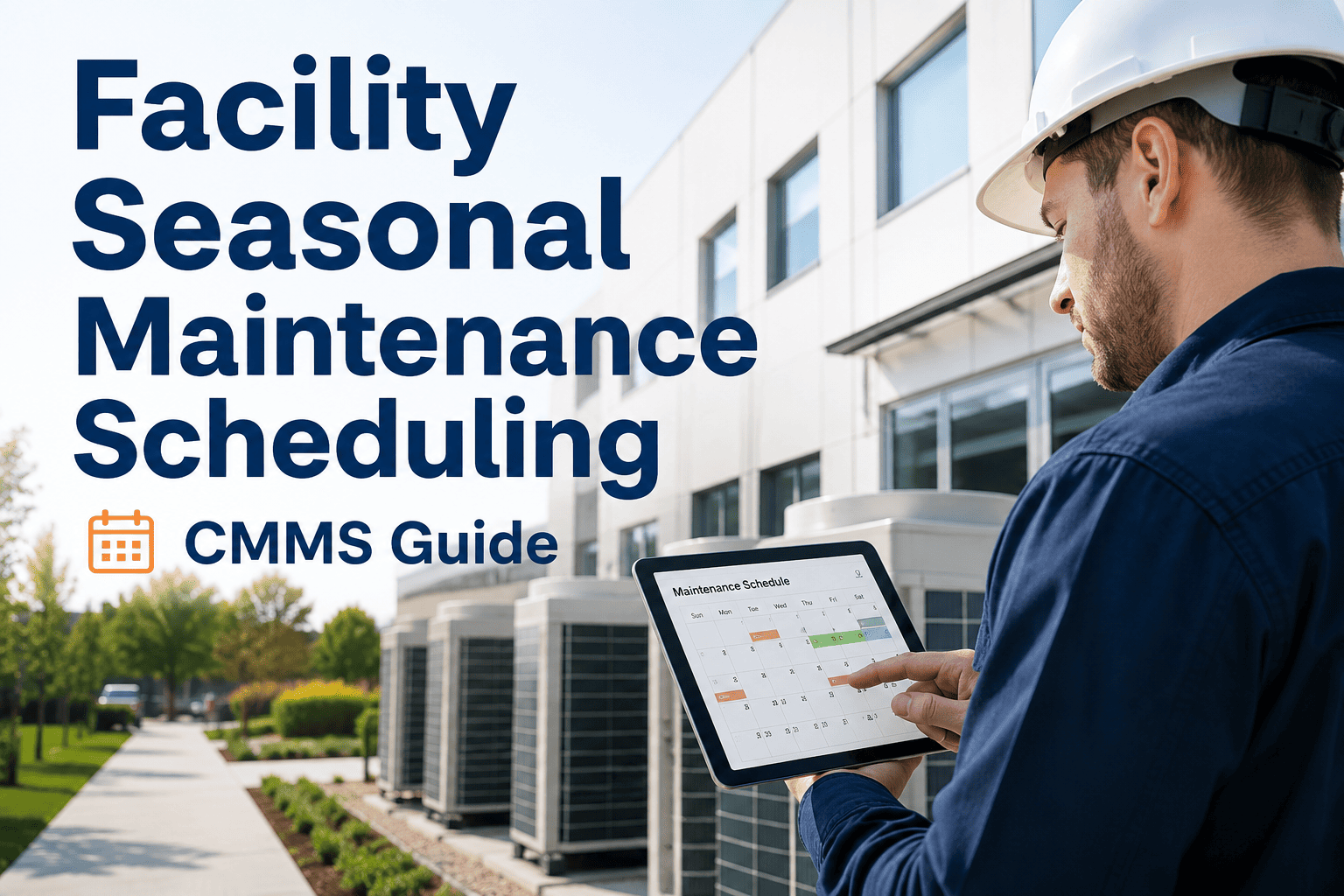
Facility Seasonal Maintenance Scheduling CMMS Guide
Quarter-by-quarter seasonal PM scheduling — HVAC changeovers, roof inspections, freeze protection, building envelope maintenance, and landscaping cycles — automated through CMMS work order packages that prevent the calendar failures behind your most expensive emergencies.
$50K–$200K
Cost of a single freeze-burst pipe event in a commercial building
65%+
Of emergency roof repairs preventable by biannual spring and fall inspections (NRCA)
4x
Emergency repair cost vs. planned seasonal maintenance for the same failure
The Four-Quarter Seasonal Maintenance Calendar — What Every Facility Must Address and When
Seasonal PM is not the same schedule repeated four times. Each quarter brings a distinct set of equipment stressors, compliance checkpoints, and contractor coordination requirements. The calendar below maps the critical tasks by quarter — and shows what breaks if you miss the window.
Q1 · Jan – Mar
Winter Operations and Spring Prep
Heating system mid-season performance audit — boiler efficiency, glycol concentration, heat trace continuity tested on all exposed pipe runs
Post-winter building envelope walkdown — freeze-thaw damage assessment on sealants, expansion joints, cladding interfaces, and foundation drainage
Contractor bookings confirmed for Q2 cooling season startup before April demand surge — refrigerant and parts pre-ordered for flagged units
Fire suppression system annual inspection scheduled — NFPA compliance certificates due before Q2 in most jurisdictions
Miss this: Spring cooling startup fails on Day 1 because no contractor was available. Freeze damage to building envelope compounds through spring rain season.
Q2 · Apr – Jun
Cooling Season Startup and Exterior
Full chiller commissioning by licensed contractor — refrigerant charge verified, condenser coils cleaned, economiser controls tested, startup report filed
Cooling tower startup — basin cleaned, chemical treatment programme activated, Legionella water management plan initial treatment documented per ASHRAE 188
Spring roof inspection — membrane assessment after winter freeze-thaw, drainage verification, flashing and sealant condition documented with photos
Exterior sealant and site remediation — recaulking scheduled before summer rain, car park crack repairs, landscaping and irrigation system activation
Miss this: Chiller fails on the first 90-degree day. Cooling tower Legionella risk unmanaged. Roof leaks from winter damage discovered by tenant complaint, not inspection.
Q3 · Jul – Sep
Peak Load Monitoring and Mid-Season Check
Chiller kW/ton efficiency logged monthly at peak load — any unit below 90% of design specification requires contractor diagnosis before August
Cooling tower mid-season inspection — basin sediment cleared, chemical treatment records reviewed, drift eliminator condition confirmed
Electrical system peak-load review — infrared thermography on main switchgear, transformer load readings, and emergency generator load bank test
Fall contractor bookings — heating system startup, fall roof inspection, and winterisation services confirmed 6–8 weeks before Q4 demand
Miss this: Electrical failure during peak summer demand. Chiller efficiency degrades 15%+ unnoticed. Fall contractor unavailability delays winterisation past first frost.
Q4 · Oct – Dec
Heating Startup and Freeze Protection
Heating system commissioning — boiler startup, combustion analysis, safety valve test, hot water system bled and circulating pump verified
Freeze protection validation — glycol concentration verified (minimum 35% for -20F), heat trace tested on all exposed pipe runs, low-limit freeze stats tested on AHUs
Cooling tower winterisation — basin drained, fill cleaned, biocide treated, and system locked out to prevent freeze damage
Fall roof inspection — post-summer UV damage assessment, gutter and drainage clearing, membrane and flashing condition documented before winter loading
Miss this: Burst pipe from untested heat trace — $50K–$200K damage. Boiler fails on first cold night. Cooling tower freeze damage destroys fill media — $15K+ replacement.
Seasonal Risk Heat Map — Which Systems Face the Highest Risk in Each Quarter
Not every system needs the same level of attention every quarter. The heat map below shows where seasonal risk concentrates — and reveals why flat-frequency PM schedules that treat every quarter equally miss the seasonal peaks that cause the most expensive failures.
| Building System |
Q1 Winter |
Q2 Spring |
Q3 Summer |
Q4 Fall |
Peak Seasonal Failure |
| Chillers and Cooling |
Low |
Critical |
High |
Low |
First-day cooling failure from missed spring commissioning — $16K avg emergency cost |
| Boilers and Heating |
High |
Low |
Low |
Critical |
Boiler fails on first cold night — no heat, tenant complaints, emergency callout |
| Plumbing and Pipes |
Critical |
Low |
Low |
High |
Freeze-burst pipe — $50K–$200K water damage and business interruption |
| Roof and Envelope |
Medium |
Critical |
Medium |
High |
Undetected membrane failure — warranty voided, $10K+ structural damage |
| Cooling Towers |
Low |
Critical |
High |
Critical |
Legionella risk from undocumented startup; freeze damage from missed winterisation |
| Electrical Systems |
Low |
Medium |
Critical |
Low |
Peak-load failure — loose connections and undersized capacity hidden in cooler months |
| Grounds and Landscaping |
Low |
High |
Medium |
High |
Irrigation failure from missed spring startup; snow hazard from unprepared grounds |
The Two Seasonal Transitions That Break Facilities — Spring Changeover and Fall Changeover
The spring heating-to-cooling transition and the fall cooling-to-heating transition are the two highest-risk maintenance windows of the year. Each transition requires a coordinated sequence of shutdown, inspection, and startup tasks that must complete before seasonal demand arrives — not after the first tenant complaint.
1
Shutdown heating plant — document boiler final readings, drain and treat if seasonal, close isolation valves on heating loops
2
Commission cooling plant — chiller startup by licensed contractor, refrigerant charge verified, condenser water treatment activated
3
Switch BAS setpoints — cooling setpoints, economiser changeover temperatures, and night setback schedules updated for cooling season
4
AHU seasonal service — all filters replaced, coils cleaned, belt tension checked after winter low-load stretch, economiser dampers cycled through full range
5
Roof and exterior inspection — post-winter membrane assessment, drainage cleared, sealant condition documented, landscaping and irrigation activated
1
Winterise cooling tower — drain basin, clean fill, treat with biocide, lock out. Failed winterisation causes freeze damage to fill media — $15K+ replacement
2
Commission heating plant — boiler startup, combustion analysis, safety valve test, hot water system bled, circulating pumps verified
3
Freeze protection validation — glycol concentration tested, heat trace continuity verified on all exposed runs, low-limit freeze stats tested on every AHU
4
Switch BAS setpoints — heating setpoints, deadbands, and changeover temperatures updated. Outdoor air damper actuators inspected for seized linkages
5
Fall roof inspection and grounds prep — gutter clearing, membrane check before winter loading, tree trimming near building envelope, snow removal contracts confirmed
Proactive Seasonal PM vs. Reactive Emergency Costs — The Financial Case
Every seasonal maintenance task has a cost. Every skipped seasonal maintenance task has a much larger cost. The comparison below shows the actual cost of proactive seasonal PM versus the emergency cost of the failure it prevents — and makes the case that seasonal PM is not an expense but an insurance policy that pays for itself every year.
Chiller Spring Commissioning
Proactive Cost
$800–$2,500
vs.
Emergency Failure
$16,000+
Q4 Freeze Protection Checks
vs.
Burst Pipe Event
$50K–$200K
Biannual Roof Inspection
vs.
Undetected Leak Damage
$10K–$50K
Cooling Tower Winterisation
Proactive Cost
$400–$1,200
vs.
Freeze Damage to Fill
$15K–$30K
SEASONAL SCHEDULING · ADVANCE ALERTS · OXMAINT
The Most Expensive Failures in Facility Management Are Calendar Failures. OxMaint Eliminates Them.
Quarterly work order packages auto-generated. Contractor bookings triggered 30 days before each seasonal window. Freeze protection, cooling startup, roof inspection, and heating commissioning — every seasonal task tracked, assigned, and documented. No spreadsheet calendar management. No missed deadlines.
Expert Review
"The three highest-risk failures in commercial facility management are all calendar failures, not equipment failures: freeze-burst pipes from skipped pre-winter heating system validation, chiller failures in the first week of summer from missed spring commissioning, and roof warranty lapses from inspections not performed on schedule. Every one of these is preventable with a seasonal PM calendar that triggers work orders automatically — and every one of them costs ten to a hundred times more as an emergency than it would have cost as a scheduled task. The technology is not the barrier. The barrier is that most facility teams manage seasonal transitions on memory and spreadsheets, and memory fails at exactly the moment the workload peaks."
Daniel Kovac, PE, CEM, LEED AP
Licensed Professional Engineer · Certified Energy Manager (AEE) · 20 years commercial facility management, seasonal operations planning, and CMMS deployment across multi-building portfolios in climate zones 4–7
Frequently Asked Questions
When should a facility manager start planning each seasonal transition?
Review the upcoming quarter's task list 6–8 weeks before the quarter starts. Contractor availability for spring chiller commissioning and fall heating startup must be confirmed well before demand peaks — waiting until April or October means competing with every other facility for the same contractors.
Book a demo to see advance scheduling in OxMaint.
How often should commercial roofs be inspected seasonally?
The NRCA recommends a minimum of twice per year — spring and fall — plus inspections after any major weather event. Most commercial roof warranties require at least one documented annual inspection to remain valid. Skipping biannual inspections voids warranty coverage on materials built to last 20–30 years.
Start free to schedule roof inspections in OxMaint.
What are the most common seasonal maintenance failures in commercial buildings?
Three dominate: freeze-burst pipes from untested heat trace or low glycol concentration in Q1, chiller failures on the first hot day from missed Q2 commissioning, and expired compliance certificates discovered during audits because no one tracked renewal dates between seasons. All three are calendar failures, not equipment failures.
Book a demo to see how OxMaint prevents all three.
Can OxMaint automate seasonal work order scheduling across multiple buildings?
OxMaint generates quarterly seasonal PM work order packages automatically at the start of each quarter — across every building in your portfolio. Contractor scheduling triggers 30 days in advance. Seasonal compliance checkpoints are tracked with advance alerts. The multi-site dashboard shows seasonal readiness per building.
Start free to configure seasonal scheduling.
What freeze protection checks should be completed before winter?
Glycol concentration verified at minimum 35% propylene glycol for -20F protection. Heat trace continuity tested on all pipe runs in unconditioned spaces. Low-limit freeze stats tested on all AHUs. Outdoor air damper actuators checked for seized linkages. Cooling tower basin drained and locked out. These checks take two hours per building and prevent $50K–$200K freeze events.
Book a demo to see Q4 freeze protection templates.
SEASONAL MAINTENANCE · QUARTERLY SCHEDULING · OXMAINT
Every Season Brings a New Set of Risks. OxMaint Brings the Work Orders That Prevent Them.
Quarterly PM packages auto-generated. Contractor bookings triggered in advance. Seasonal compliance checkpoints tracked with alerts. Spring cooling startup, fall freeze protection, biannual roof inspections, and every seasonal task across every building — scheduled, assigned, documented, and measured. No calendar failures. No surprise emergencies.