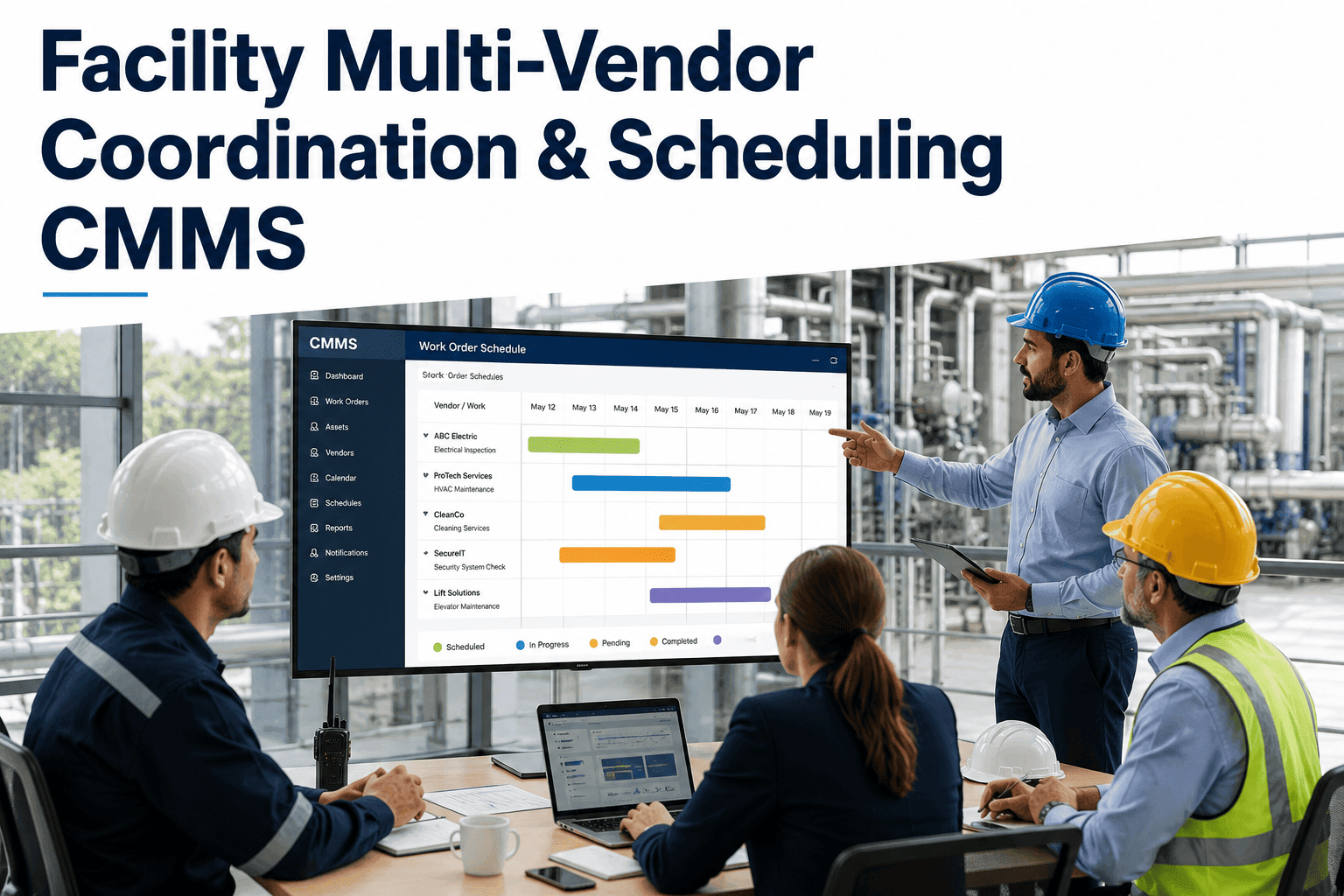
Coordinating multiple specialist vendors across a single facility is where most maintenance programs quietly bleed money — an HVAC tech idles for 45 minutes waiting on a roofer to clear a drain line, an electrical contractor shows up without lockout authorization, and two trades double-book the same scissor lift on the same afternoon. Industry benchmarks from IFMA and NFMI consistently show that 20–30% of scheduled vendor hours in poorly coordinated facilities are lost to access delays, permit gaps, and overlapping work orders. A CMMS built for multi-vendor coordination collapses that waste by giving every trade a shared schedule, a clear access window, and a documented handoff — and you can Start Free Trial to see the difference inside a single shift.
Can your facility run five trades on one asset without a single idle hour?
When HVAC, electrical, fire-spray, elevator, and roofing contractors converge on a single building, the schedule — not the labor budget — is what breaks first. A purpose-built CMMS turns overlapping scopes into a single sequenced plan with access windows, permit readiness, and digital handoffs measured to the minute.
What uncoordinated multi-vendor scheduling actually costs
A 180-asset commercial facility running 14 specialist vendors per quarter typically loses between $38,000 and $52,000 annually to scheduling friction — most of it invisible on the P&L.
"We had three contractors arrive for the same chiller room on the same morning. Nobody had the lockout tagout key. That one incident cost us 11 hours of combined labor and a tenant SLA penalty. After moving to a CMMS sequenced schedule, our vendor no-show rate dropped from 18% to under 4% in one quarter."
— Facilities Director, 1.2M sq ft medical campusA 4-week rollout for multi-vendor CMMS coordination
Most facilities can move from spreadsheet-based vendor scheduling to a fully sequenced CMMS workflow in under 30 days. Here is the field-tested rollout cadence.
Vendor registry & access profiles
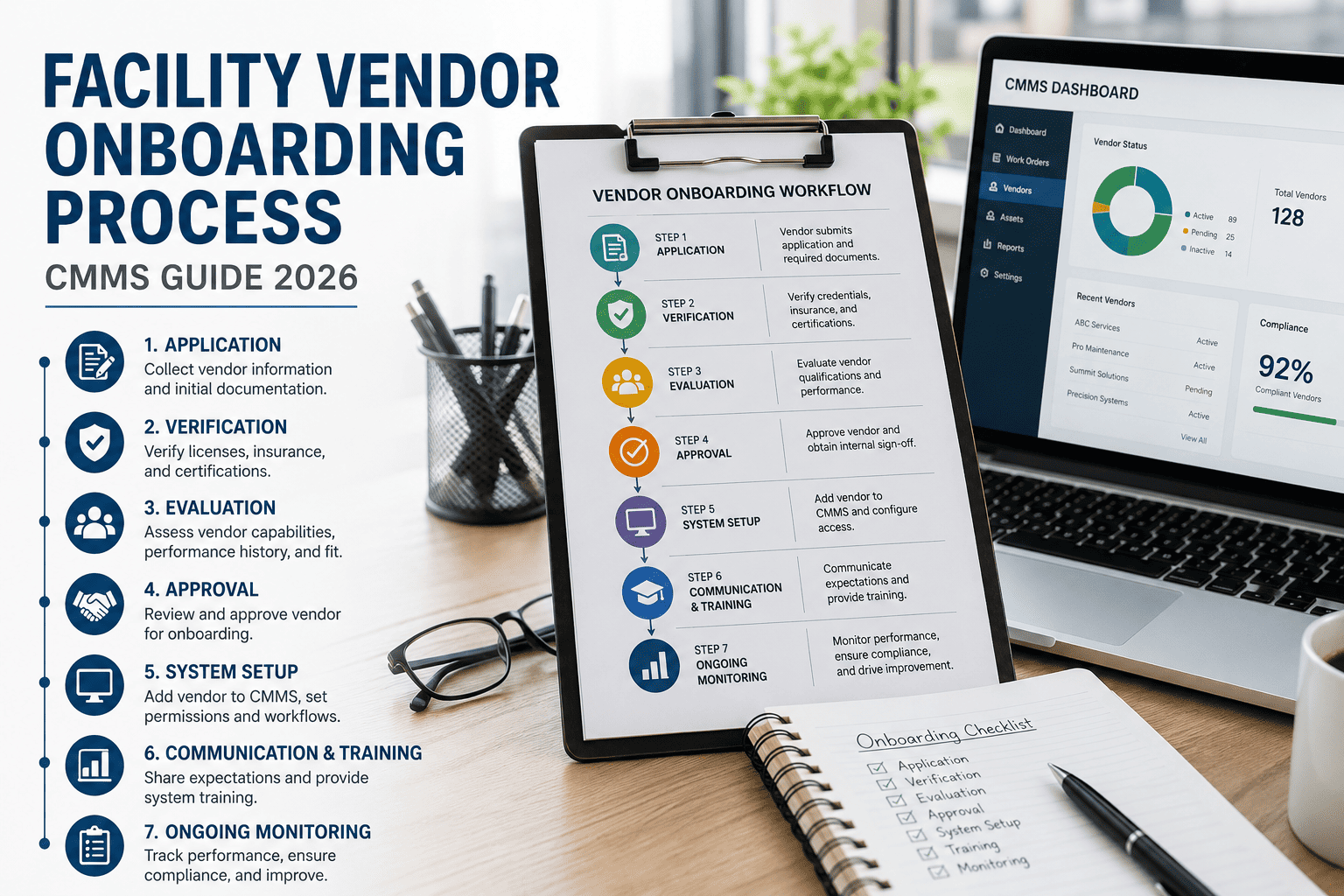
Onboard every active vendor into the CMMS with trade classification, insurance expiry, badging status, and site-specific access permissions. A clean registry is the prerequisite — 70% of coordination failures trace back to a missing or expired credential at the gate.
Asset-scoped work order templates
Build reusable work order templates for each asset class — rooftop units, switchgear, elevators, sprinkler risers — with pre-assigned vendor slots, estimated durations, and required permits (hot work, confined space, lockout/tagout). Templates cut work order creation time by 60%.
Conflict detection & sequencing rules
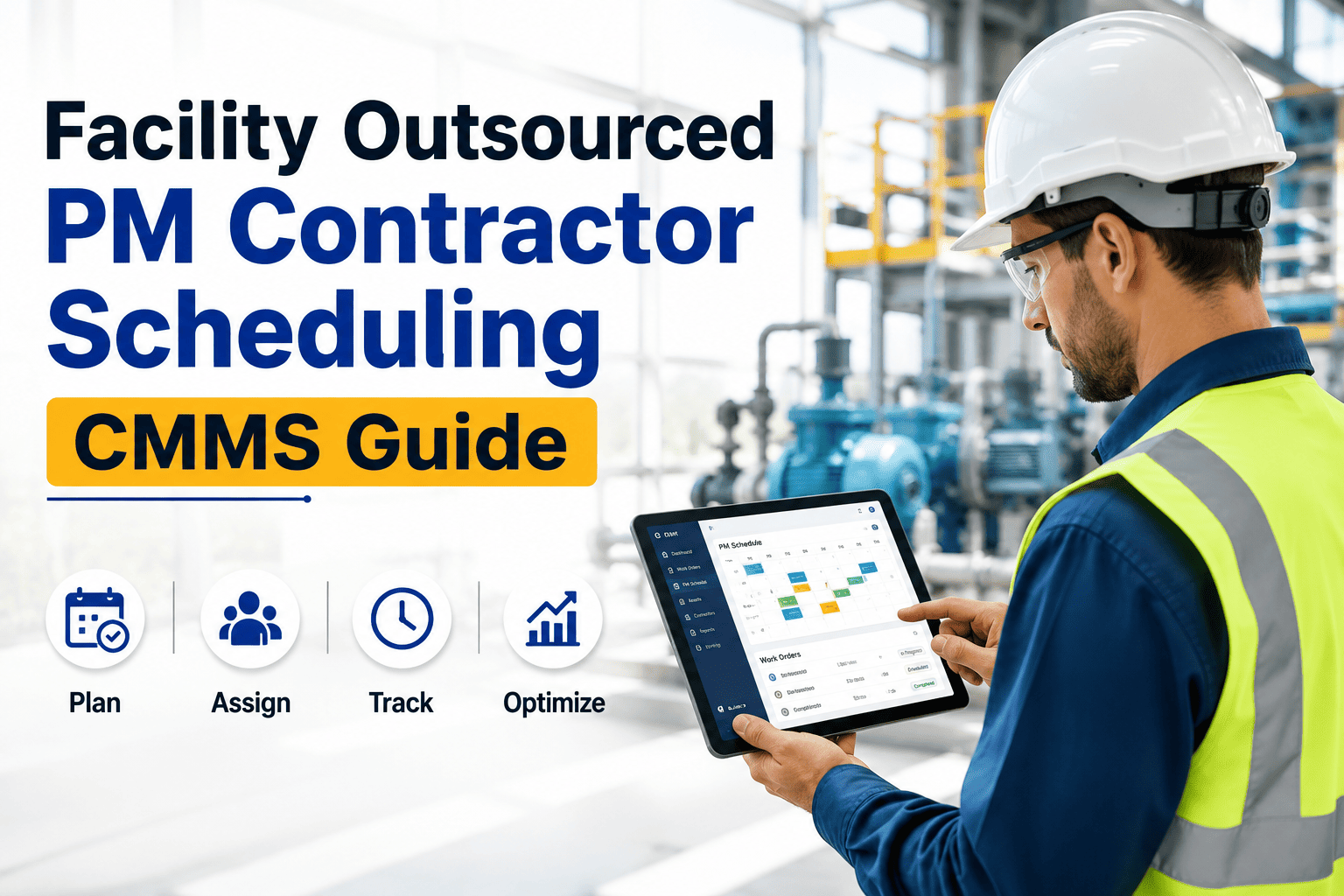
Enable the CMMS scheduling engine to flag overlapping scopes on the same asset or zone, enforce sequential handoffs (roofer clears → HVAC proceeds), and auto-generate access windows. Configure a 30-minute buffer between trades to absorb overrun without cascading delays.
Digital handoffs & SLA tracking
Activate mobile check-in/check-out for every vendor visit, require a digital handoff note when one trade releases an asset to another, and route SLA breach alerts to the facilities lead. By week four, most sites see vendor idle time drop 40–55% and on-time completion rise above 90%.
The multi-vendor coordination payback formula
Use this model to estimate annual savings from moving spreadsheet-based vendor scheduling into a sequenced CMMS. Figures below are drawn from a worked example: a 180-asset plant with 14 vendors and 320 scheduled visits per year.
| Coordination metric | Before CMMS | With CMMS (Q2) | Annual savings |
|---|---|---|---|
| Vendor idle hours / year | 1,056 | 412 | $61,180 |
| No-show / mis-schedule visits | 57 | 11 | $13,064 |
| Rework from trade overlap | 38 incidents | 9 incidents | $17,480 |
| Permit / access violations | 14 | 2 | $8,596 |
| Total measurable annual savings | $100,320 | ||
Assumes a 180-asset facility, 14 active vendors, 320 scheduled visits/year, $95/hr loaded vendor rate. Most deployments reach full savings by the end of Q2 with the 4-week rollout above.
Stop paying three vendors to wait on one access key.
Sequence every trade, permit, and handoff in a single CMMS schedule. Most facilities recover the subscription cost within the first 60 days of coordinated scheduling.
Multi-vendor CMMS coordination, answered
The five questions facilities teams ask most before moving specialist vendor scheduling off spreadsheets and into a CMMS.
How does a CMMS prevent two vendors from booking the same asset at the same time?
The scheduling engine checks every new work order against existing reservations on the same asset, zone, and required equipment (lifts, scaffolding, lockout points). If a conflict exists, the system blocks the slot and suggests the next available window with the correct buffer. Most platforms also send a real-time alert to the facilities lead so overlaps are caught before a contractor is dispatched — not after they arrive at the gate.
Can outside contractors use the system without a full license?
Yes. Most multi-vendor CMMS platforms provide a limited-access vendor portal where contractors receive a scoped work order, check in digitally, upload completion photos, and release the asset to the next trade. Vendors never see other tenants' data, asset histories, or internal cost fields — only the work order, access instructions, and handoff requirements assigned to them.
What does a digital handoff between trades actually look like?
When one vendor completes their scope, they close the work order with a handoff note, attach photos of the completed work, and confirm the asset is safe to release. The next scheduled vendor automatically receives a notification that the asset is ready, along with any conditions — for example, "roof membrane patched, HVAC pad clear, lockout removed." This eliminates the phone-tag chain that normally burns 20–40 minutes per transition. You can see the workflow in action when you Book a Demo.
How long does it take to onboard 10–15 vendors into the system?
A typical vendor registry build-out for 15 contractors takes one to two business days. You upload trade classifications, insurance certificates, badge numbers, and access permissions in bulk, then send each vendor a portal invitation. Insurance expiry and badge renewal alerts are automated from day one, so you never have to chase a lapsed COI manually again.
Will this work for facilities with multiple buildings or remote sites?
Yes. The CMMS treats each building, floor, and asset as a schedulable location with its own access rules, permit requirements, and vendor permissions. A regional facilities lead can view a single cross-site calendar, see which vendors are where at any hour, and move a contractor from one site to another without re-creating the work order — which is critical for portfolios spread across multiple zip codes.
Sequence every trade. Recover every idle hour.
Join the facilities teams using OxMaint to coordinate 10+ specialist vendors on a single shared schedule — with conflict detection, digital handoffs, and SLA tracking built in.
Free 14-day trial · No credit card