Nearly 42% of organisations struggle to maintain accurate maintenance records, and 36% face duplication or incomplete entries according to 2024 CMMS market research. The consequence is not an administrative inconvenience — it is the reason the CMMS that was supposed to enable predictive maintenance is producing reports that no one trusts. Assets logged as "Pump" instead of "CHW-P-01 — Chilled Water Pump, Building A, Level 2" are generating maintenance history that cannot be aggregated, failure patterns that cannot be detected, and PM schedules that cannot be automatically assigned. Gartner's estimate that poor data quality costs organisations $15 million per year on average is not a software problem. It is a data governance problem — and a data governance problem has a data governance solution. Book a demo to see OxMaint's Asset Lifecycle Management and data governance tools for facility managers — or start free and run a data quality assessment on your first building today.
Guide · Asset Data Governance · Asset Lifecycle Management
Facility Asset Master Data Cleanup Guide
A step-by-step guide to auditing your asset register, establishing naming conventions and hierarchy standards, scoring data quality per field, and implementing governance that keeps the data clean after the initial cleanup is done.
Typical Asset Register Data Quality Audit — Before Cleanup
Location — full hierarchy
51%
Make / model / serial
44%
Criticality classification
29%
Industry benchmark — facility management CMMS, pre-cleanup state
Why Bad Asset Data Breaks Everything Downstream
01
KPI reports become meaningless
MTBF, MTTR, and equipment availability require work orders linked to the correct asset record. When the same physical asset has 3 different records (duplicate entries from different years), its failure history is split across all three — and the calculated MTBF is 3× higher than the real figure. Reports built on this data are actively misleading.
02
PM scheduling fails silently
Preventive maintenance templates can only be assigned to an asset with a known type, criticality, and make/model. An asset entered as "HVAC Unit" with no system type, no criticality, and no model number cannot have the correct PM template assigned. It gets no scheduled PM — which gets discovered at the next breakdown, not before.
03
Spare parts forecasting is impossible
AI demand forecasting and manual reorder planning both require knowing which assets consume which parts. If assets lack make/model data, the parts linkage cannot be made. If assets are duplicated, consumption is split across phantom records. The storeroom optimisation that should follow from good asset data cannot happen when the asset data is incomplete.
04
Capital planning uses age estimates, not condition data
Without installation dates, remaining useful life calculations are impossible — and capital replacement decisions are made by asking the most experienced maintenance technician how old the equipment looks. Without condition scoring history, the FCI calculation has no data to aggregate. The capital budget submission becomes a political negotiation rather than a data-driven request.
The Naming Convention Standard — What Every Asset ID Must Encode
An asset ID that encodes the right information enables search, reporting, and bulk operations without additional context. The format below works for most facility management portfolios and can be adapted per organisation.
| ID Component |
What It Encodes |
Example |
Bad Example |
Why It Matters |
| System code |
2–4 letter code for the asset system type |
AHU, CHW, ELV, FPS, GEN |
"HVAC Unit 3" — no code, no system |
Enables filtering all assets of the same system type across sites without full-text search |
| Sequential number |
Zero-padded number unique within system type |
AHU-01, AHU-02... AHU-14 |
"AHU 1", "AHU1", "AHU-one" — three formats for the same sequence |
Consistent format enables alphabetical sort = numbered order; prevents AHU-10 appearing before AHU-2 |
| Building code |
Short code for the building — 2–4 characters |
AHU-01-BDA, AHU-01-BDB |
"Building A AHU 1" — breaks bulk operations across buildings |
Enables portfolio-level reporting and bulk PM assignment for all assets in a building |
| Floor/zone suffix (optional) |
Level or zone identifier for large buildings |
AHU-01-BDA-L3 (Level 3) |
No location at all — technician cannot find asset from ID |
Critical for dispatch — technician needs to navigate to the asset from the work order, not call for directions |
Before Cleanup
"Pump" — Asset #447
"HVAC unit building A"
"Generator (backup)"
"Air Handler 1 — 3rd Floor (old)"
→
After Cleanup
CHW-P-01-BDA — Chilled Water Pump, Building A
AHU-03-BDA — Air Handler Unit 3, Building A
GEN-01-BDA — Emergency Generator, Building A
AHU-01-BDA-L3 — Air Handler Unit 1, Building A, Level 3
ASSET LIFECYCLE MANAGEMENT · OXMAINT
Asset Data That Cannot Be Trusted Cannot Drive Decisions. OxMaint Enforces the Standards That Make It Trustworthy.
OxMaint validates asset naming, prevents duplicate asset IDs, enforces required fields before record completion, and maintains the asset hierarchy that makes every KPI, PM schedule, and capital forecast accurate from the day the data is entered.
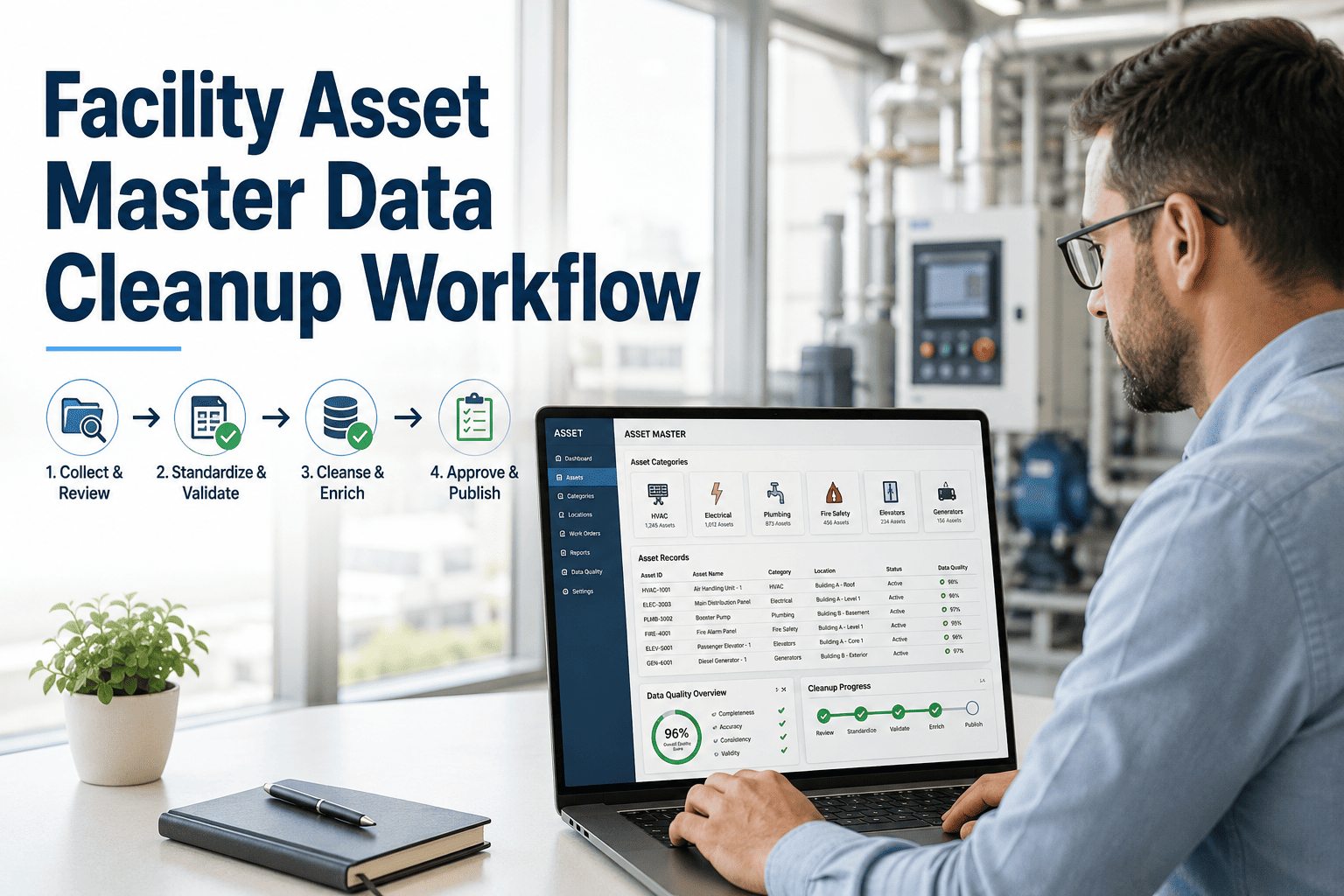
The 5-Phase Asset Master Data Cleanup Process
Phase 1
Data Audit — Score What Exists
Export every asset record. Score completeness on the six critical fields: Asset ID uniqueness, full location hierarchy, make/model/serial, installation date, criticality classification, and PM template assignment. Identify duplicates by comparing make, model, serial number, and location across records. The audit produces a data quality score per building and a prioritised cleanup list — starting with assets that have work orders but fail three or more critical field checks.
Phase 2
Define Standards Before Touching Data
Agree the naming convention format, location hierarchy levels, and criticality classification definitions before anyone edits a single record. The most common cleanup failure is correcting data to different standards in different batches — producing a result where records corrected by different team members use inconsistent formats. One document, approved by all data owners, defines the standard. All cleanup work references it.
Phase 3
Physical Verification — Walk the Buildings
Data cleanup without physical verification produces a clean-looking record that does not match reality. Each asset in the register must be physically verified: confirm it exists, confirm its location, capture nameplate data (make, model, serial, installation date where present), photograph it, and affix a QR tag if none exists. Assets in the register not found on-site are flagged as candidates for decommissioning. Assets found on-site with no register entry are added during the walkthrough.
Phase 4
Merge Duplicates, Assign PM Templates, and Classify Criticality
Merge all duplicate records onto the canonical asset record, consolidating work order history onto the surviving record. Assign PM templates based on asset type and make/model — removing the generic "inspection" PMs that were applied because no specific template existed. Apply the criticality classification to every asset: Critical / Major / Minor. These three fields — PM template, criticality, and canonical record — are the ones that drive every downstream operational benefit of a clean CMMS.
Phase 5
Governance — Keep It Clean After Cleanup
A cleanup without governance is a one-time exercise that decays back to the previous state within 18 months. Governance requires: mandatory fields enforced at data entry (OxMaint prevents asset record creation if the six critical fields are not populated); monthly data quality spot-checks (random sample of 20 records per building per month); and a defined process for decommissioning — so assets that are replaced or removed are closed in the CMMS the same week, not discovered 2 years later by a new technician.
Expert Review
"The phrase 'garbage in, garbage out' describes the fundamental problem with maintenance analytics perfectly — but it underestimates where the damage actually occurs. When asset records are incomplete, the damage starts at the PM scheduling stage, not at the analytics stage. An asset without a criticality classification does not get the right PM frequency. An asset without a make and model does not get a manufacturer-specific PM template. An asset with three duplicate records generates three sets of PM work orders — two of which are wasted. The analytics failure comes later, when the CMMS reports built on this data show MTBF and availability figures that are structurally wrong. Facility managers who wonder why their CMMS is not generating the insights it promised almost always have an asset data quality problem beneath the surface. Cleaning the data is not glamorous work. It is not a technology project. It is the unglamorous prerequisite for every analytical capability the CMMS was sold on."
Sandra Okafor, CFM, RPA
Certified Facility Manager · Real Property Administrator · 19 years multi-site facility operations and CMMS data governance · Specialist in asset master data strategy, analytics readiness, and facility management operational frameworks
Frequently Asked Questions
How long does a facility asset master data cleanup take?
Timeline depends on portfolio size, starting data quality, and whether physical verification is included. For a single facility with 500–1,500 assets and a partial existing register, a thorough cleanup takes
4–8 weeks: 1 week for data audit and scoring; 1 week for standard definition; 2–4 weeks for physical verification and data entry; 1 week for duplicate merging, PM template assignment, and criticality classification. Multi-building portfolios scale proportionally — but the standard definition phase does not scale, since the same document applies to all buildings. A portfolio of 10 buildings can often be cleaned in parallel in 8–12 weeks if physical verification teams are deployed simultaneously.
Book a demo to see OxMaint's asset import and data quality tools for bulk cleanup projects.
What are the most critical fields in an asset master record for maintenance analytics?
Ranked by the analytics capability they unlock: Asset ID (unique) — without uniqueness, all history and reporting is unreliable; Location (full hierarchy) — without location, dispatch and building-level FCI scoring fail; Make, model, serial — without these, PM template assignment and parts linkage are impossible; Criticality classification — without this, PM frequency and resource prioritisation are arbitrary; Installation date — without this, remaining useful life and capital planning are estimates; PM template assignment — without this, the asset has no scheduled maintenance regardless of how well everything else is configured. All six fields should be treated as mandatory — not optional fields to be filled "when available."
How do you handle assets with no nameplate data or unknown installation dates?
Unknown installation dates should be estimated rather than left blank — a blank date prevents all lifecycle calculations, while an estimated date enables them with an appropriate confidence flag. Estimation approaches: check previous contractor invoices or inspection reports for the earliest reference to the asset; compare photographic evidence of the asset's condition against similar assets with known ages; use the building construction date as a lower bound if no other evidence exists. For nameplate data, physical inspection of the asset itself is the primary source — manufacturer labels are often found on internal access panels, behind service covers, or on the motor tag even when the external label is damaged. OxMaint allows condition score and confidence rating fields that distinguish estimated data from verified data without blocking record completion.
What governance mechanisms prevent asset data from degrading after cleanup?
Three mechanisms provide ongoing governance: mandatory field enforcement at data entry — OxMaint prevents asset record creation and work order creation if the six critical fields are not populated, removing the option to bypass the standard; monthly data quality sampling — a systematic check of 15–20 randomly selected records per building each month catches data drift before it accumulates; and decommissioning process discipline — a defined workflow for closing assets that are replaced or removed, triggered by the same work order that documents the replacement. The single biggest governance failure is allowing decommissioned assets to remain as active records because no one formally closed them — which generates phantom PM work orders and makes physical-to-digital reconciliation progressively harder.
ASSET LIFECYCLE MANAGEMENT · DATA GOVERNANCE · OXMAINT
A CMMS Built on Clean Data Produces Insights. One Built on Poor Data Produces Decisions That Can't Be Trusted.
OxMaint enforces the naming conventions, mandatory fields, duplicate prevention, and data quality standards that turn an asset register into a reliable analytical foundation — so every KPI, every PM schedule, every capital forecast, and every spare parts decision is built on data that reflects your facility, not on approximations of it.