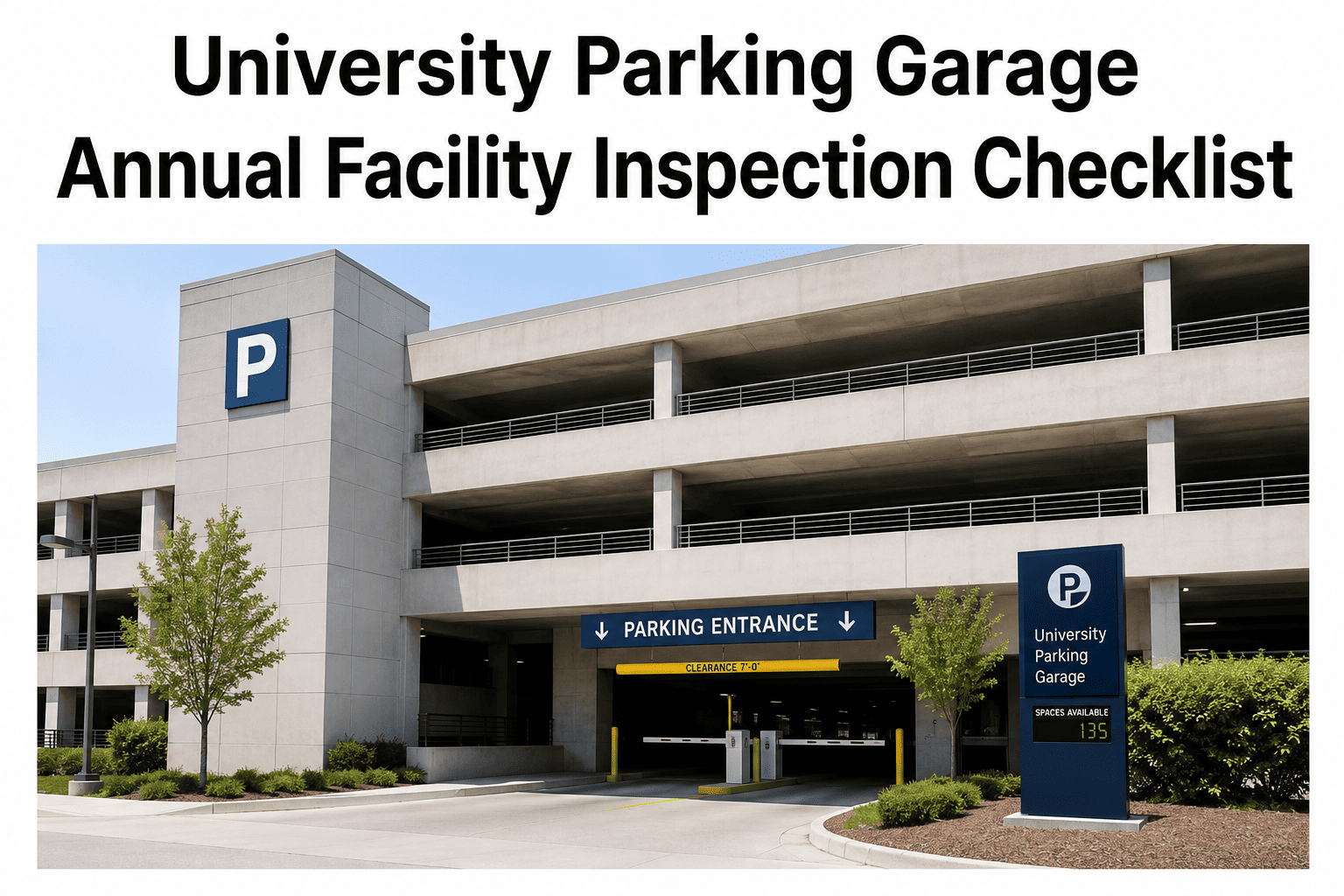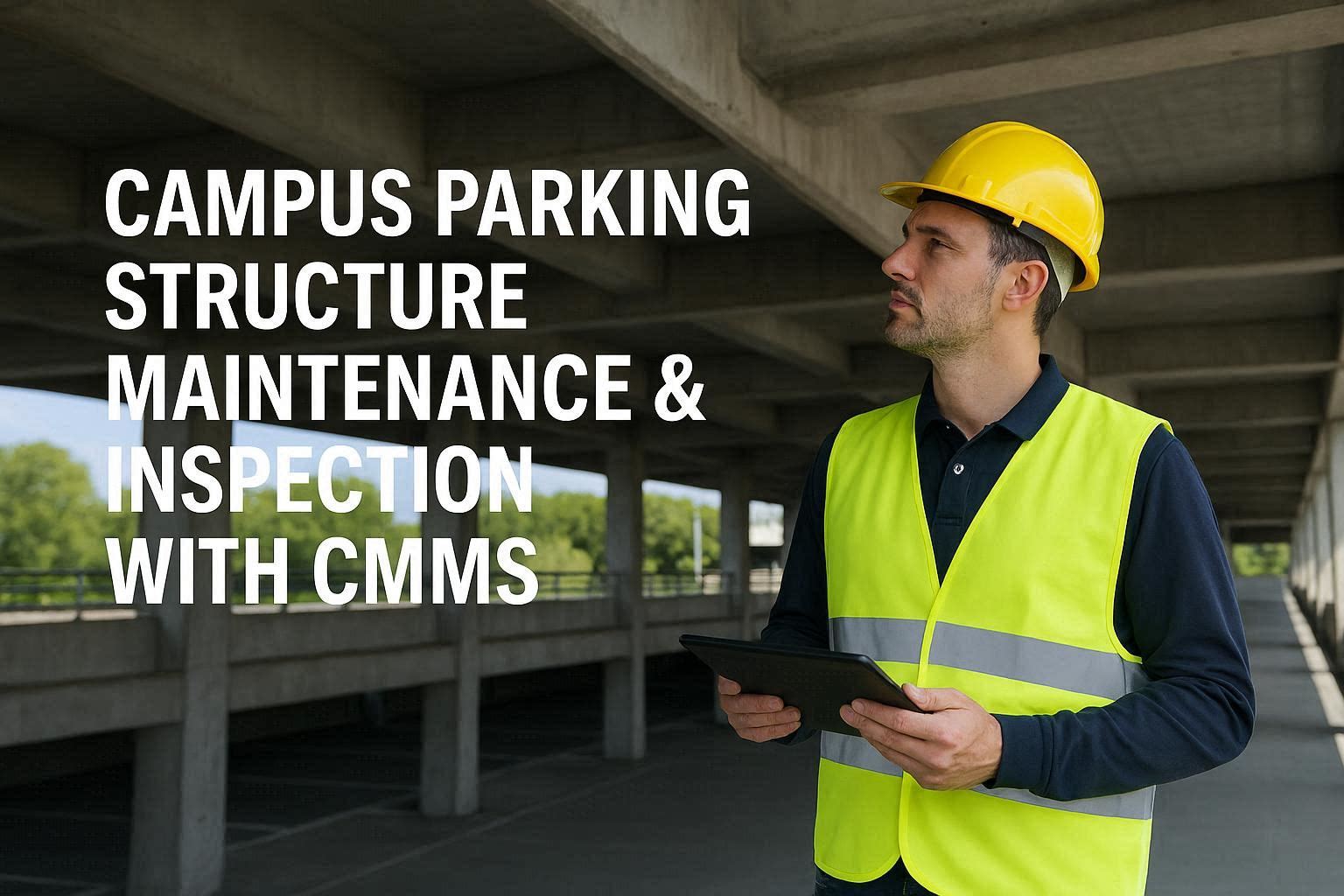
A university parking structure built in 1998 develops a crack in its post-tensioned beam on level 3. The facility team patches it with epoxy. Six months later, chloride-laden water has migrated through the traffic-bearing membrane into the reinforcing steel on level 2. The repair cost has grown from $2,400 to $185,000. This is the reality of deferred parking structure maintenance on campus — small cracks become structural failures, and reactive patching becomes capital reconstruction. Universities that track every joint, membrane section, and drain line in a CMMS catch the $2,400 problem before it becomes a $185,000 crisis. Want to see how asset-level tracking works for parking structures? Start a free trial and map your parking assets in under a day, or book a demo to walk through a campus parking maintenance configuration.
University Parking Structure and Garage Maintenance: Concrete, Membrane, and Egress
Concrete deterioration, failed membranes, and egress deficiencies are the three fastest paths to a condemned parking deck. Here is the inspection, PM, and CMMS framework that prevents all three.
What University Parking Structure Maintenance Actually Involves
Parking structures are the most abused and least maintained buildings on any campus. They endure thermal cycling, de-icing chemicals, vehicle loads, water infiltration, and UV exposure — 24 hours a day, 365 days a year. Unlike academic buildings that get attention from provosts and donors, parking decks deteriorate quietly until a chunk of concrete falls onto a vehicle or a structural engineer condemns an entire level. Proper maintenance covers three integrated systems: the concrete structure itself, the traffic-bearing waterproofing membrane, and the life-safety egress systems including lighting, signage, stairwells, and fire suppression.
According to the International Concrete Repair Institute, every $1 spent on preventive concrete maintenance saves $25 in future structural repair costs. Yet 68% of university facilities departments report having no formal PM schedule for their parking structures — they inspect only when a complaint or visible failure triggers action. That gap between designed service life and actual condition is where CMMS-tracked preventive maintenance creates measurable value. Want to close that gap on your campus? Start a free trial to build your parking structure asset registry, or book a demo to see how campuses configure parking deck PM schedules.
The Four Critical Maintenance Systems in Every Parking Structure
Post-tensioned beams, columns, slabs, expansion joints, and reinforcing steel. Chloride intrusion causes rebar corrosion, spalling, and delamination. Annual chain-drag surveys detect subsurface deterioration before visible damage appears. 82% of structural failures in parking decks originate from undetected rebar corrosion.
Polyurethane or epoxy membrane systems applied to the top deck and drive lanes protect concrete from water and chloride penetration. Membrane life is 7-12 years depending on traffic volume and UV exposure. Re-application costs $3-$5 per square foot — vs. $50-$150/sf for structural concrete repair when membrane fails.
Floor drains, trench drains, expansion joint sealants, and perimeter drainage systems. Standing water is the primary accelerant for concrete deterioration. Clogged drains cause ponding that penetrates failed joints and reaches structural steel. 91% of parking deck water damage traces back to blocked drainage or failed joint sealant.
Emergency lighting, exit signage, stairwell condition, fire standpipes, sprinkler heads, ventilation fans, and ADA-compliant pathways. IBC and NFPA 88A require specific lighting levels (5 fc minimum at floor level), ventilation rates for enclosed garages, and clear egress paths. Non-compliance creates direct liability exposure.
How Parking Structures Fail — And Where PM Intervention Points Exist
Reactive vs. CMMS-Tracked Preventive Parking Structure Maintenance
How Oxmaint Tracks Every Parking Structure Component From Membrane to Stairwell
Oxmaint's asset hierarchy maps your parking structure the way your structural engineer thinks about it: Structure > Level > Zone > System > Component. Every expansion joint, every drain, every membrane section, every light fixture, and every stairwell gets its own asset record with condition score, inspection history, and PM schedule. When your technician inspects Level 3 Zone B and notes membrane blistering, that finding is recorded against the specific membrane section — not a generic "parking garage" work order that provides no locational intelligence for future capital planning.
Every joint, drain, membrane section, beam, column, and egress component tracked individually with condition scoring from 1-5.
Annual structural surveys, quarterly drain cleaning, monthly egress checks, and biannual joint inspections — all auto-generated and assigned.
Technicians capture crack widths, spalling locations, membrane conditions, and drain status on mobile devices with GPS-tagged photos.
Condition scores feed rolling capital forecasts — predict membrane replacement years, structural repair budgets, and lighting upgrades.
Every egress inspection, lighting test, and fire system check stored with timestamps, technician signatures, and corrective action records.
Compare condition scores, maintenance spend, and remaining useful life across all campus parking structures in one dashboard view.
Universities using CMMS-tracked parking structure maintenance report 38% lower lifecycle costs and 2.4x longer intervals between major capital repairs. The data is clear: the cheapest concrete repair is the one you prevent entirely. See how Oxmaint configures parking structure PM programs — start a free trial or book a demo with our campus facilities team.
Essential Parking Structure PM Tasks and Frequencies
| PM Task | Frequency | System | Consequence of Deferral |
|---|---|---|---|
| Chain-drag delamination survey | Annual | Structural | Undetected subsurface corrosion leads to spalling and structural failure |
| Expansion joint sealant inspection | Biannual | Waterproofing | Open joints allow chloride water to reach structural steel below |
| Traffic membrane condition assessment | Annual | Waterproofing | Failed membrane allows $3/sf problem to become $50+/sf structural repair |
| Floor and trench drain cleaning | Quarterly | Drainage | Ponding water accelerates concrete deterioration by 3-5x |
| Emergency lighting and exit sign test | Monthly | Egress | Code violation, fire marshal citation, liability in emergency event |
| Stairwell and handrail inspection | Monthly | Egress | ADA non-compliance and slip/fall liability |
| Fire standpipe and sprinkler inspection | Annual | Fire/Life Safety | NFPA 25 violation, insurance risk, occupancy permit jeopardy |
| Ventilation fan operation test (enclosed garages) | Monthly | Mechanical | CO accumulation risk, code violation under NFPA 88A and IMC |
What Campuses Achieve With CMMS-Tracked Parking Structure Maintenance
Frequently Asked Questions
How does Oxmaint handle the asset hierarchy for a multi-level parking structure?
Oxmaint maps parking structures using a five-level hierarchy: Structure > Level > Zone > System > Component. Each expansion joint, membrane section, drain, light fixture, and stairwell gets its own asset record. Inspection findings, work orders, and condition scores are recorded against the specific component — not a generic building record. This means your capital plan knows exactly which zone on which level needs membrane replacement, not just that "the garage needs work." Book a demo to see the parking structure hierarchy configuration.
Can Oxmaint generate the inspection documentation needed for structural engineer reviews?
Yes. Every inspection completed in Oxmaint includes timestamped photos, condition scores, measurements (crack widths, delamination areas), and technician notes. When your structural engineer conducts their periodic assessment, they receive the full inspection history for every component — which accelerates their review and reduces their billable hours by 25-40%. The CMMS record becomes the structural engineer's baseline, not a fresh survey every time.
What egress and life-safety inspections does Oxmaint automate for parking structures?
Oxmaint auto-generates monthly PM work orders for emergency lighting tests (per NFPA 101), exit sign illumination checks, stairwell condition inspections, handrail integrity, ADA pathway clearance, and ventilation fan operation tests for enclosed garages. Annual PMs cover fire standpipe inspections (NFPA 25), sprinkler head surveys, and fire alarm panel tests. Each completed inspection creates an audit-ready compliance record with digital signature. Start a free trial to configure your egress PM schedule.
How does parking structure data feed into campus capital planning?
Oxmaint's condition scoring system feeds directly into 5-10 year CapEx forecasting models. As membrane condition scores decline, the system projects replacement year and estimated cost. As structural inspection findings accumulate, repair cost estimates update automatically. Your VP of Finance sees a rolling capital forecast for every parking structure — with the inspection data and photos that justify every line item. No more guesswork in budget requests.
Stop Patching Cracks — Start Managing Your Parking Structures as the Multi-Million Dollar Assets They Are
Oxmaint gives your campus facilities team the asset registry, PM automation, mobile inspections, and CapEx forecasting to extend parking structure life by decades — not just years. Every joint, membrane section, drain, and egress component tracked, inspected, and scored in one platform.