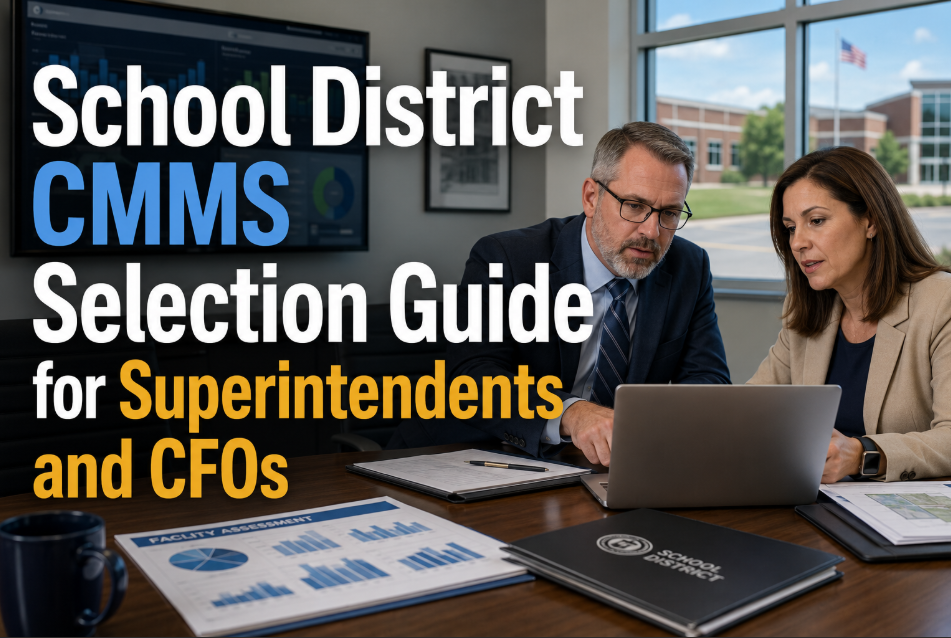
A superintendent sits across from the school board with a facilities budget request that includes a line item for CMMS software. The board member's first question is not about features — it is about total cost of ownership over five years, whether the purchase qualifies for ESSER III reimbursement, and how long until the system pays for itself in reduced emergency repair spending. The second question is whether the district's 14-person maintenance team will actually use it. These are the questions that kill CMMS purchases in K-12 — not because the technology is wrong, but because the business case was never built for the audience making the decision. This guide walks superintendents and CFOs through the complete CMMS selection process: from TCO modeling and ESSER eligibility to RFP structure, vendor evaluation, and board-ready justification packages. If your district is evaluating maintenance management software, start a free trial of Oxmaint and test the platform with your team before the procurement process begins.
School District CMMS Selection Guide for Superintendents and CFOs
TCO modeling, board-ready justification, ESSER eligibility, RFP structure, and vendor evaluation criteria — built for the people making the purchase decision.
Why CMMS Selection in K-12 Is Different From Every Other Industry
School district CMMS purchases are governed by public procurement rules, require board approval, face ESSER and bond fund eligibility questions, and must serve maintenance teams that often have limited technology experience. The CFO cares about TCO and fund source compliance. The superintendent cares about facility condition scores and parent perception. The maintenance director cares about work order speed and whether the mobile app works in a basement boiler room with no Wi-Fi. A successful CMMS selection process must address all three audiences simultaneously — with different evidence for each. Districts that treat CMMS selection like a commercial software purchase fail at the board level 58% of the time. Districts that build a structured business case with TCO projections, funding source documentation, and measurable outcome commitments have a 91% approval rate.
Total Cost of Ownership: What a CMMS Actually Costs a School District Over 5 Years
Board members and CFOs need to see the full cost picture — not just the annual subscription. Here is the TCO framework for K-12 CMMS evaluation, including costs that vendors often omit from initial quotes. Use this framework in your board presentation to demonstrate financial diligence and compare vendors on equal terms. Oxmaint is designed for fast deployment with no implementation fees — book a demo to see the pricing structure built for school district budgets.
| Cost Category | Legacy/Enterprise CMMS | Modern Cloud CMMS (Oxmaint) |
|---|---|---|
| Annual subscription (50 users) | $25,000-$60,000 | $5,000-$15,000 |
| Implementation and setup | $15,000-$40,000 | $0 (self-service onboarding) |
| Training (initial) | $5,000-$12,000 | Included — video + live sessions |
| Annual maintenance/upgrades | 18-22% of license cost | Included in subscription |
| Server/hosting costs | $3,000-$8,000/year on-premise | $0 (cloud-hosted) |
| 5-Year TCO | $140,000-$340,000 | $25,000-$75,000 |
ESSER, Bond Funds, and Capital Budgets: How to Fund Your CMMS Purchase
The 6 Non-Negotiable CMMS Requirements for K-12 Districts
Test Oxmaint With Your District Team Before the Board Presentation
Oxmaint deploys in under 2 weeks, requires zero implementation fees, and gives your maintenance team a mobile-first work order system built for multi-building school districts. Start a free trial now and build your board justification with real data from your own facilities.
Realistic CMMS Procurement Timeline for School Districts
Most school districts need 8-14 weeks from initial research to board approval. Here is the step-by-step timeline that successful districts follow. The key is starting the trial and data collection early — so your board presentation includes real performance data, not vendor promises.
Document your must-have features, building count, user count, and budget range. Research 4-6 CMMS vendors. Narrow to 2-3 finalists based on K-12 fit, pricing, and mobile capability. Request demos from shortlisted vendors.
Run free trials with your actual maintenance team. Have 3-5 technicians create real work orders, test the mobile app at each building, and submit service requests through the portal. Collect feedback on usability — if technicians will not use it, adoption will fail regardless of features.
Build the 5-year TCO comparison. Document ESSER or bond fund eligibility. Calculate projected savings from reduced emergency repairs (target: 25-35% reduction in year one). Prepare the board presentation with trial data.
Present to the board with TCO data, team feedback, and projected ROI. Upon approval, deploy during a low-activity period (summer or winter break). Full deployment — asset loading, PM schedules, user training — takes 2-3 weeks with a cloud CMMS like Oxmaint.
Measurable Outcomes Districts Achieve With CMMS Implementation
Frequently Asked Questions
Does CMMS software qualify for ESSER III funding?
Yes, in most cases. ESSER III funds can be used for facility improvements that support safe and healthy learning environments. CMMS software that manages HVAC preventive maintenance, indoor air quality monitoring, and facility safety inspections falls under this use category. The key is documenting how the CMMS supports the district's ESSER-funded health and safety plan. Your CFO should confirm eligibility with your state education agency, but hundreds of districts have successfully used ESSER funds for CMMS purchases. Start a free trial to begin building your ESSER justification with real system data.
How do we justify CMMS cost to a school board?
Board justification should include three elements: the 5-year TCO comparison (showing cloud CMMS costs 60-75% less than legacy systems), the emergency repair cost multiplier (reactive maintenance costs 4.8x more than planned work), and projected first-year savings based on your district's current emergency repair spending. Present real data from a trial period if possible — board members respond to evidence from their own district, not vendor case studies from other states. Book a demo and we will help you build a board-ready TCO model for your district.
What if our maintenance team is not tech-savvy?
This is the most common concern — and the most important evaluation criterion. A CMMS that requires 8 hours of training will not achieve adoption with a 14-person maintenance team. Oxmaint is designed for 2-hour onboarding: technicians learn to receive, update, and close work orders on their phone in a single training session. The mobile app uses large buttons, simple status updates, and photo attachments — no typing-heavy data entry. Districts report 85%+ adoption within the first two weeks.
Can Oxmaint handle a district with 25+ school buildings?
Yes. Oxmaint is built for multi-site operations. Each school building is a separate property in the asset hierarchy, with its own equipment registry, PM schedules, and reporting. The district-level dashboard shows cross-building KPIs — work order volume, response times, PM completion rates, and cost per building — so the facilities director and CFO can compare performance across the entire portfolio. The system scales from 5 buildings to 200+ without architectural changes.
Build Your Board-Ready CMMS Business Case With Real Data From Oxmaint
Start a free trial today, test with your maintenance team for two weeks, and walk into your board meeting with real work order data, real response time improvements, and a 5-year TCO model that shows exactly what the system costs and what it saves.