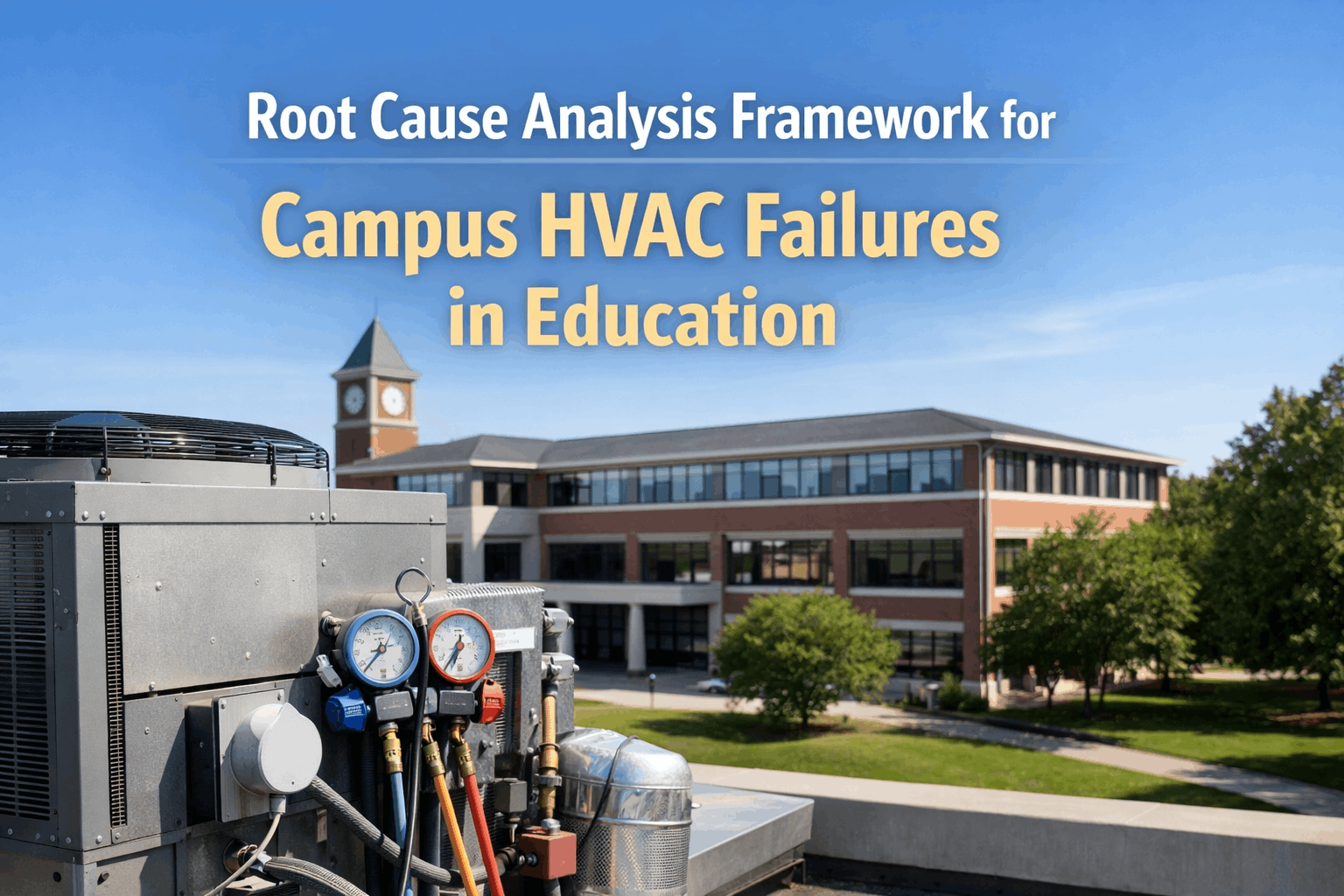
It was 2:47 PM on a September Tuesday when the university's central HVAC system failed during a critical week of midterm exams. Within hours, temperatures in lecture halls climbed past 85°F, forcing the cancellation of exams for 4,200 students. The investigation revealed the true culprit wasn't the failed compressor—it was months of ignored warning signs: rising discharge temperatures, increasing energy consumption, and intermittent pressure alarms that maintenance staff had been resetting without investigation. This wasn't equipment failure; it was a failure of analysis. A structured root cause analysis (RCA) framework could have caught the underlying refrigerant leak six months earlier, turning a $156,000 emergency into a $3,400 scheduled repair. Understanding how to systematically trace HVAC failures to their origins is what separates reactive firefighting from proactive campus facility management.
For schools and higher education institutions, campus HVAC maintenance represents one of the largest operational expenses and one of the most critical factors in student success. Research shows that students in classrooms above 80°F perform up to 14% worse on standardized tests, and HVAC-related disruptions account for significant instructional time loss each year. Yet many educational facilities still operate with aging infrastructure—41% of U.S. school districts need HVAC system updates—making systematic failure analysis not just beneficial, but essential for campus facility reliability. Book a Demo — see how structured failure tracking prevents repeat HVAC breakdowns.
What Is Root Cause Analysis for Campus HVAC Systems?
Root cause analysis is a systematic process for identifying the fundamental reasons behind HVAC failures—not just the immediate symptoms, but the underlying factors that allowed problems to develop. For campus facilities teams, RCA transforms reactive maintenance into predictive intelligence, revealing patterns that prevent future failures and protect educational continuity.
In schools and higher education environments, HVAC RCA takes on unique importance. Campus HVAC systems face challenges that commercial buildings don't: extreme occupancy fluctuations between class periods, seasonal shutdowns during breaks, aging infrastructure with limited capital budgets, and the critical need to maintain air quality for student health. A comprehensive root cause analysis approach addresses these challenges by connecting campus HVAC inspection findings with maintenance history, energy consumption data, and occupant feedback to build a complete picture of system health. Sign Up — start logging HVAC inspection findings and maintenance history in one place.
Unlike simple troubleshooting that fixes symptoms, RCA digs deeper to answer: Why did this happen? What conditions allowed it? How do we prevent recurrence? For educational facilities where HVAC reliability directly impacts student learning, this systematic approach is essential for maintaining comfortable, healthy learning environments year-round. When integrated with a schools and higher education CMMS (Computerized Maintenance Management System), RCA becomes even more powerful—enabling facilities teams to track failure patterns across multiple buildings, correlate maintenance activities with equipment performance, and leverage maintenance analytics to predict which systems need attention before they fail.
The 5-Step RCA Framework for HVAC Failures
Effective root cause analysis follows a structured methodology that moves from symptom to solution. This framework ensures facilities teams don't stop at surface-level fixes but uncover the systemic issues driving repeated failures. For campus HVAC preventive maintenance programs, implementing this framework consistently transforms how educational institutions approach equipment reliability—shifting from costly emergency repairs to planned interventions that extend equipment life and protect instructional time.
Clearly articulate the failure in measurable terms. Instead of "the HVAC isn't working," specify: "AHU-3 fails to maintain below 75°F in Science Hall during afternoon hours when outdoor temps exceed 90°F." Document conditions including time, weather, occupancy, and recent maintenance. Quantify impact—classrooms affected, duration, costs incurred.
Gather comprehensive information from multiple sources: maintenance logs, BMS trend data, technician observations, and occupant complaints. Review historical records for similar failures or related work orders. Interview stakeholders—operators who noticed early warning signs often hold critical insights that never made it into formal reports.
Apply structured analysis methods to trace symptoms to origins. The 5 Whys technique drills down through causal layers. Fishbone diagrams map contributing factors across equipment, people, processes, and environment. Fault tree analysis identifies failure combinations. Don't stop at the first "cause"—the goal is the deepest actionable root.
Create corrective actions that address root causes, not just symptoms. Prioritize solutions by effectiveness, cost, and implementation feasibility. Include preventive measures—revised inspection schedules, updated procedures, training improvements, or equipment upgrades. Ensure solutions are specific, measurable, and assigned to responsible parties.
Execute corrective actions according to plan and monitor results over time. Verify effectiveness by tracking whether the original problem recurs. Document lessons learned and update maintenance procedures, inspection checklists, and training materials. Share findings across your facilities team to prevent similar failures in other equipment.
Every step in this framework depends on accessible, organized maintenance records. Without them, your team is guessing instead of analyzing. Sign Up — digitize your HVAC maintenance records and work order history for free.
RCA Analysis Methods for Campus HVAC
Different analysis methods suit different types of failures. Selecting the right approach—or combining multiple methods—helps ensure thorough investigation. Campus facilities teams should choose methods based on failure complexity, available data, and team expertise. When supported by a robust CMMS with maintenance analytics capabilities, these methods become significantly more effective because historical data is readily accessible and patterns across equipment fleets become visible.
Want to see these RCA methods applied to your campus equipment? Book a Demo — walk through a live root cause analysis using your actual HVAC failure data.
Real-World RCA Example: The 5 Whys in Action
Problem: Classroom overheating in Building A
Why 1: Why is the classroom overheating? → The AHU supply air temperature is too warm.
Why 2: Why is supply air too warm? → The cooling coil isn't providing adequate cooling.
Why 3: Why isn't the coil cooling? → The chilled water valve is stuck partially closed.
Why 4: Why is the valve stuck? → Scale buildup from untreated water has seized the valve stem.
Why 5: Why is there scale buildup? → Water treatment chemical dosing was reduced during budget cuts last year.
Root Cause: Inadequate water treatment program
Solution: Restore chemical treatment AND implement quarterly valve exercising AND add automated monitoring of water chemistry
This is the kind of pattern that gets buried in paper work orders. A digital system surfaces it automatically. Sign Up — start capturing failure patterns across your entire HVAC fleet.
Common Campus HVAC Failure Categories
Understanding typical failure patterns helps facilities teams focus RCA efforts and develop targeted prevention strategies. Educational facilities experience distinct failure distributions compared to commercial buildings due to unique operational patterns—extended summer shutdowns, variable occupancy loads, and often deferred maintenance from budget constraints. Effective campus HVAC inspection programs should prioritize these high-frequency failure categories and use maintenance analytics to track trends over time.
Knowing which category your failures fall into is step one. Tracking whether your corrective actions actually reduce recurrence is step two. Book a Demo — see how failure category tracking works across your campus buildings.
Benefits of Systematic RCA for Educational Facilities
Implementing a structured campus HVAC failure root cause analysis program delivers measurable benefits that extend far beyond preventing repeat failures. Schools and universities that adopt systematic RCA practices report significant improvements across multiple operational areas.
First, campus facility reliability improves dramatically when failures are analyzed to their true root causes rather than just patched. Equipment that previously failed every semester starts running for years without issues once the underlying problems—whether inadequate preventive maintenance intervals, improper installation, or environmental factors—are identified and addressed.
Second, maintenance costs decrease as teams shift from reactive emergency repairs to planned interventions. Campus HVAC preventive maintenance programs informed by RCA data can reduce unplanned downtime by 25-40% while extending equipment life beyond manufacturer specifications. The maintenance analytics generated through systematic failure tracking help justify capital investments by documenting the true cost of deferred maintenance. Sign Up — start building the maintenance cost data your next capital budget request needs.
Third, student outcomes improve when classrooms maintain comfortable temperatures year-round. Research consistently shows that thermal comfort directly impacts cognitive performance, and HVAC disruptions during exams or key instructional periods can have lasting academic consequences. A robust RCA program protects instructional time by preventing the failures that force building closures.
Finally, institutional knowledge grows as RCA findings are documented and shared. When a technician discovers that a particular chiller model consistently fails due to a design weakness, that knowledge prevents the same failure across every similar unit on campus. Over time, this accumulated wisdom transforms how the entire facilities team approaches campus HVAC inspection and maintenance.
Ready to implement structured RCA at your campus? Sign Up — access RCA templates and failure tracking tools for free.