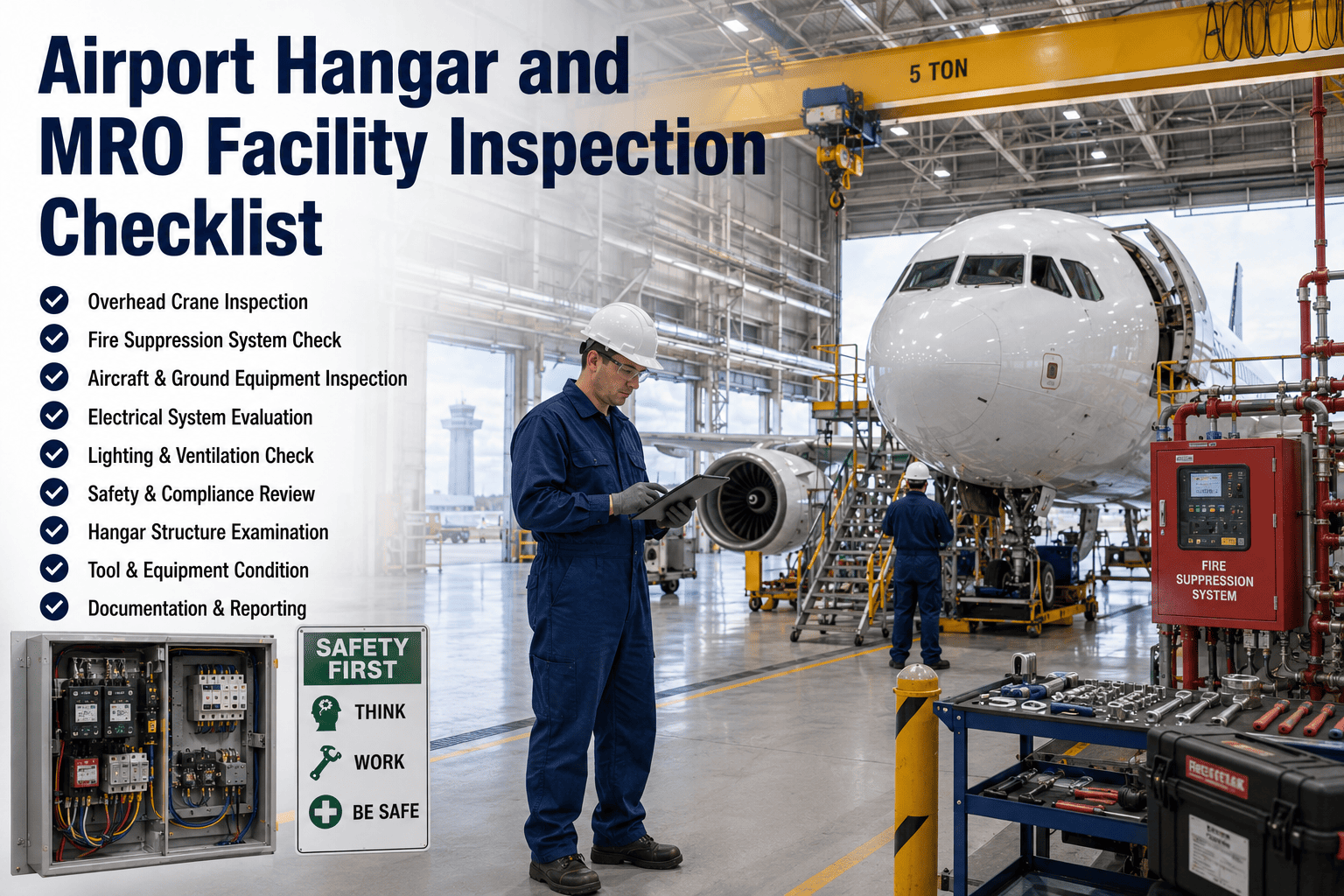
Airport Hangar and MRO Facility Maintenance Checklist
By Lewis Abbott on May 6, 2026
An airport hangar is one of the most hazardous industrial environments in aviation — it combines aircraft fuel handling, overhead crane operations, high-voltage electrical systems, confined space work, hot work near flammable materials, and high-bay structural loads under a single roof. When a hangar door drive system fails without warning, the average repair and downtime cost exceeds $35,000; a planned drive unit replacement on condition assessment runs under $4,000. When a foam fire suppression system fails its annual certification because quarterly tests were skipped, the regulatory exposure includes NFPA 409 violations, FAA 14 CFR Part 139 non-compliance, and potential certificate suspension — before the first flame appears. OSHA 1910.179 requires documented pre-shift and periodic overhead crane inspection records; absent records during an OSHA inspection are treated identically to absent inspections, with maximum serious-violation penalties reaching $16,131 per citation. This checklist covers every inspection system your hangar and MRO facility must document — fire suppression, crane systems, ventilation, electrical, structural, and operational safety — start a free trial to schedule and track every NFPA 409, ASME B30.2, and OSHA-required hangar inspection in Oxmaint, or book a demo and we will map your hangar assets and build your compliance inspection schedule in one session.
Airport Hangar and MRO Maintenance Platform
Build NFPA 409, ASME B30.2, and OSHA Compliance Into Every Inspection Cycle
Auto-scheduled crane pre-shift, monthly, and annual inspection cycles per OSHA 1910.179
Fire suppression quarterly test and annual certification tracking per NFPA 409
5–10 year hangar door, crane, and suppression system CapEx forecasting
No heavy implementation. Works across multi-hangar MRO portfolios. Live in days, not months.
Average repair and downtime cost when a hangar door drive system fails without warning — vs. under $4,000 for a planned replacement on condition assessment
$16,131
OSHA Max Penalty Per Citation
Maximum OSHA serious-violation penalty per citation — absent crane inspection records are treated identically to absent inspections
Daily
Crane Inspection Minimum
ASME B30.2 and OSHA 1910.179 require pre-shift frequent inspection of all overhead travelling cranes before each use — documentation mandatory
Quarterly
Foam System Test Interval
NFPA 409 requires quarterly operational tests of hangar foam fire suppression systems — missed tests void suppression system certification
What Is Airport Hangar and MRO Facility Inspection?
Airport hangar and MRO facility inspection is the systematic evaluation of all structural, mechanical, fire safety, and occupational health systems within aircraft maintenance and storage facilities — covering the full compliance framework that governs one of aviation's most hazard-intensive environments. Unlike terminal or landside facility inspections, hangar inspections operate under an overlapping set of specialized standards: NFPA 409 (Standard on Aircraft Hangars) governs fire suppression and construction requirements; ASME B30.2 and OSHA 29 CFR 1910.179 govern overhead crane inspection and documentation; FAA 14 CFR Part 139 Subpart D establishes safety requirements for certificated airport facilities; and OSHA 29 CFR 1910 Subpart H governs hazardous materials storage and handling.
MRO facilities add an additional compliance layer beyond standard hangars: FAA AC 145 repair station certification requirements, hazardous materials program requirements under OSHA 1910.1200, confined space entry programs per OSHA 1910.146, and respiratory protection programs for paint and coating operations. The consequence of inspection failures in this environment is sharper than most industrial settings — a foam suppression system that fails to activate during an aircraft fuel fire can destroy a $100M+ aircraft and kill maintenance personnel. An overhead crane that drops a load due to uninspected wire rope failure can cause casualties and halt all MRO operations indefinitely.
Every major inspection category in a hangar facility requires not just physical inspection but documented records with technician sign-off — specifically because OSHA, FAA, and fire authority inspectors treat absent records as evidence of non-compliance regardless of actual equipment condition. Structured digital inspection programs that auto-schedule, capture, and retain these records are the operational baseline for any hangar or MRO facility managing regulatory risk seriously — start a free trial to register your hangar assets and build your full NFPA 409 and OSHA inspection schedule in Oxmaint this week.
Eight Inspection Systems Every Hangar and MRO Facility Must Cover
01
Fire Suppression — NFPA 409
Foam or water-based suppression systems require quarterly operational flow tests, semi-annual component inspection, and annual third-party certification per NFPA 409. Missed quarterly tests void system certification and create direct FAA Part 139 compliance exposure.
02
Overhead Crane Systems
ASME B30.2 and OSHA 1910.179 require pre-shift frequent inspections (daily) and periodic inspections (monthly/annual) for all overhead travelling cranes. Wire rope, hook, brake, and runway alignment are critical documented inspection points.
03
Hangar Door Systems
Bi-fold, sliding, and hydraulic hangar doors require monthly operational tests and annual third-party certification of drive systems, limit switches, safety edges, and structural hinge conditions. Drive unit failure during aircraft movement is a catastrophic MRO disruption event.
04
Ventilation and Air Quality
Aviation fuel vapors, hydraulic fluid mist, and paint/coating particulates create occupational health hazards requiring LEV (local exhaust ventilation) system maintenance, annual air quality monitoring, and respiratory protection program compliance per OSHA 1910.134.
05
Electrical Systems
Hangar electrical systems in classified (hazardous) locations require NEC Article 513 compliant installation and annual inspection of explosion-proof fixtures, grounding bonding systems, and electrical panels in fuel handling zones. Arc flash labeling must reflect current system configuration.
06
Floor and Drainage Systems
Hangar floors carrying aircraft axle loads require slip-resistance maintenance and oil-water separator inspection. Floor drains feeding to oil-water separators must comply with EPA stormwater and industrial wastewater regulations — separator performance requires documented quarterly inspection.
07
Hazardous Materials Storage
Aviation fuel, hydraulic fluids, solvents, and paint products require storage in compliant flammable materials cabinets, proper secondary containment, current SDS documentation, and hot work permit systems per OSHA 1910.1200 and NFPA 30. Segregation from ignition sources must be verified regularly.
08
Structural and Egress Inspection
High-bay hangar structures require annual inspection of roof structural members, skylights, cladding, and expansion joints. Emergency egress routes — fire lanes, safety lanes, and pedestrian walkways painted throughout the hangar — must remain unobstructed and clearly marked at all times.
In OSHA inspections of aviation maintenance facilities, absent crane inspection records are treated as absent inspections — documentation is the compliance, not the physical check alone.
Six Critical Pain Points in Hangar and MRO Facility Compliance
Foam Suppression Quarterly Test Gaps
NFPA 409 requires quarterly flow tests of hangar foam suppression systems — yet facilities tracking these tests on paper calendars or shared spreadsheets routinely miss a quarter when schedules shift or personnel change. A missed quarterly test voids the system's current certification status, creating simultaneous NFPA 409, FAA Part 139, and local fire authority exposure. The suppression system that hasn't been quarterly-tested in 7 months is the one that gets inspected in month 8.
Undocumented Crane Pre-Shift Checks
ASME B30.2 and OSHA 1910.179 require documented pre-shift inspection of overhead cranes before each use. Facilities where crane operators perform visual checks verbally or on paper slips that are never filed have no protection when OSHA arrives — the inspector will ask for the last 12 months of pre-shift inspection logs, and an inability to produce them is treated as 12 months of non-compliant crane operation with citations issued per operational day.
Hangar Door Drive System Failures
Bi-fold and sliding hangar door drive systems degrade predictably — gearbox wear, limit switch drift, and hydraulic seal deterioration are observable months before failure. Facilities without condition-tracked inspection programs discover drive failures during aircraft movement, when a door stalls mid-travel with a $50M+ aircraft in the aperture. The repair cost is 8–10x the cost of planned replacement; the insurance and liability exposure is uncapped.
Hazmat Storage Non-Compliance
Aviation fuel, hydraulic fluids, and solvents must be stored in NFPA 30-compliant flammable materials cabinets with secondary containment, segregated from ignition sources, and with current SDS documentation accessible at all storage locations. MRO facilities expanding operations frequently accumulate hazmat quantities that cross regulatory thresholds without triggering a storage compliance review — creating violations that OSHA and fire marshals cite in combination for compounded penalties.
Arc Flash Label and Classification Gaps
Hangar electrical panels in classified hazardous locations (NEC Article 513) must have explosion-proof or intrinsically safe equipment, with arc flash labels reflecting current incident energy calculations. MRO facilities that add circuits, install new equipment, or reconfigure distribution without updating arc flash labels expose maintenance personnel to incorrect PPE selection — a direct NFPA 70E violation that OSHA cites under 1910.303.
Floor and Drain Compliance Drift
Oil-water separators in hangar drainage systems require quarterly inspection and documented cleaning cycles. Facilities that defer separator maintenance allow fuel-contaminated water to discharge to the stormwater system — creating EPA Clean Water Act violations that trigger environmental enforcement actions separate from and in addition to any OSHA or FAA findings. Floor coating degradation in high-traffic areas also progressively reduces slip resistance, converting a maintenance item into a worker's compensation liability.
Airport Hangar and MRO Facility Inspection Checklist
This checklist is organized by system and aligned to NFPA 409 (2022 Edition), ASME B30.2, OSHA 29 CFR 1910.179, OSHA 1910.1200, NFPA 30, NEC Article 513, and FAA 14 CFR Part 139. Each completed section should produce a timestamped, technician-signed record with photo documentation for any deficiency. Third-party certification sections require the contractor's license number and certification report to be filed against the asset record.
Section 1
Fire Suppression Systems — NFPA 409 Compliance
Monthly visual | Quarterly flow test | Annual third-party certification | Assigned to: Fire suppression contractor
Monthly Visual Inspection
Quarterly Operational Flow Test (NFPA 409)
Annual Third-Party Certification (NFPA 409)
Section 2
Overhead Crane and Hoist Systems — ASME B30.2 / OSHA 1910.179
Pre-shift: before each use | Monthly periodic | Annual third-party | Qualified operator required
Pre-Shift Frequent Inspection (Daily / Before Each Use)
Monthly Periodic Inspection
Annual Third-Party Load Testing and Certification
Section 3
Hangar Door Systems — Operational and Structural Inspection
Monthly operational test | Annual third-party structural and drive certification | Assigned to: Hangar door contractor
Monthly Operational Test
Annual Structural and Drive System Inspection
Section 4
Ventilation, Air Quality, and Electrical Safety
Monthly: LEV and electrical visual | Annual: air quality monitoring, arc flash review, classified area inspection
Hangar facilities that shift to digital inspection scheduling eliminate OSHA documentation citations entirely — every pre-shift crane record, foam test result, and hot work permit becomes instantly retrievable audit evidence.
How Oxmaint Solves Hangar and MRO Compliance Gaps
Multi-Frequency Inspection Scheduling
Manages simultaneous daily crane pre-shift checks, monthly door operational tests, quarterly foam flow tests, and annual third-party certifications — all auto-scheduled per asset, with advance alerts and overdue escalation that survive personnel changes.
OSHA-Ready Crane Documentation
Every pre-shift crane inspection produces a timestamped digital record with operator name, crane ID, pass/fail per check point, and photo evidence — the complete documentation package that neutralizes OSHA 1910.179 citation exposure during facility audits.
Fire Suppression Certification Tracking
Tracks quarterly foam test completion, annual certification expiry, and foam concentrate analysis results against each suppression system asset — with 30-day advance alerts before certification lapses and automatic work order generation when tests are overdue.
Condition-Based CapEx Modeling
Uses door drive condition scores, crane wire rope remaining life assessments, and suppression system component ratings to project 5–10 year capital requirements for drive unit replacement, crane refurbishment, and suppression system upgrades — enabling planned procurement instead of emergency sourcing.
Contractor Certification Management
Assigns annual crane load testing, foam system certification, and hangar door inspection to licensed contractors with credential tracking, service report attachment, and completion verification — maintaining the complete third-party compliance trail required by OSHA and FAA auditors.
Automatic Work Orders from Findings
Failed inspection items — crane wire rope approaching removal criteria, foam concentrate below minimum level, door drive anomaly, classified zone seal failure — automatically generate corrective work orders with priority, assigned crew, and target completion date, closing the gap between finding and fixing.
Reactive vs. Planned: Hangar and MRO Facility Compliance
System / Activity
Reactive (Paper-Based)
Planned (Oxmaint CMMS)
Crane Pre-Shift Checks
Paper slips completed but never filed; no retrievable record when OSHA inspector requests 12-month history
Digital record per shift with operator ID, timestamp, and per-point pass/fail — full 12-month history retrievable in seconds
Foam System Quarterly Tests
Scheduled by calendar reminder; quarter skipped when contractor unavailable; certification status unknown until audit
Auto-scheduled 6 weeks ahead; contractor work order issued automatically; test results filed to suppression system asset record
Hangar Door Inspection
Operated daily but never formally inspected; drive failure discovered mid-operation with aircraft in aperture
Monthly operational test logged; annual contractor inspection condition-rated; drive replacement projected in 5-year CapEx model
Hot Work Permits
Paper permits issued and discarded; no audit trail for post-incident investigation or OSHA records request
Digital permit per event with pre-check verification, fire watch log, and post-work sign-off — permanently retained in facility record
Oil-Water Separator
Cleaned when visibly full or when drain backs up; EPA stormwater violations discovered during environmental audit
Quarterly service auto-scheduled; disposal manifest filed per event; EPA compliance trail maintained without manual tracking
CapEx Planning
Drive unit and crane refurbishment requested as emergency capital when failure occurs — 6–12 month lead time causes MRO operational disruption
Condition scores trend over inspection cycles; replacement projected 3–5 years ahead; planned procurement at 40–60% lower cost than reactive replacement
ROI of Structured Hangar and MRO Inspection Programs
8–10x
Drive Failure Cost Premium
Hangar door drive failure during aircraft operation costs 8–10x more than a planned condition-based replacement
$0
OSHA Citation Exposure
Complete digital crane inspection records eliminate OSHA 1910.179 documentation citation exposure — the most common hangar audit finding
100%
Certification Cycle Completion
Auto-scheduled facilities maintain 100% on-time completion of quarterly foam tests and annual crane certifications — vs. below 65% for calendar-tracked programs
5 yr
CapEx Forecast Horizon
Condition-tracked hangar assets generate 5-year replacement forecasts that eliminate emergency capital requests for door drives, crane components, and suppression systems
What does NFPA 409 require for airport hangar fire suppression inspection?
NFPA 409 (Standard on Aircraft Hangars, 2022 Edition) requires a structured maintenance and inspection program for all hangar fire suppression systems — typically foam-water deluge systems for Group I and Group II hangars. Monthly visual inspections must cover foam concentrate levels, system control panel status, nozzle and piping condition, and detection device integrity. Quarterly operational flow tests are required to verify the system discharges foam solution at the correct concentration and application rate, with alarm notification confirmed to the airport fire station. Annual third-party certification requires a licensed fire suppression contractor to conduct a comprehensive system inspection, foam concentrate sample analysis, and full documentation of component condition with pass/fail records. Missed quarterly tests result in loss of current certification status, creating simultaneous NFPA 409 and FAA 14 CFR Part 139 compliance exposure that cannot be retroactively resolved.
What overhead crane inspection records does OSHA 1910.179 require?
OSHA 29 CFR 1910.179 requires two levels of documented crane inspection: frequent inspections performed before each use or daily (whichever is shorter), covering hooks, wire rope, limit switches, and brakes; and periodic inspections on a monthly to annual cycle depending on crane usage, covering all components including structural members, runway rails, sheaves, and overload protection. The critical compliance point is documentation — OSHA inspectors request the last 12 months of pre-shift inspection logs, and an inability to produce them is treated as 12 months of non-compliant crane operation with citations issued per operational day. ASME B30.2 specifies the specific inspection criteria and rejection criteria for wire rope (6 broken wires per rope lay), hooks, and sheaves. Annual third-party load testing by a qualified crane inspection engineer with a documented load test report is also required to maintain crane certification.
How often do hangar door systems need to be inspected and serviced?
Hangar door inspection operates on a monthly operational test cycle and an annual structural and drive system certification cycle. Monthly tests should cover full open-close operation with cycle time recording, safety edge system function testing, limit switch verification, and weather seal condition. The cycle time record is particularly valuable for trending — a drive system that takes 20% longer to cycle than its baseline is approaching drive unit failure, giving 3–6 months of lead time for planned replacement. Annual inspections by a certified hangar door contractor should cover structural hinge and panel connection condition, gearbox oil analysis, hydraulic system pressure and seal condition, and wind load locking verification. Drive unit condition scores from annual inspections feed directly into 5-year CapEx models, enabling planned replacement at 40–60% lower cost than emergency sourcing after a failure event.
How does CMMS software improve hangar and MRO facility compliance management?
CMMS software like Oxmaint addresses the three compliance failure modes most common in hangar and MRO facilities: missed inspection cycles, undocumented inspections, and no condition trending for CapEx planning. Oxmaint auto-schedules daily crane pre-shift checks, monthly hangar door tests, quarterly foam system flow tests, and annual third-party certifications per asset — with advance alerts and overdue escalation that survive personnel changes. Every inspection produces a timestamped digital record with technician sign-off and photo attachments that satisfies OSHA, NFPA 409, and FAA audit requests without manual filing. Condition scores from door drive inspections, crane wire rope assessments, and suppression system component ratings are trended over time to project replacement needs 3–5 years out, enabling planned procurement at a fraction of the emergency replacement cost. Facilities using Oxmaint maintain 100% on-time certification cycle completion and have zero OSHA documentation citation exposure during facility audits.
Airport Hangar and MRO Maintenance Platform
Eliminate OSHA Citations and Suppression System Lapses — Permanently
Turn every crane, hangar door, fire suppression system, and hazmat storage area into a compliant, documented, condition-tracked asset with Oxmaint.
Daily crane pre-shift records, quarterly foam tests, and annual certifications — all auto-scheduled
OSHA 1910.179 and NFPA 409 audit documentation retrievable in under 10 minutes
5-year CapEx forecasting for door drives, crane refurbishment, and suppression upgrades
Used by operations teams managing 10,000+ assets. Live in days, not months.