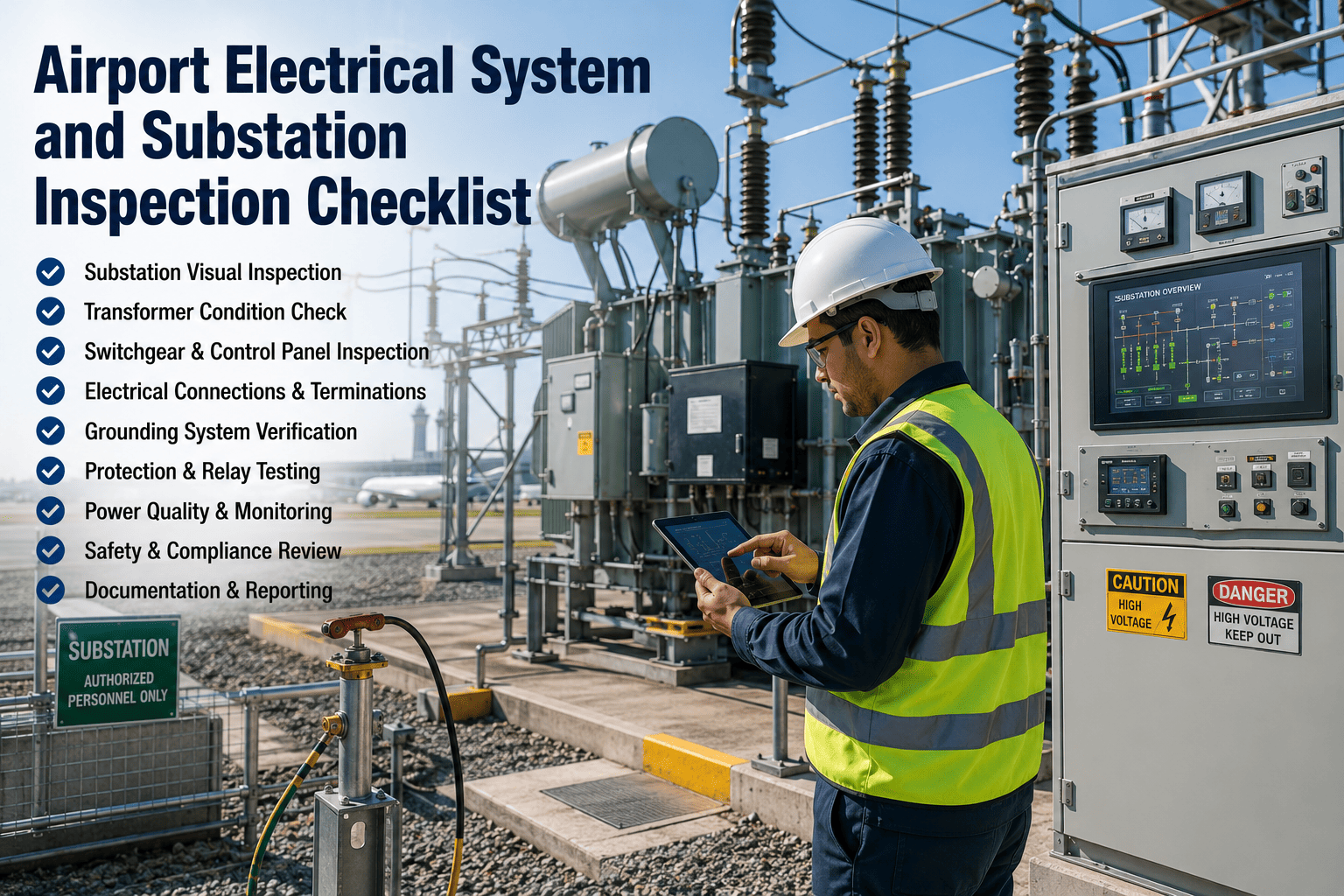
Airport Electrical System and Substation Inspection Checklist
By Jack Edwards on May 6, 2026
A single substation failure at a major airport doesn't just cut power to a terminal wing — it cascades into runway lighting outages, ILS navigation aid failures, jetbridge lockouts, security screening shutdowns, and baggage system halts. Industry data puts the average cost of unplanned airport power outage at $680,000 per hour when delays, compensation, and operational penalties are combined. Yet 47% of airport electrical failures are directly traceable to deferred or missed preventive maintenance on substations and distribution equipment. Since the 2023 update, NFPA 70B inspection requirements shifted from recommended practice to mandatory standard — meaning airports without documented electrical inspection programs are now in direct regulatory non-compliance, not just best-practice gaps. This checklist covers every inspection element your team needs across substations, transformers, switchgear, grounding, and distribution panels — start a free trial to schedule and track every NFPA 70B-mandatory inspection across your entire airport electrical network in Oxmaint, or book a demo and we will map your substation and distribution assets in one session.
Airport Electrical Maintenance Platform
Close the NFPA 70B Compliance Gap Before the Next Audit
Auto-scheduled thermographic and insulation resistance testing per NFPA 70B cycles
Digital sign-off records retrievable for FAA, CAA, and insurance audits instantly
5–10 year transformer and switchgear CapEx forecasting by asset age and condition
No heavy implementation. Works across multi-site airport portfolios. Live in days, not months.
Average cost per hour of unplanned airport power failure including delays and operational penalties
47%
Failures From Deferred PM
Of airport electrical failures traced to missed or deferred preventive maintenance on substations
4.8x
Reactive vs. Planned Cost
Emergency switchgear failure response costs 4.8x more than a scheduled condition-based replacement
12 mo
NFPA 70B Mandatory Cycle
2023 NFPA 70B update mandates inspection of ALL electrical equipment at minimum every 12 months
What Is Airport Electrical System Inspection?
Airport electrical system inspection is the structured, standards-based evaluation of every component in the power generation, distribution, and control chain that keeps an airport operational — from the incoming high-voltage substation feeding 33kV to 132kV utility supply down through transformers, switchgear, distribution panels, grounding systems, and the airfield lighting circuits that directly govern runway and taxiway safety. Unlike commercial building electrical inspections, airport electrical systems operate under 24/7 continuous load with zero tolerance for outages in life-safety and navigation aid circuits.
The governing framework in the United States combines FAA Advisory Circular 150/5340-26 (airfield lighting electrical systems), NFPA 70B (electrical equipment maintenance — now mandatory since 2023), NFPA 70E (electrical safety in the workplace), and IEEE C2 for high-voltage installations. Together these standards define inspection intervals, test procedures, documentation requirements, and minimum safe work conditions. The 2023 NFPA 70B update is particularly significant: it elevated the standard from recommended practice to mandatory requirement, meaning facilities without a documented Electrical Maintenance Program (EMP) are now directly non-compliant — not simply behind on best practice.
A complete airport electrical inspection program covers seven asset categories: substations, power transformers, switchgear and circuit breakers, grounding and bonding systems, distribution panels and MCCs, airfield lighting regulators, and emergency power systems. Each category has distinct inspection intervals — annual visual inspection applies universally, while insulation resistance testing runs on 3-year cycles and protection relay calibration on 5-year cycles for most high-voltage equipment. Transformer oil analysis is annual for units over 10 years old — start a free trial to auto-schedule every interval across your full electrical asset inventory in Oxmaint.
Eight Dimensions of a Complete Airport Electrical Inspection Program
01
Substation Visual Inspection
Annual walkdown of all substation equipment — insulators, bushings, surge arrestors, bus connections, and enclosure integrity. Detects physical damage, contamination, and animal intrusion before they trigger failures.
02
Transformer Oil Analysis
Annual dissolved gas analysis (DGA) and oil dielectric testing for transformers over 10 years old. DGA detects internal arcing, overheating, and cellulose degradation 12–18 months before failure becomes imminent.
03
Thermographic Scanning
Infrared scanning of all switchgear, panels, and bus connections — mandatory annually under NFPA 70B 2023, with 6-month intervals for Condition 3 equipment. Identifies hot spots before they escalate to arc flash events.
04
Insulation Resistance Testing
3-yearly megger testing of cable insulation, transformer windings, and motor circuits. Trending insulation resistance values over multiple cycles reveals degradation rates that point-in-time tests alone cannot detect.
05
Protection Relay Calibration
5-yearly secondary injection testing of all protection relays — overcurrent, differential, earth fault, and distance relays. Miscalibrated relays are the primary cause of delayed fault clearance and transformer damage during faults.
06
Grounding System Verification
Annual earth resistance testing at all substation ground grids and equipment bonding points. Airport grounding must meet IEEE 80 requirements — failures create touch and step potential hazards for personnel during fault events.
07
Emergency Power Testing
Monthly no-load starts plus quarterly load transfer tests for all standby generators. NFPA 110 mandates 30-minute loaded runs at minimum. Life-safety circuits including runway lighting must transfer within 10 seconds.
08
Arc Flash Hazard Analysis
IEEE 1584-based arc flash studies updated every 5 years or after significant system changes. Labels on all switchgear and panels must reflect current incident energy levels — stale labels create PPE selection errors.
Airports without a documented Electrical Maintenance Program are now in direct NFPA 70B non-compliance — since 2023, inspection is mandatory, not recommended.
Where Airport Electrical Programs Break Down: 6 Pain Points
Missed Thermographic Cycles
Infrared scanning is now mandatory annually under NFPA 70B 2023, with Condition 3 equipment requiring 6-month scans. Facilities relying on manual calendar reminders or spreadsheet tracking miss scans when personnel change — leaving hot spots undetected in live switchgear for over a year.
Transformer Oil Analysis Gaps
Power transformers have 25–40 year lifecycles, but airports lose an average of 6–12 years of remaining useful life due to delayed oil analysis. Dissolved gas anomalies detected 12 months late convert from a $15,000 oil reclamation job into a $400,000+ emergency transformer replacement.
Audit Documentation Failures
FAA and insurance audits require complete, date-stamped inspection records with qualified technician sign-off. Paper logbooks and disconnected spreadsheet files cannot produce this evidence on demand — creating compliance exposure during every CAA or FAA audit cycle that teams only discover when an auditor is already on site.
Stale Arc Flash Labels
Arc flash hazard analysis must be updated every 5 years or after system configuration changes. Airports that add generation capacity, reconfigure distribution, or install new MCCs without updating arc flash labels leave workers selecting PPE based on incorrect incident energy values — a direct NFPA 70E violation.
Unplanned CapEx Spikes
Without condition trending tied to asset age and maintenance history, transformer and switchgear replacement needs appear as emergency capital requests rather than planned budget items. Reactive switchgear replacement costs 3.2x more than condition-based planned replacement — and airport procurement cycles are not designed for emergency equipment sourcing.
Knowledge Loss on Personnel Change
Airport electrical teams hold critical institutional knowledge about system quirks, historical fault events, and equipment-specific inspection requirements. When experienced technicians retire or transfer, this knowledge disappears unless captured in structured digital records — leaving replacement staff managing high-voltage equipment with no inspection history to reference.
Airport Substation and Electrical System Inspection Checklist
The following checklist is organized by system category and aligned with NFPA 70B 2023 mandatory intervals, IEEE C2, NFPA 70E, and FAA AC 150/5340-26 for airfield lighting systems. Each section should produce a timestamped, technician-signed record. Where external licensed contractors are required, their certification number and inspection report should be attached to the work order record.
Generator starts: Monthly | Load transfer test: Quarterly | Full load bank test: Annual
Standby Generator Inspection
UPS and Battery Systems
Every dollar spent on planned airport electrical maintenance prevents approximately $4.80 in emergency repair costs — and eliminates the $680,000-per-hour outage risk entirely.
How Oxmaint Solves Airport Electrical Maintenance Gaps
Multi-Interval Scheduling Engine
Manages simultaneous inspection cycles — annual thermographic, 3-year insulation resistance, 5-year relay calibration — across your entire electrical asset inventory, with automated alerts 30 days before each cycle is due and escalation if tasks go overdue.
Digital Sign-Off and Photo Records
Every inspection produces timestamped records with technician digital signature, photo attachments, and test value fields — satisfying NFPA 70B documentation requirements and producing audit-ready reports retrievable in minutes, not days of manual filing.
Condition Trending and CapEx Modeling
Tracks DGA gas levels, insulation resistance values, and thermographic condition ratings across inspection cycles — plotting deterioration trends that predict replacement needs 3–5 years out and feeding directly into capital budget planning.
Asset Hierarchy for Electrical Systems
Structures your electrical assets as Airport > Substation > Transformer/Switchgear/Panel, keeping maintenance history, test results, and compliance records organized by individual asset — not lost in shared folders or paper files.
Contractor Integration and Certification Tracking
Assigns high-voltage inspection tasks to licensed external contractors with certification number fields, test report attachment, and completion verification — maintaining a complete contractor compliance trail without separate spreadsheet tracking.
Automatic Work Order from Findings
NFPA 70B Condition 3 findings, DGA anomalies, or failed trip tests automatically generate corrective work orders with priority classification, assigned crew, and target completion date — closing the gap between identifying a fault and scheduling its repair.
Is NFPA 70B mandatory for airport electrical maintenance, or just a recommendation?
Since the 2023 update, NFPA 70B shifted from recommended practice to mandatory standard. Chapter 9 of NFPA 70B 2023 now establishes mandatory scopes of work and inspection intervals by product type, meaning airports without a documented Electrical Maintenance Program (EMP) aligned to these requirements are in direct non-compliance. The 2023 update also mandates thermographic inspection of all electrical equipment at minimum every 12 months, with Condition 3 equipment requiring 6-month infrared scans. Combined with NFPA 70E workplace safety requirements and FAA AC 150/5340-26 for airfield lighting systems, airport electrical teams must now operate under a fully documented, scheduled, and records-maintained inspection program.
How often should airport substations and transformers be inspected?
The mandatory baseline under NFPA 70B 2023 is annual visual inspection for all electrical equipment. Beyond that baseline, power transformers require annual oil sampling and dissolved gas analysis for units over 10 years old, with insulation resistance and winding tests on a 3-year cycle. Switchgear contact resistance and trip testing also runs on a 3-year cycle. Protection relay calibration via secondary injection testing is required every 5 years. Arc flash hazard analysis must be updated every 5 years or after significant system changes. Transformer oil analysis timing is the most commonly missed interval — airports without automated scheduling frequently allow 18+ months to pass between DGA samples, compressing the window to intervene before critical gas levels are reached.
What does dissolved gas analysis (DGA) detect in airport transformers?
DGA analyzes the concentration of key gases dissolved in transformer oil — hydrogen, methane, ethane, ethylene, acetylene, carbon monoxide, and carbon dioxide — each of which indicates a specific fault type and temperature range. Acetylene is the most critical: its presence at any level indicates high-energy arcing inside the transformer and requires immediate investigation. Elevated CO and CO2 indicate paper insulation breakdown. Rising ethylene and ethane suggest moderate thermal degradation of oil. IEEE C57.104 provides reference gas limits and rate-of-change thresholds for interpretation. DGA detects developing faults 12–18 months before they become critical failures, converting what would be a $400,000+ emergency transformer replacement into a planned oil reclamation or targeted repair at a fraction of the cost.
How does CMMS software improve airport electrical inspection compliance?
A CMMS like Oxmaint addresses the three most common failure points in airport electrical maintenance programs: missed inspection cycles, lost documentation, and no condition trending. Oxmaint auto-schedules all NFPA 70B inspection intervals per asset — annual thermographic, 3-year insulation testing, 5-year relay calibration — with advance alerts that survive personnel changes. Every inspection captures digital sign-off, test values, and photo evidence in the asset record, producing audit-ready documentation retrievable in minutes. DGA and thermographic results are trended across cycles to identify deteriorating assets 3–5 years before they reach replacement threshold — enabling planned procurement instead of emergency capital requests. Airports using Oxmaint report zero missed inspection cycles and 10-minute audit report generation versus 2–3 days with paper-based systems.
Airport Electrical Maintenance Platform
Stop the $680K-Per-Hour Outage Risk Before It Finds You
Turn every substation, transformer, and switchgear asset into a compliant, trackable, NFPA 70B-managed system with Oxmaint.
Auto-scheduled thermographic, oil analysis, and relay calibration cycles
Audit-ready NFPA 70B documentation — retrievable in under 10 minutes
5–10 year transformer and switchgear replacement CapEx forecasting
Used by operations teams managing 10,000+ assets. Live in days, not months.