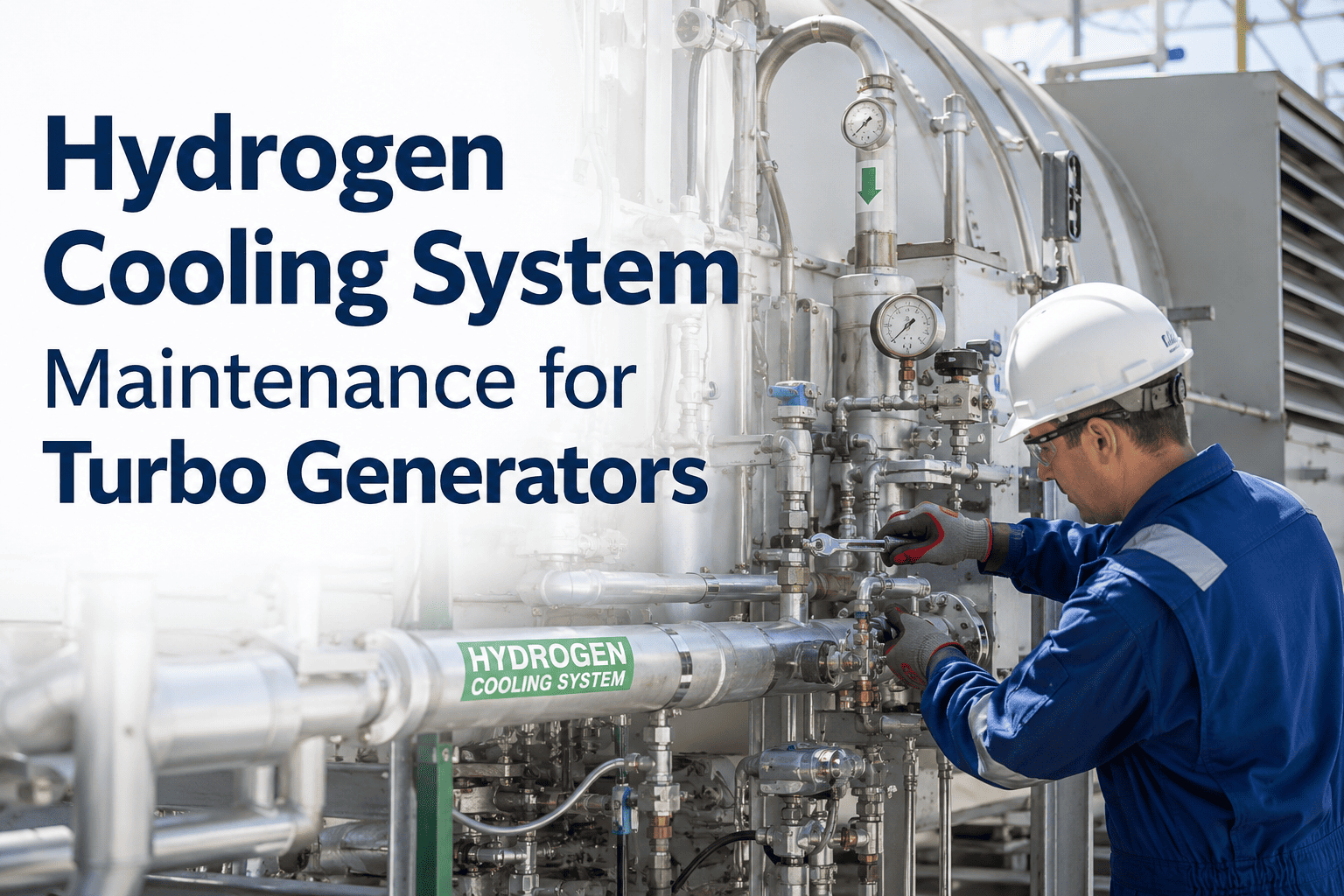
A generator's hydrogen cooling system is one of the most critical and least forgiven auxiliary systems in a power plant. Hydrogen offers seven times the thermal conductivity of air and dramatically reduces windage losses — but it operates under pressure in an environment where any seal failure, purity drop, or dryer malfunction creates either a fire hazard, a winding temperature excursion, or a forced outage. Most generator failures that begin with hydrogen system degradation are preventable — but only if maintenance teams have a structured program with documented inspection intervals, purity trend records, and seal oil condition tracking connected to their CMMS. OxMaint's maintenance platform gives generator reliability teams the audit trail, PM scheduling, and real-time alert integration needed to run a hydrogen cooling program that is safe, documented, and cost-effective.
Blog · Generator Maintenance · Hydrogen Cooling
Steam Turbine Generator Hydrogen Cooling System Maintenance
Purity management, leak detection programs, dryer servicing, oil seal condition tracking, and CMMS records — a complete field guide for generator maintenance engineers.
H₂ System — Critical Priority
98%+
Minimum H₂ purity for safe operation
4×
Higher explosion risk below 95% purity
$1.8M
Avg. cost of generator forced outage from seal failure
40%
Generator failures preventable by structured H₂ PM programs
System Overview
Why Hydrogen Cooling Demands a Dedicated Maintenance Program
Hydrogen-cooled generators account for the majority of utility-scale generation capacity above 100 MW. The hydrogen gas circulates through the rotor and stator winding at 3–6 bar gauge pressure, removing heat 7× more effectively than air. This performance advantage comes with a system that has zero tolerance for neglect: a single compromised shaft seal introduces air, drops purity below the explosive mixture threshold (4–75% H₂ in air), and converts a routine maintenance window into an emergency. The four subsystems below each require their own PM structure.
Generator H₂ Cooling System
3–6 bar · 95–100°C operating temp
Purity Control
H₂ analyzers, CO₂ purging sequence, makeup gas system
Shaft Seals / Oil System
Seal oil pumps, differential pressure control, rundown tanks
Gas Dryers
Silica gel or molecular sieve, dew point monitoring, switchover
Leak Detection
Ultrasonic, catalytic bead, tracer gas, pressure decay testing
Purity Management
Hydrogen Purity: Operating Limits, Monitoring, and the Purge Protocol
Hydrogen purity is not a comfort metric — it is a safety boundary and an efficiency parameter simultaneously. Every percentage point below 98% purity increases windage loss and winding temperature rise, while also moving the gas mixture closer to the explosive range. Maintaining purity above 98% requires continuous monitoring, scheduled analyzer calibration, and a documented purge and fill protocol that is practiced — not just written down.
98–100%
Safe Operating Zone
Normal operation. Windage loss at minimum. Monitor weekly.
95–97.9%
Caution Zone
Investigate air ingress source. Seal oil system check required within 24 hrs.
90–94.9%
Purge Required
Schedule CO₂ displacement purge. Do not vent directly. Load reduction advised.
Below 75%
Explosive Hazard Zone
Trip and isolate. Emergency H₂ blanketing required. Do not introduce ignition sources.
Purity Monitoring — PM Actions and Frequencies
Daily
H₂ purity reading from online analyzer — log to CMMS asset record
Weekly
Cross-check online analyzer against portable reference instrument. Document deviation.
Monthly
Analyzer calibration with certified reference gas. Calibration record to CMMS.
Annually
Full purge-and-fill procedure practice run with documented hold point sign-offs.
Seal Oil System
Shaft Seal and Oil System — The Most Failure-Prone Hydrogen Subsystem
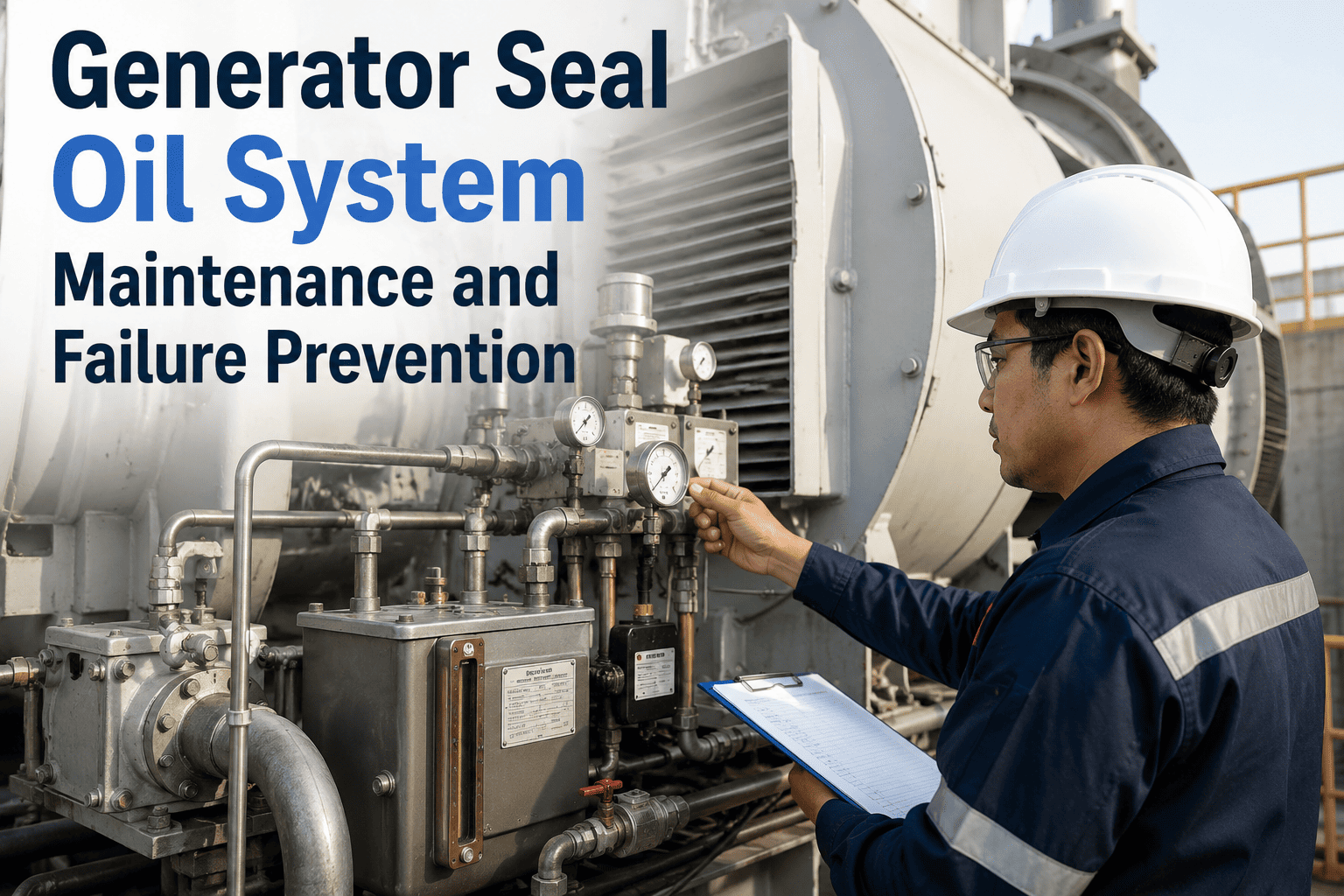
The shaft seal oil system is the most mechanically complex part of the hydrogen cooling system and the root cause of the majority of hydrogen-related forced outages. Seal oil must be maintained at a pressure differential of 0.35–0.70 bar above hydrogen gas pressure at all times — if this differential fails, hydrogen leaks outward or air leaks inward, both of which are unacceptable. Understanding the failure chain is essential to designing a PM program that prevents rather than reacts.
| Component |
Failure Mode |
Consequence |
Detection |
PM Interval |
| Seal oil pump (AC main) |
Bearing wear, impeller cavitation |
Loss of differential pressure — air in-leakage |
Differential pressure alarm, vibration trending |
Inspect every 8,760 hrs |
| Seal oil pump (DC emergency) |
Inoperative on demand — battery/motor fault |
No backup on AC pump trip — trip generator |
Monthly test run — documented in CMMS |
Monthly functional test |
| Differential pressure regulator |
Diaphragm rupture, set-point drift |
ΔP drops below 0.35 bar — H₂ escape path opens |
ΔP transmitter, continuous monitoring |
Calibrate every 6 months |
| Shaft seal rings (Babbitt) |
Wear, score marks from shaft runout |
Increased oil consumption, H₂ contamination of oil |
H₂-in-oil analyzer, oil consumption tracking |
Inspect at major outage |
| Rundown tank / gravity feed |
Level sensor failure, valve seizure |
No seal oil on coast-down — air ingress on trip |
Level indicator — inspect quarterly |
Functional test quarterly |
Structured H₂ Maintenance Programs
Every Hydrogen System PM, Alert, and Inspection Record — Tracked in OxMaint
OxMaint auto-schedules purity analyzer calibrations, seal oil pump tests, and dryer switchover PMs — and links every alert event to an inspection work order with a full audit trail for safety compliance.
Gas Dryers
Hydrogen Gas Dryers — Moisture Control and Switchover Discipline
Moisture in the hydrogen system is a direct threat to stator winding insulation. Water vapour carried in hydrogen that condenses on winding insulation initiates partial discharge, accelerates slot discharge erosion, and reduces insulation resistance — often without an immediate alarm. Gas dryers remove moisture from the circulating hydrogen, but their desiccant capacity is finite and must be tracked against operating hours and inlet dew point conditions.
Silica Gel Dryers
Most common type — 200–500 MW units
Regeneration Temp
120–150°C
Switchover Trigger
Outlet dew point >−40°C
Desiccant Replacement
Every 3–5 years or 25,000 hrs
CMMS PM Interval
Quarterly visual + annual full service
Molecular Sieve Dryers
Higher capacity — 500 MW+ units and cyclic duty
Regeneration Temp
250–300°C
Switchover Trigger
Outlet dew point >−50°C
Desiccant Replacement
Every 6–8 years under normal conditions
CMMS PM Interval
6-monthly dew point check + biennial full service
Dryer Failure Consequences
When dew point is not monitored and switchover fails
Moisture at 1,000 ppm in H₂ reduces winding insulation resistance by 30–60% over 6 months
Condensate accumulation triggers partial discharge — detectable only via PD monitoring, not standard IR
Repair cost of moisture-damaged stator winding: $400K–$1.2M depending on rewind extent
Leak Detection
Hydrogen Leak Detection — Methods, Intervals, and CMMS Record Requirements
Hydrogen is colorless, odorless, and burns with an invisible flame. A leak that is not detected by instrumentation will not be seen, smelled, or heard until it reaches an ignition source. A structured leak detection program uses complementary methods — fixed detectors, portable instruments, and periodic pressure decay testing — and logs every test result in the CMMS as a permanent asset record.
01
Fixed Catalytic Bead Detectors
Continuous monitoring
Positioned at cable box entries, terminal boxes, and seal oil area. Alarm at 10% LEL (0.4% H₂). Test monthly with certified calibration gas. Replace sensor elements every 3 years.
CMMS: Monthly calibration WO + 3-year replacement PM
02
Ultrasonic Leak Detection
Quarterly survey
Hand-held ultrasonic instruments detect turbulent flow through seal gaps and flange leaks. Effective for flanges, valve glands, and seal oil pipe joints that fixed detectors cannot cover. All findings logged by location.
CMMS: Quarterly survey WO with location-tagged findings
03
Tracer Gas Testing
At each planned outage
5% H₂ / 95% N₂ tracer mixture injected after unit is de-energised and H₂ displaced. Detector survey identifies leakage paths with pinpoint accuracy. Mandatory before any welding or hot work permit.
CMMS: Outage inspection WO with tracer test sign-off hold point
04
Pressure Decay Testing
Annually / after major maintenance
System pressurised to 120% of normal operating pressure with N₂. Pressure monitored over 4–8 hours. Decay rate above 0.05 bar/hr triggers leak investigation before H₂ is reintroduced.
CMMS: Annual pressure test WO with pass/fail record and decay rate logged
Frequently Asked Questions
Generator Hydrogen System — Questions Maintenance Engineers Ask
What is the minimum safe hydrogen purity level for a generator?
The minimum safe operating purity is 98% by volume. Below 95%, windage losses increase measurably and the system begins approaching conditions where air contamination could create a flammable mixture. Below 75% H₂, the gas inside the casing enters the explosive range (4–75% H₂ in air).
OxMaint's CMMS tracks daily purity readings and can trigger alert work orders when readings fall below configurable thresholds.
How often should the seal oil differential pressure regulator be calibrated?
The differential pressure regulator should be calibrated every 6 months. Set-point drift of just 0.05 bar can compromise the seal oil-to-hydrogen pressure margin.
Book a demo to see how OxMaint auto-schedules calibration PMs and logs the as-found versus as-left set-point values for each calibration.
What causes hydrogen in seal oil and why is it dangerous?
Hydrogen dissolves into seal oil at the shaft seal face under pressure. As the oil returns to the seal oil tank at lower pressure, dissolved H₂ comes out of solution and accumulates above the oil surface. If the tank venting system is inadequate or blocked, H₂ concentrations can reach ignitable levels in an enclosed space — a confined space hazard that requires continuous monitoring and proper tank venting maintained in CMMS inspection records.
Can OxMaint support hydrogen system safety records for regulatory compliance?
Yes. OxMaint captures every PM completion, calibration record, test result, and inspection finding with timestamps, technician identity, and attached documentation. This creates the audit trail required by IEC, IEEE, and local electrical safety authority standards for pressurised hydrogen systems.
Start free and configure your generator's hydrogen system asset hierarchy.
How do I know if my hydrogen dryer desiccant needs replacement?
The definitive indicator is outlet dew point — if the active dryer vessel cannot maintain outlet dew point below −40°C (silica gel) or −50°C (molecular sieve) after regeneration, the desiccant capacity is exhausted and replacement is required. Secondary indicators include increasing switchover frequency and visual degradation of desiccant granules during outage inspection.
Your Generator's Hydrogen System Needs a Maintenance Program That Matches Its Risk Profile
OxMaint structures your hydrogen cooling maintenance program — from daily purity logs to tracer gas test records — in one auditable CMMS. Safety compliance, forced outage prevention, and complete asset memory across every generator in your fleet.