A hydrogen seal oil failure is not an ordinary generator fault — it is the point where a maintenance gap turns into a fire hazard, an unplanned trip, and a multi-day generator outage all at once. Seal oil systems keep hydrogen sealed inside the generator casing by maintaining an oil pressure slightly above gas pressure at every seal ring, and when that differential drifts even briefly, hydrogen escapes toward a hot bearing or an ignition source. Most plants only discover the seal oil system is fragile after a trip, when the differential pressure trend, the float trap history, and the seal ring temperature log would have shown the problem weeks earlier. Reliability teams are shifting away from calendar-based seal oil checks toward condition-based monitoring built on OxMaint's predictive maintenance platform for power plant generators.
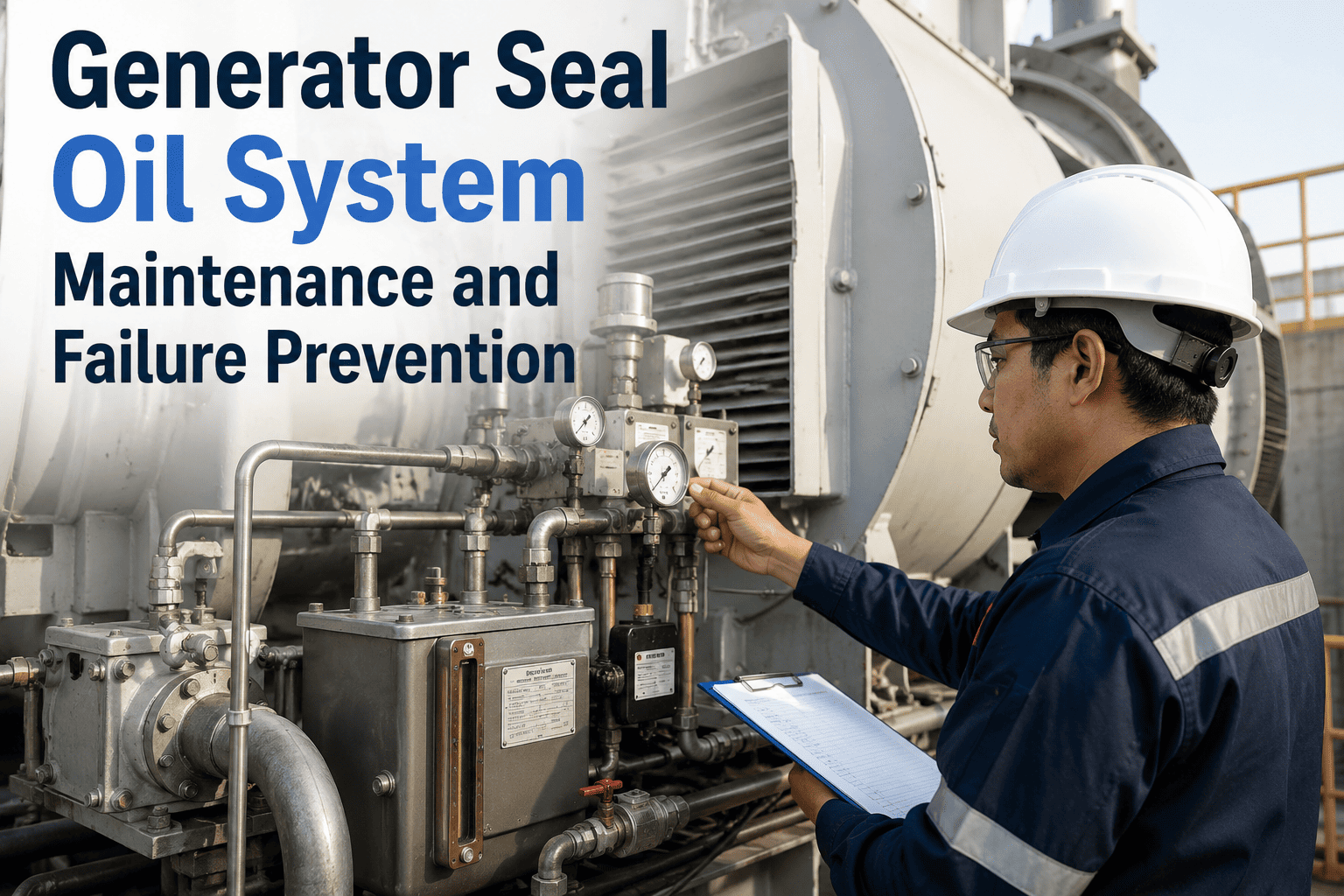
Generator Seal Oil System Maintenance and Failure Prevention
Hydrogen seal oil failures rank among the highest-consequence, lowest-visibility risks in a thermal power plant. Here is the complete condition-monitoring and maintenance framework reliability teams use to keep differential pressure, seal ring temperature, and oil purity inside safe limits.
Why Seal Oil Failures Escalate Faster Than Other Generator Faults
Unlike a bearing wear issue that develops over months, a seal oil differential collapse can move from normal operation to hydrogen leakage in minutes if the backup pump does not engage in time. The four risk factors below explain why this system demands tighter monitoring discipline than almost any other rotating asset in the plant.
Self-Igniting Gas
Hydrogen escaping at a seal failure point tends to ignite from the friction heat at the failure itself, with no external spark required.
Narrow Safe Margin
The oil-to-gas differential pressure window is deliberately tight, so small pump, valve, or cooler faults can push the system out of tolerance.
Backup Dependency
Primary and backup seal oil pumps must switch over automatically; an untested transfer valve or dead backup pump removes the entire safety margin.
Silent Degradation
Float trap wear, cooler fouling, and detector float sticking progress slowly and rarely trigger an alarm until the failure is already underway.
The Seal Oil System, Component by Component
A generator seal oil system is a closed loop of interdependent components. Weakness in any single component below eventually shows up as a differential pressure or purity excursion elsewhere in the loop.
Common Failure Modes and Early Warning Signals
Reliability engineers rely on a small set of recurring failure patterns to anchor their inspection routines. The table below maps each failure mode to the parameter that typically moves first.
| Failure Mode | Root Cause | First Warning Signal | Consequence If Missed |
|---|---|---|---|
| Seal ring overheating | High seal oil temperature, cooler fouling | Embedded thermocouple trend rising | Ring metal damage, hydrogen leak path |
| Differential pressure collapse | Pump degradation, regulator drift | ΔP trending toward alarm limit | Hydrogen escapes into oil or atmosphere |
| Backup pump non-start | Untested auto-transfer logic, dead starter | Failed monthly changeover test | No redundancy during primary pump fault |
| Float trap wear | Mechanical wear, contamination | Rising gas content in returning oil | Gas carryover, seal oil purity loss |
| Seal oil contamination | Filter bypass, cooler leak | Particle count and moisture rise | Accelerated seal ring and pump wear |
Stop Discovering Seal Oil Problems After the Trip Alarm Sounds
OxMaint tracks differential pressure, seal ring temperature, and float trap trends against your alarm thresholds continuously, and generates a work order the moment a trend crosses into risk territory.
Moving From Calendar-Based to Condition-Based Maintenance
Fixed-interval seal oil maintenance is easy to schedule but conservative — it forces outages on components that may still have useful life while missing faults that develop between scheduled checks. Condition-based maintenance closes that gap.
The KPIs Generator Reliability Teams Track Monthly
Unplanned Seal Oil Trips
Count of forced outages attributable to seal oil differential loss or seal ring overheating in a rolling 12-month window.
Backup Pump Test Pass Rate
Percentage of scheduled auto-transfer and backup pump start tests completed and passed on time.
Alert-to-Response Time
Time between a threshold breach alert and a technician acknowledging and beginning corrective action.
ΔP Variance From Setpoint
How far the operating differential pressure drifts from its designed setpoint across a full load cycle.
A Recommended Seal Oil Maintenance Schedule
The schedule below reflects common practice across combined-cycle and coal-fired generator fleets, adjusted to each OEM's specific tolerances.
| Task | Frequency | Evidence Captured |
|---|---|---|
| Differential pressure trend review | Continuous / daily review | ΔP trend chart, threshold breach log |
| Seal ring thermocouple check | Continuous / daily review | Temperature trend by seal ring location |
| Backup pump auto-transfer test | Monthly | Pass/fail record, transfer time logged |
| Float trap inspection | Quarterly | Wear assessment, gas carryover reading |
| Oil cooler cleaning and filter change | Semi-annual or on differential rise | Before/after cooler ΔT, filter condition |
| Full seal oil system overhaul | Major outage interval | Complete teardown report, ring replacement record |
Frequently Asked Questions
What is the actual safety margin between seal oil pressure and hydrogen pressure?
Most generator OEMs specify a differential of roughly 3 to 5 psi above the hydrogen casing pressure, though the exact figure depends on the machine design and seal type. The margin exists so that momentary pressure fluctuations during load changes do not cause hydrogen to escape past the seal rings. Plants that let this differential drift toward the lower edge of tolerance are effectively operating with a reduced safety buffer, even if no alarm has triggered yet. Book a demo to see how OxMaint tracks this margin continuously.
How often should the backup seal oil pump actually be tested?
Monthly auto-transfer testing is standard practice at most well-run plants, since the backup pump and its transfer valve are the only protection during a primary pump failure. A pump that has not been exercised in months can fail to start or fail to reach rated pressure quickly enough, which defeats the entire purpose of having redundancy. Testing should record both a pass/fail result and the actual transfer time, not just a checkbox. Start free in OxMaint to schedule and track these tests automatically.
Can seal oil contamination really cause a generator trip?
Yes, contaminated seal oil accelerates wear on the seal rings and pump internals, and moisture or particulate content can interfere with the regulator's ability to hold a stable differential pressure. Over time, this shows up as increasing noise in the ΔP trend and eventually as an unexpected excursion outside tolerance. Routine oil sampling for particle count and moisture is a low-cost way to catch this before it becomes a trip-causing event.
What is the difference between condition-based and calendar-based seal oil maintenance?
Calendar-based maintenance performs the same inspection or component replacement on a fixed schedule regardless of actual equipment condition, which can mean replacing parts that still have useful life or missing faults that develop between intervals. Condition-based maintenance instead monitors live parameters like differential pressure and seal ring temperature and triggers work only when a trend crosses a defined threshold. Most plants use a hybrid: condition-based monitoring for daily risk, calendar-based intervals for teardown-level overhauls.
How quickly does a plant recover from a hydrogen seal failure?
Recovery time depends heavily on the extent of damage, but a seal ring replacement following an overheating event typically requires the generator to be taken offline, the rotor partially or fully withdrawn depending on seal location, and the affected ring replaced and re-tested before hydrogen can be safely reintroduced. This commonly takes two to four days for a straightforward ring replacement, longer if the failure damaged adjacent bearing or shaft surfaces. Sign in to OxMaint to build the monitoring program that keeps this scenario rare.
Your Next Seal Oil Excursion Should Be a Work Order, Not a Trip.
OxMaint gives generator reliability teams a single, continuously updated view of differential pressure, seal ring temperature, and backup system health across every unit in the fleet.