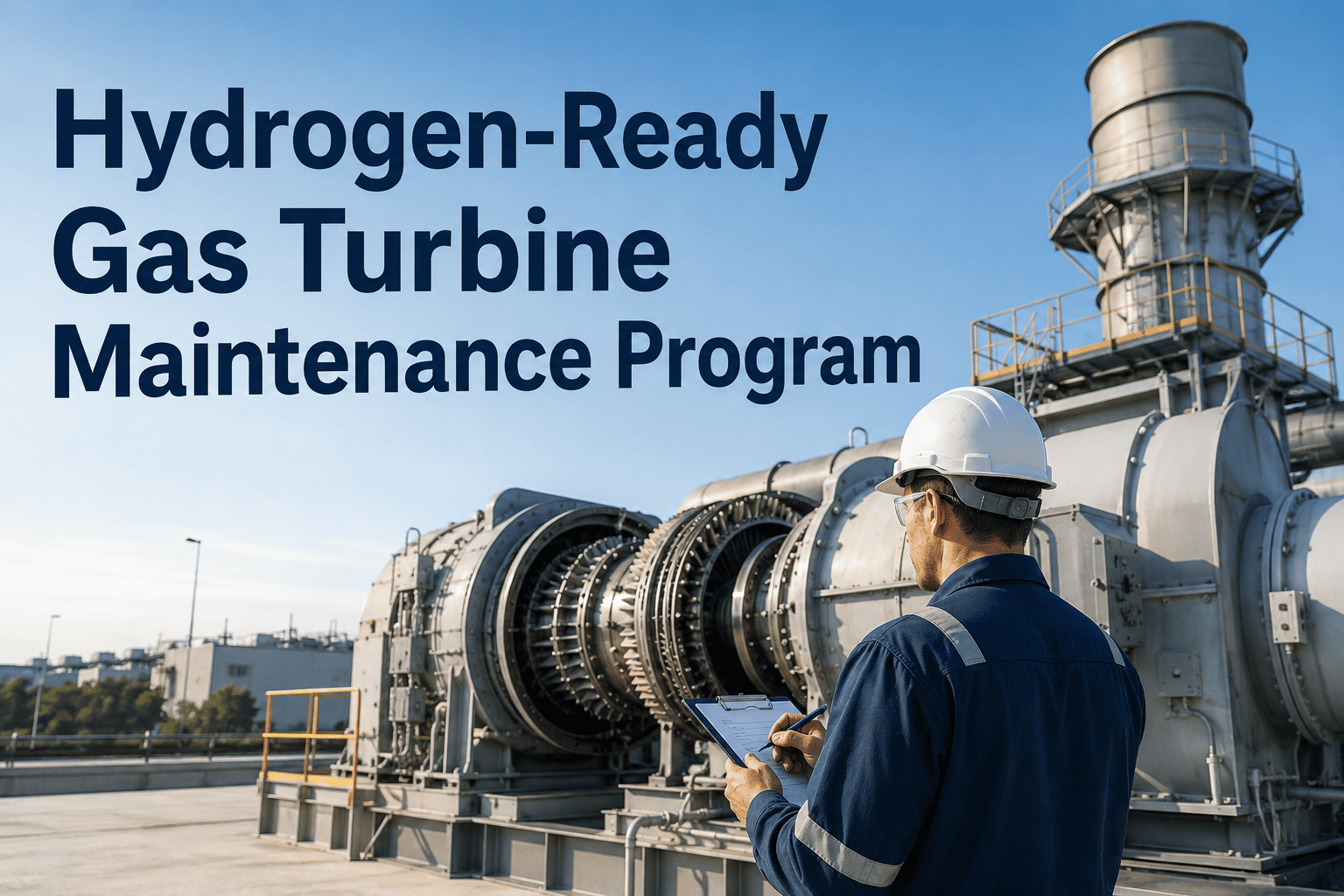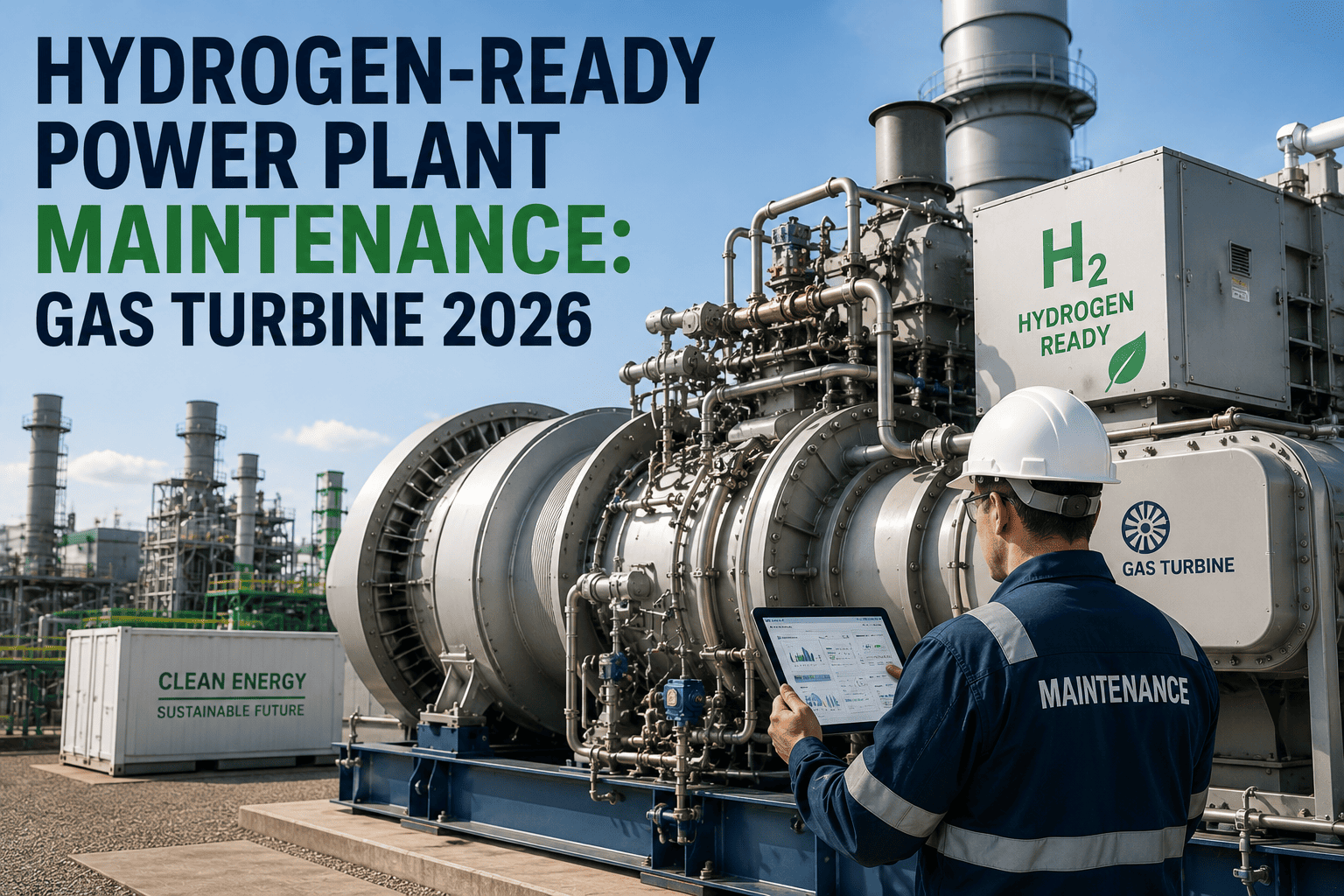
Hydrogen-ready gas turbine maintenance demands a fundamentally different playbook than natural-gas-only operations — by 2026, over 40% of new large-frame turbines are expected to ship H2-capable, and retrofitting existing fleets means rethinking combustion hardware, fuel-system materials, NOx monitoring, and preventive maintenance scheduling from the ground up. Hydrogen burns hotter and faster, embrittles certain alloys, and raises flame temperatures by 200–300°C, which directly impacts hot-gas-path inspection intervals, spare-parts strategy, and compliance documentation. This guide maps the full H2 turbine maintenance lifecycle — fuel delivery, combustion dynamics, materials compatibility, emissions control, and CMMS readiness — so your reliability team can transition without unplanned outages or regulatory surprises. If you are scaling hydrogen power plant maintenance across multiple assets, OxMaint's AI-powered CMMS automates work-order scheduling, tracks H2-specific spare parts, and predicts hot-gas-path degradation before it forces a trip — you can Start Free Trial today or book a personalized demo below.
Hydrogen Turbine Maintenance 2026
Is your maintenance program ready for 100% hydrogen fuel?
H2 combustion raises flame temperatures up to 300°C, accelerates hot-gas-path wear, and demands new inspection intervals, material specs, and emissions monitoring — all before the 2026 readiness deadline. The plants that act now will avoid unplanned outages and compliance penalties.
A single unplanned H2-related turbine trip costs $340K–$1.2M in lost generation and restart fuel. OxMaint's predictive maintenance engine flags degradation patterns 2–4 weeks before failure, cutting unplanned downtime by 30–50%.
Maintenance Readiness Checklist
Hydrogen gas turbine maintenance checklist: 12 critical inspection areas
Transitioning an H2-ready turbine from commissioning to full hydrogen operation requires inspecting and re-certifying systems that natural-gas maintenance programs never touch. Below are the four priority tiers — each item should be a tracked preventive maintenance task in your CMMS with a defined interval, owner, and compliance record.
Fuel Delivery System
- Inspect H2 piping for embrittlement — API 941 materials (304L, 316L) every 6 months
- Leak-test all flanged joints and valve seats quarterly with H2-specific detectors
- Verify flame arrestors and deflagration relief vents — monthly functional test
- Calibrate H2 concentration sensors at fuel skid — 90-day interval, drift ≤2%
Combustion & Hot Gas Path
- Borescope combustor liners and transition pieces — shorten interval by 40% at >30% H2
- Inspect DLN/DLE fuel nozzles for flashback damage — every 8K operating hours
- Check first-stage turbine blades for thermal creep — ultrasonic thickness at 12K hours
- Record combustion dynamics (dynamic pressure transducers) — trend daily for flashback
Emissions & NOx Control
- Calibrate CEMS NOx analyzers — 15 ppm limit at 15% O2, quarterly RATAs
- Verify steam/water injection rates for NOx suppression — weekly flow validation
- Monitor exhaust temperature spread — >15°C deviation triggers inspection
- Log H2O vapor concentration in exhaust — condensation corrosion risk above 18%
Materials & Lubrication
- Audit seals and gaskets for H2 compatibility — replace nitrile with EPDM or Kalrez
- Test lube oil for H2 absorption — quarterly Karl Fischer moisture, TBN trending
- Inspect hydrogen seal oil system — differential pressure 0.2–0.5 bar above H2 side
- Verify casing drain systems for H2 accumulation — weekly bubble test
ROI Analysis
Cost of reactive vs. predictive H2 turbine maintenance: the numbers
A 180-asset power plant operating two H2-capable large-frame turbines typically spends $1.2M annually on maintenance. Transitioning from reactive breakdown maintenance to a predictive, CMMS-driven H2 maintenance program fundamentally changes the cost curve. Here is the financial model.
Annual Downtime Cost (Reactive)
Unplanned Trips × Duration × Generation Rate + Restart Fuel
4 trips/yr × 18 hrs × $8,500/hr + $22K restart = $656K
Annual Savings (Predictive via OxMaint)
Downtime Cost × Downtime Reduction % + Spares Optimization
$656K × 40% + $84K inventory = $346K/yr saved
| Maintenance Metric | Reactive (Status Quo) | OxMaint Predictive | Annual Impact |
|---|---|---|---|
| Unplanned turbine trips | 4–6 per year | 1–2 per year | −$340K to −$510K |
| Mean time to repair (MTTR) | 22 hours | 12 hours | −$85K labor + restart |
| Hot-gas-path overhaul cost | $2.4M (reactive scope) | $1.8M (planned scope) | −$600K per overhaul cycle |
| Spare-parts inventory carrying | $420K (overstocked) | $280K (right-sized) | −$140K working capital |
| Compliance documentation labor | 180 hrs/yr manual | 20 hrs/yr automated | −$24K labor |
| Total estimated annual savings | — | — | $346K–$590K |
Model based on a two-unit 7FA-class plant at 50% H2 blend, 6,500 operating hours/year, $85/MWh wholesale rate. Actual results vary by fleet size, H2 percentage, and current maintenance maturity.
Transition Roadmap
How to build an H2-ready turbine maintenance program: 6-month timeline
Plants that methodically phase in hydrogen maintenance readiness over six months avoid the two most common failure modes: rushed material audits that miss embrittlement risks, and incomplete CMMS reconfiguration that leaves H2-specific tasks untracked. Here is the month-by-month roadmap used by plants that successfully crossed 30% H2 blending without a single unplanned trip.
Month 1
Baseline Asset & Materials Audit
Catalog every component in the H2 fuel path — piping, valves, seals, gaskets, sensors — and flag materials incompatible with hydrogen service per API 941 and ASME B31.12. Load all assets into OxMaint with H2-compatibility tags so future work orders automatically reference the correct material specs.
Month 2
Rebuild Preventive Maintenance Schedules
Shorten borescope inspection intervals by 30–40% for units at >30% H2. Create H2-specific PM templates in OxMaint for fuel-system leak tests, sensor calibration, combustion-dynamics trending, and seal-oil differential checks — each with digital checklists and photo capture.
Month 3
Spare-Parts Strategy & Critical Spares Buffer
Identify H2-specific consumables — DLN nozzles, flashback-resistant liners, EPDM/Kalrez seals, H2-certified sensors — and set min/max reorder points in OxMaint's inventory module. Lead times for H2-rated combustor parts can exceed 14 weeks; buffer accordingly.
Month 4
Sensor Integration & Predictive Analytics
Connect combustion dynamics, exhaust temperature spread, and NOx CEMS data feeds into OxMaint's predictive engine. Configure anomaly thresholds: combustion pressure oscillation >2.5 kPa, exhaust spread >15°C, NOx drift >10% from baseline — each auto-generates a prioritized work order.
Month 5
Compliance & Documentation Hardening
Map every H2 maintenance task to its regulatory citation — EPA 40 CFR Part 60 Subpart KKKK, ISO 55000 asset management, local air-quality permits. OxMaint auto-generates audit trails linking work orders, technician sign-offs, sensor readings, and parts consumed into a single compliance packet.
Month 6
Full H2 Blend Ramp-Up & Live Monitoring
Begin staged H2 blending increases — 5%, 15%, 30%, 50% — with OxMaint dashboards displaying real-time combustion dynamics, NOx, and maintenance backlog. Run the predictive model for 30 days at each plateau before increasing blend. Target: zero unplanned trips during ramp-up.
How OxMaint Helps
OxMaint: the CMMS built for hydrogen turbine maintenance
Most CMMS platforms were designed for natural-gas operations and cannot model H2-specific degradation curves, material compatibility rules, or multi-blend inspection logic. OxMaint was architected to handle exactly these variables — here is how four core capabilities map directly to hydrogen maintenance outcomes.
H2-Aware Predictive Maintenance
OxMaint's AI engine ingests combustion dynamics, exhaust spread, and vibration data, then models hot-gas-path degradation against your specific H2 blend percentage. It auto-adjusts inspection intervals as blend ratios change — no manual schedule recalculation.
Outcome: 30–50% fewer unplanned turbine trips
Digital H2 Work Orders & Checklists
Every H2 maintenance task — from API 941 piping inspections to seal-oil differential checks — runs as a mobile digital work order with step-by-step checklists, mandatory photo capture, and material-spec validation. No paper, no gaps, no missed steps.
Outcome: 100% audit-ready documentation in real time
H2-Specific Spare-Parts Tracking
Tag every spare with H2 compatibility ratings, blend-level thresholds, and lead-time buffers. OxMaint tracks min/max levels for 14-week-lead-time H2 combustor parts and auto-generates purchase requests before stock hits critical — no more scrambling mid-outage.
Outcome: 25–35% reduction in inventory carrying cost
Live NOx & Combustion Dashboards
Real-time dashboards display NOx ppm, combustion dynamics, exhaust temperature spread, and H2 blend percentage side-by-side with maintenance backlog. When emissions drift >10% from baseline, OxMaint auto-triggers an inspection work order before regulators ever see the deviation.
Outcome: zero compliance violations during H2 ramp-up
See OxMaint on your hydrogen assets
Book a 30-minute demo with H2 maintenance workflows built in
We will load your turbine models, H2 blend targets, and current PM schedules into a live OxMaint environment so you can see predictive alerts, work-order automation, and compliance reporting on your own data — before you switch.
Frequently Asked Questions
Hydrogen turbine maintenance: what reliability teams ask most
How often should H2 gas turbine combustors be inspected?
At hydrogen blend levels above 30%, borescope inspections of combustor liners and DLN fuel nozzles should occur every 8,000 operating hours — roughly 40% more frequently than natural-gas-only intervals. Flame temperatures rise 200–300°C with H2, accelerating thermal creep and flashback damage on nozzle tips. OxMaint automatically adjusts these intervals based on your actual blend percentage and operating hours, so the inspection schedule is always correct without manual recalculation.
What materials are incompatible with hydrogen turbine service?
Nitrile rubber (Buna-N), standard carbon steels with hardness above 22 HRC, and certain 400-series stainless steels are susceptible to hydrogen embrittlement and should be replaced with 316L stainless, EPDM, Kalrez, or Inconel 625/718 per API 941 and ASME B31.12. A full material audit of the fuel delivery path is essential before any H2 blending begins. OxMaint tags every asset with material compatibility data so work orders automatically flag incompatible replacement parts.
Does hydrogen blending increase NOx emissions?
Yes — hydrogen's higher flame temperature typically raises NOx output by 15–35% at equivalent loads unless combustion tuning and steam/water injection are adjusted. Most H2-capable DLN systems are redesigned to hold NOx below 15 ppm at 15% O2, but this requires continuous CEMS monitoring and frequent calibration. OxMaint's live dashboards track NOx against your permit limits and auto-generate calibration work orders quarterly to stay compliant with 40 CFR Part 60 Subpart KKKK.
Can existing CMMS software handle hydrogen turbine maintenance?
Most legacy CMMS platforms lack fields for H2 blend percentage, material compatibility ratings, or combustion-dynamics integration — forcing teams to track H2-specific tasks in spreadsheets alongside the CMMS, which creates audit gaps and missed inspections. OxMaint was built with H2-ready asset tagging, blend-dependent PM logic, and sensor-data ingestion so everything lives in one system. You can Book a Demo to see H2 workflows on a live environment.
What is the payback period for an H2-specific CMMS implementation?
For a two-unit plant spending $1.2M annually on turbine maintenance, implementing OxMaint for hydrogen-ready operations typically pays back in 4–7 months. The savings come from three sources: 30–50% fewer unplanned trips ($340K–$510K/yr), 25–35% lower spare-parts carrying cost ($84K–$140K/yr), and eliminated manual compliance labor ($20K–$24K/yr). Implementation takes 2–4 weeks including data migration from spreadsheets or legacy CMMS.
Start your hydrogen readiness program today
Get OxMaint running on your H2 turbine fleet in under 14 days
Import your asset list, PM schedules, and spare-parts inventory. Configure H2-specific inspection templates and predictive alerts. Go live before your next combustion inspection cycle — no migration fees, no long implementation.
Free 14-day trial · No credit card

.png)