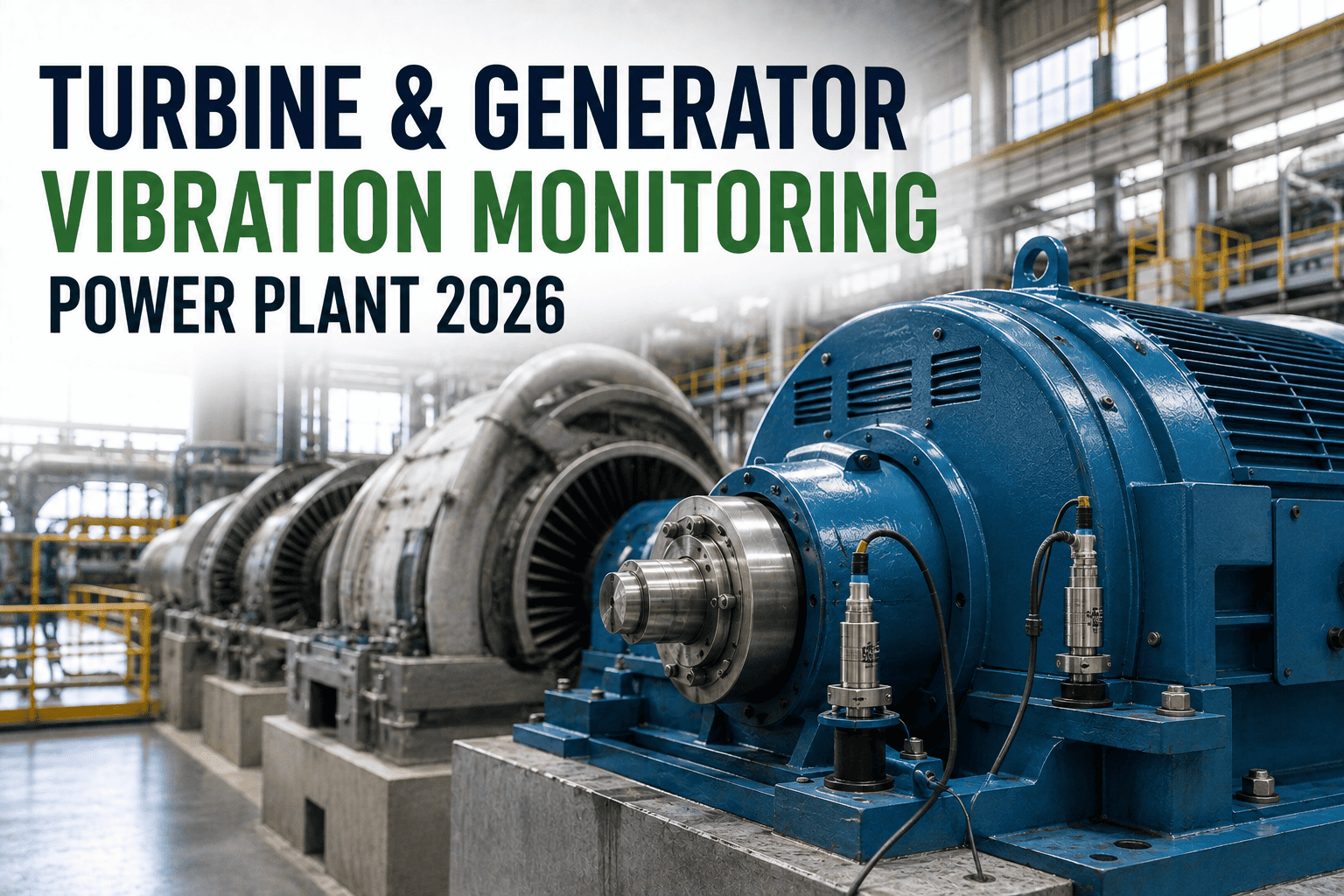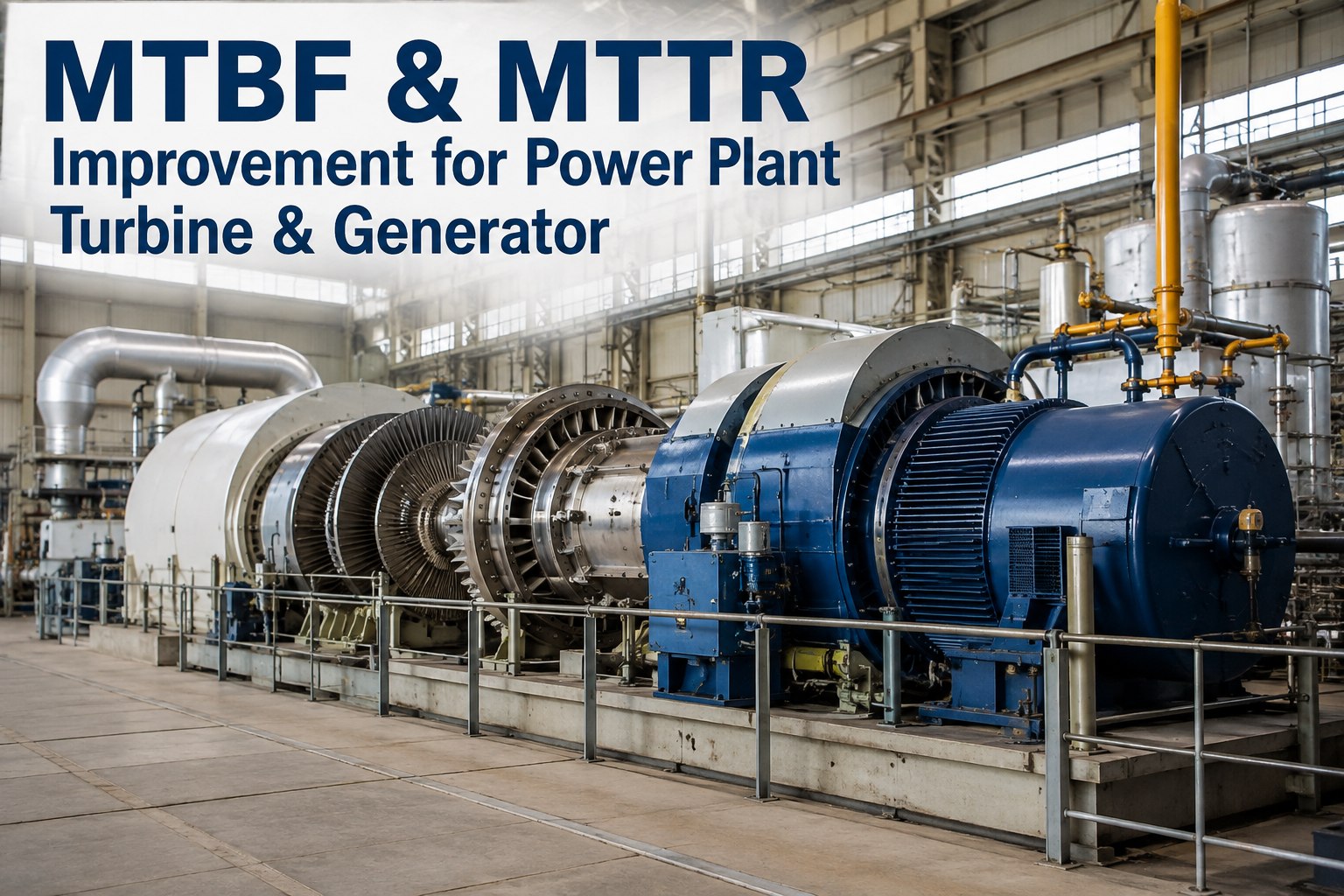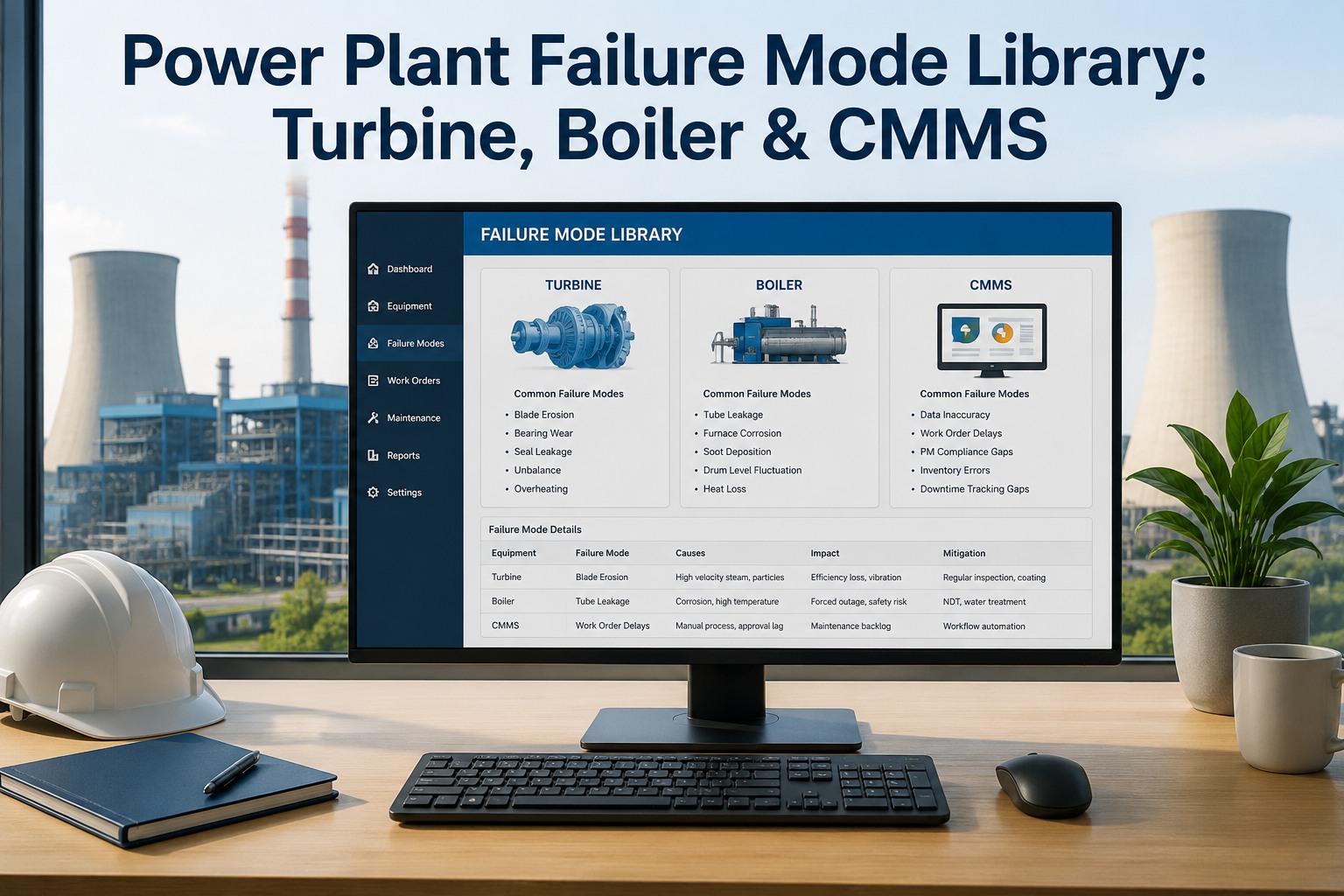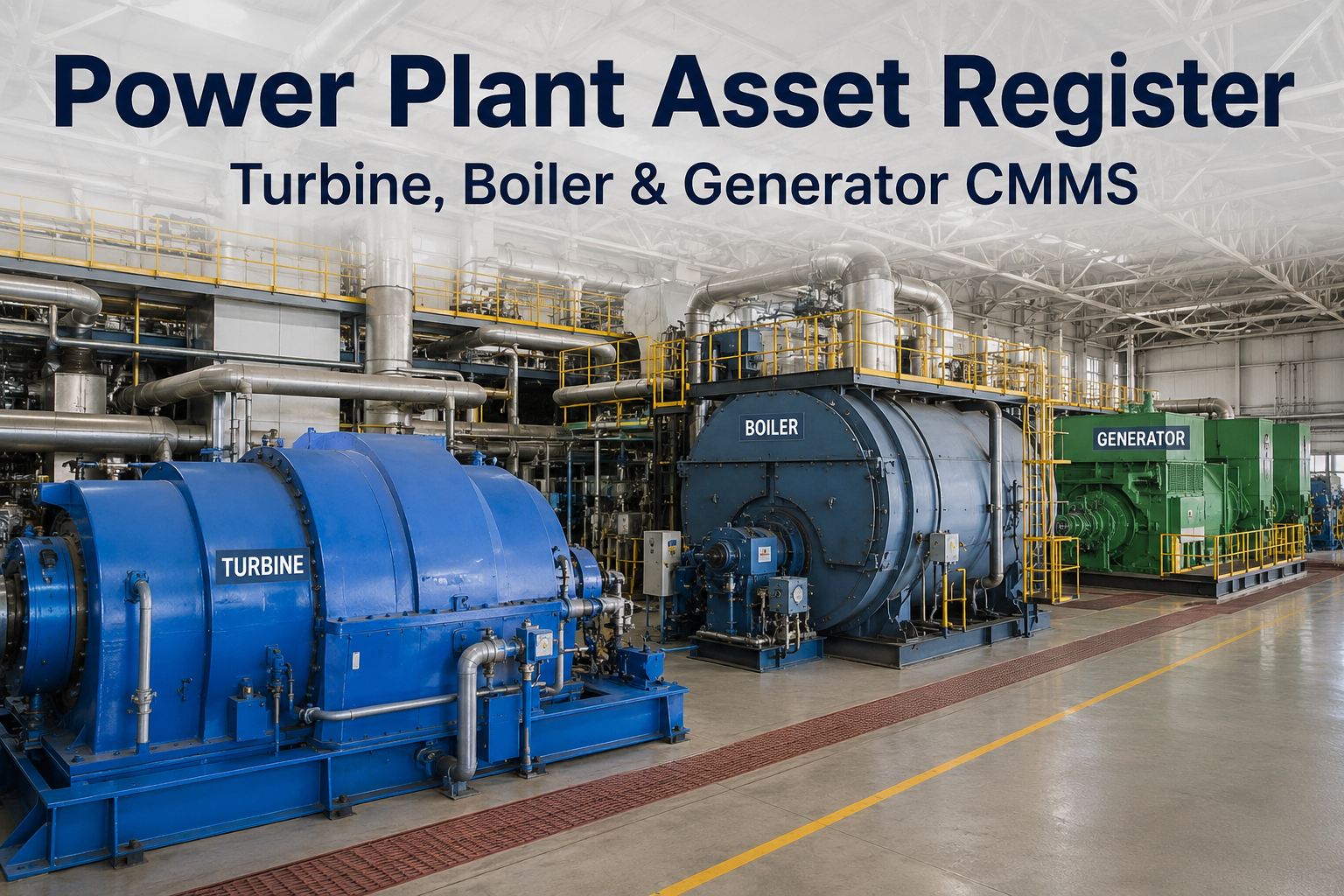
Remaining useful life prediction for power plant turbines and generators—covering turbine blade RUL, generator winding RUL and bearing remaining life—helps reliability teams anticipate failures, schedule outages strategically, and avoid unplanned downtime that can cost upwards of $10,000 per MW per day. By combining condition-monitoring data with historical operating profiles, engineers can calculate how much life is left in critical assets like steam turbine blades, generator winding insulation, and journal bearings before failure probability becomes unacceptable. Implementing a CMMS that tracks these RUL indicators—such as OxMaint—transforms raw inspection data into automated work orders, preventive maintenance schedules, and predictive alerts so repairs happen during planned outages, not mid-cycle. If you want to see how this works on your assets, you can Start Free Trial today, or read on for the full remaining life guide.
RUL PREDICTION FOR POWER PLANTS
How much life is left in your turbine blades and generator windings?
Blade erosion, winding insulation degradation and bearing wear each follow distinct degradation curves. When you can calculate the remaining useful life (RUL) of these critical components within a CMMS, you shift from reactive firefighting to planned, cost-controlled interventions — extending asset life by 15–30% and cutting unplanned outage risk dramatically.
WHAT DRIVES TURBINE BLADE RUL
Key Factors Affecting Turbine Remaining Life
A steam turbine blade typically operates 100,000–200,000 hours before requiring replacement — but erosion, fatigue and creep can cut that by 40% if condition data isn't tracked.
Solid Particle Erosion (SPE)
Oxide scale from boiler tubes impacts first-stage blades at 500°C+, thinning leading edges. Monitoring steam purity and erosion rate lets you predict blade RUL within a ±6-month window — and trigger inspection work orders before loss of efficiency exceeds 2%.
Creep & Thermal Fatigue
Cyclic operation (daily start-stop) accelerates creep rupture in root attachments. Tracking equivalent operating hours (EOH) against the OEM creep curve gives a defensible remaining life estimate for high-pressure blades and rotors.
Vibration & Tip Clearance
A 20% rise in blade-passing vibration frequency often signals tip rub or looseness. Trending vibration spectra inside a CMMS flags the exact stage and estimated remaining operating hours before a major overhaul is unavoidable.
Corrosion Pitting (L-1 / L-0)
Moisture in the last-stage blades causes stress-corrosion cracking. Borescope inspection intervals should tighten once pitting density exceeds 3 pits/cm² — a threshold OxMaint can auto-flag from inspection checklists.
DEGRADATION CURVES
Generator Winding RUL: Insulation Life Prediction
Generator stator winding insulation degrades following a 10°C rule — every 10°C rise above design temperature halves remaining insulation life. A well-tracked winding RUL program prevents $500K–$2M stator rewind failures.
INSULATION REMAINING LIFE (YEARS)
RULwinding = Lrated × 2(Trated − Toperating) / 10
Where Lrated = design life (typically 30 yrs), Trated = rated hotspot temp (e.g. 155°C for Class F), Toperating = measured hotspot. A generator running 10°C hot loses 50% of its remaining winding life.
BEARING REMAINING LIFE (L₁₀)
L10 = (C / P)p × (106 / 60n)
C = dynamic load rating, P = equivalent load, p = 3 for ball / 3.33 for roller bearings, n = RPM. When vibration trending shows spalling initiation, actual bearing RUL is typically 10–20% of the calculated L₁₀.
WORKED EXAMPLE
A 500 MW gas turbine plant tracks its generator stator winding at 165°C hotspot — 10°C above the 155°C Class F design. Applying the 10°C halving rule, a winding originally rated for 30 years loses 15 years of life. If the unit has already run 12 years, the estimated generator winding RUL is just 3 years, not the 18 years a calendar-based PM plan would assume. OxMaint's predictive analytics flagged this trend from continuous temperature logs, auto-generated a stator insulation test work order, and gave the planning team 8 months to source a rewind contractor — avoiding a forced outage that would have cost $1.2M in lost generation and emergency repair premiums.
RUL MAINTENANCE STRATEGY
From Blade Life Prediction to Action: The 6-Step RUL Workflow
Plants that formalise their RUL maintenance power strategy see a 25–40% reduction in unplanned downtime within the first year of implementation.
Baseline Asset Condition
Import OEM design life, operating-hour logs, and historic inspection findings into the CMMS asset registry. OxMaint normalises data across turbine stages, generator windings, and bearings so every component has a digital twin starting point.
Feed Live Sensor Data
Connect vibration, temperature, partial-discharge and oil-analysis feeds. The OxMaint integration layer accepts OPC-UA, Modbus and MQTT so your SCADA historian streams directly into the asset record — no manual data entry.
Calculate Component RUL
Apply physics-based models (Arrhenius for insulation, Miner's rule for fatigue, L₁₀ for bearings) alongside AI-trended anomaly detection. OxMaint recalculates turbine remaining life and generator RUL after every inspection or sensor update.
Prioritise by Criticality & RUL
Each asset receives a dynamic risk score combining RUL shortness, failure consequence (safety, production, environmental), and spare-parts lead time. A blade with 4 months RUL and a 6-month forge lead time jumps to the top of the overhaul plan.
Trigger Preventive & Predictive Tasks
When RUL crosses a threshold (e.g. <12 months for bearings), OxMaint auto-generates a work order with task checklists, required spares from inventory, and the assigned technician — turning prediction into scheduled action.
Update Model with Inspection Findings
Borescope, megger, and dissipation-factor test results feed back into the RUL calculation, tightening the prediction. This closed loop is what separates a living RUL program from a static spreadsheet — and what drives the 30%+ downtime reduction.
HOW OXMAINT HELPS
OxMaint: The AI-Powered CMMS for Turbine Lifecycle & RUL
OxMaint unifies condition data, work-order automation, and spare-parts inventory so your RUL predictions actually drive maintenance decisions — not just dashboards.
Predictive RUL Engine
AI models trend vibration, temperature, and PD data to recalculate blade, winding, and bearing RUL continuously — alerting you 30–90 days before failure. Outcome: cut unplanned downtime 30–50%.
Automated Work Orders
When RUL crosses a threshold, OxMaint auto-creates a work order with checklist, spare parts, and technician assignment — eliminating paper and email. Outcome: 70% less admin time on PM scheduling.
Asset & Spare-Parts Linkage
Every RUL-driven task pulls the correct blade, winding kit, or bearing from inventory — and reserves it. Lead-time warnings ensure 6-month forge orders are placed on time. Outcome: eliminate 95% of stock-out delays.
Maintenance Analytics & Audit Trail
Full RUL history per asset — inspection results, model recalibration, work-order closure — is logged for ISO 55000 compliance and insurer audits. Outcome: pass audits in hours, not weeks.
REACTIVE vs PREDICTIVE
Calendar-Based PM vs RUL-Driven Maintenance: Cost Comparison
A 180-asset power plant spending $42K/yr on fixed-interval PM can save $18K–$25K annually by switching to RUL-based task triggers — while also reducing unplanned failures.
| Maintenance Approach | Avg. Annual Cost (180 assets) | Unplanned Downtime/yr | Spare-Parts Waste | RUL Visibility |
|---|---|---|---|---|
| Reactive (Run-to-Failure) | $68,000 | 240 hrs | Low | None |
| Calendar-Based PM | $42,000 | 95 hrs | High (22% overhauled early) | Static / OEM estimate |
| OxMaint RUL-Driven | $24,000 | 22 hrs | Minimal (3%) | Live, AI-recalculated |
SEE IT ON YOUR ASSETS
Stop guessing. Start predicting remaining useful life.
See how OxMaint turns your turbine, generator, and bearing condition data into automated, RUL-driven work orders — in a 30-minute live demo on your asset hierarchy.
FREQUENTLY ASKED QUESTIONS
Power Plant RUL: Your Top Questions Answered
What is remaining useful life (RUL) in a power plant turbine?
Remaining useful life is the estimated operating time (in hours or cycles) a turbine component — such as a blade, rotor, or bearing — has left before its failure probability exceeds an acceptable threshold. It is calculated by combining OEM design life, current operating-hours, and condition-monitoring data (vibration, temperature, erosion rate). OxMaint's CMMS continuously recalculates turbine RUL as new inspection and sensor data arrives, so maintenance teams always have a live estimate rather than a static spreadsheet figure.
How is generator winding RUL calculated?
Generator winding RUL is most commonly calculated using the thermal ageing 10°C halving rule: for every 10°C the stator hotspot temperature exceeds the insulation class rating, the remaining insulation life is halved. Engineers combine this with partial-discharge trending, dissipation-factor (tan-δ) tests, and visual borescope findings. When winding RUL drops below a set threshold (e.g. 3–5 years), OxMaint auto-generates an insulation-test work order and flags the generator for a planned rewind — you can Book a Demo to see the alert workflow.
Why should a power plant use a CMMS for RUL maintenance?
A CMMS like OxMaint closes the loop between RUL prediction and maintenance action. Without a CMMS, RUL calculations live in isolated spreadsheets that rarely trigger timely work orders. OxMaint links each asset's RUL score to its work-order system, spare-parts inventory, and inspection history — so when blade life prediction drops to 6 months, the correct blade is reserved, a borescope inspection is scheduled, and the planning team is notified automatically.
What data is needed to predict turbine blade remaining life?
Blade life prediction requires four data streams: (1) OEM design life and material specs, (2) cumulative operating hours and start-stop cycles (EOH), (3) condition-monitoring data such as vibration spectra, steam purity logs, and efficiency decay, and (4) inspection findings from borescope or NDT (non-destructive testing) reports. OxMaint ingests all four via manual entry, CSV import, or live SCADA integration (OPC-UA / Modbus), providing a single asset record for each blade stage.
How accurate is RUL prediction for power plant equipment?
RUL accuracy depends on data quality and model maturity. Physics-based models (Arrhenius, Miner's rule, L₁₀) typically predict within ±10–15% of actual failure time when fed consistent condition data. AI-enhanced models — like those in OxMaint — improve accuracy over time as they learn from each inspection and failure event. Most plants achieve actionable RUL windows (accurate enough to plan a major overhaul) within 6–9 months of deploying the CMMS on critical assets. You can Start Free Trial to benchmark accuracy on your own equipment.
READY TO EXTEND ASSET LIFE?
Predict blade, winding & bearing RUL — then act on it automatically.
OxMaint gives your reliability team AI-driven remaining life prediction, automated work orders, and full ISO 55000-ready audit trails. Join the power plants cutting unplanned downtime by 77%.
Free 14-day trial · No credit card