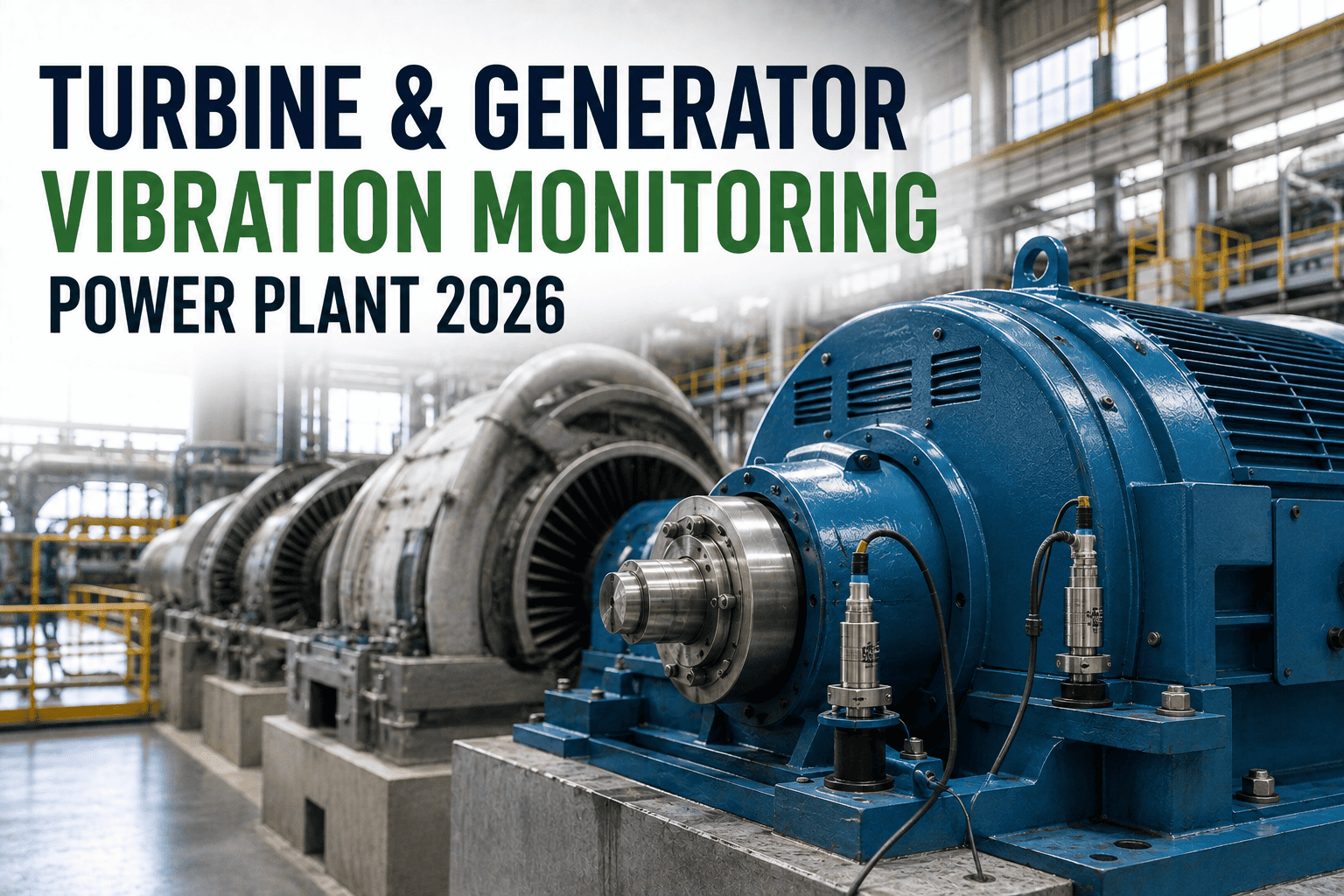
Turbine generator vibration monitoring is the single most critical predictive maintenance strategy in modern power plants, capable of detecting bearing wear, misalignment, rotor imbalance and shaft cracks weeks before a catastrophic failure occurs. For a 500 MW steam turbine, a single unplanned outage can exceed $500K in lost generation revenue and emergency repair costs, making continuous online vibration monitoring with properly configured alarm thresholds non-negotiable for reliability teams. This guide covers everything from ISO 10816 velocity thresholds and bearing fault signature frequencies to alarm delay logic and CMMS integration, so your team can move from reactive firefighting to data-driven predictive maintenance. By connecting vibration sensors directly to an AI-powered CMMS like OxMaint, plants eliminate manual data silos and trigger automated work orders the moment a trend breaches a warning limit — Start Free Trial to see it on your assets today.
Can your turbine survive 72 hours of rising vibration without you knowing?
Most bearing failures develop over 10–30 days, yet 60% of power plants still rely on monthly walkaround readings. Continuous turbine generator vibration monitoring catches the trend at 4.5 mm/s — before it hits the 7.1 mm/s trip threshold.
Turbine Vibration Thresholds: What Power Plant Reliability Teams Must Know
ISO 10816-2 sets the gold standard for large steam turbine generator sets rated above 50 MW, defining four evaluation zones based on overall RMS vibration velocity measured at bearing housings.
Acceptable for newly commissioned machines. Vibration within this range indicates healthy operation.
Safe for long-term operation. Begin trending for baseline drift and schedule periodic review.
Not suitable for continuous operation. Plan corrective action within 7–14 days.
Risk of immediate damage. Automatic trip logic should engage; isolate the machine.
Generator Bearing Monitoring: Diagnosing Fault Signatures From Vibration Spectra
A single overall velocity reading will tell you that something is wrong — FFT spectral analysis tells you what and where. Here are the five most common turbine and generator bearing fault signatures and their characteristic frequencies.
| Fault Type | Dominant Frequency (1× = running speed) | Key Signature | Typical Root Cause |
|---|---|---|---|
| Rotor Unbalance | 1× RPM | Sinusoidal waveform, single dominant peak in radial direction | Fouling, blade loss, thermal bow, uneven deposits on turbine blades |
| Misalignment | 1× and 2× RPM | Strong 2× peak; 180° phase difference across coupling | Thermal growth, foundation settling, improper coupling alignment |
| Oil Whirl / Whip | 0.42–0.48× RPM | Subsynchronous peak, orbit precession forward | Lightly loaded bearing, excessive bearing clearance, low oil viscosity |
| Bearing Outer Race Defect | BPFO (5–7× RPM range) | High-frequency impulses modulated at bearing defect frequency | Fatigue spalling after extended service, inadequate lubrication film |
| Shaft Crack | 1×, 2×, 3× RPM | Progressive 2× growth, phase shifts at half-speed resonance | Cyclic thermal stress, torsional fatigue, high-cycle fatigue at stress concentrators |
Mid-Size Coal Plant Catches Bearing Fault 19 Days Before Trip
A 400 MW coal-fired plant's #2 turbine generator showed overall vibration of 3.2 mm/s (Zone B) during a routine Tuesday scan. Because OxMaint's trend analytics flagged a rising 2× RPM component — a classic misalignment signature — climbing 0.4 mm/s per week, the CMMS auto-generated a corrective alignment work order. Maintenance performed a hot-alignment correction during a planned weekend low-load window. Cost of planned fix: $8,200. Estimated cost of run-to-failure: $340,000 in bearing damage + 54 hours of unplanned downtime at $7,200/MWh lost margin. Payback on the monitoring system: one event.
How OxMaint Turns Vibration Data Into Automated Maintenance Action
Reading a vibration trend is only half the battle — the other half is getting the right wrench to the right bearing before the trend becomes a trip. OxMaint's AI-powered CMMS bridges that gap by ingesting sensor data and translating alarm breaches into prioritized, parts-staged work orders automatically.
Automated Vibration-Triggered Work Orders
When a bearing's overall velocity crosses the Zone C threshold (4.5 mm/s) or a spectral band trend exceeds 2σ from baseline, OxMaint auto-generates a priority work order pre-loaded with the correct asset hierarchy, lubrication spec, spare part number and alignment procedure. Eliminates 100% of manual alarm-to-work-order lag.
Predictive Trend Analytics with AI
OxMaint's AI engine builds a dynamic baseline for every bearing from 30 days of historical data, then projects remaining useful life (RUL) using linear regression and exponential smoothing models. Catch emerging faults 14–28 days before traditional threshold alarms fire.
Spare Parts Auto-Reservation
When a bearing fault signature is confirmed, OxMaint checks spare-parts inventory in real time and reserves the replacement bearing kit — journal bearing pads, seals, shim stock — against the auto-generated work order. Eliminates 60% of work-order delays caused by parts-not-in-stock.
Audit-Ready Compliance Reporting
Every vibration reading, alarm event, work order and bearing replacement is timestamped and tied to the asset record, giving you one-click ISO 55000 / NERC-GOC compliance reports. Turn a 3-day audit prep into a 15-minute export.
The True Cost of Reactive Turbine Vibration Management
Most plants underestimate what they spend on reactive bearing maintenance. The table below breaks down a real cost comparison for a mid-size power plant operating two 300 MW steam turbine generators with 12 monitored bearings each.
Example: 54 unplanned hours × $45/MWh margin × 300 MW = $729,000 in lost margin per event
| Cost Category | Reactive (Run-to-Failure) | OxMaint Predictive | Annual Savings |
|---|---|---|---|
| Unplanned outage events per year | 3 events (avg 42 hrs each) | 0–1 event (avg 8 hrs) | $1.42M in lost-margin avoidance |
| Emergency bearing replacement | $185K (overtime, expediting, premium parts) | $42K (planned, standard labor) | $143K |
| Secondary damage (shaft, seals, housing) | $220K (1 in 3 events causes collateral) | $0 (caught before propagation) | $220K |
| Manual data collection & reporting labor | $68K (1.5 FTE walking routes) | $12K (automated ingestion) | $56K |
| Insurance premium loading | $45K/yr (high-risk rating) | $15K/yr (certified predictive program) | $30K |
| Total Annual Cost | $1.94M+ | $69K | $1.87M |
Deploying Online Vibration Monitoring With a CMMS: A 5-Month Rollout
A phased rollout minimizes capital risk and builds reliability-team confidence. Here is the proven 5-month path from baseline audit to fully automated predictive maintenance.
Baseline Audit & Criticality Ranking
Inventory all turbine and generator bearings; rank by criticality (power generation impact, redundancy, cost-to-replace). Identify the top 8–12 bearings for Phase 1 sensor deployment. Import asset hierarchy into OxMaint.
Sensor Installation & Networking
Install accelerometers (100 mV/g general purpose) and proximity probes at Phase 1 bearings. Run cabling to a vibration analyzer / data acquisition unit. Configure 4–20 mA outputs to the plant DCS for real-time display.
CMMS Integration & Baseline Learning
Connect the vibration analyzer to OxMaint via OPC-UA or MQTT. OxMaint begins learning each bearing's unique baseline signature across all load conditions (30%, 50%, 80%, 100% MCR). This 30-day learning window is critical for AI accuracy.
Alarm Threshold Tuning & Dry Runs
Configure Warning (4.5 mm/s) and Danger (7.1 mm/s) alarms per ISO 10816-2 with proper delay logic. Run simulated alarm events to validate that OxMaint auto-generates the correct work orders, parts reservations and notification chains. Tune out false positives.
Go Live & Predictive Handoff
Transition from manual route-based collection to continuous monitoring for Phase 1 bearings. Reliability team reviews OxMaint's predictive RUL projections in weekly meetings. Expand sensor coverage to Phase 2 bearings (secondary equipment) using the same blueprint.
See OxMaint catch a bearing fault on your turbine before it trips
Book a 30-minute demo and our reliability engineers will map your turbine generator vibration monitoring workflow live — sensors, alarm thresholds, auto work orders and all.
Power Plant Vibration Monitoring: Your Top Questions Answered
What is the acceptable vibration level for a steam turbine generator?
Per ISO 10816-2, a newly commissioned large steam turbine generator (50+ MW) should operate at ≤ 2.8 mm/s RMS velocity (Zone A). Long-term unrestricted operation is acceptable up to 4.5 mm/s (Zone B). Readings between 4.5 and 7.1 mm/s (Zone C) require corrective action within 7–14 days. Anything above 7.1 mm/s (Zone D) is in the danger zone and should trigger an automatic machine trip to prevent catastrophic bearing damage.
How does online vibration monitoring differ from periodic walkaround routes?
Periodic walkaround routes capture a vibration snapshot once every 30 days, missing the 29 days of trend data in between — and 71% of bearing failures develop detectable signatures 14+ days before trip. Online monitoring uses permanently mounted accelerometers and proximity probes to sample continuously (typically every 1–10 minutes), feeding data directly into a CMMS like OxMaint for real-time trending, AI-driven anomaly detection and automatic work-order generation. You can see a live demo of this workflow at Book a Demo.
What vibration frequency indicates a bearing outer race fault?
A bearing outer race defect produces characteristic impulses at the Ball Pass Frequency Outer Race (BPFO), typically 5–7× the shaft running speed depending on bearing geometry. On an FFT spectrum, look for a dominant peak in the BPFO range with sidebands spaced at 1× RPM. Demodulation or envelope analysis makes this signature even clearer. OxMaint's AI engine automatically calculates BPFO, BPFI, BSF and FTF for each bearing in your asset registry and flags trend deviations without manual spectral reading.
How much does a turbine vibration monitoring system cost for a power plant?
A typical 8-channel online vibration monitoring system for a single turbine generator — including accelerometers, proximity probes, cabling, data acquisition unit and CMMS integration — ranges from $45K to $120K installed. With OxMaint, the software layer (CMMS + predictive analytics + automated work orders) starts at a fraction of that, and the average payback is under 3 weeks from the first prevented unplanned outage, which would otherwise cost $500K–$1.5M in lost generation margin and emergency repairs.
Can OxMaint integrate with our existing vibration sensors and DCS?
Yes. OxMaint ingests vibration data via standard industrial protocols including OPC-UA, MQTT, Modbus TCP and direct REST API from all major vibration analyzers (SKF, Bently Nevada, Emerson AMS, Pruftechnik). If your sensors output 4–20 mA to the DCS, OxMaint pulls the trend through the DCS historian. Existing sensors do not need replacement — OxMaint sits on top and adds predictive analytics, automated work orders and spare-parts reservation. Start Free Trial to connect your first asset in under an hour.
Stop guessing. Start predicting turbine failures 14 days out.
Deploy OxMaint's AI-powered CMMS with vibration-triggered work orders and join power plants that cut unplanned downtime by 40–60% in the first year.
Free 14-day trial · No credit card

.png)