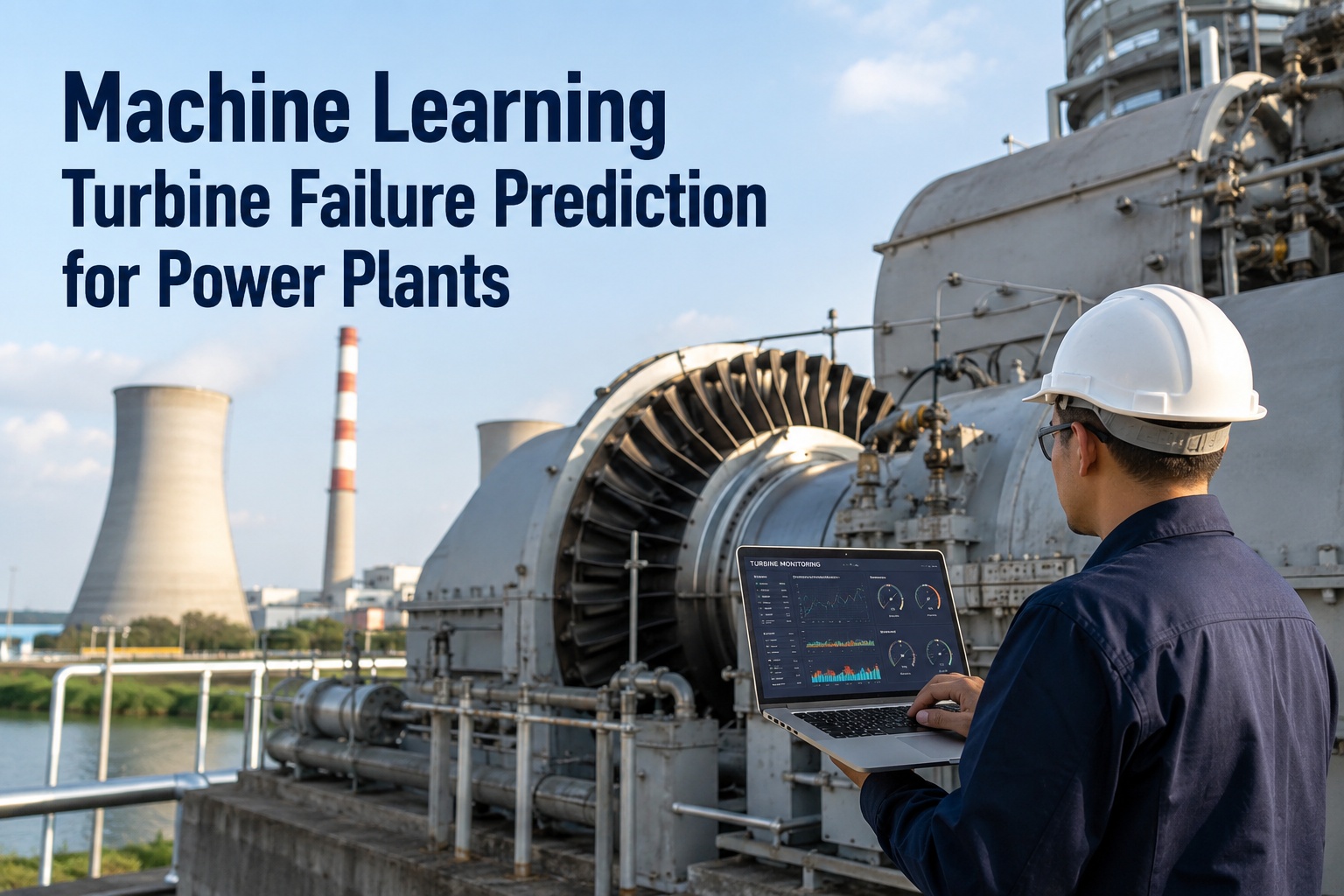
Machine learning turbine failure prediction for power plants leverages operational sensor data—vibration, temperature, pressure and rpm—to forecast equipment degradation weeks before a critical fault occurs, shifting maintenance from reactive to predictive. For a 500 MW combined-cycle plant, an unplanned gas turbine trip can cost $200K–$450K per day in lost generation and startup penalties, making ML maintenance for power generation one of the highest-ROI applications of industrial AI. Turbine failure prediction ML models trained on SCADA and condition-monitoring history can detect bearing, blade and combustion anomalies with 85–95% accuracy, giving reliability teams a 5–20 day advance warning window. OxMaint integrates these predictive ML signals directly into work-order workflows so dispatch, parts allocation and safety permitting happen automatically. Ready to see it on your assets? Start Free Trial or read on for the model architecture, feature engineering and ROI breakdown.
PREDICTIVE ML FOR POWER GENERATION
Predict turbine failures 5–20 days before they trip your plant
A single unplanned gas-turbine outage costs $200K–$450K per day. OxMaint's machine learning turbine prediction engine fuses SCADA, vibration and oil-analysis data to flag bearing, blade and combustion faults early—then auto-generates the work order, parts list and safety permit so your crew acts before the trip.
ML TURBINE MODEL ARCHITECTURE
How a turbine ML prediction model is built from plant data
Building a turbine failure prediction ML model requires four layers: historical data ingestion, feature engineering, fault classification, and remaining-useful-life (RUL) regression. Plants that complete all four layers typically cut unplanned turbine downtime 30–50% within the first operating cycle.
Data ingestion & labeling
Pull 12–24 months of SCADA tags (1 Hz), vibration spectra, oil lab results, trip logs and maintenance history. Label failure events by failure mode—bearing wear, blade fouling, combustion instability—so supervised classifiers can learn the patterns.
Feature engineering
Transform raw signals into model-ready features: RMS vibration trend, spectral kurtosis, bearing-defect frequencies, exhaust-spread deviation, ramp-rate stress counters and temperature-rate-of-change windows. Good features matter more than algorithm choice.
Fault classification
Train a Random Forest or gradient-boosted model to classify the fault type; train an LSTM or survival model to estimate RUL. Ensemble both so the CMMS receives both a “what is failing” and a “when it will fail” signal.
CMMS action loop
When prediction confidence exceeds 80%, OxMaint auto-creates a work order, reserves spare parts, assigns the right technician and generates a safety permit checklist—closing the gap between detection and dispatch.
FEATURE ENGINEERING & FAULT CLASSES
What features drive ML fault detection for turbines
The strongest predictors of turbine failure aren't single threshold alarms—they're multi-sensor trend deviations. Below are the highest-importance feature groups and the fault classes they detect, based on published EPRI and OEM field studies.
| Feature group | Key engineered features | Fault class detected | Typical lead time |
|---|---|---|---|
| Vibration spectra | RMS trend, spectral kurtosis, bearing-defect freq (BPFO/BPFI/BSF) | Bearing outer-race wear, rotor unbalance | 12–20 days |
| Exhaust temperature | Spread deviation, can-to-can delta, rolling std-dev (1 h window) | Combustor can failure, nozzle clogging | 5–10 days |
| Oil analysis | Particle count trend, ferrous density, viscosity delta, water ppm | Gearbox wear, lube-oil degradation | 15–30 days |
| Pressure & flow | Compressor discharge pressure / inlet pressure ratio, mass-flow delta | Compressor fouling, filter blockage | 7–14 days |
| Start-stop counters | Cumulative cycle count, ramp-rate stress, hot-start vs cold-start ratio | Thermal-fatigue cracking, creep | 30–60 days |
ROI & PAYBACK
Cost of one turbine trip vs. ML prediction payback
A mid-size 180-asset power plant spending $42K/year on reactive turbine repairs and losing 3 days of generation per unplanned outage is bleeding roughly $1.1M annually. Predictive ML maintenance flips that equation.
Annual unplanned-trip cost
3 trips × 3 days × $300K/day + $42K repairs
= $2.74M / year
With ML prediction (70% trips prevented)
1 trip × 3 days × $300K + planned-maintenance premium $18K
= $918K / year — saving $1.82M
HOW OXMAINT HELPS
From ML signal to dispatched work order — in one platform
Most plants run their ML turbine prediction model in a data-science notebook that emails an alert—then a planner manually creates a work order, calls the storekeeper, and prints a permit. OxMaint collapses that chain into seconds.
Predictive work-order automation
When OxMaint's ML engine confidence crosses 80%, a ranked work order is auto-generated with fault type, affected asset, recommended action and priority—no manual ticket creation. Cuts dispatch lag from hours to under 2 minutes.
Spare-parts auto-reservation
The work order checks inventory for bearings, seals and filters, reserves stock and triggers a reorder if min-stock is breached—eliminating the “part not available” delay that turns a 1-day planned outage into a 4-day scramble.
Asset health dashboard
Every turbine, compressor and generator gets a live health score (0–100) driven by the ML model's probability-of-failure output. Reliability engineers see which assets are degrading, by how much, and when intervention is needed—all in one view.
Audit-ready compliance trail
Every prediction, work order, parts transaction and permit sign-off is time-stamped and stored—giving you ISO 55000-aligned records and instant evidence for NERC, OSHA or insurer audits without rebuilding history from spreadsheets.
REAL-WORLD SCENARIO
A 180-asset plant: from reactive to ML-predictive in 90 days
Data connect & baseline
OxMaint ingests 18 months of SCADA, vibration and work-order history for two Frame 7FA gas turbines and one steam turbine. Baseline OEE and unplanned-trip count established: 5 trips/year, 82% availability, $2.7M annual trip cost.
Model training & validation
ML turbine prediction model trained on labeled fault data. Back-tested on held-out events: 89% recall on bearing faults, 84% on combustor anomalies, 12-day median lead time. Thresholds tuned to keep false alarms below 2 per month per asset.
Live prediction & auto-dispatch
OxMaint goes live. Week 3: model flags bearing-defect-frequency trend on GT-2 with 87% confidence. Work order auto-created, spare bearing reserved, permit generated. Planned outage scheduled in next low-demand window—trip avoided, $310K saved.
See OxMaint predict failures on YOUR turbines
Book a 30-minute demo and we'll connect your sample SCADA data, show the ML prediction dashboard live, and map the auto-work-order flow end to end.
FAQ
Machine learning turbine failure prediction — your questions answered
How much data is needed to train a turbine failure prediction ML model?
Most reliable turbine failure prediction ML models require 12–24 months of continuous SCADA data (1 Hz minimum), vibration spectra, oil-analysis results and a labeled maintenance history of at least 5–10 failure events per fault class. Plants with less history can bootstrap with transfer learning from similar turbine models, then fine-tune on live data. OxMaint's onboarding includes data-connectors for all major SCADA and condition-monitoring systems so ingestion takes days, not months.
What accuracy can ML fault detection achieve for power plant turbines?
Published field studies and OxMaint deployments show 85–95% fault-detection accuracy (recall) for bearing, blade and combustor faults when models are trained on sufficient labeled data, with false-alarm rates held below 2 per month per asset. Accuracy depends heavily on feature engineering quality—spectral kurtosis, bearing-defect frequencies and exhaust-spread deviations are among the strongest predictors. Start Free Trial to evaluate the model on your own historical data.
How does ML predictive maintenance compare to traditional preventive maintenance for turbines?
Traditional preventive maintenance follows fixed intervals (e.g., 8,000-hour hot-gas-path inspections) regardless of actual condition, which means some parts are replaced too early (wasting spend) and some fail between intervals (causing trips). ML prediction models continuously evaluate real-time condition data and trigger maintenance only when degradation trends indicate a developing fault—typically extending mean time between overhauls 10–20% while cutting unplanned trips 30–50%.
Can OxMaint integrate ML turbine predictions with our existing CMMS or work-order process?
Yes. OxMaint is a full AI-powered CMMS and EAM platform, so predictions flow directly into work-order creation, spare-parts reservation, technician dispatch and safety-permit workflows without any manual handoff. If you already use a legacy CMMS, OxMaint offers REST API connectors and can operate alongside it during transition—many plants run OxMaint's ML layer in parallel for 60–90 days before fully switching. Book a Demo to see the integration path for your stack.
What is the typical ROI and payback period for ML maintenance in power generation?
A 500 MW combined-cycle plant preventing two unplanned gas-turbine trips per year saves $1.2M–$2.7M in lost generation, startup fuel and penalties alone. Add reduced spare-parts spend (10–15%) and labor overtime (15–25%), and total annual savings commonly reach $1.5M–$3M. With deployment costs of $60K–$150K for software, integration and model training, most plants achieve payback in 6–12 months.
Stop reacting to turbine failures. Start predicting them.
Deploy OxMaint's AI-powered CMMS with ML turbine prediction in weeks, not months. Your first work order from a prediction could fire within 90 days of go-live.
Free 14-day trial · No credit card
.png)