Gas turbine compressor fouling is one of the most predictable and most consistently undermanaged performance losses in the power generation industry. Airborne contaminants — dust, salt, industrial particulates — coat compressor blades and reduce aerodynamic efficiency, degrading output and heat rate every hour the turbine operates. A disciplined compressor wash program combining online washing with scheduled offline washes can recover 1–2% of lost output per cleaning cycle. At 850 MW, that's real money. One power plant using OxMaint to systematically track online and offline wash records, trend recovery curves, and schedule wash intervals based on actual fouling rates — rather than fixed calendars — recovered $620,000 in annual generation value. This is the story of how that happened, and what it means for your plant. Start your free trial — set up your compressor wash program in under 60 minutes.
Case Study · Gas Turbine · Compressor Wash · OxMaint
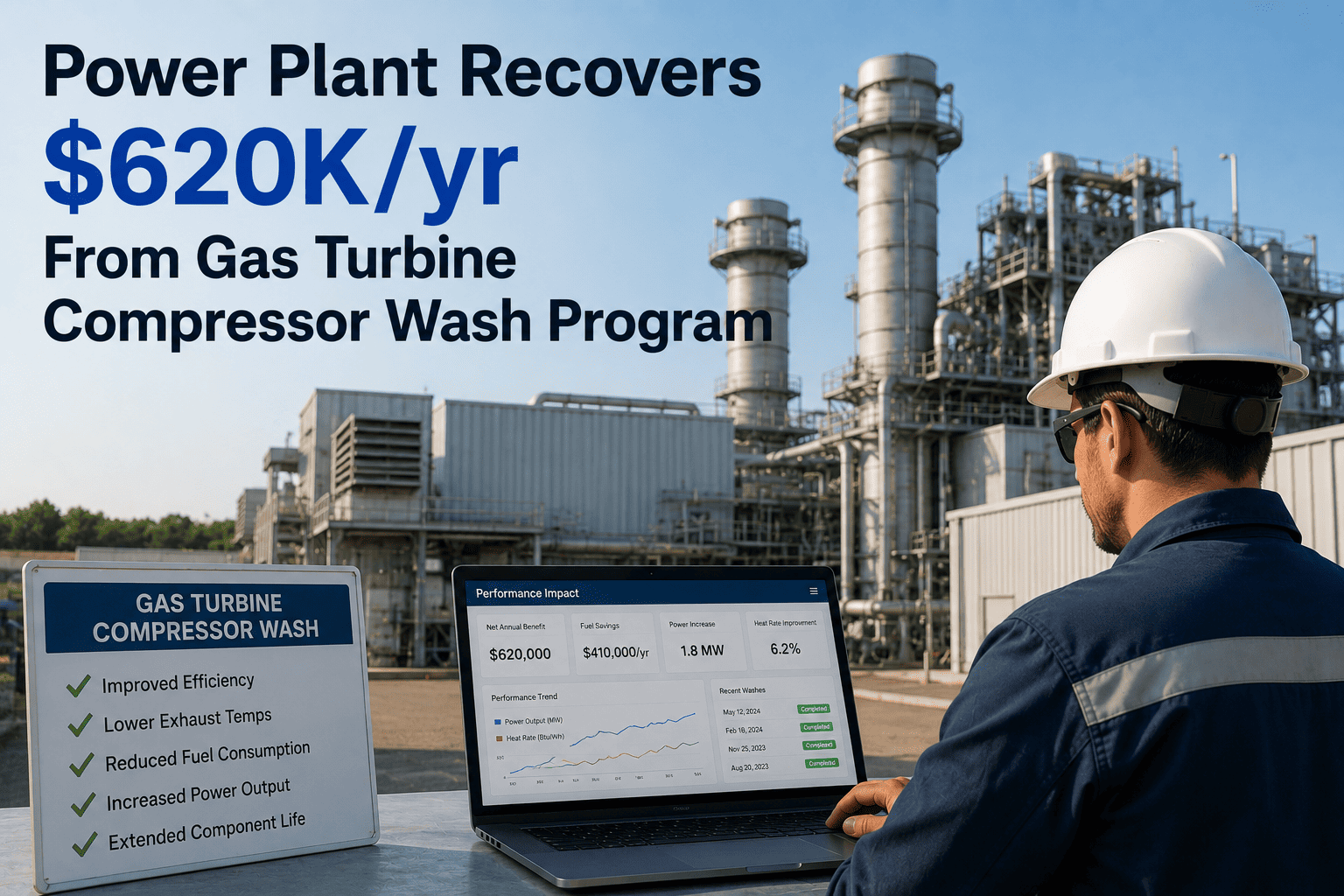
$620K/Year Recovered From a Gas Turbine Compressor Wash Program.
An 850 MW combined cycle plant turned compressor wash records and recovery curve trending into one of the highest-ROI maintenance programs in its operating history — using OxMaint CMMS to drive the decision engine.
$620K
Annual generation value recovered
34%
Reduction in heat rate degradation
12 mo
Time to full ROI from CMMS deployment
The Problem
How Compressor Fouling Was Quietly Costing the Plant $620K/Year
The plant had a compressor wash program. On paper. In practice, online washes happened on a fixed 72-hour cycle regardless of actual fouling rate, offline washes were scheduled by availability rather than recovery data, and no one was trending the performance gap between washes. The result was predictable — and costly.
Output Loss Without Program
1.8% avg
Output Loss With Optimized Program
0.6% avg
Recoverable Performance Gap
1.2% / cycle
Annual Value at $40/MWh
$620K
What Was Missing
The Four Gaps That Prevented Value Recovery
01
No Recovery Curve Trending
Online washes happened on schedule, but nobody tracked how much output returned after each wash — so the plant had no way to know if fouling was accelerating, the wash chemistry was losing effectiveness, or certain units were degrading faster than others.
02
Fixed-Interval Online Washes
Online wash intervals were set at 72 hours across all units regardless of site contamination levels. During high-dust periods, fouling accelerated to the point where 24-hour intervals would have been more economical. During clean periods, 72-hour washes were unnecessary.
03
Offline Washes Driven by Availability
Offline crank washes — which recover 3–5x more performance than online washes — were scheduled based on maintenance availability and unit commitment windows, not performance data indicating when the recovery value would be highest.
04
Fragmented Records
Online wash logs were in one spreadsheet, offline wash records in another, and performance data lived in the plant historian with no one connecting it to the wash program. No single view meant no optimization was possible.
The OxMaint Solution
How OxMaint Turned Wash Records Into a $620K Program
The plant deployed OxMaint CMMS to centralize every aspect of the compressor wash program — from work order generation to recovery curve data capture. The change wasn't complex. It was consistent. See the platform that powered this — book a 30-minute demo.
Step 01
Online Wash Records Digitized and Standardized
Every online wash logged in OxMaint with timestamp, unit ID, wash chemistry used, pre-wash output (MW), and post-wash output (MW). This single change created the recovery curve dataset that all subsequent optimization depended on.
Step 02
Recovery Curve Trending Built Into the Dashboard
With 8 weeks of consistent records, OxMaint's analytics surfaced the recovery per wash trend — showing that average recovery had dropped from 1.4% to 0.9% over 6 months, indicating compressor blade condition warranted inspection before the scheduled outage.
Step 03
Offline Wash Intervals Driven by Performance Threshold
OxMaint was configured to trigger an offline crank wash recommendation when the unit's rolling output loss exceeded 1.2% — signaling that online washes alone weren't maintaining target performance and offline recovery was economically justified.
Step 04
Online Wash Frequency Adjusted by Fouling Rate
Recovery curve data enabled the plant to dynamically adjust online wash intervals — tightening from 72 to 36 hours during a seasonal dust period and extending to 96 hours during a low-fouling winter period. Net result: more washes when they mattered, fewer when they didn't.
Step 05
Cross-Unit Comparison Identified Outlier Units
With all four units on OxMaint, recovery curves were compared across the fleet. Unit 3 consistently showed 30% lower recovery per wash — flagging a compressor blade condition issue that would have been invisible without standardized cross-unit records.
Measured Outcomes — 12 Months Post-Deployment
The Numbers That Changed How the Plant Manages Compressor Maintenance
$620K
Annual Generation Value Recovered
Calculated against pre-program baseline. Improved wash timing and interval optimization maintained 0.6% average output loss vs. 1.8% before the program.
34%
Heat Rate Degradation Reduction
Fuel cost savings compound directly onto the generation value recovery. Improved compressor efficiency means fewer BTUs per MWh across all operating hours.
1 unit
Blade Issue Caught Early
Unit 3's outlier recovery curve triggered inspection 6 months before scheduled outage. Early intervention cost $80K. Failure at full load would have cost $1.4M.
18 wk
Payback Period for CMMS
Total OxMaint deployment — onboarding, configuration, training — paid back from generation value recovery in 18 weeks. Year 1 net gain exceeded 10x platform cost.
Proven at 850 MW Combined Cycle
Your Compressor Wash Program Could Be Recovering This Much Too.
The first step isn't changing your wash chemistry or buying new equipment. It's capturing the data you already have — wash dates, pre- and post-wash output, offline wash timing — in a system that lets you trend, compare, and optimize. OxMaint makes that setup take hours, not months.
OxMaint Compressor Wash Features
Everything Your Wash Program Needs — Built Into One Platform
Online Wash
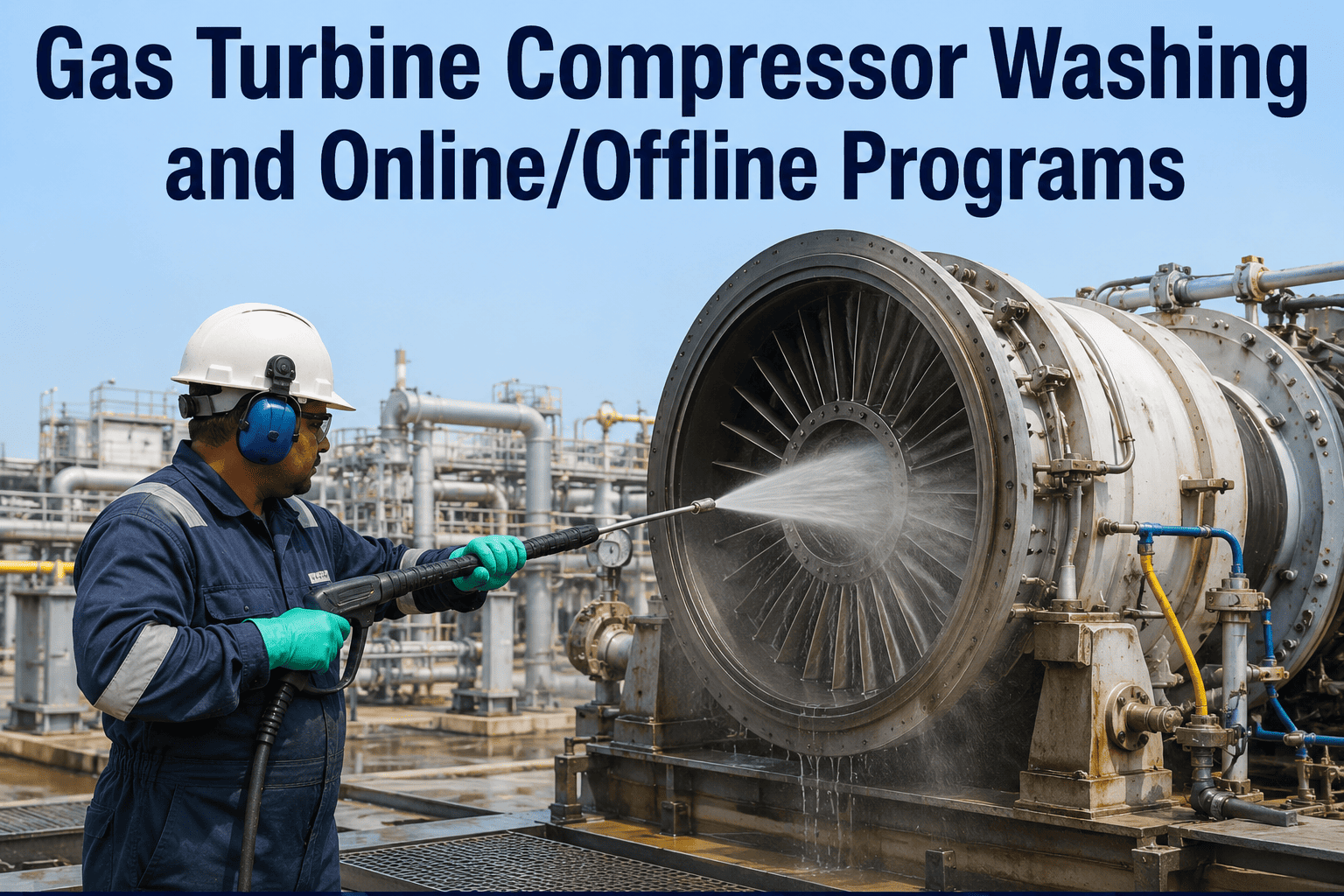
Online Wash Work Order and Record Capture
Work order auto-generates at configured interval. Technician logs pre-wash MW, post-wash MW, chemistry batch, and nozzle condition — all from mobile in the field. Recovery per wash calculated automatically.
Offline Wash
Crank Wash Scheduling and Performance Capture
Offline crank wash work orders include full procedure checklist, pre/post performance measurements, and parts used. Scheduling integrates with unit commitment data to minimize opportunity cost of outage window selection.
Analytics
Recovery Curve Trending and Fleet Comparison
Rolling recovery curve trended per unit, per season, and per chemistry type. Cross-unit comparison flags outliers. Declining recovery trend auto-generates alert for inspection before scheduled outage window.
Optimization
Performance-Based Interval Recommendations
OxMaint calculates the economically optimal online wash interval from current fouling rate, energy price, and wash cost inputs — recommending interval changes when fixed schedules are costing more than they're recovering.
Frequently Asked Questions
Compressor Wash Programs — What Plants Ask Most
How much output recovery should we expect from an online compressor wash?
Typical online wash recovery ranges from 0.5% to 2.0% of rated output depending on fouling severity, compressor age, and wash chemistry. OxMaint's recovery tracking helps you measure actual recovery per wash at your specific site conditions — which is far more useful than industry averages.
Set up your wash tracking program in a free trial.
How do you determine the optimal online wash frequency?
Optimal frequency balances the value of recovered output against the cost of the wash operation and any production interruption. OxMaint calculates this from your actual recovery curve data, current energy price, and site-specific fouling rate — updating the recommendation as conditions change.
See interval optimization in a demo.
What's the difference in recovery between online and offline (crank) compressor washes?
Offline crank washes typically recover 3–5x more output than online washes because the turbine is cold-soaked and stationary, allowing more thorough cleaning of the full compressor section. Online washes maintain performance between offline intervals but cannot fully replace periodic crank wash events.
Can OxMaint integrate with our plant historian to import pre- and post-wash performance data automatically?
Yes. OxMaint integrates with OSIsoft PI, Aspen IP.21, and other plant historians via API to pull performance data automatically at wash event timestamps — eliminating manual data entry and ensuring accurate recovery curve calculations.
Discuss historian integration in a demo.
How quickly can a compressor wash program be configured in OxMaint?
A standard compressor wash program — online and offline wash templates, recovery calculation fields, trend dashboard, and alert thresholds — can be configured and deployed within one day. Most plants see their first recovery curve data within two weeks of going live.
Real Plant · Real Results · Reproducible
The Data Exists in Your Plant Today. OxMaint Organizes It.
Every gas turbine plant has compressor wash records somewhere. Most are fragmented, inconsistently captured, and impossible to trend. OxMaint takes that data, structures it, and turns it into the economic intelligence that drove $620K in recovered value — at one plant, in one year.