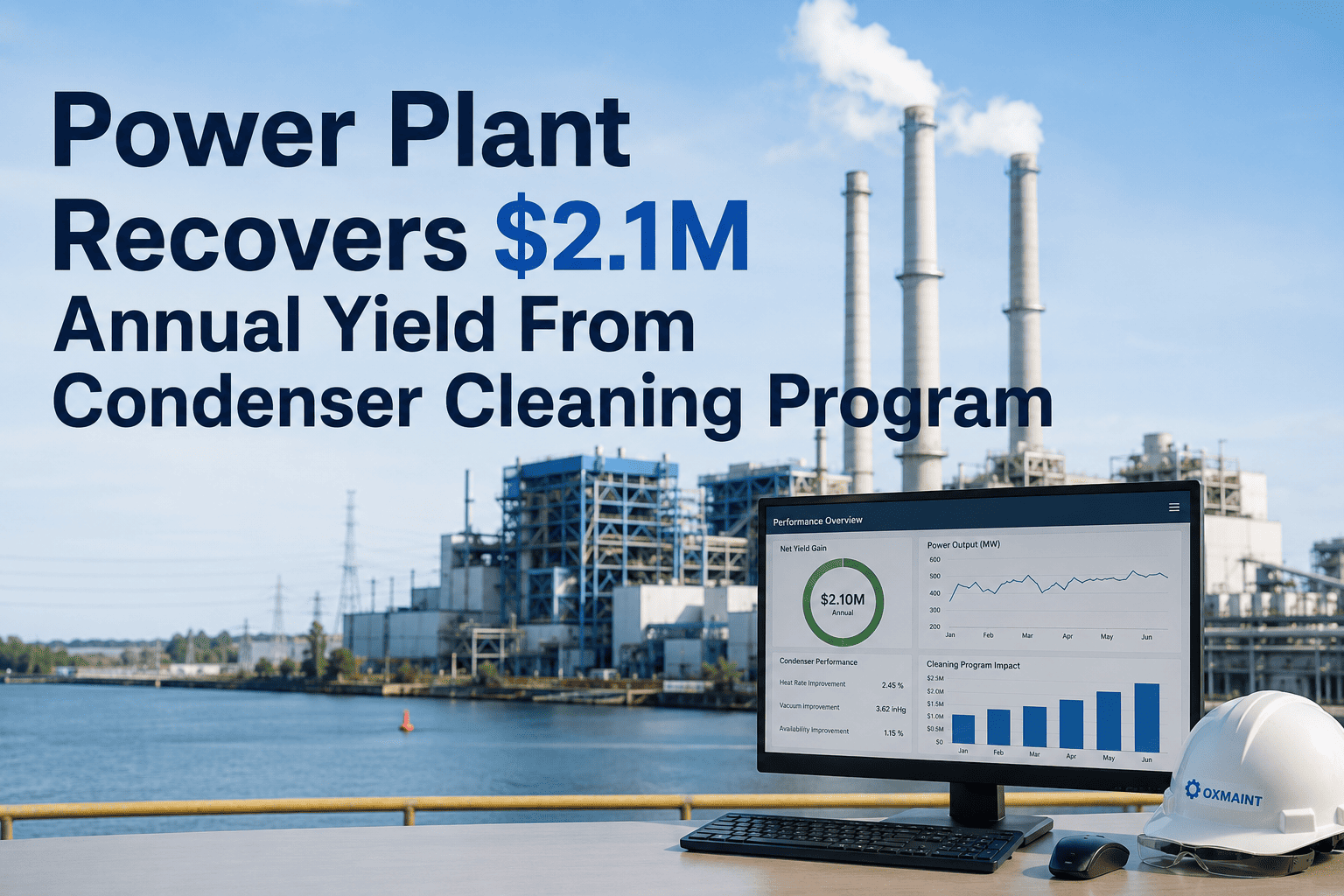
Condenser backpressure degradation is one of the most expensive and least-acknowledged efficiency losses in thermal power generation. A condenser operating at just 1 inch HgA above its clean design backpressure costs a 500MW plant approximately $180,000 to $280,000 in annual heat rate penalty — and most plants are operating 2 to 4 inches above design for months before anyone flags it as a maintenance priority. The plant in this case study was no different: three condensers, a manual tube cleaning schedule based on calendar intervals rather than actual fouling data, and a chronic heat rate problem that finance kept attributing to fuel quality. By deploying OxMaint's backpressure trending and cleanliness factor work order system, the plant's maintenance team built a data-driven condenser cleaning program that recovered $2.1M in annual generation yield — not through capital investment, but through better decisions about when and what to clean.
$2.1M
Annual Yield Recovered
3 Units
Condensers Under Management
68%
Reduction in Unnecessary Cleanings
0.4 in HgA
Average Backpressure Improvement Per Unit
Why Calendar-Based Condenser Cleaning Costs Plants More Than They Realize
The typical condenser cleaning program in thermal power is driven by outage schedule and maintenance tradition, not by actual fouling state. This means plants are doing two expensive things simultaneously: cleaning condensers that do not yet need it (wasting labor and outage window time), and missing condensers that have fouled significantly between scheduled events. OxMaint's approach replaces the calendar with a cleanliness factor model that tells your team exactly which condenser is performing below threshold — and by how much — so every cleaning is triggered by data, not by the date.
Before OxMaint
Condensers cleaned quarterly regardless of fouling state
Backpressure tracked in SCADA but not trended against design baseline
Cleanliness factor never calculated — fouling identified visually at cleaning
Heat rate degradation blamed on fuel, not condenser performance
3 condensers average 2.6 in HgA above clean design backpressure
→
After OxMaint Program
Cleaning triggered when cleanliness factor drops below 0.85 threshold
Backpressure trended daily against temperature-corrected design baseline
Automated WO generated when fouling threshold crossed — not when scheduled
Heat rate attribution model separates condenser loss from fuel variability
3 condensers average 0.4 in HgA above clean design backpressure
The Cleanliness Factor Model: How OxMaint Quantifies Condenser Fouling
Cleanliness factor is the ratio of actual condenser performance to theoretical clean performance under identical operating conditions. A condenser at 100% cleanliness transfers heat exactly as designed. A condenser at 75% cleanliness is carrying a fouling burden that translates directly into elevated backpressure and heat rate penalty. OxMaint calculates cleanliness factor continuously from operating data — inlet water temperature, outlet water temperature, steam flow, and backpressure — and plots it against the temperature-corrected design curve.
Cleanliness Factor vs. Backpressure Penalty — Relationship Model
Clean Zone (CF 0.90–1.00)
Backpressure within 0.2 in HgA of design. No action required.
Watch Zone (CF 0.80–0.90)
0.3–0.7 in HgA above design. Schedule cleaning within 30 days. This plant's trigger threshold is CF 0.85.
Act Zone (CF 0.70–0.80)
0.8–1.4 in HgA above design. Immediate cleaning work order. Revenue loss accelerating daily.
Critical Zone (CF Below 0.70)
1.5+ in HgA above design. Where this plant's condensers were running before the program. Estimated $580K/unit/year loss.
How the Work Order Automation Works
The cleanliness factor calculation is only valuable if it drives action automatically. OxMaint connects the fouling model to the work order system so that no human decision is required to escalate a fouling alert into a maintenance event. This closed loop between performance data and maintenance execution is what converts a monitoring dashboard into a yield recovery program.
1
Daily Backpressure Trending
Operating data feeds the temperature-corrected cleanliness factor model each shift. Trend direction, rate of fouling, and current CF value displayed per condenser.
2
Threshold Alert Generated
When CF crosses the configured trigger threshold (0.85 for this plant), OxMaint generates an alert with current backpressure penalty, estimated revenue impact per day, and recommended action.
3
Cleaning Work Order Created
System automatically generates a condenser cleaning work order with tube count, water box assignment, and recommended cleaning method based on historical fouling pattern for that unit.
4
Post-Clean Verification
Post-cleaning backpressure data is automatically compared to pre-clean baseline. CF restoration percentage is logged against the work order — building a cleaning effectiveness record for each unit.
5
Eddy Current Correlation
Eddy current test findings from tube inspections are logged against individual tubes. Tubes flagged for plugging are tracked, and the cleanliness model adjusts for reduced tube count in subsequent calculations.
Your Condensers Are Losing Revenue Every Hour They Run Above Design Backpressure
OxMaint's cleanliness factor model tells you exactly how much — and triggers the work order automatically when the number crosses your threshold. No dashboard monitoring required.
The $2.1M Yield Recovery — Where It Came From
| Condenser Unit |
Pre-Program CF |
Post-Program CF |
Backpressure Improvement |
Annual Yield Recovery |
| Condenser A (Unit 1) |
0.67 |
0.91 |
1.4 in HgA |
$840,000 |
| Condenser B (Unit 2) |
0.71 |
0.89 |
0.9 in HgA |
$740,000 |
| Condenser C (Unit 3) |
0.74 |
0.88 |
0.7 in HgA |
$520,000 |
| Fleet Total |
0.71 avg |
0.89 avg |
0.4 in HgA avg |
$2,100,000 / year |
Frequently Asked Questions
What operating data does OxMaint need to calculate cleanliness factor continuously?
The cleanliness factor model uses cooling water inlet temperature, cooling water outlet temperature, steam flow to condenser, and measured backpressure. These parameters are typically available from existing SCADA or plant DCS and can be fed to OxMaint via manual entry or automated data integration.
Sign up free to configure your condenser monitoring setup.
Can the system manage both once-through and recirculating cooling water systems?
Yes. OxMaint's condenser module supports once-through river or lake cooling systems, recirculating cooling tower systems, and air-cooled condensers. Each configuration uses a different baseline model and fouling trigger logic appropriate for the cooling water chemistry and flow characteristics of that system type.
How does OxMaint handle condenser performance changes caused by ambient temperature variation vs. actual fouling?
The platform's cleanliness factor model applies temperature correction to the design baseline before calculating CF — so ambient temperature variation is accounted for automatically. Rising backpressure during a hot summer doesn't trigger a false fouling alert; only backpressure that deviates from the temperature-corrected design curve causes an alert.
Book a demo to see the correction methodology.
Does the platform integrate eddy current tube inspection data with the cleanliness factor model?
Yes. Eddy current inspection findings — tube plugging counts, wall loss measurements, and defect zone mapping — are logged against individual tube records within the condenser's equipment hierarchy. Plugged tube counts automatically adjust the heat transfer area used in cleanliness factor calculations, ensuring the model remains accurate as tube plugging accumulates over the condenser's operating life.
Fouling Trending
→
Auto Work Orders
→
$2.1M Recovered
Build a Condenser Cleaning Program That Pays for Itself in Year One
OxMaint gives your plant the cleanliness factor intelligence, automatic work order generation, and post-clean verification tracking to run a condenser program that is genuinely data-driven — not calendar-driven. Start your free account today and see how much your condensers are currently costing you.