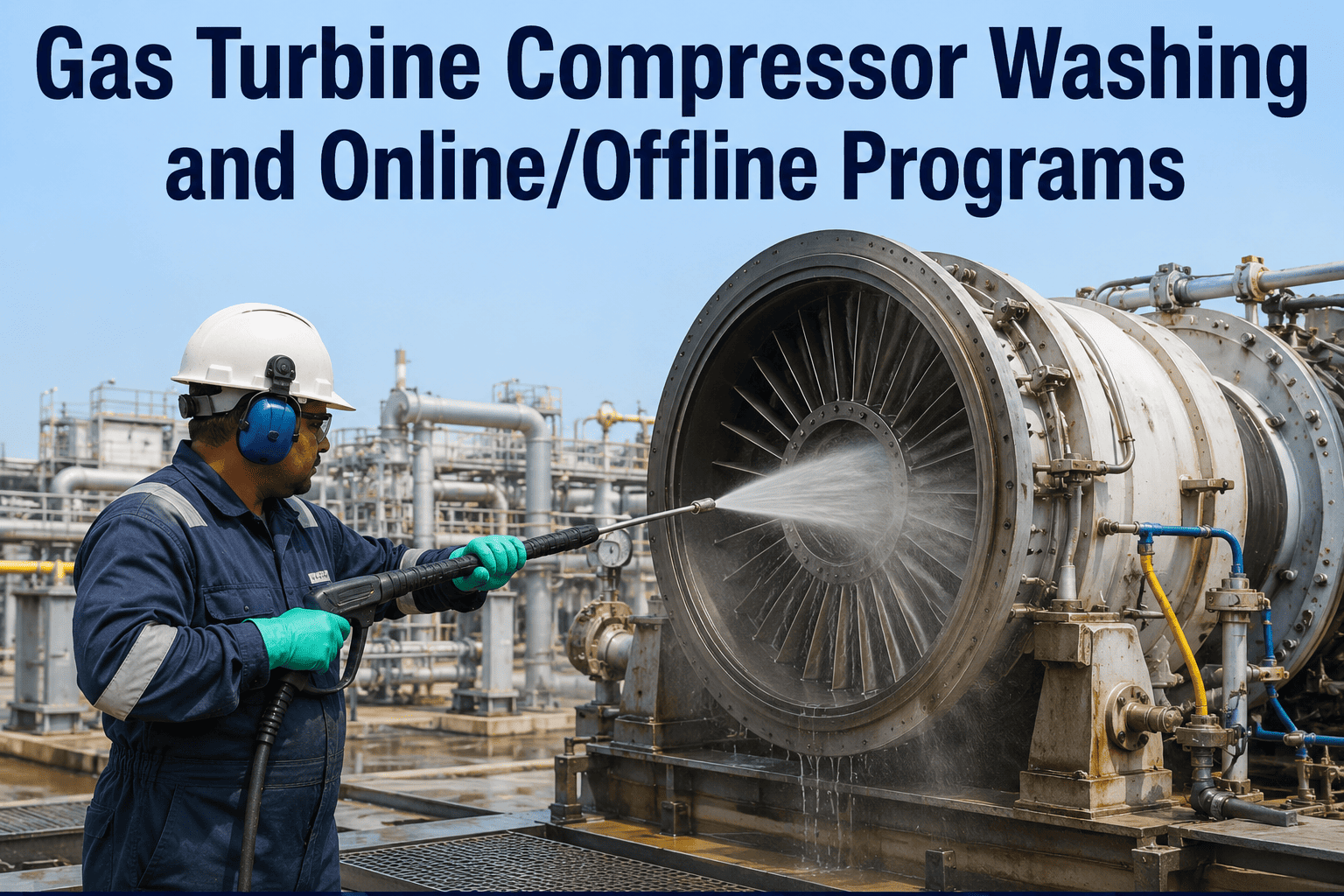
Gas Turbine Compressor Washing and Online/Offline Programs

By Johnson on May 28, 2026

gas-turbine-compressor-washing-online-offline-programs

Compressor fouling is the single largest recoverable cause of gas turbine performance loss — responsible for 70 to 85 percent of all gas turbine efficiency deterioration over its service life. A 5 percent drop in compressor efficiency on a 100 MW turbine silently burns an extra $1.2 million in fuel per year while reducing sellable output by the same degraded margin. For a 240 MW combined-cycle unit, a 1 percent drop in compressor pressure ratio costs approximately $6.25 million per year in fuel overconsumption and lost generation revenue. The physics are straightforward: airborne particles 1 to 5 microns in diameter penetrate inlet filters, adhere to compressor blade surfaces, alter the precise airfoil profile, and reduce mass flow, pressure ratio, and isentropic efficiency with every hour of operation. The financial consequence is equally straightforward — and entirely recoverable with a structured, condition-tracked compressor washing program. Most operators still wash on fixed calendar schedules, missing the fact that fouling rates vary by season, ambient conditions, and site environment by as much as 300 percent, resulting in over-washing when unnecessary and under-washing when it costs most. This guide covers the complete online and offline compressor washing framework: how each method works, what each recovers, the water quality and SOP requirements that protect your hot section, and how a CMMS turns a wash event into a documented performance recovery record. Start your free Oxmaint trial to bring condition-based compressor wash scheduling to your turbine fleet, or book a demo to see live compressor performance tracking on real gas turbine data.

Gas Turbine Compressor Washing 2026 Guide

Gas Turbine Compressor Washing: Online and Offline Programs

The complete framework — fouling economics, online vs offline programs, water quality specifications, step-by-step SOPs, recovery curve benchmarks, and CMMS-tracked wash records that document every dollar recovered.

70–85%
of all GT efficiency deterioration caused by compressor fouling — the dominant recoverable degradation mode

$1.2M
annual fuel over-consumption from a 5% compressor efficiency drop on a 100 MW turbine

~100%
of fouling-related power loss is recoverable with a correctly executed offline wash program
The Fouling Problem

What Fouling Does to Your Turbine — Stage by Stage

Every gas turbine breathes enormous volumes of air. A 172 MW turbine ingests enough air in one year to fill a football-field-sized column rising over 1,300 miles. At a typical ambient concentration of just 10 ppm of airborne contaminants, that same turbine ingests over 139 metric tons of foulant annually — even with good inlet filtration. Sub-5-micron particles that pass the filter deposit on compressor blade surfaces, altering the precise airfoil geometry that each stage was designed to maintain.

The Fouling Cascade: From Blade Deposit to Revenue Loss
1
Blade Surface Deposit
Sub-5-micron particles adhere to first-stage compressor blades. Roughness increases. Boundary layer thickens. Designed airfoil profile is compromised.
2
Mass Flow Reduction
Air mass flow drops as aerodynamic efficiency falls. Each downstream stage receives misaligned, denser flow — the cascade effect multiplies the first-stage loss.
3
Pressure Ratio Decline
Compressor discharge pressure drops. The turbine control system compensates by increasing fuel flow to maintain exhaust temperature — heat rate rises while output falls simultaneously.
4
Power and Revenue Loss
Net output falls. Fuel cost per MWh rises. For a 250 MW unit operating at $50/MWh, a 3% power loss equals over $3.3M in annual generation revenue foregone — silently, every hour.
Online vs Offline

Online Wash vs Offline Wash: What Each Does and When to Use It

Online and offline washing are complementary strategies, not competing alternatives. Online washing slows the fouling rate and extends the interval to the next offline event. Offline washing restores performance that online washing cannot recover. Plants that run only one method are leaving either output or downtime on the table. The decision matrix below clarifies when each method applies and what each achieves.

Online Wash
Turbine running at load — no shutdown required
How it works Atomized demineralized water (with or without detergent) injected via nozzles at the compressor inlet plenum while the turbine is at load. Liquid-to-gas ratio kept below 2% to avoid surge.
Performance recovery 2.3–2.8% compressor efficiency recovered per wash event at moderate fouling levels
Best frequency Every 3–7 days at site conditions with moderate fouling rate. Daily wash justified at high-fouling coastal or industrial sites.
Limitations Cannot dissolve baked-on deposits. Does not restore all fouling-related loss. Must use demineralized water to prevent hot section corrosion from sodium and chlorides.
Primary value Slows fouling accumulation rate. Extends the offline wash interval. Maintains baseline performance between offline events.
Offline Wash
Turbine shutdown — deep cleaning with soak cycle
How it works Turbine shut down and cooled. Starter cranks the compressor at 20–50% starting speed. Detergent-and-demin-water mixture injected, then soak period, then multiple demin rinse cycles.
Performance recovery 5.85–6.5% efficiency recovered per wash event — up to near-100% recovery of all fouling-related loss when executed correctly
Best frequency Monthly at high-fouling industrial sites. Quarterly at clean-environment sites. Optimum interval is condition-driven, not calendar-driven.
Limitations Requires turbine shutdown, cranking, and cooldown — typically 4 to 12 hours total process time. Generation is lost during the event.
Primary value Restores virtually all recoverable fouling loss. Resets the performance baseline. Should always be scheduled against condition data, not fixed calendar.
Performance Recovery Curve — Combined Online and Offline Program
100% 97% 94% 91% 88%


No wash program


Combined program
Fouling degradation Online wash events Offline wash recovery

Online washing maintains performance between offline events. Offline washing resets the baseline. A plant running no structured program loses 10–15% of rated output before any single operator notices.

See condition-based wash scheduling running live on real turbine performance data

Oxmaint tracks compressor pressure ratio, heat rate deviation, and isentropic efficiency trend per turbine — and calculates the optimal wash event timing before fouling cost exceeds wash cost. No fixed calendar, no guesswork.

Water Quality

Water Quality Requirements: The Non-Negotiable Foundation of Every Wash Program

Using untreated or inadequately demineralized water in a compressor wash is not a minor shortcut — it is a direct path to hot section corrosion damage from sodium, chlorides, and alkali earth compounds. Salts present in untreated water enter the combustion path and cause severe high-temperature corrosion on turbine blades and vanes. The water quality specification below applies to both online and offline wash programs without exception.

Compressor Wash Water Quality Specification
Conductivity
Less than 0.5 µmho/cm
High conductivity indicates dissolved salts. Sodium and chloride above threshold cause blade and vane corrosion in the hot section.
Total Dissolved Solids
Less than 1.0 ppmw
TDS above 1 ppm introduces metallic contamination into the combustion path. Measure with handheld meter before every wash event.
pH
Between 7.0 and 9.0
Acidic water (pH below 7) corrodes compressor blades. Highly alkaline water can deposit scale. Neutral-to-slightly-alkaline range is the safe window.
Sodium and Potassium
Less than 0.5 ppm each
Alkali metals are the primary hot corrosion agents at turbine operating temperatures. Even trace contamination accumulates on first-stage blades with each wash cycle.
Chlorides
Less than 0.5 ppm
Chlorides cause stress corrosion cracking on turbine disk and blade alloys. Coastal sites must be especially vigilant — municipal water supplies near coast often exceed this limit.
Detergent pH
Neutral — OEM approved formulation
Water-based neutral pH detergents preferred for environmental and materials compatibility. Solvent-based products only for mineral oil foulants. RTU (Ready-to-Use) biodegradable formulations recommended.
Water Source Verification
Test before every wash event
Demineralized water polishing skids can experience catalyst bed channeling. A passing test last week does not guarantee today's water quality. Test with handheld meter — conductivity, TDS, and pH take under 2 minutes.
Step-by-Step SOPs

Compressor Wash SOPs: Online and Offline Procedures

Online Wash Procedure
01
Pre-Wash Water Quality Verification
Test wash water conductivity (target below 0.5 µmho), TDS (below 1.0 ppmw), and pH (7–9). Log results in CMMS against the turbine asset record before authorizing injection. Do not proceed if any parameter is out of specification.
02
Record Pre-Wash Performance Baseline
Log compressor inlet temperature, compressor discharge pressure, exhaust temperature, MW output, and heat rate at the current load point. This pre-wash snapshot enables the post-wash recovery calculation — without it, the wash event has no documented value.
03
Prepare Wash Skid and Nozzle System
Verify atomizing nozzle condition — blocked or worn nozzles produce droplet sizes outside the design range and reduce cleaning effectiveness. Mix detergent with demineralized water at OEM-specified ratio. Verify wash skid pressure is within the design injection pressure range.
04
Inject Detergent-Water Mixture
Activate nozzles and inject detergent-water mix at the specified liquid-to-gas ratio (typically below 2%). Ramp flow gradually — do not step-inject at full flow rate. Total injection duration per OEM specification for the turbine model and current load level.
05
Flush Cycle with Pure Demineralized Water
Follow detergent injection with a minimum 5-minute flush using pure demineralized water. The flush rinses detergent residue and loosened deposit material through the drain system. Continue flush until drain effluent runs visibly clear.
06
Record Post-Wash Performance Recovery
Log compressor discharge pressure, MW output, and heat rate at the same load point as the pre-wash baseline — 20 to 30 minutes after wash completion to allow effluent drainage. Calculate recovered MW and improved heat rate. Log in CMMS as the wash event recovery record.
Offline Wash Procedure
01
Shutdown and Cooldown
Shut down the turbine and allow cooldown to the safe wash temperature threshold (wheel space temperature below 66°C per GE procedure, or per OEM specification). Do not begin offline wash on a hot turbine — thermal shock risk to blades is significant and can cause damage that reduces compressor life.
02
Open Drains and Prepare IGV
Open all compressor drain valves to allow effluent escape. Set inlet guide vanes to the open position to maximize wash fluid access to all compressor stages. Verify drain piping is clear and directed to the effluent collection system — offline wash effluent typically requires treatment before disposal.
03
Inject Detergent Solution While Cranking
Start the turbine on the starter motor at 20–50% of starting speed (no combustion). Inject heated detergent-water solution (38–68°C) at the specified volume into the compressor inlet. Crank through full solution injection, then allow the compressor to coast to a stop.
04
Soak Period
Allow the detergent solution to soak for a minimum of 20 to 30 minutes. This is the most cleaning-critical step — the soak period allows the detergent to penetrate and dissolve baked-on deposits that surface contact during cranking cannot remove.
05
Multiple Rinse Cycles with Demineralized Water
Perform 3 to 5 rinse cycles: crank to 20–50% starting speed, inject pure demineralized water flush volume, coast to stop, allow drainage. Repeat until drain effluent conductivity and pH are within specification. Each rinse cycle further removes loosened deposit and detergent residue.
06
Document Recovery Against Pre-Wash Baseline
After return to service, log post-wash compressor discharge pressure, MW output, heat rate, and isentropic efficiency at the same reference load point as the pre-wash baseline. Record recovered MW, reduced heat rate, and estimated fuel savings. Log as the offline wash recovery record in CMMS for ROI reporting and next-wash interval planning.
CMMS Records

What a CMMS-Tracked Wash Program Documents That a Calendar Schedule Cannot

A

Condition-Based Wash Trigger

A CMMS tracking compressor discharge pressure and isentropic efficiency trend calculates when continued fouling cost exceeds the generation loss from an offline wash event — and issues the work order at the right moment, not the calendar date. Start free on Oxmaint to begin condition-based wash scheduling today.

B

Performance Recovery Documentation

Every wash event in Oxmaint generates a before-and-after performance record: pre-wash MW output, post-wash MW output, recovered capacity, heat rate improvement, and estimated annual fuel savings at the current operating hours. This is the data that justifies the wash program to plant leadership and insurers.

C

Water Quality Log per Event

Pre-wash water quality test results — conductivity, TDS, pH — are stored against each wash work order. If hot section corrosion is ever investigated, the water quality record for every wash event is available immediately. Without CMMS logging, this data lives on paper or not at all. Book a demo to see water quality logging in action.

D

Fouling Rate Trending per Site

Fouling rates at the same plant vary by season, ambient temperature, and local air quality by as much as 300%. A CMMS that stores every wash event's pre-wash performance deviation from the clean baseline can calculate the site-specific fouling rate curve — and automatically adjust the recommended online and offline wash interval for current conditions.

FAQ

Frequently Asked Questions: Compressor Washing

How often should online compressor washing be performed?

Online washing frequency is site-specific and should be condition-driven, not calendar-fixed. At high-fouling coastal or industrial sites, daily washing is justified. At moderate-fouling inland sites, every 3 to 7 days is typical. The indicator is compressor discharge pressure trend — if it is dropping 0.3% per day, that is your online wash frequency target. Sign up for Oxmaint to track fouling rate and auto-calculate your site-specific online wash interval.

Does online washing recover as much performance as offline washing?

No. Online washing typically recovers 2 to 3 percent of lost efficiency per event — it maintains cleanliness but cannot dissolve baked-on deposits. Offline washing with a detergent soak cycle recovers 5 to 6.5 percent and can restore virtually all fouling-related loss when executed correctly. The two methods serve different functions and must be used together. Book a demo to see recovery benchmarks for your turbine class.

Why must demineralized water be used — can we use clean municipal water?

No. Municipal water contains sodium, chlorides, and alkali earth compounds that cause high-temperature corrosion on turbine blade alloys and stress corrosion cracking on compressor discs. Even trace contamination accumulates with each wash cycle. Demineralized water with conductivity below 0.5 µmho and TDS below 1.0 ppmw is the minimum standard for both online and offline wash programs.

How do we know when to schedule an offline wash vs continuing online washing?

The decision is economic, not intuitive. When the hourly cost of continued fouling (lost MW revenue plus fuel over-consumption) exceeds the cost of the offline wash event (generation loss during the 4–12 hour process plus wash consumables), the offline wash ROI is positive and the event should be triggered. A CMMS that tracks fouling cost continuously makes this calculation automatically. Start free on Oxmaint to set up automated offline wash trigger calculations.

Can Oxmaint track compressor performance data and wash records for multiple gas turbines at once?

Yes. Oxmaint manages performance trending, wash work orders, water quality logs, and recovery documentation per turbine across an entire fleet — with benchmarking between units to identify which turbines are fouling faster and why. Book a demo to see multi-turbine compressor wash management live.

Build a condition-based compressor wash program that documents every dollar recovered

Oxmaint tracks compressor performance deviation from the clean baseline, calculates the optimal wash trigger for your site fouling rate, generates work orders automatically, and logs before-and-after recovery data for every wash event. Start free with your first turbine asset, or see a live compressor wash management workflow in a 30-minute demo.
Share This Story, Choose Your Platform!