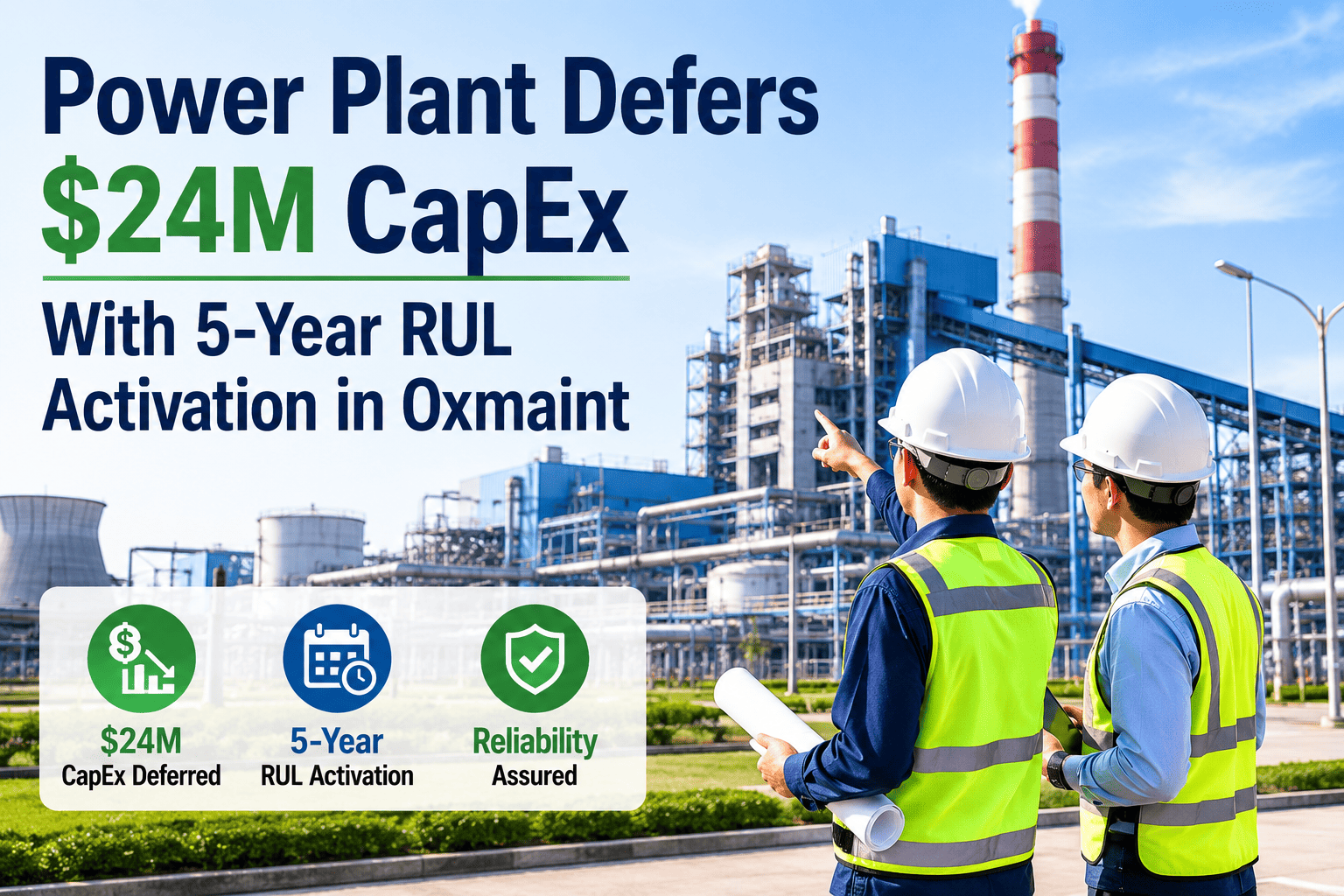
Capital expenditure decisions at power plants are rarely driven by data — they are driven by fear. Fear that aging boilers, mills, fans, and transformers will fail during peak demand. Fear of regulators, insurance auditors, and asset managers who point to nameplate end-of-life dates and demand replacement. But when one power plant activated Oxmaint's Remaining Useful Life (RUL) engine across its aging critical assets, their engineering team discovered something counterintuitive: the assets marked for replacement weren't near failure at all — they were being replaced on schedule, not on condition. By replacing calendar-driven capital planning with continuous RUL data from Oxmaint, this plant deferred $24 million in CapEx and extended asset lifecycles well past assumed end-of-life dates — without increasing operational risk. Book a 30-minute demo to see how Oxmaint RUL activation works for your asset portfolio.
CASE STUDY — POWER GENERATION
$24M CapEx Deferred in One Fiscal Year
A power plant activates Oxmaint RUL across boiler, mill, fan, and transformer assets — and discovers that every asset scheduled for replacement still had years of safe, productive life remaining.
5yr
Avg Lifecycle Extension
0
Unplanned Failures During Period
THE SITUATION
When End-of-Life Dates Drive Capital Budgets — Not Condition Data
This mid-size coal-to-gas transition power plant had been operating on a capital replacement plan inherited from the original asset commissioning documentation. Boilers rated for 30 years, ID fans designed for 25-year service, pulverizers and transformers on replacement schedules set decades earlier by manufacturers who were projecting average operating profiles — not the actual load, duty cycle, and maintenance history of this specific plant. The result was a five-year capital plan with $24 million in asset replacements queued on dates, not conditions. No one had validated whether these assets actually needed replacement. The plant's maintenance director brought in Oxmaint specifically to answer one question: which replacements are genuinely urgent, and which can wait?
ASSETS ENROLLED IN OXMAINT RUL MONITORING
Boilers
3 units
Tube thickness, corrosion rate, thermal cycling fatigue, inspection history
$9.2M deferred
Pulverizers / Mills
6 units
Roll wear measurement, classifier condition, vibration trending, throughput degradation
$6.8M deferred
ID/FD Fans
4 units
Blade erosion inspection, bearing condition, motor current trending, vibration analysis
$4.4M deferred
Transformers
5 units
Oil dielectric strength, dissolved gas analysis, thermal imaging, load history
$3.6M deferred
HOW RUL WORKS IN OXMAINT
From Nameplate Age to Actual Remaining Life — How the Engine Works
Oxmaint's RUL engine replaces a single static end-of-life date with a continuously updated remaining useful life estimate based on real operating data. For each asset class, the RUL model combines sensor data, inspection records, operating hours, and historical failure patterns to calculate how much usable life remains — and how quickly that life is being consumed at current operating conditions. Start your free Oxmaint trial and activate RUL for your first asset class in under 48 hours.
1
Operating Data Ingestion
Sensor streams, inspection records, maintenance history, and operating hours feed into the Oxmaint asset record continuously. Each data point updates the asset's health index.
2
Degradation Rate Modeling
Oxmaint models how fast each asset is consuming its useful life based on duty cycle, operating stress, and maintenance quality — not calendar time alone.
3
RUL Estimate Generation
A probabilistic remaining useful life estimate is calculated with confidence intervals — showing optimistic, expected, and conservative end-of-life dates per asset.
4
CapEx Decision Support
Capital planning teams use Oxmaint RUL data to sequence replacements by actual urgency — deferring low-risk assets and prioritizing genuine near-failure scenarios.
WHAT THE DATA REVEALED
Asset by Asset: What Oxmaint RUL Found That the Capital Plan Missed
| Asset |
Scheduled Replacement |
Oxmaint RUL Estimate |
CapEx Deferred |
Decision |
| Boiler Unit 1 |
Year 1 (budget) |
7+ years remaining |
$4.1M |
Deferred — enhanced monitoring program activated |
| Boiler Unit 2 |
Year 2 |
4.5 years remaining |
$3.2M |
Deferred — targeted tube replacement in Year 3 |
| Mill A (x3) |
Year 1–2 |
3 to 6 years remaining |
$4.4M |
Deferred — condition-based roll replacement only |
| ID Fan Unit 2 |
Year 1 |
Under 18 months |
— |
Accelerated — moved to Year 1 budget priority |
| Transformers T1–T4 |
Year 2–4 |
5 to 9 years remaining |
$3.6M |
Deferred — annual DGA monitoring schedule set |
| ID Fan Unit 3 |
Year 3 |
6+ years remaining |
$1.8M |
Deferred — blade erosion repair scheduled in Year 2 |
One asset — ID Fan Unit 2 — was found to be in worse condition than the capital plan assumed. Oxmaint RUL data accelerated its replacement, preventing a potential forced outage. This is what condition-based capital planning looks like: defer what's healthy, accelerate what's actually at risk.
Is Your Capital Plan Based on Dates or Data?
Oxmaint RUL activation gives your engineering team the condition data to challenge assumptions, defer unnecessary spend, and identify the assets that genuinely need attention — before they fail.
"Our capital plan had been handed down from the original EPC contractor's assumptions. Nobody had ever actually validated whether the replacement dates made sense for how we operate these assets. Oxmaint RUL gave our engineering team the data to walk into the board meeting and say: these seven replacements can wait, this one cannot. We deferred $24 million and made one replacement we genuinely needed to make. That's what we hired Oxmaint to do."
Director of Asset Management
—
450 MW Thermal Power Plant, Transition Generation Portfolio
FREQUENTLY ASKED QUESTIONS
What Engineering Teams Ask About Oxmaint RUL for Power Plant CapEx Planning
How does Oxmaint RUL account for assets that have already exceeded their nameplate service life?
Oxmaint RUL models actual physical condition — not calendar age. For assets past nameplate service life, the engine uses inspection data, sensor trends, and failure history to calculate how much additional life remains under current operating conditions. Many assets operated conservatively can far exceed nameplate dates when condition data supports it.
Start your free trial to enroll your first over-life asset in Oxmaint RUL monitoring.
Can Oxmaint RUL data be used to justify CapEx deferrals to insurers, regulators, or asset managers?
Yes. Oxmaint generates audit-ready RUL reports with full data provenance — showing the sensor readings, inspection records, and analytical model that produced each RUL estimate. These reports are exportable in PDF and CSV formats and have been used to support CapEx deferral decisions with insurers, lenders, and regulatory bodies.
Book a demo to review Oxmaint's RUL reporting format for your asset class.
What happens when Oxmaint RUL identifies an asset that is worse than the capital plan assumed?
Oxmaint generates an alert when RUL confidence intervals fall below configurable thresholds, flagging the asset for accelerated review. The case study above included exactly this scenario — ID Fan Unit 2 was in worse condition than scheduled, and Oxmaint data led to its replacement being prioritized rather than deferred. This dual capability — defer healthy assets, accelerate failing ones — is the core value of condition-based capital planning.
Does Oxmaint RUL require specialized sensors that aren't already installed at most power plants?
For most asset classes covered in this case study — boilers, mills, fans, transformers — Oxmaint RUL can be activated using existing inspection records, operating history, and standard instrumentation already present at the plant. New sensor deployment is optional and can be added incrementally to improve RUL accuracy on high-criticality assets.
How long before Oxmaint RUL estimates are accurate enough to inform CapEx decisions?
Initial RUL estimates are generated within 14 to 21 days of data ingestion for assets with existing maintenance history. Accuracy improves as Oxmaint accumulates more operating data. For assets with 12 or more months of historical records imported into Oxmaint at deployment, the initial RUL estimate is typically accurate enough to support deferral or acceleration decisions immediately.
Start your free Oxmaint trial and import your asset history to begin RUL modeling today.
$24M Was Waiting in the Data. Oxmaint RUL Found It.
Stop replacing assets on dates. Start replacing them on condition. Oxmaint RUL activation for power plant asset portfolios — live in under 30 days, audit-ready from day one.