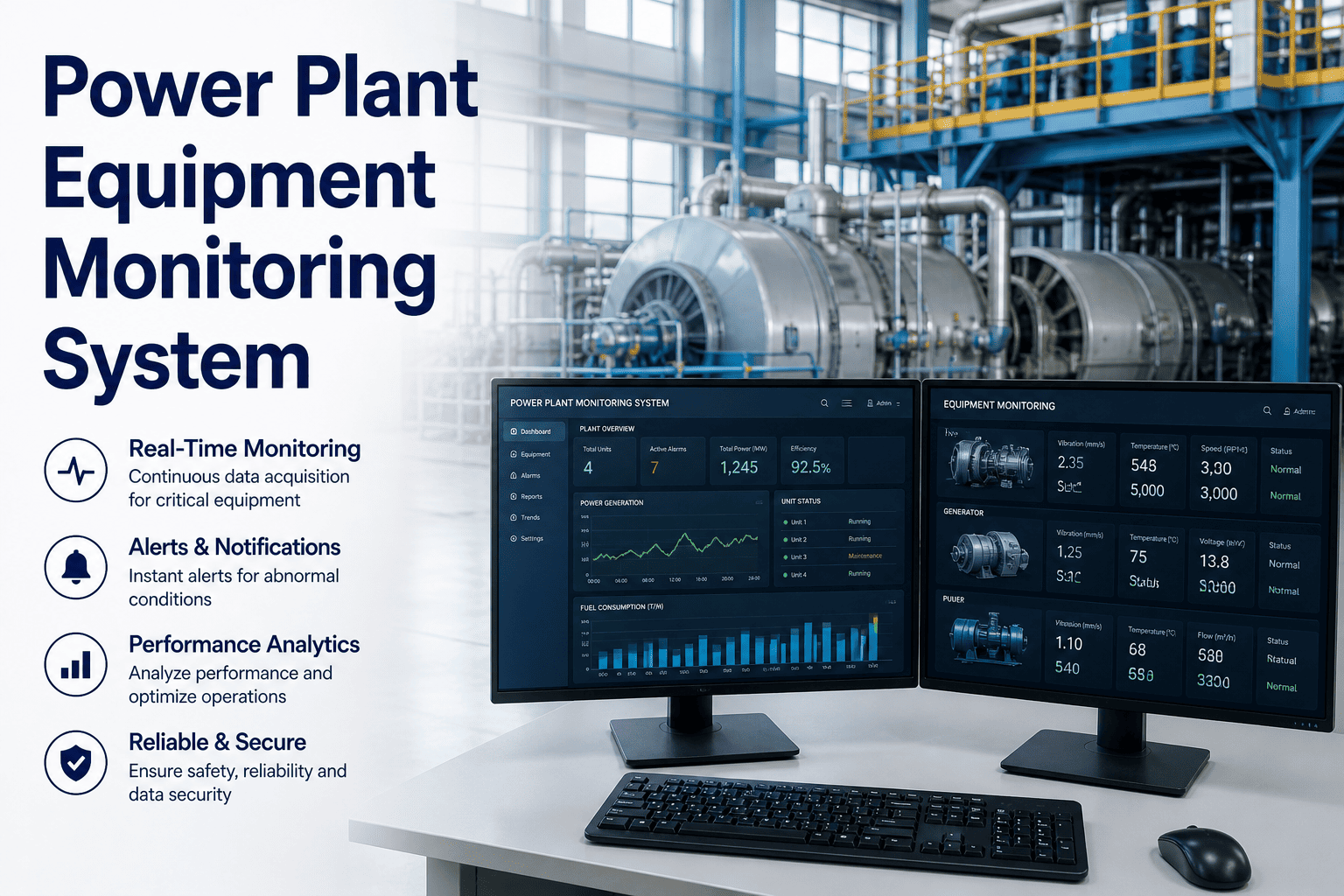
Every unplanned equipment failure in a power plant costs more than just repair expenses — it costs megawatt-hours of lost generation, regulatory exposure, and the kind of operational credibility that takes years to rebuild. Traditional maintenance schedules and manual checks cannot detect the early-stage anomalies that precede catastrophic failure in turbines, generators, transformers, and rotating machinery. A real-time equipment monitoring system changes the equation by continuously reading vibration, temperature, pressure, and electrical parameters across every critical asset — surfacing deviations before they escalate. Book a demo to see how OxMaint's Monitoring platform connects to your plant assets, tracks equipment health scores in real-time, and sends alerts before failure windows open.
Power Generation · Asset Monitoring · Predictive Intelligence
Power Plant Equipment Monitoring System
Real-time condition tracking, AI-driven diagnostics, and automated alert systems for turbines, generators, transformers, pumps, and all rotating machinery — built for utility-scale reliability.
73%
of power plant failures are predictable with continuous monitoring
40%
reduction in unplanned downtime with real-time condition alerts
3–8×
ROI on predictive monitoring vs reactive maintenance programs
Why It Matters
What Traditional Monitoring Misses — and What It Costs
Scheduled inspections capture asset condition at a single moment in time. Between those moments, thermal runaway, bearing wear, insulation degradation, and flow restrictions develop undetected. In power generation, the gap between a detectable anomaly and catastrophic failure is often measured in hours — not weeks. The table below illustrates what reactive monitoring leaves on the table.
Traditional / Scheduled Monitoring
Point-in-time readings only
Manual inspection rounds
Failure detected after event
Paper-based records, delayed reporting
No cross-asset correlation
High unplanned outage frequency
OxMaint Real-Time Equipment Monitoring
Continuous 24/7 parameter streaming
Automated sensor-based data capture
Anomaly detected 3–21 days before failure
Digital audit trail with timestamped readings
AI correlation across asset groups
Planned maintenance windows replace emergencies
Asset Coverage
Equipment Classes Monitored Across the Plant
A power plant monitoring system must cover the full equipment hierarchy — from primary generation assets to auxiliary systems that, when they fail, trip the whole unit. OxMaint maps monitoring profiles to each equipment class with parameters and alert thresholds calibrated to that asset type.
Steam & Gas Turbines
Vibration (X/Y/Z)
Bearing temperature
Shaft eccentricity
Steam inlet pressure
Exhaust temperature
Critical — single-point failure risk
Generators & Exciters
Winding temperature
Hydrogen pressure
Stator current imbalance
Insulation resistance
Rotor flux density
Critical — generation output direct link
Transformers & Switchgear
Oil temperature
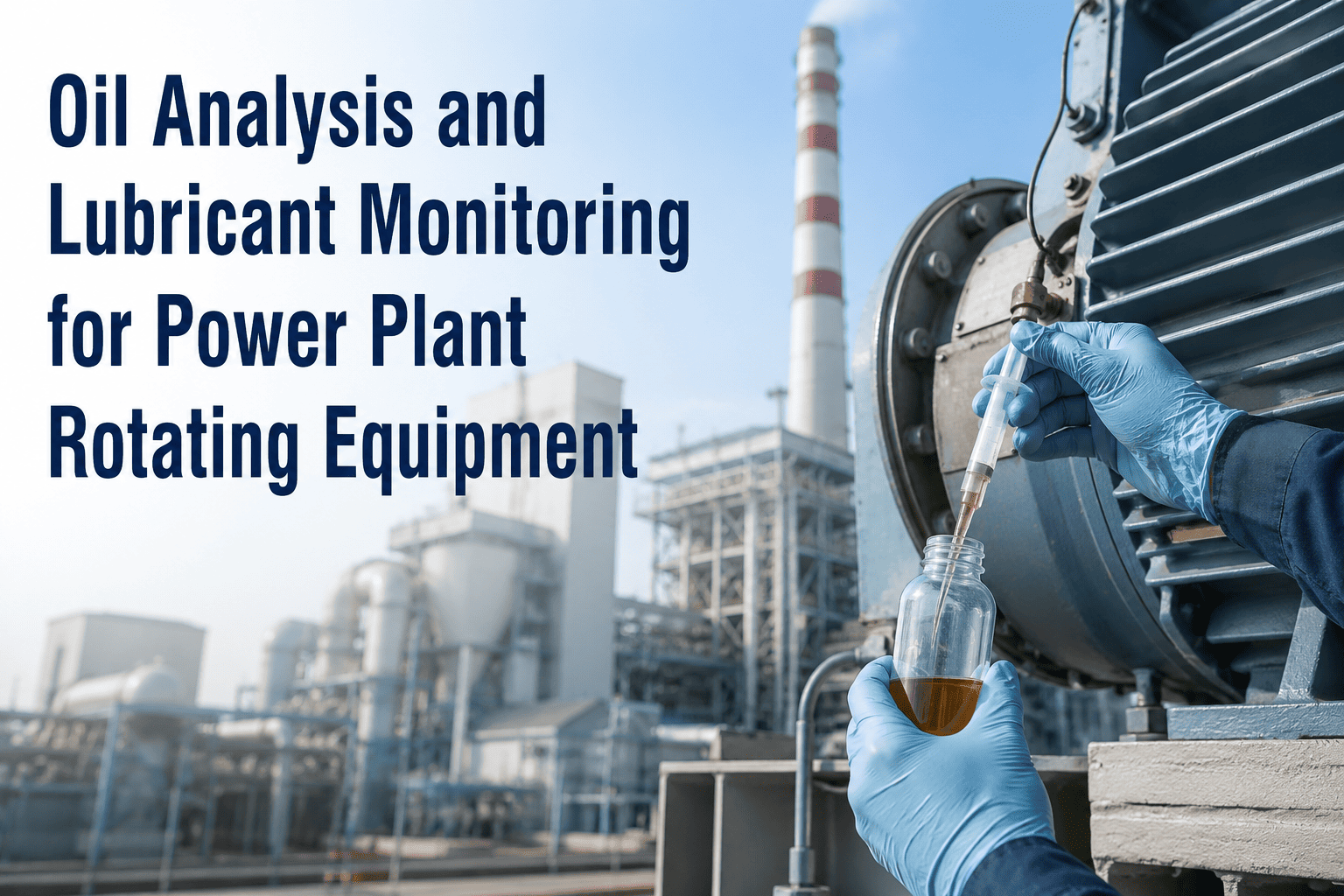
Dissolved gas analysis
Load tap changer wear
Partial discharge events
Cooling fan status
High — long lead time for replacement
Boilers & Heat Exchangers
Tube wall temperature
Drum pressure
Flue gas O₂ level
Waterwall differential
Soot blower cycles
High — efficiency and safety critical
Pumps & Compressors
Flow rate deviation
Seal temperature
Discharge pressure
Motor current draw
Cavitation index
Medium-High — auxiliary system dependency
Cooling Systems & Fans
Inlet/outlet delta-T
Fan blade vibration
Condenser vacuum
Water treatment levels
Tower fan RPM
Medium — efficiency multiplier effect
Map every critical asset in your plant to a real-time monitoring profile. OxMaint's Monitoring platform supports industrial IoT sensors, SCADA integration, and manual reading capture in one unified system.
Alert Architecture
How the Alert System Works: From Sensor to Work Order
A monitoring system is only useful if anomalies translate into action before damage occurs. OxMaint structures alerts in severity tiers and routes them directly to the right team — eliminating the delay between detection and response.
01
Sensor Reading Captured
IoT sensors or SCADA feeds transmit real-time parameter data to the OxMaint platform continuously. Manual readings are logged by field technicians on mobile.
02
AI Anomaly Detection
The AI engine compares readings against asset-specific baselines, historical patterns, and cross-asset correlations — flagging deviations that match known failure signatures.
03
Alert Tiered and Routed
Level 1 (watch) goes to the shift technician. Level 2 (caution) alerts the reliability engineer. Level 3 (critical) pages the plant manager and triggers automatic work order creation.
04
Work Order Executed and Closed
Technicians receive task details on mobile, complete the job, and close the work order with findings. All data feeds back into asset health history for trend learning.
Key Parameters
Monitoring Parameters That Predict Failure Before It Happens
| Parameter |
Equipment Type |
Failure Mode Detected |
Typical Warning Window |
Alert Threshold Basis |
| Vibration (RMS) |
Turbines, pumps, motors |
Bearing wear, imbalance, misalignment |
7–21 days |
ISO 10816 / ISO 20816 standard bands |
| Bearing Temperature |
All rotating equipment |
Lubrication failure, overloading |
4–12 hours |
Manufacturer rated max + trend slope |
| Dissolved Gas (DGA) |
Power transformers |
Internal arcing, thermal faults |
Weeks to months |
IEC 60599 gas ratios |
| Stator Winding Temp |
Generators |
Insulation degradation, overload |
2–7 days |
IEC Class rating limits |
| Differential Pressure |
Filters, heat exchangers |
Fouling, blockage, bypass failure |
3–10 days |
Design delta-P ± operational band |
| Motor Current Signature |
All motor-driven equipment |
Rotor bar cracking, eccentricity |
14–30 days |
Baseline spectrum deviation % |
Implementation
Getting Your Plant Live on OxMaint Monitoring
Deploying a plant-wide monitoring system does not require a multi-year IT project. OxMaint is structured for phased deployment — starting with your highest-risk assets and expanding to full coverage without operational disruption.
Phase 1
Asset Register & Risk Mapping
Document all equipment, assign criticality ratings, and identify the top 20% of assets by failure consequence. These become your priority monitoring targets.
Week 1–2
Phase 2
Sensor & SCADA Integration
Connect existing SCADA data feeds, install IoT sensors on priority assets, and configure mobile data capture for equipment without sensor infrastructure.
Week 2–4
Phase 3
Baseline & Threshold Setup
Establish operating baselines for each asset under normal load conditions. Configure alert thresholds per parameter using manufacturer specs and ISO standards.
Week 3–5
Phase 4
Live Operations & Refinement
Go live with real-time dashboards, alert routing, and automated work orders. AI thresholds self-refine over 60–90 days as the system learns your plant's operating patterns.
Week 5 onward
FAQs
Frequently Asked Questions
Does OxMaint work with existing SCADA and DCS systems already in the plant?
Yes. OxMaint integrates with standard SCADA protocols including OPC-UA, Modbus, and REST APIs. Plant teams typically connect existing data infrastructure in days rather than months, without replacing any control systems.
Book a demo to discuss your specific SCADA setup.
How long does it take before the AI alerts become reliable and actionable?
Initial threshold-based alerts are active from day one using manufacturer specs and ISO standards. AI-refined anomaly detection typically reaches high confidence after 60–90 days of operational data collection per asset.
Can the system monitor both thermal and mechanical parameters on the same dashboard?
OxMaint consolidates all parameter types — vibration, temperature, pressure, electrical, and flow — into a single asset health view. There is no need to switch between separate monitoring tools.
Start a free trial to explore the dashboard.
Is the system suitable for smaller plants or only large utility-scale facilities?
OxMaint scales from single-unit plants to multi-site utility portfolios. The asset register and monitoring profiles are fully configurable, so a 50 MW plant and a 2,000 MW facility use the same platform with different scope settings.
What happens when a critical alert fires during a night shift with no reliability engineer on-site?
Alert routing is fully configurable by time-of-day and severity. Level 3 critical alerts can escalate via SMS, email, or push notification to on-call engineers, shift supervisors, or plant managers — with automatic work order creation so nothing falls through.
Stop Waiting for Equipment to Tell You It Has Already Failed
OxMaint's real-time monitoring platform watches every critical asset in your power plant — detecting thermal, mechanical, and electrical anomalies days before they become outages. Your next unplanned failure is preventable.