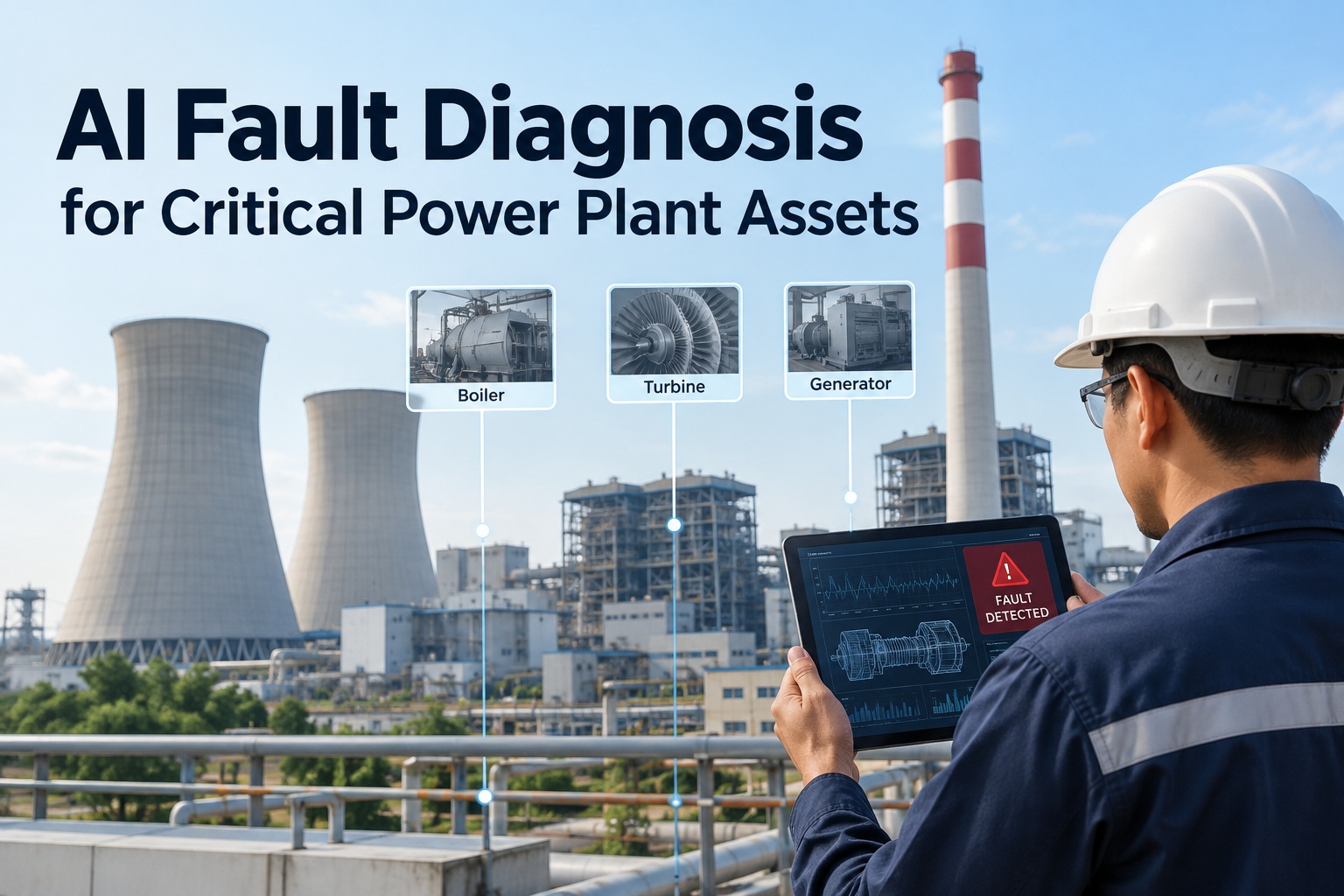
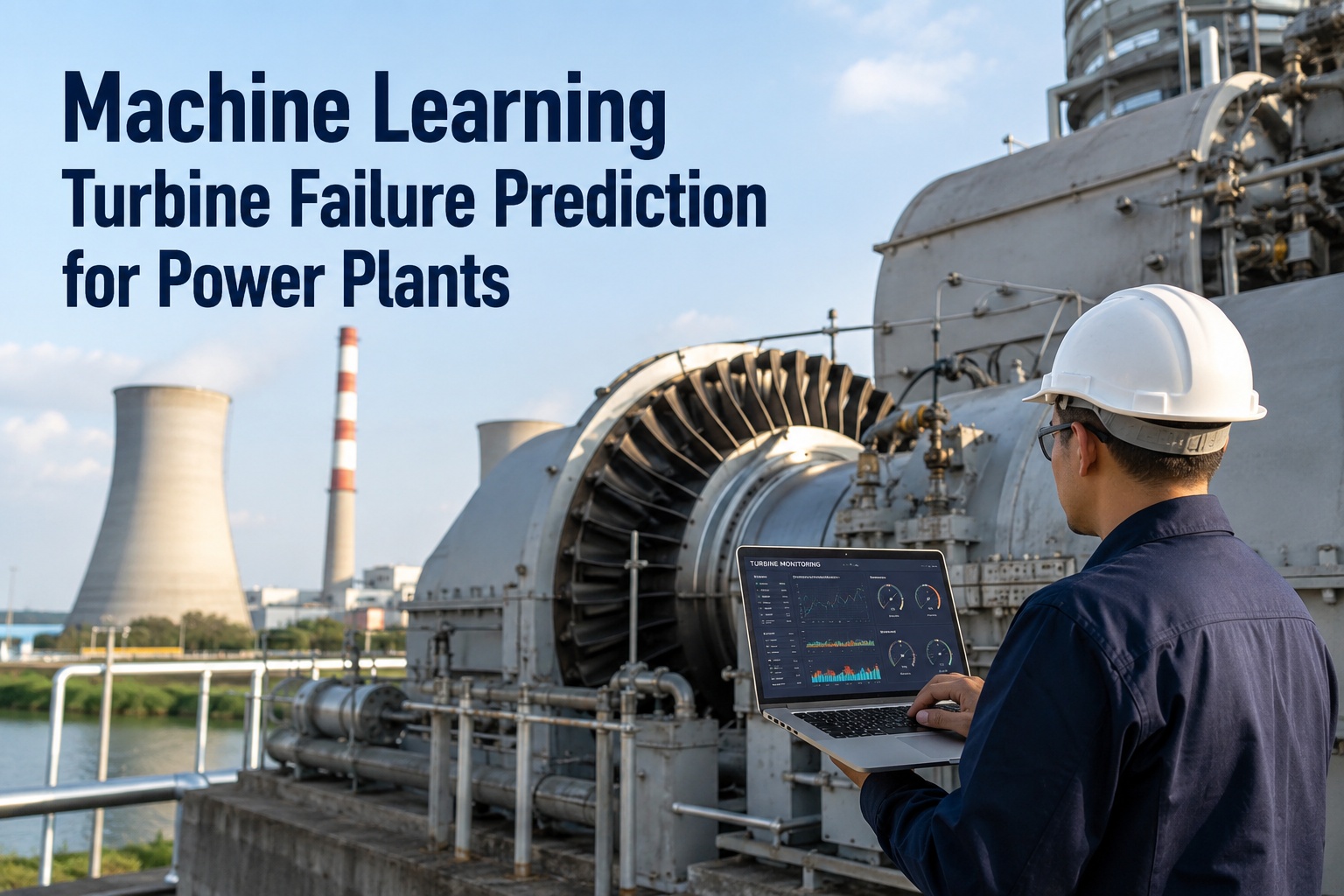
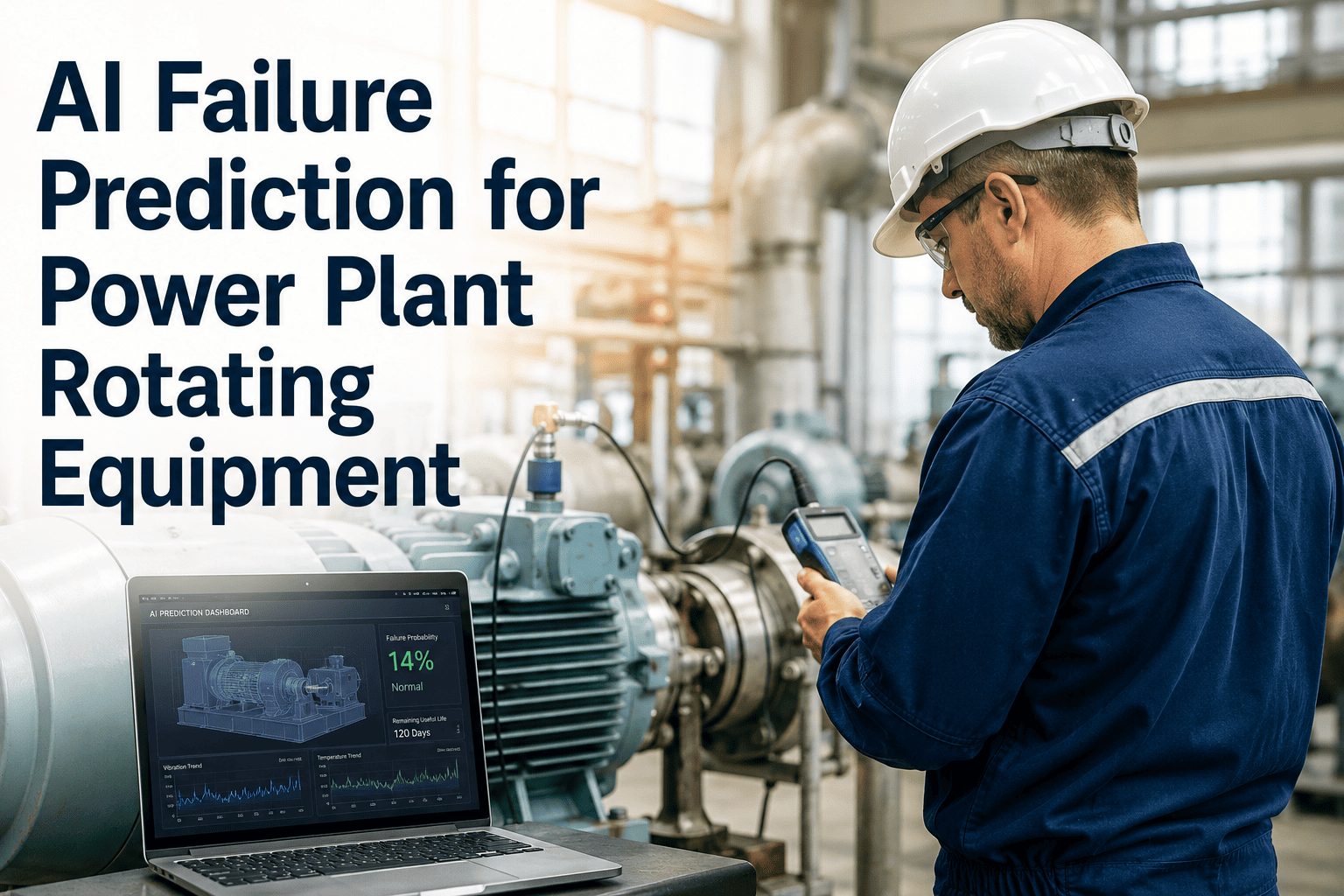
A turbine that trips offline at 2 AM without warning doesn't just cost hours of output — it triggers emergency dispatches, scrambles your maintenance crew, and exposes every adjacent system to cascading risk. The failure didn't start at 2 AM. It started weeks earlier in a vibration trend your sensors captured but no one analyzed. Start detecting faults before they become failures with Oxmaint — real-time AI anomaly detection built for power plant operations teams.
AI Predictive Fault Detection for Power Plant Equipment
How machine learning and real-time sensor analytics identify equipment failures weeks before they happen — reducing unplanned downtime by up to 50% across turbines, boilers, generators, and auxiliary systems.
Why Traditional Maintenance Keeps Failing Power Plants
Gas and steam turbines account for 43% of all power plant equipment failures. Boiler tube issues drive 52% of thermal plant forced outages. Yet most maintenance teams still rely on scheduled inspections — checking equipment on a fixed calendar regardless of actual wear state. The result: healthy components get serviced unnecessarily while degrading ones keep running until they trip.
The gap isn't effort — your teams are working hard. The gap is information. Traditional threshold alarms catch problems only after a sensor exceeds a preset limit, by which point damage is already occurring. What plants need is a system that reads the pattern of change, not just the momentary value.
The AI Fault Detection Pipeline: From Raw Sensor Data to Actionable Alerts
AI predictive fault detection is not a single algorithm — it is a four-stage intelligence pipeline that converts continuous equipment data into failure forecasts with timelines, confidence levels, and recommended actions. Understanding each stage helps maintenance managers set realistic expectations and deploy the technology where it delivers fastest value.
Continuous Data Ingestion
SCADA, DCS, and IoT sensors stream vibration, temperature, pressure, current draw, and flow data into the AI platform. Every reading is timestamped and linked to the specific asset. No sampling — full fidelity, continuous.
Baseline Learning and Anomaly Scoring
The AI builds an individual normal behavior model for each asset — not generic equipment averages. Deviations from that specific asset's baseline are scored in real time. Rules-based fault detection for known failure modes is active from day one, achieving over 90% detection accuracy within the first week.
Pattern Recognition Across Signals
A bearing lubrication fault doesn't appear in one sensor — it appears as a subtle combination of rising shaft vibration, minor exhaust temperature increase, and current draw trending upward over 72 hours. AI catches these multi-signal patterns that no manual review process can track across hundreds of assets simultaneously.
Prioritized Alert and Work Order Generation
When the anomaly score crosses a configurable threshold, the CMMS generates a work order automatically — pre-loaded with fault diagnosis, recommended actions, required parts, and safety procedures. The maintenance team acts on intelligence, not guesswork.
Which Power Plant Equipment Benefits Most From AI Fault Detection
Not all equipment carries equal risk. Prioritize AI monitoring where forced outages are most costly and where degradation patterns give the longest advance warning window. The following equipment categories account for over 80% of major power plant forced outages and show the strongest ROI from predictive monitoring.
What AI Sees — and When — Compared to Traditional Monitoring
The value of AI fault detection is measured in lead time: how many weeks before an unplanned outage does the system give you actionable warning? The table below shows documented detection lead times across common power plant failure modes, contrasting AI pattern recognition with traditional threshold alarm approaches.
| Failure Mode | Equipment | AI Detection Lead Time | Threshold Alarm Lead Time | Primary Sensor Signal | Financial Impact if Missed |
|---|---|---|---|---|---|
| Bearing lubrication failure | Gas turbine | 3–6 weeks | Hours to days (after damage) | Vibration + exhaust temp pattern | $500K–$2M unplanned outage |
| Compressor blade fouling | Gas turbine | 2–4 weeks | Efficiency loss visible, not flagged | Heat rate deviation trending | 3–5% efficiency loss sustained |
| Boiler tube wall thinning | Thermal boiler | 3–8 weeks | No alarm until leak occurs | Tube metal temp asymmetry | Emergency repair + lost generation |
| Generator insulation degradation | Generator | 6–18 months | None — no threshold covers slow drift | Partial discharge level trending | $5–15M generator rewind or replacement |
| Feedwater pump cavitation | Auxiliary pump | 1–3 weeks | 1–2 days (cavitation noise audible) | Discharge pressure + vibration | Impeller replacement + production stop |
| Main transformer overheating | Transformer | 3–18 months | Hours (thermal alarm, too late) | Dissolved gas analysis trend | $10–40M transformer loss |
Swipe to view all columns on mobile
See AI fault detection working on your plant's actual equipment data
In a 30-minute demo, we walk through real anomaly scoring, automated work order creation, and the cost-avoidance dashboard that quantifies every prevented outage in dollars — not estimates.
What Accuracy to Expect — and When
One of the most common questions from plant managers evaluating AI fault detection is: how accurate is it, and how long before it starts delivering value? The answer depends on which type of detection you need. Rules-based fault detection for known failure signatures — stuck valves, bearing degradation patterns, sensor drift — achieves over 90% accuracy from the first week because the logic is pre-built. Predictive failure forecasting, which requires learning each asset's individual baseline, improves over 3–6 months. Most plants report 85–92% prediction accuracy for major failure modes by month six.
The 8–15% of failures that aren't predicted are typically sudden catastrophic events that produce no detectable degradation pattern — structural fractures from undetected material defects, or external force events. AI cannot prevent what produces no signal. What it does prevent is the large majority of failures that do produce early signals but go undetected without continuous pattern analysis.
How Oxmaint Delivers AI Fault Detection for Power Generation Teams
Real-Time Anomaly Scoring Per Asset
Every turbine, boiler, generator, and auxiliary asset has a live anomaly score updated continuously from sensor data. When a score trends upward over multiple readings — even below alarm threshold — the system flags it for review before the problem becomes urgent. Sign up free to connect your first asset and see anomaly scoring live.
Automated Work Orders With Fault Diagnosis
When the AI identifies a fault pattern, the CMMS generates a work order automatically — with fault diagnosis, required tools, safety procedures, and parts request included. If the part isn't in stock, procurement receives a purchase request at standard lead time. No manual touchpoints, no missed steps. Book a demo to see automated work order generation.
NERC GADS Compliance Documentation
Every sensor reading, anomaly score, alert, and work order is logged with timestamps automatically. Audit-ready NERC GADS compliance reports are generated without manual data collection — eliminating the 15–20% of maintenance managers' time typically spent on compliance documentation. Start free to see compliance reporting.
Cost-Avoidance Dashboard
The Oxmaint cost-avoidance dashboard quantifies every prevented outage in dollars — not estimates. Each avoided failure is logged with the fault type, detection lead time, and calculated avoided cost based on your plant's specific revenue and repair cost data. Management sees the ROI without needing to request a report. Book a demo to see the cost dashboard.
Frequently Asked Questions
How quickly can AI fault detection be deployed on an operating power plant?
For plants with existing SCADA or DCS infrastructure, sensor data integration typically completes in 1–2 weeks. Rules-based fault detection for known failure signatures is active immediately upon connection, with AI baseline learning for predictive forecasting producing reliable alerts within 4–8 weeks. Sign up for Oxmaint to connect your first assets and see detection results within days.
Does AI fault detection replace our existing maintenance team and scheduled PMs?
No — it changes what your team works on and when. Scheduled PMs that are not condition-driven are replaced by condition-based interventions triggered by actual equipment state. Maintenance engineers shift from reactive investigation to proactive planning, spending more time on high-value decisions and less on paperwork and emergency response. Book a demo to see how Oxmaint integrates with existing maintenance workflows.
What happens when the AI generates a false positive fault alert?
False positives decrease significantly after the first 6–12 weeks as baseline models stabilize for each asset. In the early phase, alerts are reviewed by maintenance engineers before work orders are generated — the system recommends, the engineer confirms. Over time, high-confidence alerts auto-generate work orders while borderline anomalies continue to route for human review. Start free to configure alert confidence thresholds for your team.
Which sensors are most important to add first if we're starting with limited instrumentation?
Prioritize vibration sensors on turbine bearings and driven equipment, thermocouple arrays on boiler tube walls and generator windings, and motor current monitoring on all driven auxiliaries. These three sensor types cover the failure modes responsible for 70–80% of forced outage hours in most thermal plants. Book a demo to review your current instrumentation against the recommended baseline.
Connect your power plant assets to AI fault detection — and stop reacting to failures that were predictable
Oxmaint monitors every turbine, boiler, generator, and auxiliary system in real time — scoring anomalies, generating work orders, and quantifying every prevented outage. Start free or see it running on actual generation facility data in a 30-minute demo.