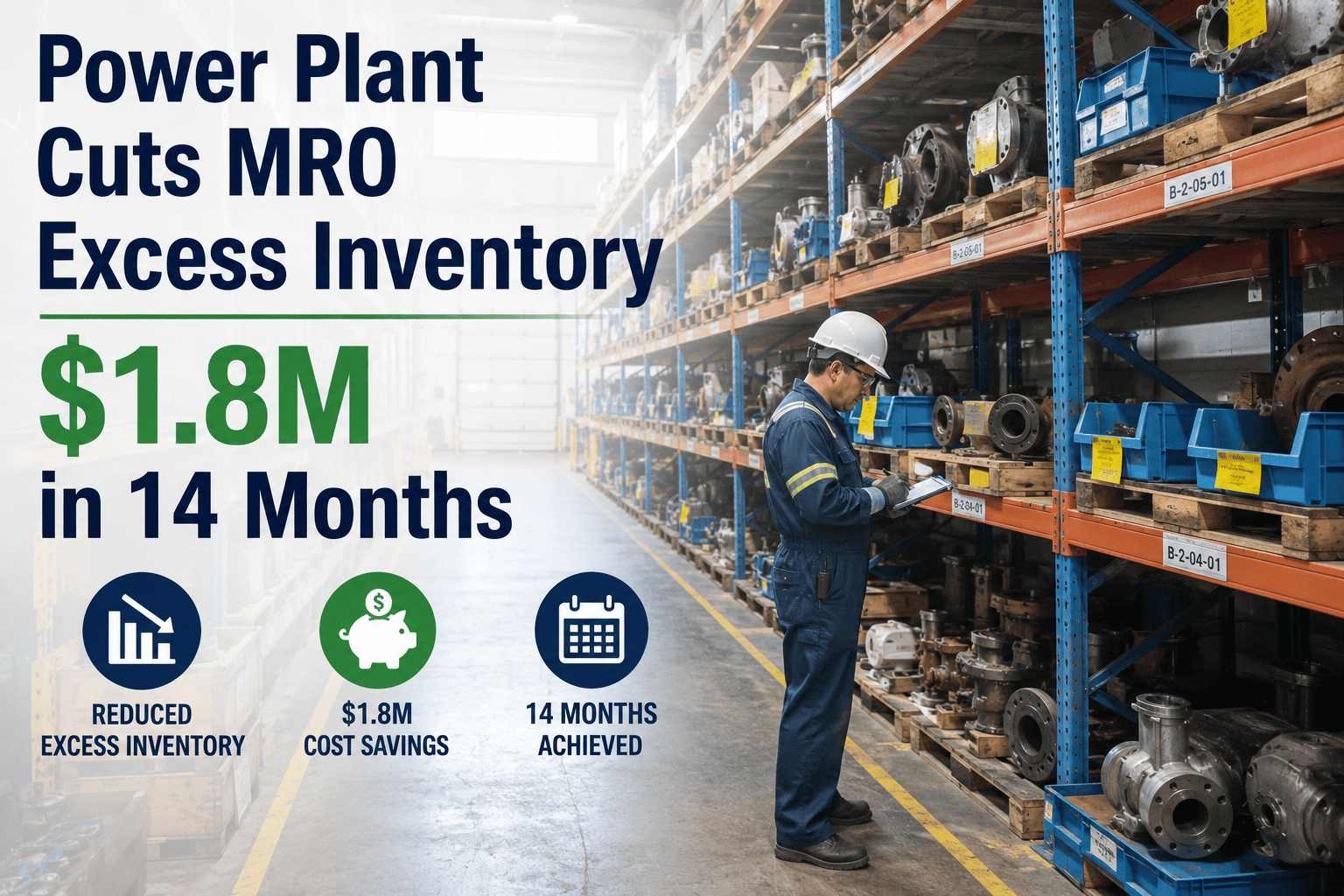
Most power plant storerooms have two inventory problems happening simultaneously — not enough of the parts that matter, and far too much of the parts that don't. The result is emergency procurement when critical spares aren't in stock, and years of carrying cost on obsolete inventory that will never be used. At one power plant, the MRO storeroom held $4.2 million in parts inventory. Fourteen months after activating Oxmaint's asset-linked storeroom and criticality matrix, $1.8 million of that inventory had been identified as excess or obsolete — and systematically liquidated or returned to suppliers without a single negative impact on maintenance performance. The plant didn't reduce what they stocked. They restructured it around what actually matters, using data instead of habit. Book a 30-minute demo to see how Oxmaint storeroom analysis works for your facility.
MRO INVENTORY CASE STUDY
$1.8M in Excess Inventory. Found. Eliminated. In 14 Months.
One power plant. One Oxmaint asset-linked storeroom deployment. $1.8 million in excess and obsolete MRO inventory identified and liquidated — without a single critical-spare stockout.
$1.8M
Excess / Obsolete Inventory Eliminated
14 mo
Time to Full Storeroom Rationalization
0
Critical-Spare Stockouts During Period
43%
Storeroom Carrying Cost Reduction
THE INVENTORY PROBLEM
How Power Plant Storerooms Accumulate $1.8M in Parts That Shouldn't Be There
The MRO inventory problem at power plants isn't a purchasing failure — it's a visibility failure. Without a direct link between storeroom inventory and the assets that actually consume those parts, purchasing decisions are made on gut feel, legacy orders, and the instinct to "keep extra just in case." Parts accumulate across decades without anyone knowing which ones are still relevant to the current installed asset base. Decommissioned equipment leaves behind spare parts that nobody needs. Start your free Oxmaint trial and run your first storeroom-to-asset linkage analysis in under a week.
WHERE THE $1.8M IN EXCESS INVENTORY WAS FOUND
$684K
Orphaned Parts
Spare parts linked to decommissioned or replaced equipment that was no longer in the active asset register
$522K
Over-Stock on Low-Criticality Parts
Parts for non-critical assets stocked at 5x to 12x the justifiable quantity based on failure frequency and lead time
$378K
Duplicate Stocking
Same part stocked under multiple part numbers due to vendor changes, specification updates, or data entry inconsistencies
$216K
Expired or Degraded Stock
Seals, gaskets, lubricants, and electrical components beyond shelf-life with no tracking of expiry dates in the previous system
THE OXMAINT METHOD
Asset-Linked Storeroom: How Oxmaint Connects Every Part to the Asset That Needs It
The foundation of Oxmaint's storeroom rationalization methodology is a two-way link between every storeroom item and the active asset it supports. Once that link exists, the system can answer the question no spreadsheet-based inventory system can answer: which parts in this storeroom are not linked to any active, critical asset — and why are we carrying them?
1
Asset Register Completion
All active plant assets are registered in Oxmaint with component-level hierarchy. Decommissioned assets are marked inactive — immediately flagging their associated spare parts for review.
2
Parts-to-Asset Linkage
Each storeroom item is linked to the specific asset(s) that consume it. Items with no asset link are flagged as unlinked — the first filter in identifying orphaned inventory.
3
Criticality Matrix Application
Oxmaint's criticality matrix assigns a criticality tier (Critical, High, Standard) to each asset. Stocking quantity recommendations are generated based on criticality, failure frequency, and supplier lead time — flagging over-stocks on low-criticality items.
4
Excess and Obsolete Report
Oxmaint generates an E&O report ranking storeroom items by excess quantity value — giving the inventory team a prioritized action list for returns, write-downs, and liquidations sorted by financial impact.
5
Critical Spare Verification
Before any reduction action, Oxmaint confirms that critical-tier assets have adequate spares on hand — ensuring the rationalization program doesn't create the stockout risk it aims to eliminate.
14-MONTH RESULTS BREAKDOWN
Where the Savings Came From — Month by Month
| Timeframe |
Action Taken |
Inventory Reduction |
Critical Spare Status |
| Months 1–2 |
Asset register completed, storeroom linked to assets, unlinked parts flagged |
$284K orphaned parts identified |
No impact — all critical spares confirmed |
| Months 3–5 |
Over-stock report generated; 47 line items reduced to criticality-based quantities |
$412K excess quantity returned to suppliers |
Critical-tier minimum stock levels maintained |
| Months 6–8 |
Duplicate part number consolidation; 38 duplicates resolved |
$310K duplicate stock liquidated |
Part consolidation improved fill rate accuracy |
| Months 9–11 |
Shelf-life program activated; expired items identified and replaced at proper levels |
$216K expired stock written down and removed |
Replacement of expired critical items completed |
| Months 12–14 |
Storeroom optimization finalized; reorder triggers set per criticality tier |
$578K final E&O disposal from residual review |
0 stockouts across full 14-month period |
Your Storeroom Has Excess Inventory. Oxmaint Will Show You Exactly Where It Is.
Asset-linked storeroom, criticality-based stock optimization, and excess and obsolete reporting — built for power plant maintenance teams who need data, not guesswork.
"We had a CFO who thought our storeroom was just a money pit. He wasn't wrong, but the problem wasn't that we were buying parts — it was that we had no idea which parts were connected to anything we still operated. Oxmaint showed us $684,000 in spare parts for equipment we had decommissioned two years prior. It was sitting in bins taking up space and tying up cash. We returned what we could and wrote off the rest. The CFO approved the Oxmaint license for three years after seeing that first report."
Plant Manager
—
280 MW Combined-Cycle Power Plant, Southwest Operations
FREQUENTLY ASKED QUESTIONS
What Maintenance and Operations Teams Ask About Oxmaint MRO Optimization
How does Oxmaint determine what the right stock quantity is for a given spare part?
Oxmaint's criticality matrix calculates recommended stocking quantities based on three inputs: the criticality tier of the linked asset, the historical consumption rate (failure frequency), and the supplier lead time for replenishment. A critical asset with a 12-week lead time and quarterly failure rate gets a different stocking recommendation than a standard-tier asset with a 2-week lead time and annual failure rate.
Start your free trial to configure your first criticality-based stocking model in Oxmaint.
Can Oxmaint identify duplicate part numbers created by supplier changes or purchasing inconsistencies?
Yes. Oxmaint's part deduplication tool compares part descriptions, specifications, and interchangeability flags across your storeroom catalog to identify potential duplicates for human review. The plant in this case study eliminated 38 duplicate line items representing $310,000 in redundant stock. Confirmed duplicates are consolidated under a single part record with a combined on-hand quantity.
Book a demo to see the Oxmaint duplicate detection workflow for your parts catalog.
How does Oxmaint handle shelf-life tracking for seals, gaskets, lubricants, and electrical components?
Oxmaint supports shelf-life expiry dates per part record, with automatic alerts generated before expiry. When a part is received into the storeroom, the expiry date is logged. The system generates work orders for shelf-life review before expiry — preventing situations where maintenance teams discover during a repair that the replacement seal in stock has degraded past its service rating.
Does the excess and obsolete report show the financial value of each identified item or just quantities?
Oxmaint's E&O report displays both quantity excess and unit-cost-based financial value per line item, ranked by total excess value so the inventory team can prioritize the highest-impact disposals first. The report is exportable in CSV format for finance team review and can be configured to show average cost, last purchase price, or replacement cost valuation depending on your accounting methodology.
What happens if an asset is decommissioned and its spare parts are flagged for review — how does Oxmaint handle the transition?
When an asset is marked inactive or decommissioned in Oxmaint, all linked spare parts are automatically flagged in the storeroom as orphaned stock. The system generates an orphaned inventory report showing the total carrying value of affected parts, giving the inventory team a structured review process: evaluate for cross-asset applicability, return to supplier, transfer to another site, or write off.
See how Oxmaint manages decommissioning transitions in your free trial.
$1.8M Was Sitting in Your Storeroom. Oxmaint Will Help You Find It.
Asset-linked inventory, criticality-based stocking, excess and obsolete reporting, shelf-life tracking — everything your maintenance team needs to stop carrying parts you don't need and start having the ones you do.