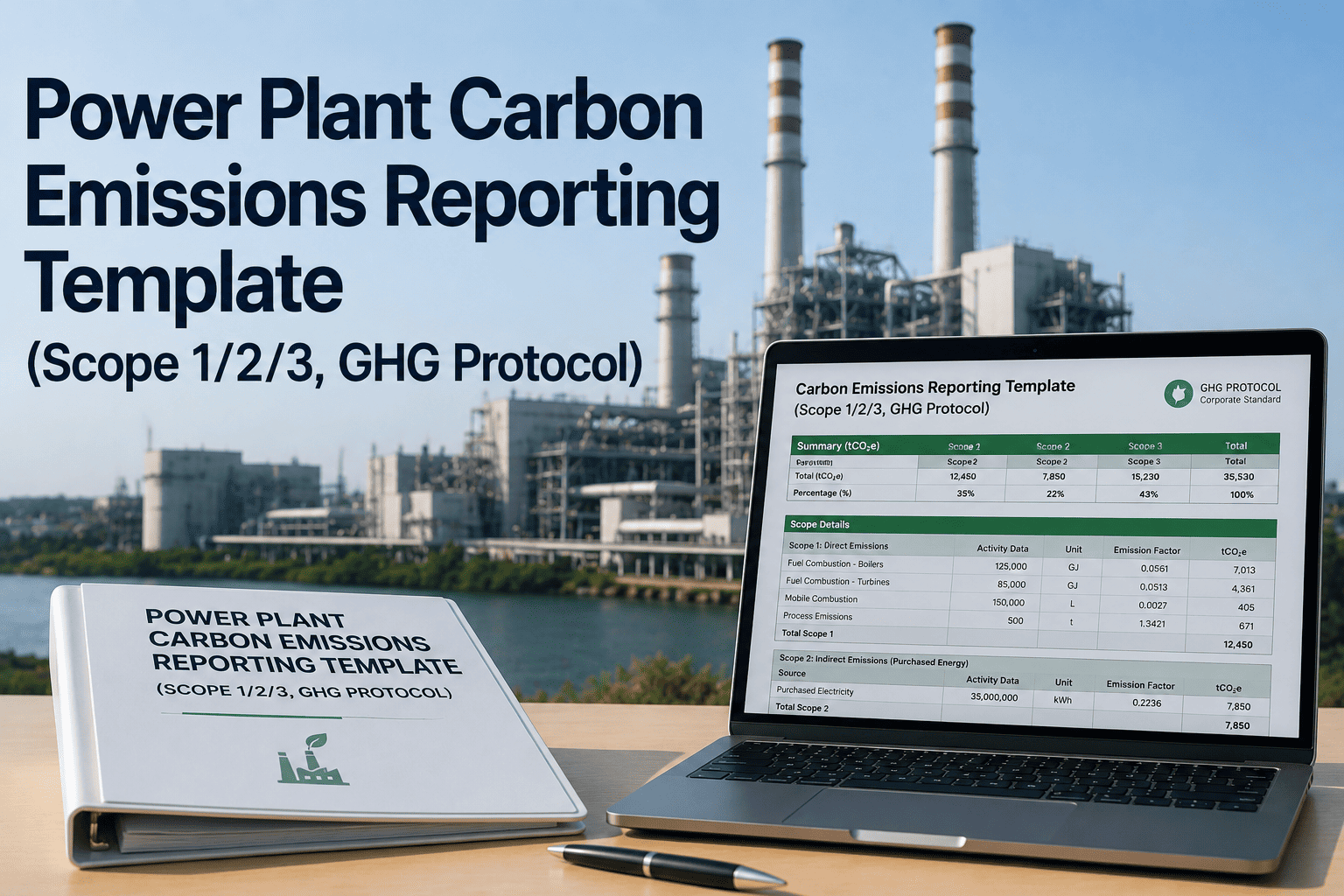
Every year, the sustainability team at a 680 MW gas-fired power plant spent five weeks building one carbon report. The data was all there — fuel burn logs in the DCS, purchased electricity in utility billing, contractor invoices in accounts payable, maintenance histories in CMMS work orders — but it lived in six different systems and no single person had access to all of it. By the time the annual Scope 1, 2, and 3 disclosure reached the board, it was already three months out of date and had been manually reconciled across 14 spreadsheets by four people. Investors, regulators, and lenders were asking better questions than the data could answer. After deploying OxMaint's sustainability module — which pulls emissions data directly from maintenance work orders, fuel consumption records, and equipment run logs — the same disclosure took five hours to produce, covered all three scopes with full GHG Protocol alignment, and included an audit trail that third-party verifiers could follow back to the source record for every figure. The plant issued its first verified ESG report the following quarter. Start your OxMaint free trial and see how your maintenance data maps to Scope 1, 2, and 3 before you commit to anything.
Case Study · Carbon Reporting · Scope 1 · Scope 2 · Scope 3 · ESG
From 5 Weeks of Spreadsheets to a 5-Hour Verified ESG Report — How One Power Plant Transformed Carbon Reporting
The data existed. The problem was finding it, reconciling it, and trusting it. OxMaint pulled every emission figure directly from maintenance records — eliminating manual compilation and producing a board-ready Scope 1/2/3 disclosure in a single working day.
14
Spreadsheets Eliminated
6
Data Systems Consolidated
4
People Freed From Manual Compilation
100%
Figures With Source Audit Trail
The Root Problem
Why 5 Weeks Was the Honest Answer — The Data Fragmentation Map
The sustainability team did not have a carbon accounting problem. They had a data retrieval problem. Every number needed for the annual disclosure existed somewhere — just not anywhere they could access without a week of email chains.
Annual Carbon Report
Needed in one document
DCS / SCADA
Fuel burn logs per turbine
No emissions conversion · Export only in raw CSV
Utility Billing
Purchased electricity kWh
PDF invoices · Manual data entry required
Accounts Payable
Contractor and parts spend
No emissions flag · ERP locked to finance team
CMMS Work Orders
Equipment run hours and condition
Efficiency losses not converted to CO2e
HR / Training System
Employee travel and commute data
Separate system · No GHG mapping
Procurement
Supply chain emission factors
No Scope 3 factors · Manual estimation only
The result every year:
4 people · 14 spreadsheets · 5 weeks · numbers already months out of date by publication
What OxMaint Tracks
How OxMaint Pulls Scope 1, 2, and 3 Data Directly From Maintenance Operations
Fuel combustion in turbines, boilers, and auxiliary units is logged against maintenance work orders. OxMaint applies GHG Protocol emission factors to convert fuel consumption records into CO2e automatically — by asset, unit, and facility. No separate carbon accounting spreadsheet.
Data pulled from:
Fuel consumption per work order
Equipment run-hour logs
Combustion efficiency readings
Fugitive refrigerant records
Grid emission factors are updated per reporting period and applied to purchased electricity consumption pulled from utility billing records. Location-based and market-based methods both supported — switchable in the dashboard for different disclosure frameworks.
Data pulled from:
Purchased electricity by meter
Grid emission factor (updated per period)
Renewable energy certificate records
Steam and heat consumption logs
Contractor activity recorded in OxMaint work orders, parts procurement from SAP or inventory modules, and employee travel data all feed into Scope 3 calculations. Emission factors from the GHG Protocol Scope 3 standard applied automatically — no manual estimation.
Data pulled from:
Contractor work order records
Parts and materials procurement
Waste disposal logs
Business travel and commute entries
OxMaint · Scope 1 · Scope 2 · Scope 3 · GRI · SASB · GHG Protocol
Your Maintenance Records Are Already a Carbon Ledger. OxMaint Reads Them That Way.
Every work order your team closes contains emissions data. Fuel burn, run hours, contractor activity, parts consumption — OxMaint converts all of it to CO2e in real time. No more five-week assembly. No more out-of-date figures at board review.
The Transformation
The Same Report. One Working Day Instead of Five Weeks.
Data collection
18 days of emails, exports, and manual data requests across 6 departments
Emissions calculation
Manual GHG Protocol factor lookup and Excel formula application across 14 spreadsheets
Scope 3 coverage
Incomplete — contractor and procurement data too difficult to reconcile in time
Third-party verification
Not possible — no traceable audit trail from reported figure to source data
Data freshness at publication
3–4 months out of date — reporting period closed before assembly finished
Frameworks covered
GRI 305 only — SASB and TCFD sections incomplete or omitted
Data collection
Automatic — pulled live from work orders, fuel logs, and procurement records continuously
Emissions calculation
GHG Protocol factors applied in real time to every asset record — CO2e updated with each work order closure
Scope 3 coverage
Complete — contractor work orders and parts procurement feed Scope 3 automatically
Third-party verification
Full audit trail — every figure traceable to source work order with timestamp and technician ID
Data freshness at publication
Current to the day — dashboard reflects live operational data, not month-old exports
Frameworks covered
GRI 302, 303, 305 · SASB Electric Utilities · TCFD · all in one export
The 5-Hour Report Day
How the Sustainability Manager Spent the Day That Used to Take Five Weeks
8:00 AM
Open OxMaint sustainability dashboard
Live Scope 1, 2, and 3 figures already calculated for the full reporting year. Emissions intensity per MWh generated visible by asset and by unit. No data request sent to any department.
8:45 AM
Review asset-level emission breakdown
Three turbines flagged for compressor fouling-linked heat rate degradation — showing measurable Scope 1 emissions increase per MWh. Maintenance work orders pulled and forwarded to operations for the next planned outage window.
10:15 AM
Run GRI 302, 305 and SASB export
OxMaint generates structured exports mapped to GRI 302 (Energy), GRI 303 (Water), and GRI 305 (Emissions) disclosure requirements simultaneously. SASB Electric Utilities sector export generated in the same operation. Every figure includes source reference for third-party verifier use.
11:30 AM
Prepare TCFD climate risk section
Emissions trend data and efficiency KPIs from OxMaint populated into the TCFD narrative template. No data requested from operations, engineering, or finance — all figures pulled directly from the dashboard.
1:00 PM
Complete report ready for board review
Full Scope 1/2/3 carbon disclosure delivered to the CFO and sustainability board committee — current to the day, third-party verifiable, covering all three disclosure frameworks. Five hours total. Zero interdepartmental email chains.
Frequently Asked Questions
Carbon Reporting With OxMaint — What Sustainability Managers Ask
How does OxMaint calculate Scope 1 emissions from maintenance records?
OxMaint logs fuel consumption per turbine, boiler, and auxiliary unit against individual work orders. GHG Protocol emission factors are applied automatically to convert fuel records into CO2e — by asset, unit, and facility — in real time. No separate spreadsheet or carbon accounting tool is required.
Start free to see how your fuel records map to Scope 1.
Which ESG disclosure frameworks does OxMaint support?
OxMaint generates structured data exports aligned to GRI 302 (Energy), GRI 303 (Water), GRI 305 (Emissions), SASB Electric Utilities sector standards, and TCFD climate risk disclosure requirements — all from a single export operation. Every figure includes a source audit trail for third-party verification.
Book a demo to see a sample export for your reporting framework.
Can OxMaint handle Scope 3 emissions from contractors and procurement?
Yes. Contractor activity logged in OxMaint work orders and parts procurement records from connected inventory or ERP systems feed Scope 3 calculations automatically using GHG Protocol Scope 3 emission factors. The plant in this case study achieved complete Scope 3 coverage for the first time — categories previously omitted due to data access difficulty were fully included.
Start a free trial to map your contractor data to Scope 3.
Can a third-party verifier trace every carbon figure back to its source?
Yes. Every emission figure in an OxMaint export includes a traceable source reference — the specific work order, fuel log entry, or procurement record that generated it, with timestamp and technician attribution. This is what enabled the plant in this case study to issue its first independently verified ESG report within one quarter of OxMaint deployment.
How long does it take to set up OxMaint for carbon reporting at a power plant?
Most plants complete sustainability module setup in three to five weeks — importing asset records, configuring emission factor assignments, and connecting fuel and procurement data sources. The plant in this case study issued its first OxMaint-generated ESG report within one quarter of go-live.
Book a scoping call to see a realistic setup timeline for your facility.
OxMaint · Carbon Reporting · Scope 1 · 2 · 3 · GRI · SASB · TCFD · Free to Start
Five Weeks of Spreadsheets Is Not a Reporting Process. It Is a Risk.
Out-of-date figures. Unverifiable sources. Missing Scope 3. Frameworks left incomplete. Every one of those gaps is visible to investors and regulators who now know exactly what a complete ESG disclosure looks like. OxMaint converts your existing maintenance records into a live, board-ready carbon ledger — no extra data collection, no interdepartmental emails, no five-week scramble.