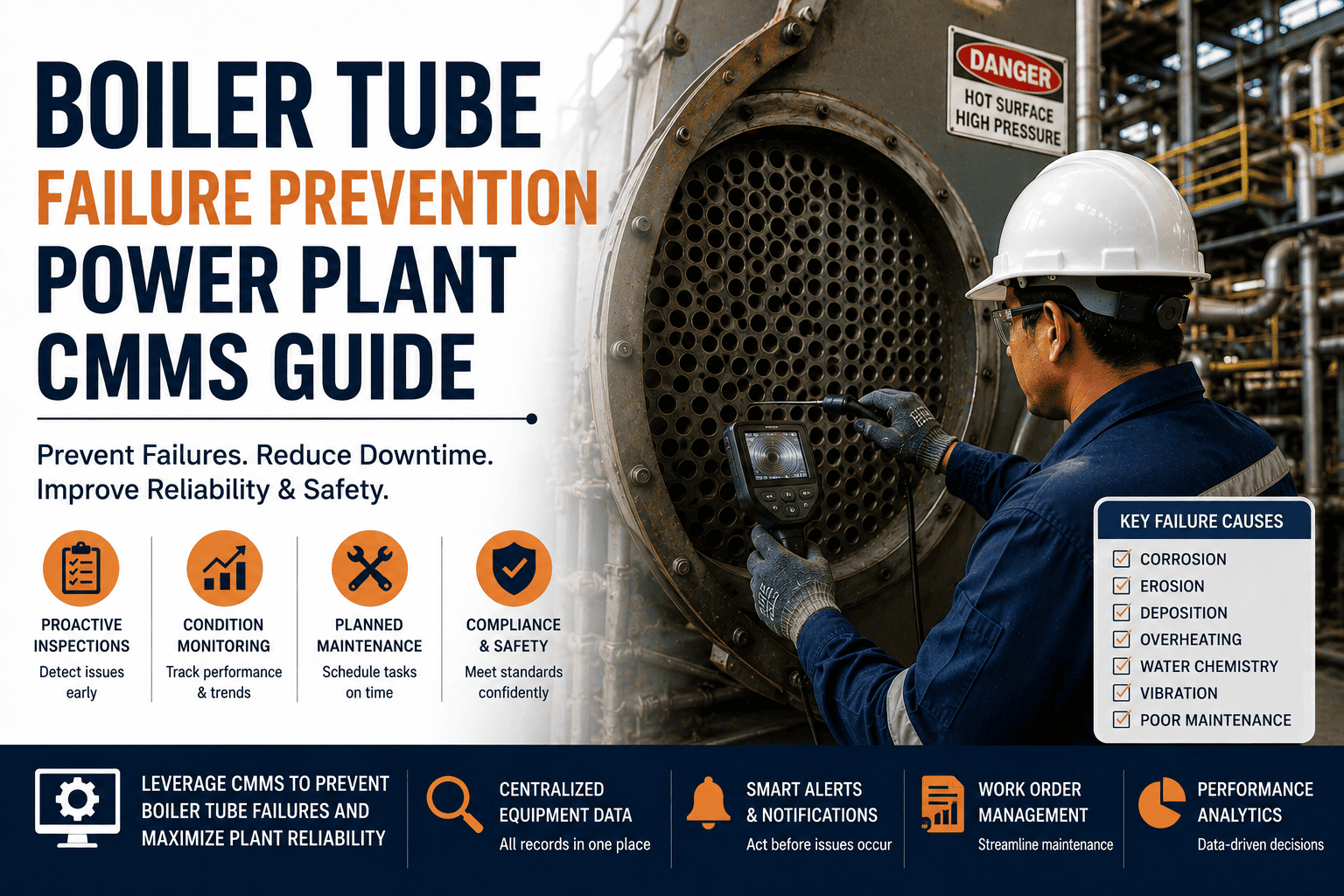
Boiler reliability is the single largest determinant of whether a power plant hits its availability contract — a single forced outage on a 500 MW unit routinely clears $1.2M in lost generation per day, and tube leaks account for roughly 40% of those events. This guide consolidates the 2026 inspection cadence, waterwall and superheater PM routines, safety valve testing protocols, and CMMS work-order discipline that maintenance managers actually use to push tube-failure downtime below 2% of operating hours. You will find concrete cycles, acceptance ranges, and a worked example for a 600 MW subcritical unit. When you are ready to operationalize it, you can Start Free Trial and load these routines as repeatable PM templates.
Is your boiler inspection cycle actually preventing tube failures — or just documenting them?
40% of forced boiler outages trace back to tube leaks that a risk-based inspection would have caught one cycle earlier. This guide gives you the cadence, acceptance criteria, and CMMS workflows to close that gap before your next planned outage window.
Why 2026 changes the boiler maintenance math
Plants running pre-2010 subcritical units now average 6.8% equivalent forced outage rate (EFOR) on boiler-related equipment, compared to 3.1% for peers using risk-based inspection (RBI) aligned to API 580. The gap is widening as cycling duty increases.
A 600 MW subcritical plant spending $1.1M annually on emergency tube repairs and derate losses typically recovers a full CMMS implementation within 4.2 months once inspection intervals shift from time-based to risk-based prioritization.
Tiered boiler inspection checklist by component and interval
Each tier below maps to a CMMS PM template. Frequencies assume base-load duty; cycling units should compress intervals by roughly 30%.
Operational Walkdowns
- Bottom ash hopper water level and seal integrity
- Soot-blower supply pressure at 1.2–1.4 MPa header
- Drum level glass and capillary reference leg
- Furnace draft maintained at −25 to −50 Pa
- Tube-wall temperature trends reviewed for hot spots
Condition Monitoring
- Non-destructive UT mapping on waterwall target zones
- Feedwater chemistry audit (pH 9.0–9.6, conductivity <6 µS/cm)
- Safety valve lift setting verification per ASME PTC 25
- Flame scanner lens cleaning and UV signal strength log
- Refractory and gunite inspection at burner throats
Major Overhaul Inspection
- 100% visual + UT on superheater/reheater high-risk circuits
- Boiler internal inspection per NBIC Part 3 and jurisdictional code
- Economizer tube thickness mapping with 50 mm grid resolution
- Drum and headers: magnetic-particle inspection of stress risers
- Hydrostatic test at 1.5× MAWP after major tube replacement
Tube inspection intervals — acceptance criteria at a glance
These intervals are derived from EPRI boiler reliability data and aligned to API 580 risk categories. Use the remaining-threshold column to trigger CMMS work orders automatically.
| Component | Risk Tier | Inspection Interval | Method | Min Wall Remaining | CMMS Trigger |
|---|---|---|---|---|---|
| Waterwall — burner zone | High | 12 months | UT + visual | 70% nominal | Auto PM at 75% |
| Superheater outlet | High | 12 months | UT + replication | 75% nominal | Auto PM at 80% |
| Reheater inlet | Medium | 24 months | UT spot-check | 80% nominal | Manual review |
| Economizer finned | Medium | 18 months | UT grid map | 75% nominal | Auto PM at 80% |
| Steam drum internals | High | 36 months | MPI + visual | No cracking | Outage scope |
| Safety relief valves | High | 12 months | Bench / online test | Lift ±3% set pressure | Auto PM annual |
Planning the 2026 boiler outage — month-by-month
A well-scoped boiler outage starts 9 months before scaffold drop. The timeline below assumes a 21-day outage window on a 500–700 MW unit and maps directly to CMMS milestone triggers.
Risk-based scope package finalized
Compile UT trending data from the last 3 outages, rank circuits by remaining-life regression, and lock the tube-replacement work scope. Target 85% of high-risk circuits covered.
Long-lead materials on order
Order SA-213 T91 superheater sections, SA-210 A1 waterwall panels, and refractory castables. Confirm mill certifications and code-stamp documentation before shipment.
NDT and welding crews scheduled
Finalize contractor manning tables, weld procedure specifications (WPS), and NDT method sheets. Verify ASME Section IX qualifications for T91 dissimilar welds.
Online NDT and baseline readings
Perform accessible UT readings while the unit is at temperature where safely possible. Pre-tag all isolation points and confirm LOTO procedures with operations.
Inspection, repair, hydro, and return to service
Day 1–8 inspection and NDT, Day 9–15 tube replacement and welding, Day 16–18 hydro at 1.5× MAWP, Day 19–21 refractory cure and refractory dry-out. CMMS logs every WPS and NDT report.
Data closeout and RBI model refresh
Load all UT thickness data into the CMMS asset registry, update remaining-life regression curves, and recalibrate next-inspection intervals. Issue a formal outage report within 30 days.
Quantifying the return on a CMMS-driven boiler PM program
The formula below captures the annual savings a power plant should expect when moving from reactive boiler maintenance to a CMMS-orchestrated, risk-based PM strategy. Use it to build your own internal business case.
Worked example: 600 MW subcritical plant
A 600 MW unit averaging 4.2 forced tube-leak outages per year at $1.15M per event, plus $680K in derate losses, deploys a CMMS at $48K/yr all-in. After RBI implementation, forced outages drop to 1.6 per year and derate losses fall to $210K. Net annual savings: $2.83M, with payback in 4.2 months.
Turn this guide into repeatable PM templates in one afternoon
Load every inspection tier, tube threshold, and safety-valve test interval from this guide directly into your asset registry — then let the CMMS auto-generate work orders on schedule.
Boiler maintenance and inspection — 2026 FAQs
The five questions maintenance managers ask most when migrating boiler PM from spreadsheets to a CMMS.
How often should power plant boiler tubes be inspected?
High-risk circuits — waterwall burner zones, superheater outlets, and reheater hot legs — should receive UT thickness mapping every 12 months under base-load duty, or every 8 months on cycling units. Medium-risk components like economizer finned sections and reheater inlets can extend to 18–24 months. The key is trending remaining wall thickness against a regression curve, not relying on a fixed calendar interval, so that the CMMS triggers a work order at 75–80% of nominal wall.
What water chemistry limits prevent boiler tube corrosion in 2026?
For all-volatile treatment in a subcritical drum unit, maintain pH between 9.0 and 9.6, cation conductivity below 0.2 µS/cm at the economizer inlet, and total dissolved solids under 6 µS/cm. Oxygen scavenger residuals should stay at 10–20 ppb residual hydrazine or its equivalent. Excursions outside these bands for more than 4 hours should auto-generate a CMMS corrective work order, because caustic gouging and hydrogen damage can initiate within a single chemistry upset.
How does a CMMS improve boiler maintenance strategy versus spreadsheets?
A CMMS replaces static logs with a live asset registry that links every UT reading, weld repair record, and safety-valve test to the specific tube circuit or component tag. That linkage enables risk-based interval adjustment — the system recalculates next-inspection dates from actual degradation rates rather than a fixed calendar. Plants typically cut forced outages by 35–50% in the first 18 months. You can Book a Demo to see the boiler PM template library pre-loaded.
What safety valve testing protocol satisfies ASME PTC 25 and NBIC?
Safety relief valves on the steam drum and superheater outlet must be bench-tested or pop-tested at least every 12 months, with lift pressure verified within ±3% of set pressure. For online testing without lifting, use a Trevitest-style assist device and record the set-pressure deviation in the CMMS. Any valve that drifts more than 3% must be removed, refurbished, and recalibrated before the unit returns to service, per NBIC Part 4.
What is the typical payback period for CMMS-driven boiler maintenance?
Most mid-size fossil plants (300–700 MW) recover full CMMS implementation costs within 4–6 months. The savings come from three buckets: fewer forced outage events (each worth $0.8–1.5M), reduced derate hours from early-defect detection, and lower emergency repair labor premiums. A plant spending $1M+ annually on unplanned boiler repairs should expect $2–3M in net annual savings after rollout. You can validate your own numbers when you Start Free Trial and import your outage history.
Ready to cut boiler forced outages by 40% next cycle?
Deploy the full 2026 inspection cadence, tube-threshold triggers, and safety-valve PM templates in your CMMS this week — no migration project required.
Free 14-day trial · No credit card