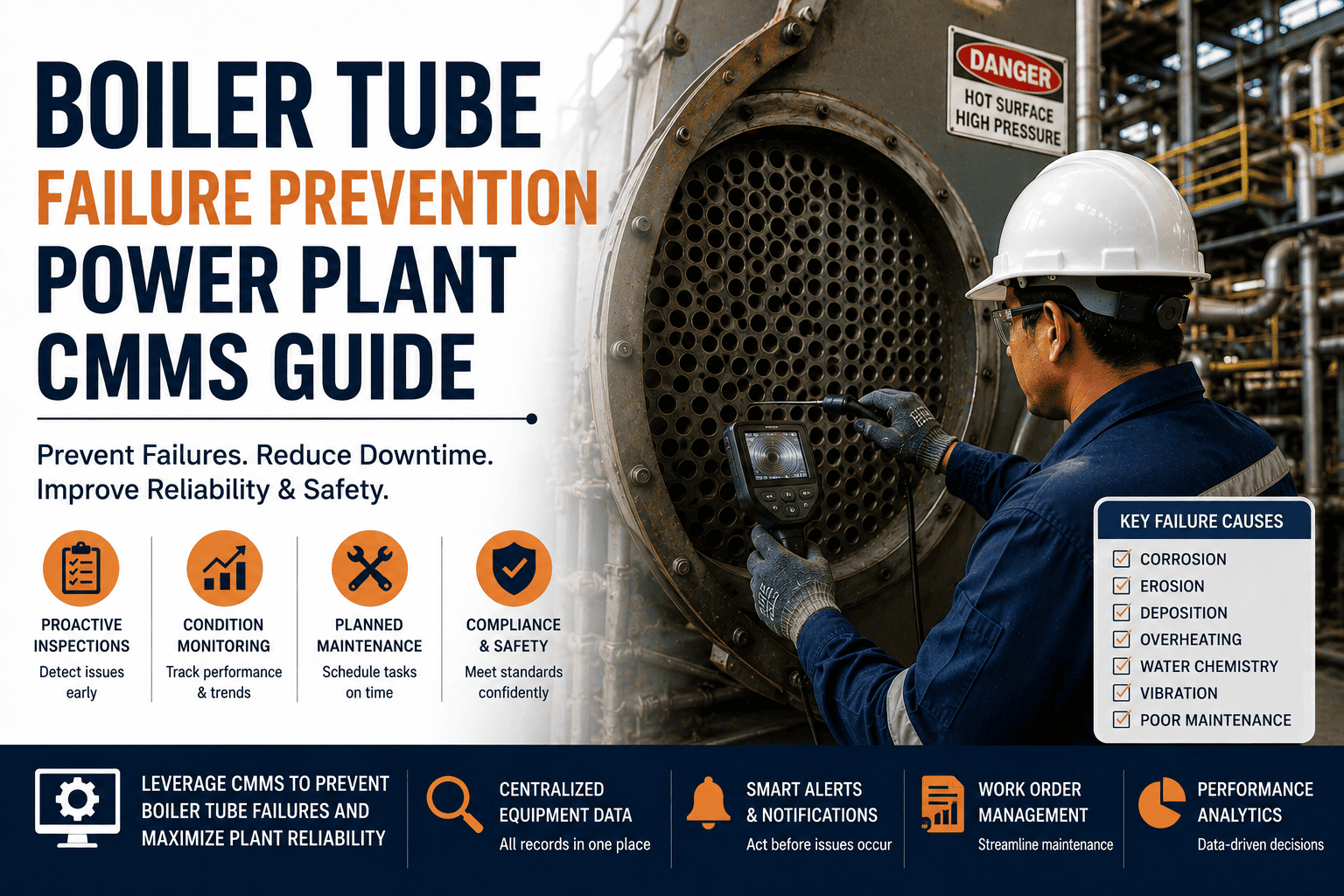
Boiler waterwall tubes operate at membrane stresses of 60–120 MPa and surface flux densities of 200–400 kW/m², so a single 0.8 mm wall-thickness deviation can cut creep life from 200,000 hours to under 80,000. This guide condenses field-proven inspection intervals, NDE routing, fin-weld acceptance criteria and thickness-survey mapping into a maintenance program a plant reliability team can implement inside one shutdown window. Plants that pair this playbook with a CMMS-driven PM schedule typically recover 1.5–3% of availability lost to forced tube leaks. If you want to operationalize it immediately, you can Start Free Trial on Oxmaint,and migrate your waterwall asset register this week.
What if your next forced tube leak were already visible in today's thickness survey?
Over 40% of boiler tube failures originate in the waterwall, and the average forced-outage cost runs $250,000–$600,000 per day of lost generation. A disciplined inspection and maintenance program catches the 0.5 mm thinning trend long before it becomes a 00:00 trip event.
Four failure mechanisms drive 90% of waterwall tube leaks
Before scheduling NDE, your inspection plan must target the specific mechanism attacking the panel. Each mode has a tell-tale location, morphology, and acceptance threshold.
Fireside corrosion — reducing atmosphere
Sulfidation and chloride attack in substoichiometric zones. Common in low-NOx burner retrofits where O₂ drops below 1.5%. Metal loss of 0.1–0.4 mm/yr typical; look for orange-black scale and "alligator-skin" fissures.
Fly-ash erosion
High-velocity ash impingement thins the tube crown at 0.2–0.6 mm/yr. Peaks where flue gas exceeds 18 m/s and at sootblower lane impingement lines. UTT mapping reveals horseshoe-shaped metal loss.
Caustic / under-deposit gouging
Waterside attack where NaOH concentrates beneath porous deposits at heat-flux peaks. Produces hemispherical gouges 3–8 mm deep that can perforate a 5 mm wall in under 12 months. Often invisible to visual inspection.
Fin-weld cracking
Membrane-fin welds crack from thermal cycling and weld-root lack-of-fusion. Cracks propagate into the tube body within 200–400 cold starts. A 10 mm crack is a reportable condition per NBIC; 25 mm mandates repair.
Tiered waterwall PM checklist — daily to overhaul interval
Apply the tiers below as standing PMs in your CMMS. Each carries a documented pass/fail criteria so technicians close the work order with a decision, not a note.
Shift-level monitoring
- Walk-down boiler casing for hot spots (IR spot > 120 °C above ambient = escalate)
- Verify feedwater conductivity < 2 µS/cm and pH 9.0–9.6
- Log sootblower steam pressure and number of cycles
- Inspect bottom-ash hopper for tube-rubbing shingles
Running-condition surveillance
- Thermography survey of casing doors and buckstays
- Compare drum-level trends with feedwater flow for hidden leaks
- Sample blowdown for silica and sodium (target Na < 10 ppb)
- Review OEM cumulative cycle counter vs. design fatigue curve
Inspection-tier shutdown
- UT thickness grid on 100% of burner-belt panels (50 mm pitch)
- MT inspection of all buckstay and burner-throat attachment welds
- Borescope 25% of high-heat-flux tubes for under-deposit gouging
- Measure fin-weld leg size and gap; document any crack > 5 mm
- Photograph and geo-tag every repair candidate into the CMMS asset record
From UT readings to a repair decision in five steps
A 600 MW unit generates 4,000–7,000 thickness readings per survey. Without a structured pipeline those numbers sit in spreadsheets; with one, they become a ranked repair list before the boiler doors close.
Grid definition
Map a 50 mm × 100 mm grid on burner-belt tubes, 200 mm elsewhere. Assign every grid point a tube ID, elevation, and panel-side tag inside the CMMS asset hierarchy.
UT data capture
Use a 5–10 MHz dual-element transducer calibrated against a certified step wedge. Capture three readings per point (crown, 30°, 60°) to catch off-axis erosion.
Remaining-life calc
Apply Rremaining = (tmeasured − tcritical) / corrosion-rate. Flag any point with Rremaining < next planned inspection interval as a replacement candidate.
Repair ranking
Sort candidates by criticality × probability-of-failure. Cluster adjacent thin tubes into panel sections so welders cut one block instead of dozens of fish-mouth repairs.
Post-repair baseline
Re-survey all replaced panels and store as the new t-zero baseline. The next outage's corrosion rate is then calculated from real delta, not nominal wall.
A 180-asset plant turning $42K of inspection data into $1.1M of avoided outages
The math below is built from a real mid-merit coal plant running 4,800 hours/year. Replace the four inputs with your own numbers — the structure holds for any subcritical or supercritical unit.
Pleak = historic leak frequency · Hdown = average forced-outage hours · $/MWh = spark or replacement price · ηcatch = fraction of leaks predicted by the inspection program (typically 0.35–0.55 with disciplined UTT trending).
| Program maturity | Leak frequency (leaks/yr) | Mean detection lead time | Forced outage hours | Annual loss exposure |
|---|---|---|---|---|
| Reactive (run-to-failure) | 2.4 | 0 (no prediction) | 174 h | $4.8M |
| Spreadsheet-tracked PM | 1.5 | 3 months | 108 h | $3.0M |
| CMMS-driven waterwall PM (Oxmaint) | 0.6 | 14 months | 43 h | $1.2M |
Turn your next outage's UT data into a ranked repair plan — before the boiler cools.
Oxmaint ingests thickness grids, flags tubes below remaining-life threshold, and auto-generates work orders tied to the exact panel and elevation.
Inspection findings — what to keep, weld, or replace
Make consistent repair calls across every shift with a single criteria table tied to ASME P-3 and your OEM design minimums.
| Finding | Measure | Monitor | Repair this outage | Replace panel |
|---|---|---|---|---|
| Tube wall thinning | UT thickness (mm) | ≥ 90% nominal | 75–89% nominal | < 75% nominal or Rremaining < 1 cycle |
| Fin-weld crack | Length (mm) | ≤ 5 mm, no tube-body propagation | 5–25 mm, surface only | > 25 mm or into tube wall |
| Under-deposit gouge | Depth (mm) | ≤ 0.5 mm, pH in spec | 0.5–1.5 mm, acid cleaning | > 1.5 mm or perforated |
| Fireside corrosion | Loss rate (mm/yr) | ≤ 0.15 | 0.15–0.40, apply weld overlay | > 0.40 or < 3.0 mm remaining |
| Tube ovality | D/D ratio | ≤ 4% | 4–8%, monitor next 2 outages | > 8% |
From 11 forced leaks a year to two — in one outage cycle
"We moved 6,200 UT readings into Oxmaint and the system auto-ranked 38 tubes below our 80% threshold. We replaced 22 of them in a 9-day outage. Over the next 12 months we had two leaks — down from eleven the prior year. The CMMS thickness-trend chart is now the first slide in every reliability review."
"Fin-weld crack tracking used to live in three field notebooks. Now every crack is geo-tagged to a panel-elevation ID and the next outage's PM auto-populates with MT inspection calls. We caught a 22 mm crack propagating into the tube body that would have tripped the unit within weeks."
Waterwall inspection — the five questions every plant asks
How often should a boiler waterwall be inspected?
At minimum an internal UT thickness survey every annual shutdown, with full burner-belt coverage every 18–24 months for units over 200 MW. High-cycling units (more than 150 starts/year) should add a quarterly thermography round and a borescope inspection of high-heat-flux zones between major outages. Your CMMS should auto-trigger these intervals from the asset record, not from someone's memory.
What thickness warrants tube replacement versus monitoring?
Industry convention is to replace when measured wall is below 75% of nominal design thickness, or when remaining-life calculation falls below the next planned inspection interval. Between 75% and 89% you repair — typically a weld overlay or a fish-mouth insert — and re-baseline. Above 90% you monitor and trend. Always confirm the corrosion rate from at least two surveys separated by 4,000 operating hours before authorizing a panel cut.
Which NDE methods are required for fin-weld inspection?
Magnetic particle testing (MT) is the primary screen for surface and near-surface cracks in carbon-steel membrane welds. For stainless-clad or non-magnetic areas, use liquid penetrant (PT). Any indication over 5 mm should be confirmed with eddy-current or ultrasonic shear wave to rule out subsurface propagation into the tube body. Document every indication with location, length, and a panel-elevation tag in your CMMS.
Can Oxmaint integrate with our existing inspection contractors and UT instruments?
Yes. Oxmaint accepts CSV and PDF thickness imports from any UTT instrument — Olympus, GE/Krautkramer, Sonatest — and lets third-party contractors upload findings against a controlled asset hierarchy. You can Book a Demo to see a live import of a 4,000-point survey and the auto-generated repair ranking.
How long does it take to deploy a waterwall PM program in Oxmaint?
Most plants complete asset-hierarchy import, PM-template configuration, and technician onboarding in 2–4 weeks. The system ships with pre-built waterwall PM templates (daily rounds, quarterly thermography, annual UTT grid) so you start from a working baseline rather than a blank database. A 14-day free trial is enough to import one boiler's asset register and run a dry outage-planning cycle before committing.
Build a waterwall program that predicts the next failure before it trips your unit.
Import your last UT survey, auto-rank tubes by remaining life, and turn the ranked list into scheduled work orders — all inside one CMMS built for power-plant reliability teams.
Free 14-day trial · No credit card