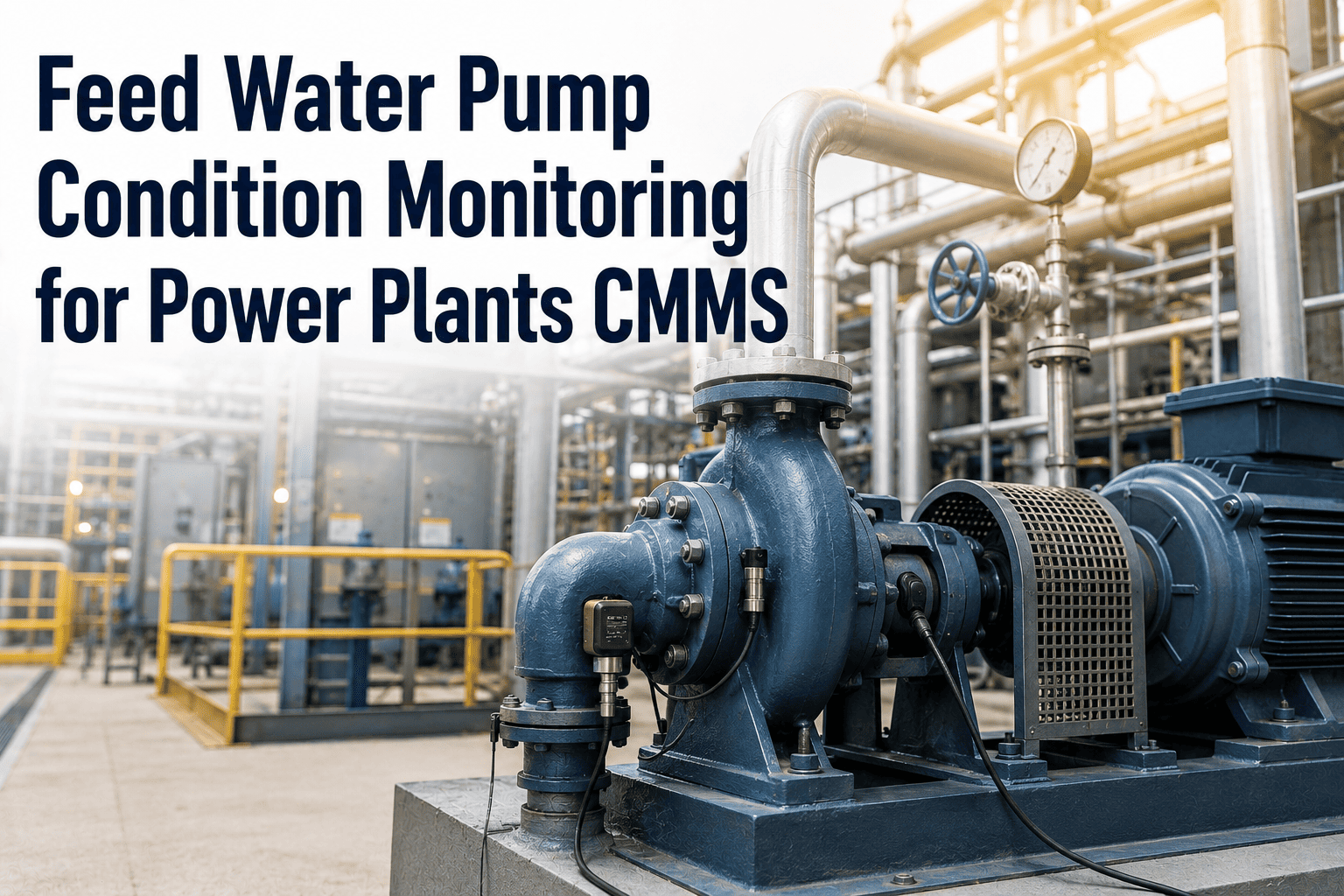
Feedwater pump condition monitoring is the single highest-leverage reliability practice in a power plant — a boiler feed pump (BFP) that fails unexpectedly can force a unit derate or full outage within hours, costing $50K–$500K per day in lost generation. For maintenance and reliability teams running feed water pump power plant assets, a CMMS-integrated monitoring strategy combining vibration analysis, seal health tracking, and cavitation detection can cut unplanned BFP downtime by 30–50% and extend mean time between overhauls by 18–24 months. This guide walks through the critical monitoring parameters, failure modes, and how a pump monitoring CMMS like OxMaint turns sensor data into preventive and predictive work orders — automatically. Ready to modernize your feedwater maintenance guide? Start Free Trial and see it on your assets today.
Is your boiler feed pump one vibration event away from a forced outage?
70% of feedwater pump failures show detectable vibration, temperature, or seal-leak signatures 2–6 weeks before catastrophic breakdown. OxMaint's AI-powered CMMS catches those signals early, auto-generates work orders, and keeps your BFP running at full load.
Critical feedwater pump failure modes you must monitor
Boiler feed pumps operate at 150–250 bar discharge pressure, 160°C+ temperatures, and speeds exceeding 5,000 RPM. Under these conditions, six failure modes account for over 90% of unplanned BFP trips. Each produces detectable precursors that a pump monitoring CMMS can capture and act on.
Bearing wear & spalling
High-frequency vibration (5–20 kHz) rises 3–6 months before bearing seizure. SKF and ISO 10816 thresholds flag this early; without monitoring, expect a $15K–$40K rebuild plus 12–48 hours of downtime.
Mechanical seal degradation
Seal leak rates above 10–30 drops/minute or flushing-pressure deviation signal face wear or O-ring hardening. Left unaddressed, a seal failure at temperature can flash to steam and damage the shaft sleeve.
Cavitation & suction recirculation
NPSH margin below 1.3× NPSHr causes vapor bubble collapse at the impeller eye, erasing material at 2–5 mm/month. Vibration at vane-pass frequency and discharge-pressure fluctuation are the tell-tale signs.
Impeller & wear-ring erosion
Internal wear-ring clearance beyond 0.5 mm drops pump efficiency 3–8% and shifts the performance curve. Flow-degradation trending in the CMMS catches this long before output suffers.
Shaft misalignment & unbalance
1x and 2x running-speed vibration amplitudes above 4.5 mm/s RMS indicate coupling misalignment or rotor unbalance — correctable with a laser alignment in under 4 hours if caught early.
Lube-oil degradation
Oil analysis showing water above 200 ppm or viscosity change greater than 10% signals cooler-tube leaks or oxidation. A single lube-oil failure can destroy both bearings and the seal in minutes.
BFP condition monitoring parameters & ISO thresholds
A robust BFP health monitoring program tracks five parameter families. Each has an internationally recognized alarm threshold — these are the values your pump monitoring CMMS should evaluate every data cycle.
| Parameter | Monitoring Method | Alarm Threshold | Critical / Trip | Lead Time to Failure |
|---|---|---|---|---|
| Vibration (overall) | Accelerometer on DE & NDE bearings | 4.5 mm/s RMS (ISO 10816 Zone C) | 7.1 mm/s RMS | 2–6 weeks |
| Bearing temperature | RTD or thermocouple | 80°C (176°F) | 95°C (203°F) | 1–4 weeks |
| Seal leak rate | Visual / leak detector / flush flow | 30 drops/min | Steady stream | 2–8 weeks |
| Discharge pressure | Pressure transmitter | ±5% of design head | ±10% deviation | 1–3 months |
| Lube oil condition | ISO 4406 cleanliness / water / viscosity | /19/16, 200 ppm H₂O | /22/19, 500 ppm | 1–6 months |
The real cost of a feedwater pump failure — and the payback of monitoring
A single unplanned BFP outage on a 500 MW coal-fired unit costs $180,000–$250,000 per day in lost generation margin alone, plus $25K–$60K in emergency repair labor and parts. Condition-based monitoring typically pays for itself by preventing just one event.
A 500 MW unit losing 2 days at $50K/MW-day + $40K repair + $30K derate = $300,000 per event
2 events/yr × $300K × 60% reduction − $18K CMMS = $342,000/yr net savings
How OxMaint's CMMS powers feedwater pump health monitoring
OxMaint connects your BFP sensor data, inspection rounds, and work-order execution into one AI-driven platform — turning condition signals into prioritized, compliant action before a fault escalates. Here is what changes when a power plant moves from spreadsheets and reactive calls to OxMaint.
Predictive vibration & temperature alerts
OxMaint ingests vibration, temperature, and pressure data from your SCADA, PLC, or IoT sensors and applies ISO 10816 / API 610 thresholds with AI trend analysis. When a BFP crosses Zone C, the system auto-generates a priority work order with diagnostic context — cutting unplanned downtime 30–50%.
Automated PM scheduling for BFPs
Replace calendar-based PMs with condition-triggered maintenance plans. OxMaint schedules oil changes, seal inspections, and vibration rounds based on actual runtime, load hours, and trend data — extending MTBO by 18–24 months and eliminating unnecessary maintenance.
Asset hierarchy & spare-parts readiness
Model each BFP as a full asset hierarchy — pump, motor, coupling, seal, bearings — with linked BOMs and min/max spares. When a work order fires, OxMaint checks inventory, reserves parts, and flags shortages so your team executes in hours, not days.
Reliability analytics & audit trails
Track MTBF, MTTR, OEE, and availability per BFP in real time. Every work order, reading, and repair is timestamped and audit-ready for NERC, ISO 55000, and internal reliability reviews — giving your team the data to justify capital decisions.
Rolling out BFP condition monitoring with a CMMS — 4-month timeline
A typical power plant can move from reactive BFP maintenance to full condition-based monitoring in 90–120 days. Here is what the rollout looks like when implemented through OxMaint.
Asset hierarchy & baseline data import
Import existing BFP asset records, work history, PM schedules, and spare-parts lists into OxMaint. Establish baseline vibration, temperature, and performance curves for each pump. Most plants complete this in 2–3 weeks with OxMaint's onboarding support.
Sensor integration & threshold configuration
Connect accelerometers, RTDs, pressure transmitters, and oil-analysis results to OxMaint via OPC-UA, Modbus, or REST API. Configure ISO 10816 alarm bands, bearing-defect frequencies, and cavitation signatures per BFP model.
Auto work-order generation & team training
Build condition-triggered work-order templates — vibration alarm → inspect bearing, seal leak → plan seal replacement, oil degradation → schedule oil change. Train maintenance technicians on mobile work-order execution and reading capture.
AI tuning & expansion to remaining pumps
OxMaint's AI refines alarm thresholds from 60–90 days of operating data, reducing false positives by 40–60%. Roll out to condensate, circulating-water, and service-water pumps using the same template. Measure MTBF improvement and ROI.
See OxMaint on your feedwater pumps — book a 30-minute demo
We'll map your BFP asset hierarchy, show you a live condition-monitoring dashboard, and build a sample auto-generated work order on the call.
Feedwater pump condition monitoring — frequently asked questions
What is feedwater pump condition monitoring?
Feedwater pump condition monitoring is the continuous or periodic measurement of vibration, temperature, seal leakage, pressure, and oil quality on a boiler feed pump to detect developing faults before they cause a forced outage. When integrated with a CMMS like OxMaint, these measurements automatically trigger preventive or corrective work orders based on ISO 10816 and API 610 thresholds.
How does a CMMS improve boiler feed pump maintenance?
A CMMS centralizes BFP asset records, work-order history, PM schedules, spare-parts inventory, and condition data in one platform. Instead of reacting to failures, maintenance teams get auto-generated work orders when vibration or temperature crosses alarm thresholds, reducing unplanned downtime 30–50% and extending MTBO by 18–24 months. You can book a demo to see a live BFP monitoring workflow in OxMaint.
What vibration levels indicate a problem in a boiler feed pump?
Per ISO 10816, overall vibration velocity above 4.5 mm/s RMS (Zone C) on a BFP bearing housing warrants investigation, and 7.1 mm/s RMS (Zone D) is a trip-level condition. Specific defect frequencies — 1x for unbalance, 2x for misalignment, and bearing-defect frequencies (BPFO, BPFI, BSF) — each point to a different root cause that your CMMS should flag with automated diagnostic context.
How much does feedwater pump condition monitoring cost?
A basic vibration and temperature monitoring setup for one BFP costs $8K–$25K in sensors and wiring, plus a CMMS subscription of $15K–$30K/year for a mid-sized plant. With a single avoided BFP outage saving $180K–$300K, most plants see payback in under 6 months. OxMaint includes condition-monitoring workflows, work-order automation, and analytics in a single platform subscription.
Can OxMaint integrate with our existing SCADA or PLC system?
Yes. OxMaint supports OPC-UA, Modbus TCP, REST API, and MQTT connections to pull vibration, temperature, pressure, and flow data from your existing SCADA, PLC, or standalone condition monitors. Sensor readings are stored, trended, and evaluated against configurable alarm thresholds — then auto-converted into prioritized work orders. Start a free trial to test the integration on your data.
Stop reacting to BFP failures. Start predicting them.
Join power plants that cut unplanned BFP downtime by 30–50%, extended overhaul intervals by 18+ months, and eliminated paper work orders — all with OxMaint's AI-powered CMMS.
Free 14-day trial · No credit card