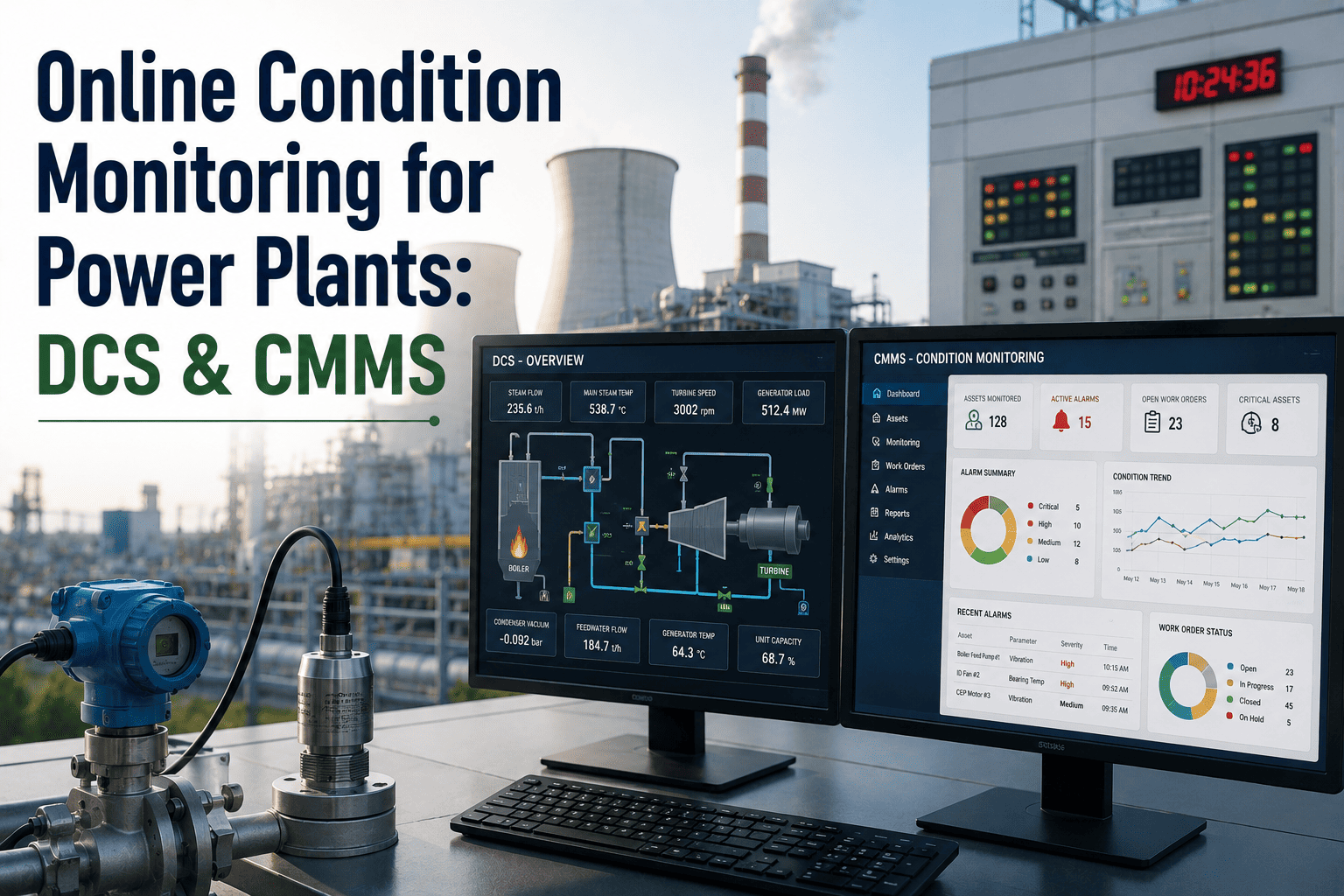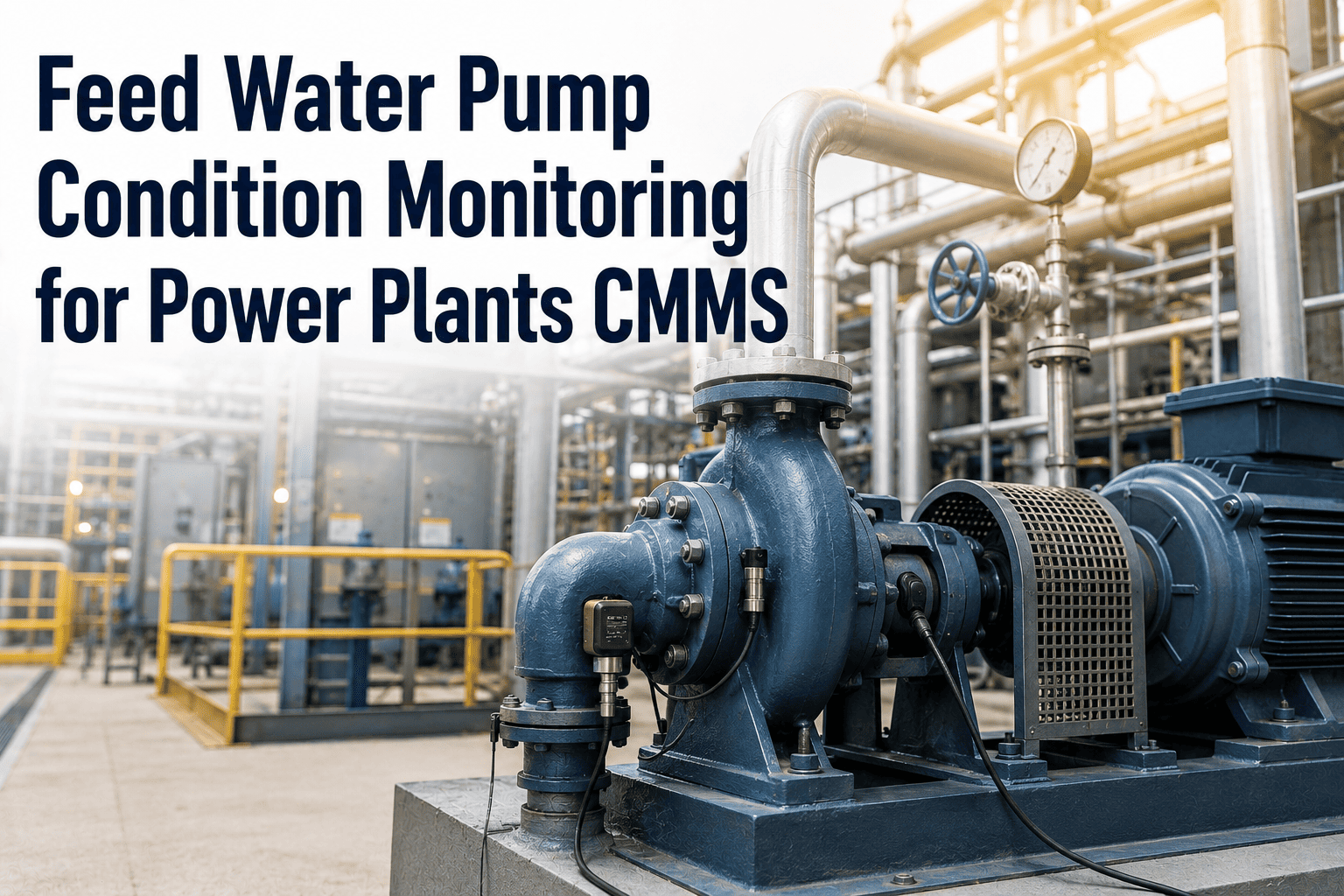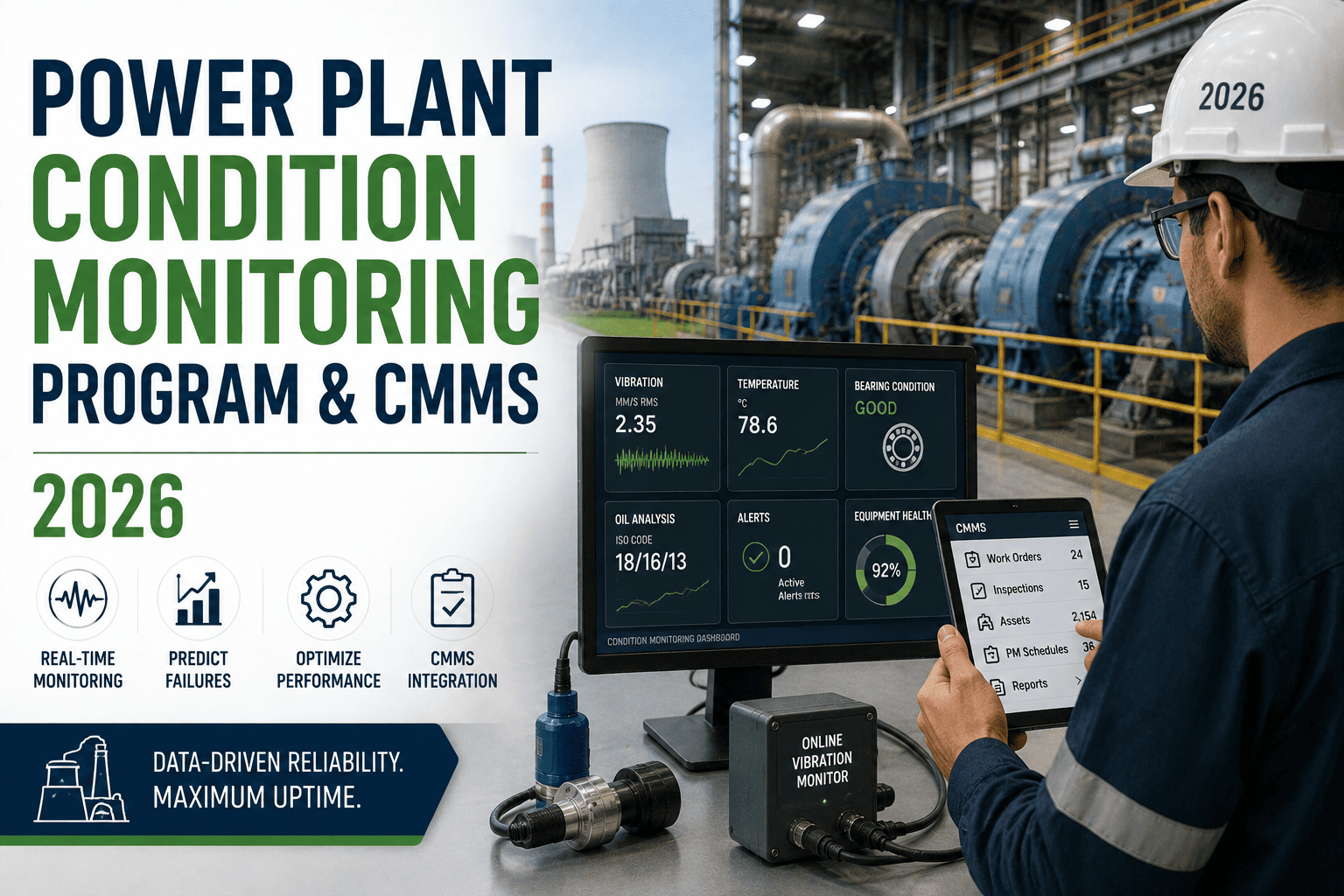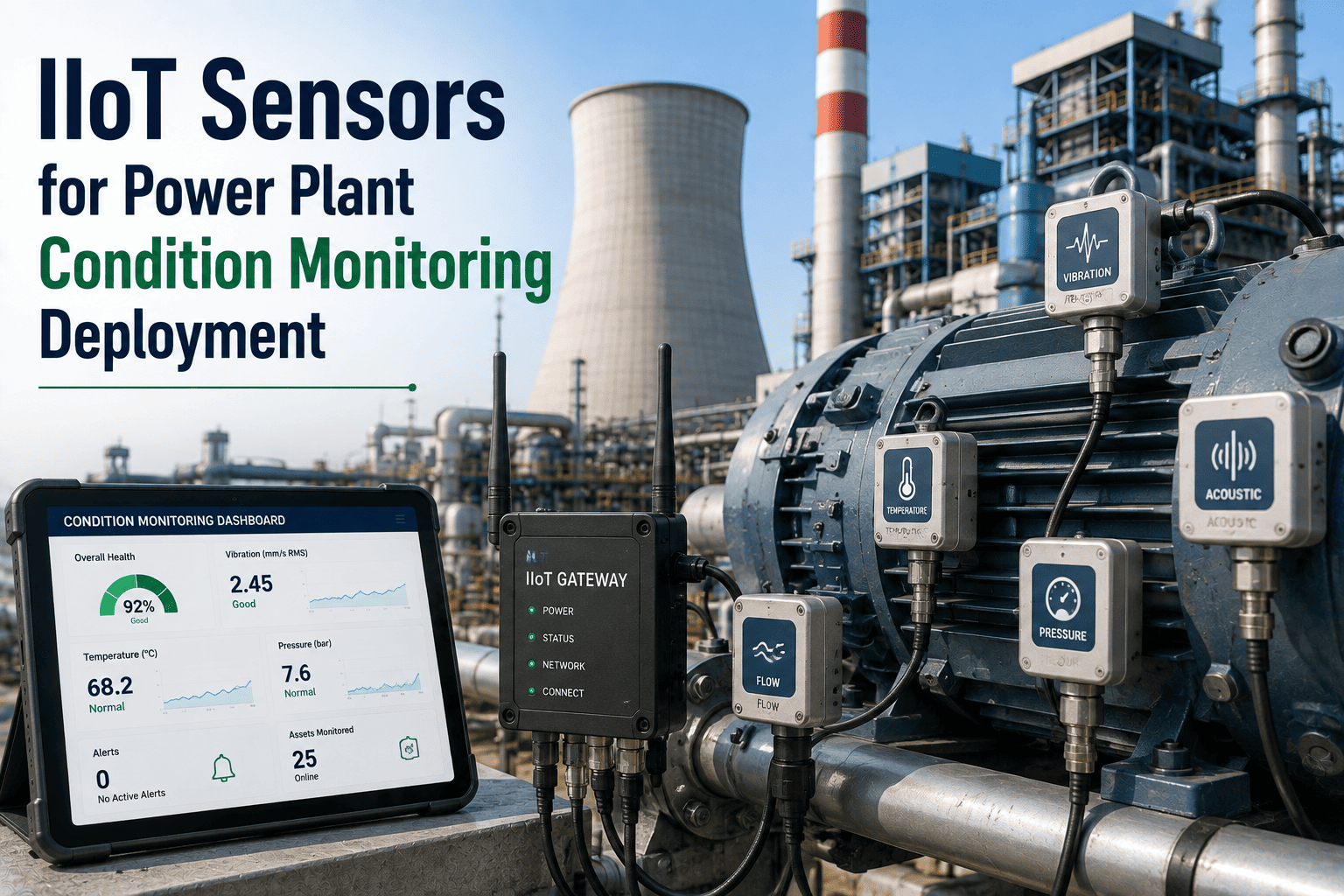
Deploying IIoT sensors for power plant condition monitoring is the fastest path from reactive firefighting to predictive, data-driven maintenance — but only if the sensor data flows into a CMMS that can act on it. Modern power plant IIoT deployments combine wireless vibration sensors, thermal imaging, and process parameter monitoring to detect bearing degradation, winding faults, and tube leaks weeks before failure. A well-architected condition monitoring IIoT strategy typically cuts unplanned downtime 30–50% and reduces maintenance costs by 15–25% within the first year. The real ROI unlock happens when those sensor streams feed directly into a maintenance platform like OxMaint, which auto-generates work orders the moment a threshold breaches. Ready to see it on your assets? Start Free Trial or read on for the full deployment guide.
How much downtime is your plant tolerating before sensors tell you something is wrong?
Most fossil and renewable plants still rely on periodic route-based inspections that catch failures 2–6 weeks too late. A modern IIoT condition monitoring deployment delivers continuous sensor data to your CMMS — turning anomaly detection into automated work orders within minutes, not maintenance cycles. Below is a practical, vendor-neutral deployment blueprint for power generation teams.
Which IIoT sensors does a power plant need for condition monitoring?
A power plant condition monitoring IIoT stack typically spans four sensor categories, each mapping to a specific failure mode. Selecting the right mix — rather than over-sensoring every asset — is what keeps deployment payback under 18 months.
Step-by-step IIoT sensor deployment plan for power plants
A phased rollout protects capital budget and proves ROI before you scale. The timeline below reflects a typical 500–800 MW thermal or CCGT plant deploying 150–400 sensor points across critical assets.
Criticality Assessment & Asset Register
Rank every asset by consequence of failure (production loss, safety, environment) using ISO 55000 principles. The top 15–20% of assets — typically turbine auxiliaries, BFPs, ID/FD fans, condensate pumps, and main generators — become Phase 1 sensor candidates. Import the full asset hierarchy into OxMaint so every sensor maps to a specific asset ID.
Sensor Selection & Pilot Installation
Deploy 30–60 wireless vibration and thermal sensors on the top-quartile critical assets. Validate sensor mounting, sampling rates, and baseline data quality. Confirm mesh network coverage and gateway placement. Typical pilot hardware cost: $18K–$45K depending on sensor count and protocol (LoRaWAN, Wi-Fi, or 5G private).
CMMS Integration & Baseline Trending
Connect sensor gateways to OxMaint via MQTT, REST API, or OPC-UA. Establish 2–4 weeks of baseline vibration spectra and thermal trends. Configure alert thresholds (ISO 10816 vibration severity zones, temperature rise rates) and map each alert to a pre-built work-order template inside OxMaint.
Automated Work-Order Triggers Go Live
Activate automated work-order generation: when a sensor crosses an alarm threshold, OxMaint creates a work order with asset ID, alarm context, recommended action, and required parts — assigned to the right technician. Begin measuring Mean Time to Detect (MTTD) and Mean Time to Repair (MTTR) improvements.
Scale to Full Plant & Predictive Analytics
Extend sensor coverage to secondary assets. Enable OxMaint's AI-driven predictive models that correlate multi-sensor data (vibration + temperature + current) to forecast remaining useful life (RUL). Most plants reach full ROI within 8–14 months of Phase 4 go-live.
What is the ROI and payback period for power plant IIoT sensors?
Industry benchmark data from EPRI, McKinsey, and Deloitte converge on a consistent ROI range for condition monitoring IIoT in power generation. The formula below helps you model your own plant's payback.
A 600 MW CCGT plant with 180 critical assets
| Cost / Benefit Category | Without IIoT CMMS | With IIoT + OxMaint | Annual Delta |
|---|---|---|---|
| Unplanned downtime hours | 240 hrs/yr | 120 hrs/yr | −50% |
| Mean time to detect (MTTD) | 14 days (route-based) | < 15 minutes | −99% |
| Spare parts inventory carrying cost | $420K/yr | $336K/yr | −20% |
| Forced outage frequency | 6 events/yr | 2–3 events/yr | −50–58% |
| Maintenance labor overtime | $185K/yr | $120K/yr | −35% |
| Sensor + platform investment | $0 | $96K/yr | +$96K |
How OxMaint turns IIoT sensor data into maintenance action
Sensors alone don't prevent failures — the CMMS that ingests, interprets, and acts on that data does. OxMaint is built to be the intelligent layer between your IIoT sensor streams and your maintenance technicians' hands.
Automated Anomaly-to-Work-Order Engine
When a wireless vibration sensor on your boiler feed pump crosses ISO 10816 Zone D, OxMaint auto-generates a work order pre-filled with asset history, alarm context, safety procedures, and required spare parts — routed to the qualified on-shift technician within 60 seconds. No manual data entry, no missed alerts.
AI-Driven Predictive Failure Forecasting
OxMaint's predictive models correlate multi-sensor data streams — vibration spectra, temperature trends, motor current signatures — to forecast remaining useful life for bearings, windings, and gear sets. RUL predictions update daily and feed directly into your preventive maintenance schedule, shifting work from reactive to planned.
Unified Asset Health Dashboard
Every sensor-tagged asset displays a live health score (0–100) alongside its work-order history, PM compliance, and failure codes. Maintenance managers see a single pane of glass spanning turbine hall to switchgear — no more toggling between the sensor vendor's portal and a separate CMMS.
Smart Spare-Parts Triggers
When a predictive alert fires, OxMaint checks spare-parts inventory for the flagged component and auto-creates a purchase requisition if stock is below the reorder point. No more discovering you lack a critical bearing at 2 AM during a forced outage — parts are staged before the work order opens.
What power plants achieve after connecting IIoT sensors to OxMaint
"We deployed 140 wireless vibration sensors across our three BFPs, condensate pumps, and ID fans, then piped everything into OxMaint. Within the first quarter, the system flagged a bearing degradation on Boiler Feed Pump B that we would have missed entirely. The auto-generated work order let us plan the replacement during a scheduled outage — saved us an estimated $780K in forced downtime."
"Switching from spreadsheets and route-based rounds to OxMaint with live sensor data cut our MTTD from almost two weeks to under an hour. The AI predictions have been accurate enough that we've shifted 60% of our PMs from calendar-based to condition-based. OEE on our critical rotating equipment is up 8 points."
See OxMaint on your assets — book a 30-minute demo
We'll connect a sample sensor feed to a live OxMaint environment using your asset types and show you exactly how anomaly alerts become automated work orders. No slides, no sales pitch — just the product on your use case.
Power plant IIoT sensor deployment — your questions answered
How many IIoT sensors does a power plant need for effective condition monitoring?
A typical 500–800 MW plant deploys 150–400 sensor points, focusing first on the top 15–20% of assets by criticality — turbine auxiliaries, boiler feed pumps, ID/FD fans, condensate pumps, generators, and large MV motors. You don't need to sensor every pump; you need continuous coverage on assets where failure causes the most production loss or safety risk. OxMaint's asset criticality ranking helps prioritize exactly which assets deserve sensor investment first.
Can existing power plant sensors integrate with a modern CMMS?
Yes. Most industrial sensors and PLC/SCADA systems built in the last 10–15 years can publish data via OPC-UA, Modbus TCP, MQTT, or REST API. OxMaint supports all four protocols plus direct gateway integrations with major sensor vendors. If your legacy sensors lack connectivity, a protocol converter or edge gateway ($200–$800 per node) bridges them to your CMMS. Book a demo and we'll assess your existing sensor estate.
What is the typical payback period for IIoT condition monitoring in power generation?
Most power plants achieve full payback within 8–14 months of go-live. A single avoided forced outage on a 600 MW unit typically saves $500K–$2M in lost generation margin alone, which dwarfs the annual sensor and platform cost ($60K–$120K). Plants with higher capacity factors, older asset base, or stricter emissions limits tend to see the fastest payback because their failure frequency and downtime cost are higher.
How does IIoT condition monitoring differ from traditional SCADA in a power plant?
SCADA monitors real-time process parameters for operational control — it tells you what is happening right now. IIoT condition monitoring tracks asset health indicators (vibration spectra, thermal trends, electrical signatures) over time to predict what will fail next. SCADA answers "is the plant running?" while IIoT + OxMaint answers "which asset will fail in the next 30 days and what should we do about it today?" The two are complementary, not replacements.
Is wireless sensor connectivity reliable enough for critical power plant assets?
Modern industrial wireless protocols — LoRaWAN, ISA100 Wireless, WirelessHART, and private 5G — achieve 99.5%+ data delivery rates in power plant environments when properly engineered. Mesh topologies self-heal around interference, and edge gateways buffer data during network interruptions. For life-safety or catastrophic-failure-critical assets, wired sensors remain the gold standard. Most plants use wireless for 80–90% of sensor points and wired for the highest-criticality assets. Start a free trial to see how OxMaint handles both data streams seamlessly.
Stop tolerating downtime your sensors could have predicted
Deploy IIoT sensors, connect them to OxMaint, and turn condition data into automated work orders that prevent failures before they cost you a megawatt. Your 14-day free trial includes full CMMS access, sensor integration templates, and live support.
Free 14-day trial · No credit card