HRSG maintenance is the single highest-leverage activity in a combined-cycle power plant — a well-executed heat recovery steam generator maintenance program can sustain 98%+ availability and extend creep-life-critical components well beyond their 25-year design horizon, while a neglected HRSG can lose 5–12% in steam output to finned-tube fouling alone. This HRSG maintenance and inspection guide distills industry best practices for tube bundle inspection, finned tube cleaning, duct burner PM, bypass stack cycling and ammonia injection grid tuning into a CMMS-driven framework. Every checklist, interval and analytics workflow here maps directly to OxMaint capabilities, so your reliability team can transition from reactive firefighting to predictive, audit-ready asset management. Ready to digitize your HRSG PM program? Start Free Trial and configure your first asset hierarchy in under an hour.
HRSG Maintenance Guide 2026
Is your HRSG losing steam output and creep-life to a reactive maintenance strategy?
A single forced HRSG outage costs a 500 MW combined-cycle plant $150K–$400K per day in lost generation. OxMaint's AI-powered CMMS turns your HRSG inspection schedule, tube-fouling trends and duct-burner PM into a predictive, audit-ready workflow — cutting unplanned downtime 30–50% and recovering lost megawatts.
Why HRSG Maintenance Can't Wait
The real cost of deferred HRSG inspection and PM
Heat recovery steam generators operate at the intersection of gas-turbine exhaust chemistry, cyclic thermal stress and high-pressure steam cycles — making them the most degradation-prone asset in a combined-cycle block. Industry data shows that plants running reactive HRSG strategies experience 3.5× more tube leaks, 8–12% lower steam output and 40% shorter creep-life on high-pressure evaporator headers than plants using structured PM programs. The cost gap is equally stark: reactive repairs average $80K–$250K per incident, while preventive interventions caught during planned outages cost $8K–$30K.
HRSG Inspection Guide
HRSG tube inspection and component-by-component PM checklist
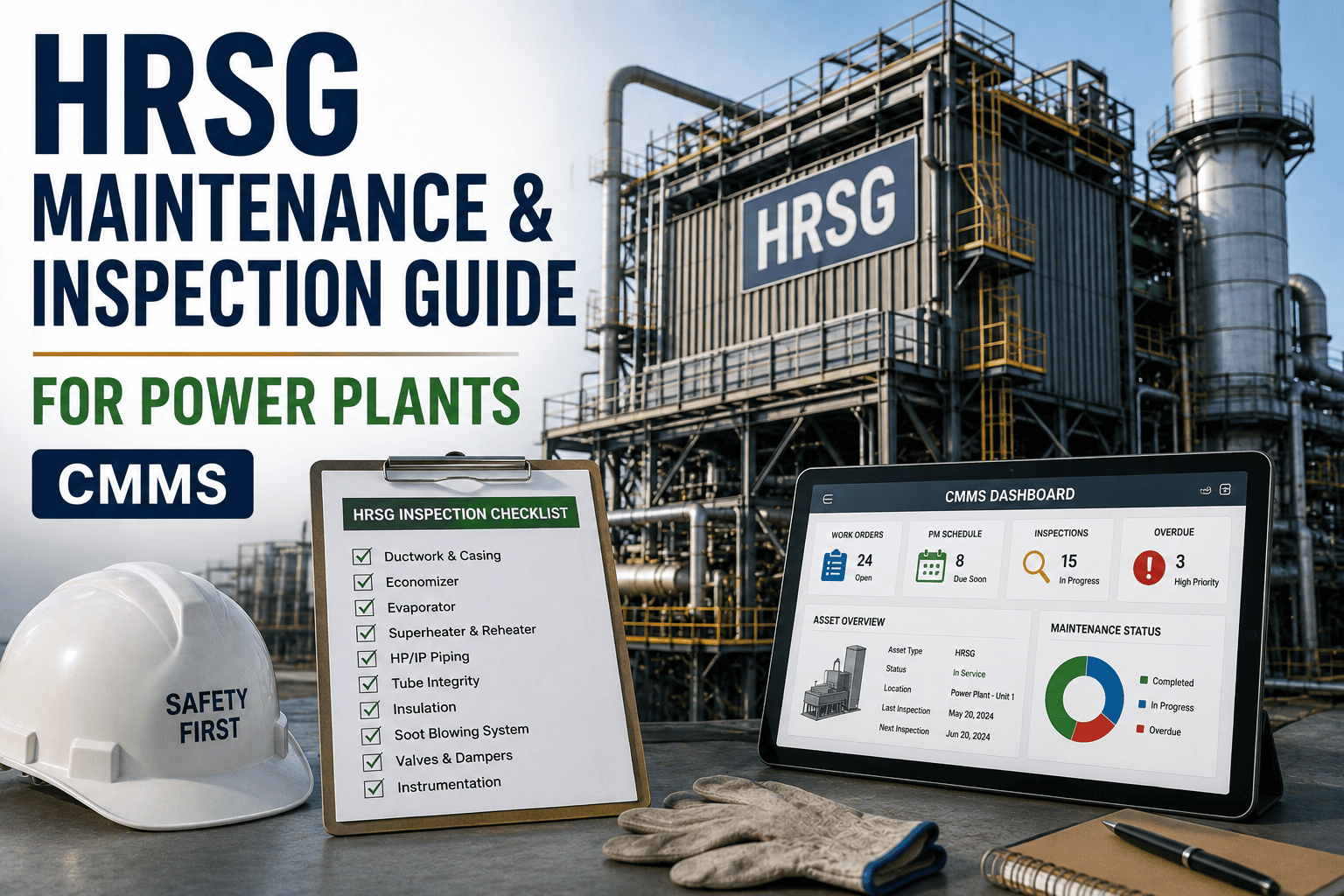
A defensible HRSG inspection program follows risk-based intervals tied to operating hours, cold starts and fuel type. Below is the essential checklist organized by subsystem, with the specific inspection method, frequency and failure mode each task targets. Load these directly into OxMaint as recurring work-order templates to auto-trigger based on runtime meters.
HP Evaporator & Superheater Tubes
- Non-destructive examination (NDE) — ultrasonic thickness mapping at every tube-to-header weld; target creep and fatigue zones
- Borescope internal inspection of header stubs for flow-accelerated corrosion (FAC) every 12–18 months
- Dye-penetrant testing on suspect welds after 1,000+ cold starts
- Record baseline thickness data in OxMaint asset history for year-over-year trend analysis
Finned Tubes & Heat Transfer Surface
- Visual and drone inspection of fin condition — look for fin-tip erosion, bond separation and deposits
- Compressed-air or high-pressure water cleaning when exhaust backpressure rises 1–2 inH₂O above baseline
- Track cleaning events and backpressure readings as meter-based PM triggers in OxMaint
- Inspect for cold-end corrosion if operating below acid dew point with sulfur-bearing fuel
Duct Burner PM
- Inspect burner runner and flame holders for warpage, oxidation and carbon buildup quarterly
- Verify fuel-gas supply pressure, orifice sizing and flame-detection logic monthly
- Clean burner elements and replace degraded flame rods per OEM hour-limits
- Log combustion temperature profiles to detect uneven firing before it damages downstream tubes
Bypass Stack & Diverter Damper
- Test diverter damper seal integrity and blade position switches during every gas-turbine outage
- Inspect bypass stack expansion joints for gas leakage and fabric degradation
- Lubricate damper linkages and verify actuator response times semiannually
- Track cycling events as a leading indicator of damper wear — critical for peaking units
Ammonia Injection Grid (AIG) & SCR
- Balance AIG flow during commissioning and recheck after every major service interval
- Inspect injection lances for nozzle plugging, ammonia salt formation and erosion annually
- Calibrate CEMS and NOx analyzer readings against reference gas quarterly
- Monitor catalyst activity and pressure drop to schedule replacement before slip limits breach
Drum Internals, Blowdown & Valves
- Inspect steam-separating internals and feedwater distribution for displacement every 3 years
- Conduct blowdown valve seat and packing inspection semiannually; verify proper cycle timing
- Calibrate drum-level transmitters and test low-level trip logic during outages
- Log every valve stroke and safety-relief valve lift in OxMaint for regulatory audit trails
Annual Maintenance Timeline
HRSG maintenance schedule: what to do and when
A risk-based HRSG PM schedule aligns inspection depth with operating hours, starts and fuel quality. The timeline below assumes a baseload combined-cycle unit (~6,000 operating hours/year, 150–250 starts). Peaking or cycling units should compress intervals by 30–40% and trigger inspections on meter readings rather than calendar months.
Duct burner fuel-pressure check, AIG flow balance verification, CEMS calibration, lubrication of damper linkages
Generate and auto-assign all monthly PMs in OxMaint with digital checklists; technicians complete on mobile, photos attached, signatures captured.
Duct burner runner and flame-holder visual inspection, NDE spot-checks on high-risk welds, ammonia lance borescope
OxMaint triggers NDE work orders automatically when operating-hour meters reach thresholds; results logged as condition-monitoring data points.
Finned tube fouling assessment, backpressure trend review, SCR catalyst sample, drum-level and safety valve function tests
OxMaint compiles a 12-month backpressure and heat-rate trend report so engineers can decide whether full water-wash is needed.
Full tube-bundle NDE mapping, header borescope, drum internals inspection, bypass damper seal replacement, expansion-joint evaluation
OxMaint builds the outage work-order package months in advance — parts pre-staged, contractors scheduled, permits pre-loaded.
Complete tube-bundle and header integrity assessment, structural steel and casing inspection, full re-tubing evaluation, remaining-life analysis
OxMaint exports the full asset history — every NDE reading, repair and meter reading — as a single audit-ready dossier for regulators and insurers.
CMMS-Driven HRSG Strategy
How OxMaint powers your HRSG maintenance and inspection program
OxMaint is built for the exact workflows that HRSG reliability teams run every day — meter-based PM triggers, condition-monitoring data ingestion, outage work-order packaging and spare-parts staging. Here is how four core capabilities map to the HRSG problems that cost plants the most money.
Meter-Based PM Triggers
OxMaint reads operating hours, cold-start counts and exhaust-backpressure meters — then auto-generates the correct HRSG PM work order at the right interval. No more calendar-only reminders that fire too early or too late.
Predictive Condition Monitoring
Ingest NDE thickness data, borescope findings and heat-rate trends into OxMaint's AI engine. It flags wall-thickness decline rates that exceed creep curves and predicts remaining useful life before a leak develops.
Outage Work-Order Packaging
Build a full HGPI or MI work-order package — parts pre-staged, contractor permits loaded, safety procedures attached, dependencies sequenced — months before the outage window opens. Track completion in real time on the floor.
Spare-Parts Inventory & Audit Trail
Track HRSG-critical spares — tube plugs, header stubs, gaskets, burner elements — with min/max reorder points tied to PM consumption. Every work order, meter reading and NDE result is time-stamped and inspector-signed.
ROI: From Reactive to Predictive
HRSG CMMS ROI: what switching to OxMaint actually saves
Consider a 500 MW combined-cycle plant with two HRSG units, currently running a spreadsheet-and-clipboard PM program. The plant averages 2.4 tube-leak forced outages per year, each costing $185,000 in lost generation and emergency repair. Finned-tube fouling has drifted to 8% heat-rate penalty because cleaning is scheduled by calendar rather than backpressure trend. After implementing OxMaint's meter-based PM, predictive NDE trending and outage packaging, the reliability team expects the following 12-month outcome.
| Cost / Savings Category | Before OxMaint (Reactive) | After OxMaint (Predictive) | Annual Savings |
|---|---|---|---|
| HRSG tube-leak forced outages (2.4 → 0.8/yr) | $444,000 | $148,000 | $296,000 |
| Recovered steam output (8% → 2% fouling penalty) | $312,000 lost generation | $78,000 lost generation | $234,000 |
| Outage duration reduction (15% on 14-day HGPI) | 14 days × $22K/day | 11.9 days × $22K/day | $46,200 |
| Spare-parts rush-order premium eliminated | $38,000 | $4,000 | $34,000 |
| Engineering & reporting labor (spreadsheets → automated) | 1,200 hrs × $95 | 300 hrs × $95 | $85,500 |
| Gross Annual Savings — less OxMaint subscription (~$24K/yr) | $671,700 | ||
"After moving our HRSG PM program to OxMaint, we cut tube-leak forced outages from three per year to one and recovered 4% in steam output just by staying on top of finned-tube cleaning intervals. The outage work-order package alone saved us two days on our last HGPI."
— Reliability Manager, 1,200 MW combined-cycle fleet, Southeast U.S.
Stop Catching Leaks — Start Predicting Them
See OxMaint on your HRSG assets — book a 30-minute demo
We'll load your HRSG asset hierarchy, PM templates and NDE inspection forms into a live sandbox so you can see meter-based triggers, predictive alerts and outage packaging working on your own equipment — before you commit.
Frequently Asked Questions
HRSG maintenance and inspection: what teams ask most
How often should HRSG tube inspection and NDE be performed?
For baseload units, conduct spot-check ultrasonic thickness and dye-penetrant testing on high-risk tube-to-header welds quarterly, with full tube-bundle NDE mapping during the 3-year hot-gas-path inspection and the 6-year major inspection. Cycling units (200+ starts/year) should compress these intervals by 30–40% or trigger inspections on start-count meters. OxMaint automates this by generating NDE work orders when operating-hour or start-count thresholds are crossed, so no inspection is missed or done too early.
What causes finned tube fouling in an HRSG and how is it cleaned?
Finned-tube fouling is driven by gas-turbine exhaust particulates, unburned hydrocarbons from duct-burner operation and, in dual-fuel plants, residue from liquid-fuel starts. Fouling layers as thin as 0.5 mm on fin surfaces can reduce heat transfer by 5–8%. Cleaning is done via compressed-air lancing during running conditions or high-pressure water washing during a short outage. The trigger should be exhaust-backpressure rise (1–2 inH₂O above baseline), not a fixed calendar date — OxMaint tracks backpressure trends and auto-generates a cleaning work order when the threshold is breached.
Can a CMMS prevent HRSG tube leaks before they happen?
Yes — a CMMS with predictive analytics like OxMaint ingests NDE wall-thickness data, tracks decline rates against creep curves and flags tubes projected to reach minimum-wall before the next inspection window. Plants using this approach typically reduce tube-leak forced outages by 30–50% within the first 12–18 months. The key is moving from calendar-based PM to condition-based PM where every NDE reading, borescope finding and meter value feeds back into the maintenance schedule. Book a demo to see the predictive trending engine on sample HRSG data.
What is the difference between HRSG CI, HGPI and MI inspection scopes?
CI (Combustion Inspection, ~annual) covers duct burner elements, finned-tube fouling assessment, CEMS calibration and drum-level function tests. HGPI (Hot Gas Path Inspection, ~3-year) adds full tube-bundle NDE, header borescope, drum internals and bypass damper seal work. MI (Major Inspection, ~6-year) is the most comprehensive — complete structural and casing inspection, remaining-life analysis and full re-tubing evaluation. OxMaint pre-builds the work-order package for each scope level with parts, permits and procedures attached, cutting outage planning time by weeks.
How long does it take to implement OxMaint for an HRSG maintenance program?
Most combined-cycle plants go live in 2–4 weeks. OxMaint's onboarding team loads your HRSG asset hierarchy, imports existing PM schedules from spreadsheets or your legacy CMMS, configures meter-based triggers for operating hours and start counts, and sets up NDE inspection templates. You can Start Free Trial today and build your first HRSG asset tree and PM template in under an hour — or schedule a guided demo and we'll walk you through a pre-configured combined-cycle sandbox.
Your HRSG Deserves Better Than a Spreadsheet
Turn HRSG maintenance from reactive cost into predictable reliability
Join the combined-cycle plants using OxMaint to cut forced outages 30–50%, recover lost megawatts and walk into every audit with a complete asset history. Start free or book a personalized demo on your assets today.
Free 14-day trial · No credit card