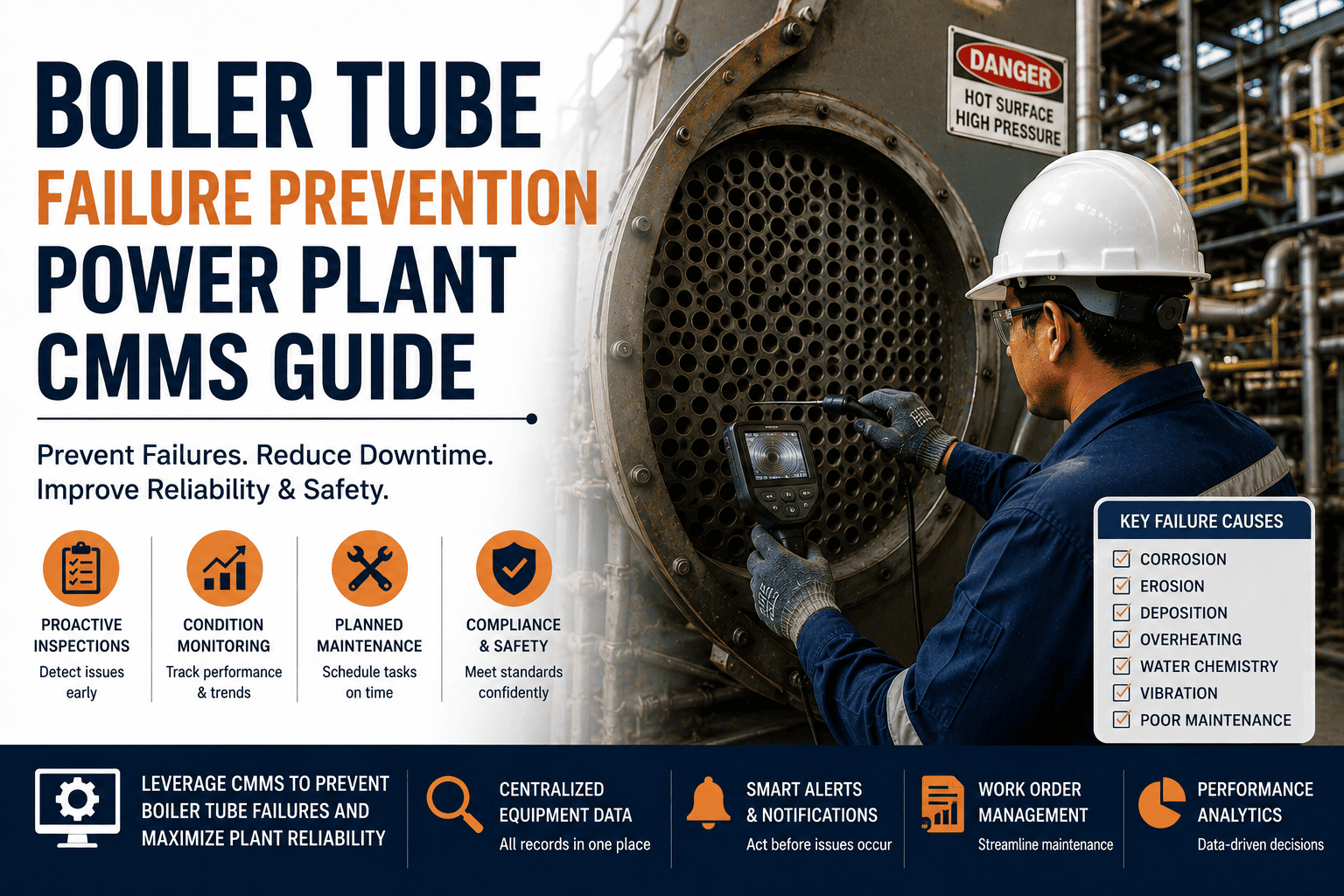
Superheater and reheater inspection in power plants is the single highest-leverage maintenance activity for boiler reliability — these tube bundles operate at 540–620 °C and 100–250 bar, making them the dominant source of forced outages in fossil and CSP steam plants worldwide. A structured superheater inspection program combines tube-bundle visual inspection, creep and wall-thickness measurement, oxide-scale (exfoliation) detection, and temperature-deviation monitoring to catch tube failures before they escalate into multi-million-dollar unplanned trips. This guide walks maintenance and reliability teams through a defensible reheater and superheater PM program, the inspection intervals that align with ISO 55000 asset-management principles, and how an AI-powered CMMS like OxMaint turns inspection data into predictive work orders — so you can Start Free Trial and see the workflow on your own assets today.
Superheater & Reheater Inspection Guide
40% of boiler forced outages start in superheater and reheater tubes. Is your inspection program catching them early?
A single superheater tube failure can trip a 500 MW unit for 3–5 days, costing $1M–$3M in lost generation and emergency repairs. This guide shows you how to build a data-driven superheater and reheater inspection program — and how OxMaint automates the work orders, PM schedules, and predictive alerts that keep your tube bundles in service.
Why Inspection Discipline Matters
The Real Cost of Skipping Superheater Tube Inspections
Superheater and reheater tubes account for roughly 40% of all boiler pressure-part failures in thermal power plants — and each unplanned tube leak costs an average of $500K–$3M in lost generation, emergency labor, and startup fuel.
A 680 MW coal-fired plant in the Midwest experienced 3 superheater tube leaks in 18 months, totaling 11 days of forced outage and $4.1M in lost margin. After implementing OxMaint to schedule annual ultrasonic thickness (UT) inspections, log creep data per tube-leg, and auto-generate tube-plugging work orders when wall loss exceeded 20%, the plant went 26 months without a single SH-related trip — saving an estimated $2.8M in avoided outage costs.
Inspection Checklist
Superheater & Reheater Tube Inspection Checklist
A defensible superheater tube inspection program covers four damage mechanisms: creep, fatigue, oxidation/exfoliation, and erosion. Use these tiered checklists during every planned outage and annual minor inspection.
Visual & NDE Inspection
- Borescope all platen and pendant tube bends for oxide blockage
- UT wall-thickness measurement on high-temperature legs (min. 10% of tubes per bank)
- Dye-penetrant or magnetic-particle test suspect welds and header stubs
- Inspect tube hangers, spacers, and guides for distortion or wear
- Photograph and GPS-tag every measurement point in the CMMS asset record
Creep & Oxide Scale
- Replica metallography on outlet headers and high-stress tube legs
- Measure internal oxide-scale thickness (non-destructive EMAT or UT)
- Calculate remaining creep life using Larson-Miller Parameter (LMP)
- Flag tubes exceeding 0.3 mm oxide scale for accelerated re-inspection
- Log creep strain data into OxMaint for trend-based predictive alerts
Temperature & Flow
- Review outlet temperature-deviation logs (flag >15 °C from mean)
- Inspect attemperator spray nozzles for flow imbalance or fouling
- Verify thermocouple calibration on all SH/RH outlet headers
- Check flue-gas temperature distribution for stratification hot spots
- Correlate DCS temperature trends with tube-wall UT data in OxMaint
Documentation & PM Triggers
- Update tube-plugging map in CMMS after every outage
- Generate work orders for tubes at <80% nominal wall thickness
- Schedule next UT inspection based on creep-rate trend, not calendar alone
- Attach inspection reports (PDF, NDE data) to the asset history record
- Trigger predictive alerts when wall-loss rate exceeds 0.05 mm/1,000 hrs
Inspection Intervals & PM Schedule
Recommended Superheater & Reheater PM Intervals
Inspection frequency should be driven by operating hours, steam temperature, and creep-damage accumulation — not just a fixed calendar. Below is the interval framework aligned with EPRI guidelines and ISO 55000 asset-management principles.
| Inspection Activity | SH/RH Component | Recommended Interval | Trigger / Threshold |
|---|---|---|---|
| Visual borescope + photo log | Tube bends, header stubs | Every planned outage (12–18 mo) | Mandatory at every turbine outage |
| UT wall-thickness survey | Outlet tube legs (high-temp) | Annual or 8,000 operating hours | Wall loss >15% from nominal |
| Oxide-scale measurement (EMAT) | SH outlet header tubes | Every 2–3 years | Scale thickness >0.3 mm |
| Replica metallography | Outlet header + stub welds | Every 3–4 years (after 100K hrs) | Creep cavitation Stage 3+ |
| Temperature-deviation review | All SH/RH banks | Monthly (DCS data analysis) | Deviation >15 °C from bank mean |
| Remaining-life calculation (LMP) | Critical SH/RH circuits | Every 4 years or post-failure | Consumed life >75% |
How OxMaint Helps
How OxMaint Turns Superheater Inspection Data Into Predictive Action
Most plants capture superheater inspection data in spreadsheets and static PDFs — making it nearly impossible to trend wall-loss rates or trigger work orders before a tube fails. OxMaint's AI-powered CMMS closes that loop.
Automated PM Work Orders
Schedule recurring UT inspection, borescope, and oxide-scale work orders automatically. OxMaint assigns them to the right technician with checklists, safety permits, and spare-part reservations attached — cutting outage planning time by up to 60%.
Predictive Wall-Loss Alerts
Log UT thickness data per tube-leg and OxMaint's AI calculates the creep-rate trend, projecting the remaining useful life. When wall-loss rate exceeds your threshold, a priority work order auto-generates — before the tube ruptures.
Asset History & Audit Trail
Every inspection report, NDE scan, tube-plug map, and repair is permanently linked to the asset record. Generate a compliance-ready audit package for ISO 55000, NFPA 85, or insurance reviewers in minutes, not weeks.
Spare-Parts Inventory Sync
When a work order calls for tube replacement or plug inserts, OxMaint checks stock levels in real time and auto-creates purchase requisitions for critical alloy spares — eliminating 2–3 day outage delays waiting on materials.
ROI & Payback
The Cost-Benefit of a CMMS-Driven Superheater PM Program
The payback math for moving from reactive superheater maintenance to a CMMS-driven PM program is rarely subtle. Below is the framework maintenance managers can use to build the business case.
Annual Savings Formula
Avoided Outage Cost = (Historical SH/RH Trips per Year) × (Avg. Trip Duration in Hours) × (Lost Margin $/MWh) × (Expected Reduction %)
A typical 500 MW plant at $30/MWh margin, 2 trips/yr × 72 hrs × $15,000/hr × 50% reduction = $1.08M/yr in avoided losses.
| Cost / Benefit Item | Without CMMS (Reactive) | With OxMaint (Predictive) |
|---|---|---|
| SH/RH tube failures per year | 2–3 unplanned trips | 0–1 (50–70% reduction) |
| Forced outage duration per event | 72–120 hrs | 24–48 hrs (pre-planned) |
| Annual lost-generation cost | $2M–$4.5M | $250K–$800K |
| Outage inspection planning time | 3–4 weeks (spreadsheet-based) | 1–1.5 weeks (auto-scheduled WOs) |
| Audit / compliance documentation | 2–3 weeks of manual reporting | Generated in <1 hour from asset history |
| Spare-part stockout delays | 2–3 days per outage event | <0.5 days (auto-reorder triggered) |
See OxMaint manage your superheater and reheater inspection program — live on your assets.
Book a 30-minute demo and we'll show you how to auto-schedule UT inspections, trend wall-loss data, and generate predictive work orders in your own plant's context.
Frequently Asked Questions
Superheater & Reheater Inspection FAQ
How often should superheater tubes be inspected in a power plant?
Superheater tubes should receive a visual borescope inspection at every planned turbine outage (typically 12–18 months), with UT wall-thickness measurement on high-temperature outlet legs annually or every 8,000 operating hours. Oxide-scale measurement via EMAT should be done every 2–3 years, and replica metallography for creep assessment every 3–4 years after the component exceeds 100,000 operating hours. Using a CMMS like OxMaint, these intervals auto-trigger based on actual operating-hour metering — not just a fixed calendar date.
What is oxide-scale exfoliation and why does it matter for superheater maintenance?
Oxide-scale exfoliation occurs when the internal steam-side oxide layer on alloy tubes (such as T22, T91, or TP347H) grows thick enough to spall off, blocking steam flow and causing localized overheating. When scale thickness exceeds 0.3 mm, the tube metal temperature rises sharply, accelerating creep damage and drastically shortening remaining life. Measuring scale thickness with EMAT and logging it in OxMaint's asset record lets the AI predict which tube legs are approaching the critical threshold — so you can plan replacements during a scheduled outage instead of reacting to a rupture.
How does a CMMS improve superheater and reheater maintenance?
A CMMS like OxMaint transforms superheater maintenance by replacing spreadsheets and paper inspection forms with structured work orders, automated PM scheduling, and trendable asset history. Every UT measurement, borescope photo, and tube-plug record is linked to the specific tube-leg asset, enabling the AI engine to project wall-loss rates, auto-generate priority work orders when thresholds are breached, and produce compliance-ready audit packages in minutes. Plants typically cut unplanned SH/RH tube failures by 50–70% and reduce outage planning time by 60% after implementation.
What are the most common superheater tube failure mechanisms?
The four dominant superheater and reheater tube failure mechanisms are creep (long-term stress rupture at high temperature), fatigue (thermal cycling cracks at header stubs and bends), oxidation/exfoliation (internal scale buildup causing overheating), and erosion (fly-ash or soot-blower impingement thinning the outer wall). Each mechanism has distinct inspection methods — UT for wall loss, replica metallography for creep cavitation, EMAT for oxide scale — and OxMaint tracks all four damage-mechanism data sets on a single asset record, giving reliability engineers a complete picture of remaining life.
How much does a superheater tube failure cost a power plant?
A single superheater tube rupture in a 500 MW unit typically costs $500K–$3M, factoring in 3–5 days of forced outage, lost generation margin at $15K–$30K per hour, emergency repair labor, and startup fuel. For a plant experiencing 2–3 SH/RH trips per year, that's $2M–$4.5M in annual avoidable losses. Implementing a CMMS-driven inspection program that prevents even one trip per year typically delivers full payback — which is why most plants see ROI within the first 3–6 months of deploying OxMaint.
Stop reacting to superheater tube failures. Start predicting them.
Deploy OxMaint's AI-powered CMMS to automate your superheater and reheater inspection program, trend wall-loss data, and generate predictive work orders before tubes fail — all on your existing asset data.
Free 14-day trial · No credit card