HRSG Maintenance & Tube Inspection With CMMS: Best Practices
By Johnson on March 19, 2026
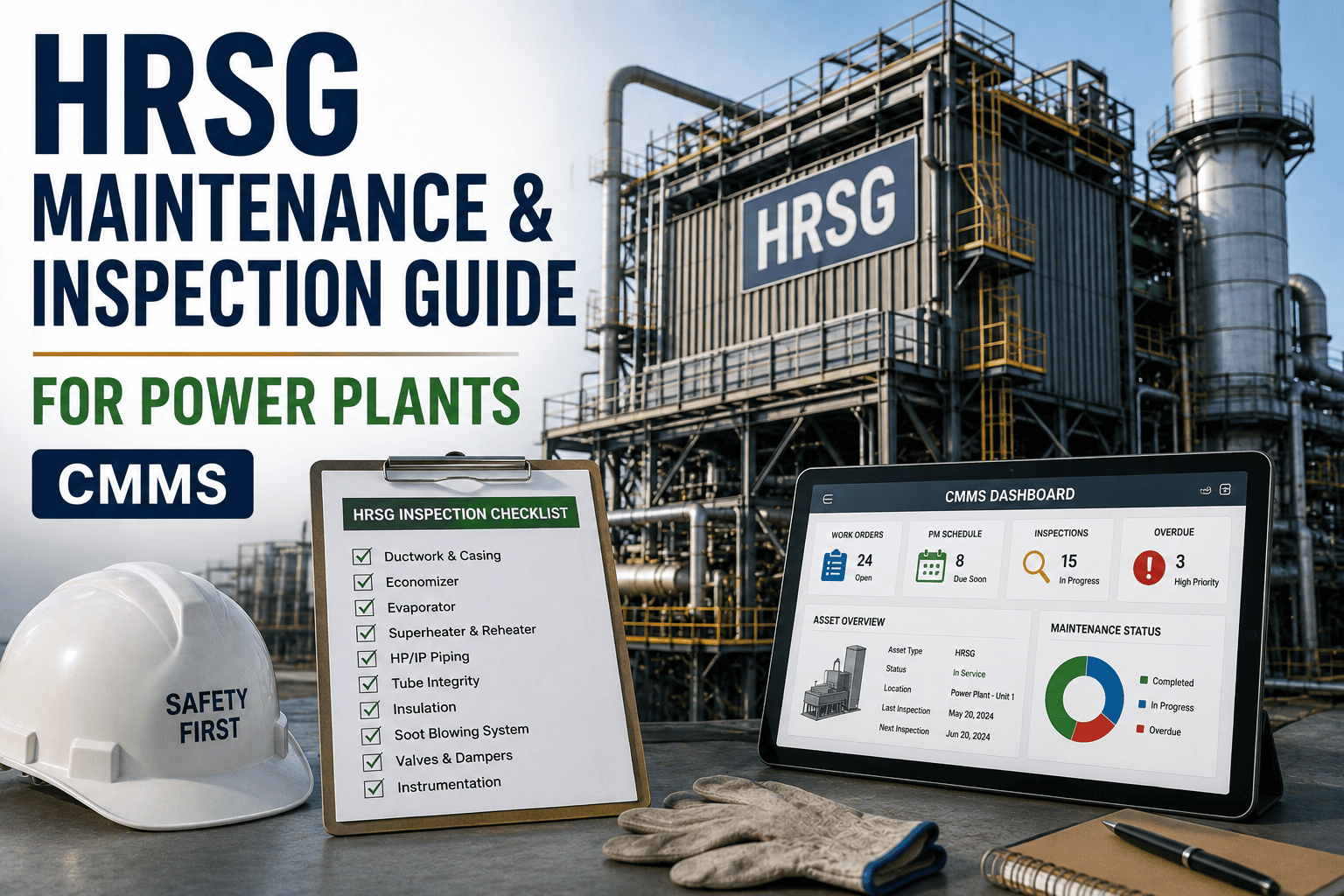
Heat Recovery Steam Generators are among the most failure-prone assets in any combined cycle plant — not because they are poorly designed, but because the degradation mechanisms that attack them are invisible until they rupture. The most dangerous truth about HRSG failure is that industry data spanning over 100 plants consistently shows that more than 90% of facilities have latent tube degradation that a structured inspection program would have detected at a fraction of the repair cost. Corrosion fatigue, creep, steam blanketing, and fabrication defect propagation add further complexity across the superheater and reheater sections. Managing this across a triple-pressure HRSG with LP, IP, and HP economizers, evaporators, superheaters, and reheaters — each with hundreds of individual tube measurement locations — is impossible without a digital system that stores thickness readings, builds trend lines across outage cycles, and alerts engineers when any location's measured thickness has crossed a minimum wall threshold. OxMaint's HRSG tube inspection CMMS does exactly that: structured inspection workflows for every section, UT reading capture by tube location and row, automated thickness trend lines across inspection cycles, and configurable minimum wall alerts — giving your team the data architecture to catch thinning years before it becomes a rupture. Start your free trial and set up your first HRSG tube inspection program in under 60 minutes.
HRSG Maintenance · Tube Inspection · UT Thickness Trending
HRSG Tube Failures Don't Happen Overnight.
But They're Only Caught If You Track the Trend.
FAC thinning, corrosion fatigue, and creep degrade HRSG tube walls outage by outage — invisibly. Structured UT inspection programs with multi-cycle thickness trending are the only way to see the failure before it becomes a forced outage.
of HRSGs have latent tube degradation detectable by structured inspection
50%
of tube leaks originate in economizer sections — highest FAC risk zone
3.5%
Efficiency loss from just 0.4 mm of iron-silica scale on tube walls
HRSG Section Risk Map
Where Tube Failures Actually Happen — and Why
Every pressure section in a triple-pressure HRSG carries a distinct failure risk profile. Understanding which sections produce which failure modes — and at what frequency — determines where your UT inspection resources must be concentrated.
Economizer
~50% of tube leaks
FAC · Corrosion Fatigue · Freeze Damage at tight-radius bends
Highest leak frequency. LP economizer bends and downcomer connections are primary FAC hotspots. UT mapping at every outage is non-negotiable.
LP/IP Evaporator
Primary FAC zone
Two-Phase FAC · Steam Blanketing · Liquid Droplet Impingement
150°C fluid temperature matches peak magnetite dissolution rate. Two-phase flow in LP evaporator strips protective oxide continuously in high-velocity sections.
Superheater / Reheater
~50% of all failures
Creep · Thermal Fatigue · Tensile Overload from attemperator spray
Hot-end tubes under highest temperature and pressure. Cycling operations dramatically accelerate thermal fatigue. Rapid cooling events cause tensile overload failures.
Tube-to-header welds are documented crack initiation sites. Phased-array UT required to detect axial cracks that standard single-angle UT misses.
Failure Mode Breakdown
The Six Mechanisms Behind HRSG Tube Failures — By Frequency
40%
Creep & Thermal Fatigue
Hot-end superheater and reheater tubes operating at design temperature limits. Cycling operations accelerate thermal transient stress beyond original baseload design assumptions.
23%
Corrosion Fatigue
Cyclic mechanical stress combined with corrosive environment at tube-header welds and bend radii. Start-stop operations since 2010 have increased this failure mode significantly.
12%
Fabrication Defects
Incorrect welding procedures or wrong material installation during original construction or past repairs. Detectable early through systematic inspection — but missed without structured programs.
12%
Tensile Overload
Rapid cooling or quenching from attemperator over-spray or condensate carry-over. Often a consequence of operational issues that monitoring can flag before the next thermal event causes failure.
9%
Flow Accelerated Corrosion (FAC)
Progressive dissolution of the protective magnetite layer in LP evaporator and economizer carbon steel tubes. Wall thinning is gradual, localized, and entirely predictable with systematic UT trending.
4%
Other (Erosion, SCC)
Stress corrosion cracking in high-alloy components and solid particle erosion in inlet areas. Less frequent but high-consequence when they occur in critical pressure boundaries.
Inspection Methods
The NDT Toolkit for HRSG Tube Inspection — What Each Method Reveals
Effective HRSG inspection is not a single method — it is a layered approach where each technique targets a specific failure mode and location. Knowing which tool to deploy, where, and at what interval is the foundation of a reliable inspection program.
Method
What It Detects
Primary Application
Interval
UT Thickness Mapping
Wall thinning from FAC, erosion, and general corrosion — quantitative measurements by location
A Single UT Reading Tells You Where You Are. A Trend Line Tells You When You'll Fail.
The most common failure in HRSG inspection programs is not the absence of UT measurements — it is the absence of a system to compare this outage's reading to the last three outages at the same tube location. Without trend data, a 6.2 mm reading at a known FAC location looks acceptable. With trend data from three prior outages — 7.8 mm, 7.1 mm, 6.5 mm, 6.2 mm — the remaining life calculation shows tube replacement is required in the next outage window, not two cycles from now.
UT Thickness Trend — LP Economizer, Row 3, Location 14
OxMaint stores every UT reading by tube section, row, and location number — building this trend automatically across every inspection cycle
Start Trending Today
Set Up Your HRSG Tube Inspection Program in Under 60 Minutes
Configure tube sections, measurement locations, UT reading capture forms, and minimum wall alerts for your HRSG — no IT project, no implementation fee.
How OxMaint Manages the Full HRSG Inspection Lifecycle
01
HRSG Asset Structure Setup
Build your HRSG's complete pressure-part hierarchy in OxMaint — LP/IP/HP economizers, evaporators, superheaters, reheaters, headers, and drums. Every tube section, row, and measurement location becomes a tracked asset with its own inspection history.
02
Structured Inspection Checklists by Section
Each HRSG section gets a configurable inspection checklist — UT measurement fields with location IDs, borescope condition ratings, visual inspection observations, and water chemistry readings. Technicians complete digitally on mobile — no paper forms, no transcription errors.
03
Tube Thickness Data Capture by Location
UT readings are entered against specific tube row and location numbers. OxMaint timestamps, stores, and immediately compares each new reading against all prior readings at the same location — displaying the trend line and calculating wall loss rate automatically.
04
Minimum Wall Alerts and Remaining Life Flags
Configure minimum acceptable wall thickness per tube section based on ASME code or OEM specifications. When any location's trend trajectory projects a breach within the next 1–2 outage cycles, OxMaint flags it for engineer review — with full trend history and rate-of-change data visible.
05
Outage-to-Outage Inspection Reports
At the close of every outage, OxMaint generates a complete HRSG inspection report — all UT readings, findings sorted by criticality, trending locations flagged for next-cycle action, and corrective work orders opened automatically for anything that exceeded acceptance criteria.
06
Regulatory and Compliance Documentation
US jurisdictions require annual HRSG inspections with documented findings. OxMaint maintains a complete, timestamped audit trail of every inspection, reading, finding, and corrective action — ready for AHJ review, insurance audits, and ASME compliance documentation without manual assembly.
Best Practices
The Six HRSG Maintenance Disciplines That Separate Reliable Plants from Repeat Failures
01
Establish UT Baseline at First Outage
Deep-entry UT mapping early in the HRSG's life establishes the baseline wall thickness at every high-risk location. Without a baseline, thinning rates cannot be calculated and remaining life estimates are guesswork. Baseline data entered into OxMaint anchors every future trend line.
02
Prioritize LP Economizer Bends and Downcomers
Approximately half of all HRSG tube leaks originate in economizer sections — specifically at tight-radius elbows and downcomer connections where FAC rates are highest due to turbulence. These locations must be included in every outage UT program, not sampled on a rotating basis.
03
Integrate Water Chemistry Records with Inspection Data
FAC rate is directly influenced by feedwater pH, dissolved oxygen, and fluid temperature. Chemistry excursions — pH below 8.8 or elevated oxygen — appear in the UT trend data as accelerated thinning rates at the following outage. Linking chemistry records to inspection findings closes the diagnostic loop.
04
Document All Findings with Photos
Photographic documentation of every drum inspection, borescope finding, and visual observation creates a visual trend record that UT numbers alone cannot provide. Deposit color changes, pitting distribution, and oxide layer condition captured across outages provide diagnostic context that prevents root cause misidentification.
05
Use Duty-Based Inspection Intervals, Not Fixed Calendar
HRSGs that cycle daily accumulate far more thermal fatigue stress per calendar year than baseload units. Inspection intervals for cycling plants should be tighter — based on number of starts and total thermal transient events — not an annual calendar date that ignores how the unit was actually operated.
06
Flag Trending Locations 2 Cycles Before Minimum Wall
Tube replacement during a planned outage costs a fraction of emergency tube repair during a forced outage. A trending location projected to reach minimum wall in two outage cycles requires procurement of replacement tube sections now — so the work can be executed in a planned window, not under emergency conditions at 2 AM.
We had UT readings going back seven years in spreadsheets across four different files — one per outage, maintained by whoever did the inspection at the time. When we finally built the trend lines in OxMaint, three LP evaporator locations showed they had been trending toward minimum wall for four years and nobody had connected the data. We caught two of those tubes before they failed. The third had already been plugged after a leak that we now understand was entirely preventable.
Industry studies report approximately 20% lower maintenance costs with preventive inspection programs versus reactive repair cycles
50%
Reduction in unplanned downtime
Structured PM programs integrated with digital CMMS platforms reduce unplanned outages by up to 50%
3–5×
Lower repair cost vs. emergency
Planned tube replacements in scheduled outage windows cost a fraction of emergency repairs during forced outages at $220K/hour generation loss
100K+
Operating hours of extended tube life
UT trending with remaining life calculations allows tube life extension decisions based on actual wall condition — not conservative calendar replacement that wastes serviceable assets
Free Trial · No Credit Card · AHJ-Ready Inspection Records
Your HRSG Tubes Are Thinning Right Now. The Question Is Whether You Can See It.
OxMaint gives your engineering team the digital inspection infrastructure to capture UT readings by tube location, build multi-outage trend lines, and get flagged on minimum wall breaches before the next outage — not after the rupture. Start your free trial and build your first tube inspection program today.
How does OxMaint store and trend UT tube thickness readings across multiple outages?
OxMaint stores UT readings against a structured location hierarchy — HRSG unit, pressure section (LP/IP/HP), module (economizer, evaporator, superheater), tube row, and location ID. Each outage's readings are timestamped and linked to the specific inspection work order. When a new reading is entered, OxMaint automatically compares it against all prior readings at that same location ID and calculates the wall loss rate (mm per year or per operating cycle). Trend lines are visible in the asset history view, and minimum wall thresholds trigger alerts when any location's trajectory projects a breach within a configurable warning window. See the thickness trending interface in a live demo.
Can OxMaint handle both planned outage inspections and between-outage condition monitoring for HRSGs?
Yes. OxMaint supports both time-based scheduled inspections (annual, biennial, or per-outage) and condition-triggered work orders based on monitoring data. For HRSG applications, planned outage inspection work packages are generated automatically from PM templates — including all UT, borescope, visual, and chemistry checklists for each section. Between outages, water chemistry monitoring, vibration, and operational data can trigger condition-based work orders when parameters exceed configured thresholds. Both streams feed into the same asset history, maintaining a complete picture of HRSG health between major inspections.
Does OxMaint provide the documentation required for AHJ and ASME boiler inspection compliance?
Yes. US jurisdictions require annual internal and external HRSG inspections with documented findings available for the Authority Having Jurisdiction (AHJ). OxMaint maintains a complete, timestamped audit trail covering every inspection work order, UT reading, borescope finding, corrective action, and sign-off. Compliance reports are generated directly from the platform — no manual assembly from spreadsheets before an audit. For ASME code compliance, every UT reading is stored with the date, technician, equipment used, and acceptance criteria — meeting documentation requirements for pressure vessel inspection records. Set up your first AHJ-compliant HRSG inspection record — free trial.
How do you prioritize which HRSG tube locations to include in a UT inspection program?
Prioritization should be based on failure mode risk, not convenience of access. LP economizer bends and downcomer connections carry the highest FAC risk and should be UT-mapped every outage. LP and IP evaporator tube rows 3–4 from the duct wall edge are known FAC hotspots due to bypass flow effects and should receive focused attention. Tube-to-header welds in superheater and reheater sections require phased-array UT for crack detection — especially in cycling units. OxMaint helps you document the inspection scope and rationale for each location, so risk-based prioritization decisions are recorded alongside the measurement data rather than existing only in the inspector's memory.