For a 500 MW coal-fired unit, a single 5-day forced outage can exceed $23.75 million in lost revenue—and boiler tube leaks alone cause 23% of all unplanned shutdowns. A modern coal plant CMMS shifts maintenance from reactive firefighting to predictive asset management, reducing unplanned downtime by up to 45% and extending the life of pulverizers, boiler tubes, ash handling systems, and ESPs. This guide lays out a complete coal-fired power plant maintenance strategy for 2026, grounded in ASME, NBIC, and NFPA 850 standards.
Coal-Fired Power Plant Maintenance Strategy & CMMS 2026
Pulverizer PM, boiler tube inspections, ash handling, and ESP maintenance—unified in a single CMMS-driven asset management platform built for the harsh realities of coal generation.
The Four Critical Asset Domains in Coal Plant Maintenance
Coal-fired generation presents uniquely hostile operating environments—abrasive pulverization, high-temperature boiler tubing, combustible dust in ash conveyance, and high-voltage particulate collection. Each domain demands specific inspection intervals, sensor integrations, and CMMS-enforced safety workflows.
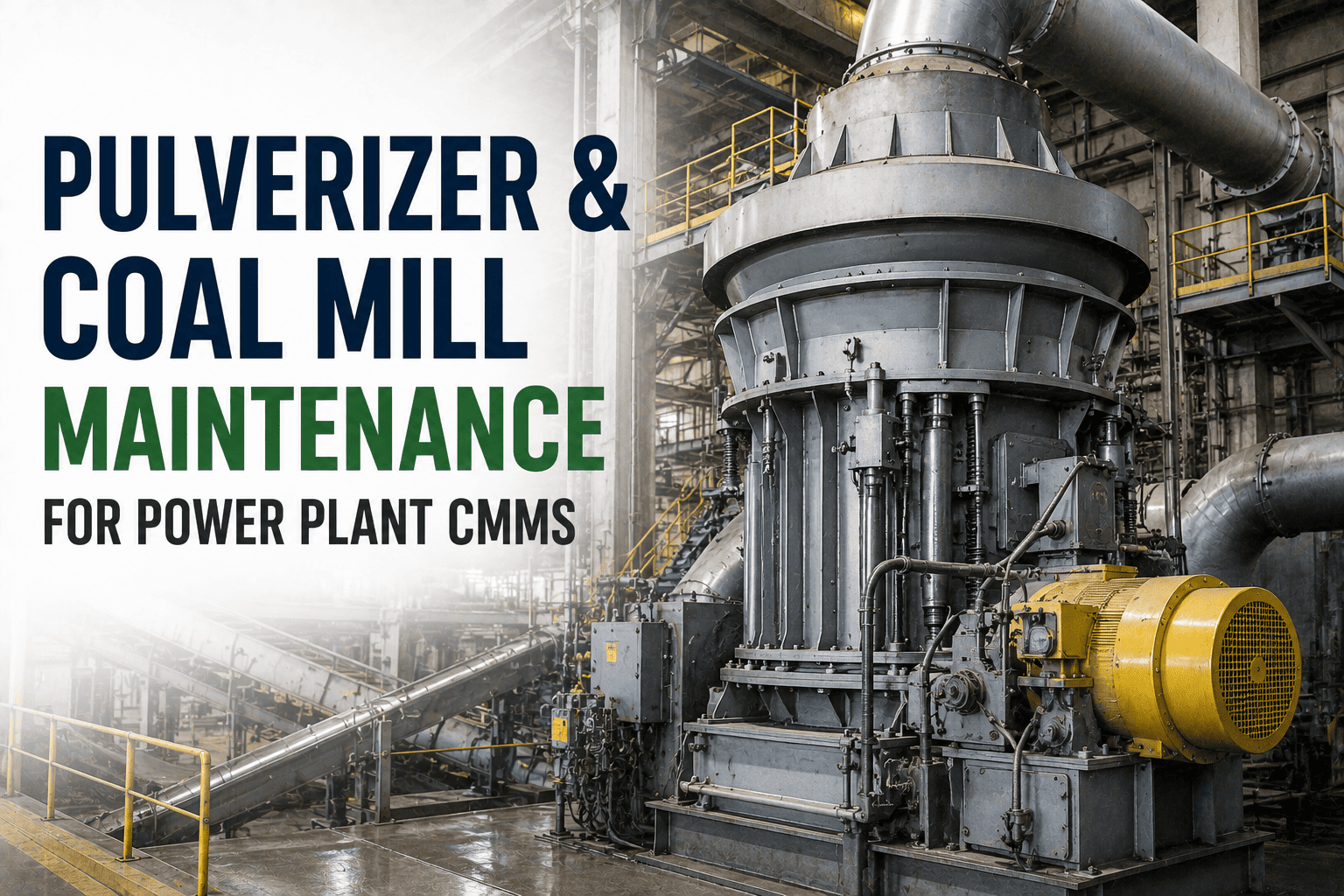
Pulverizers & Coal Mills
Babcock & Wilcox EL-Series, MPS, and ABB-CE Raymond bowl mills operate in the most abrasive environment in the plant. Gearbox failures and grinding element wear dominate failure modes.
- 250 hrs: Inspect & clear pyrite trap; check grinding element tolerances (< 0.125 in clearance)
- 2,000 hrs: Vibration analysis on mill gearbox (baseline < 0.15 in/sec peak)
- 8,000 hrs: Replace grinding rings and balls/shoes
Acoustic emission sensors: 20–60 kHz = metal-on-metal contact (worn grinding elements); 100–150 kHz = journal bearing distress. Route via OPC-UA; auto-generate work orders when amplitude exceeds 3σ from baseline.
Boiler Tube Inspections
Governed by ASME Section I and NBIC. Fly ash erosion, short-term overheating on superheater/reheater tubes, and caustic gouging are primary failure modes.
- Wall thickness: 2.5-in OD, 0.25-in nominal wall; replace at 0.150 in
- Inspection tech: Crawler robots with Pulsed Eddy Current (PEC) & Phased Array UT (PAUT)—no scaffolding required
- Data integration: PAUT 3D heat maps overlaid on CMMS asset hierarchy; erosion rate (mils/operating hr) dynamically adjusts next outage date
Build down to specific tube rows (e.g., Boiler > Waterwall > Front Wall > Row 12). Store nominal thickness, retirement thickness, and erosion rate per tube section.
Ash Handling Systems
Denseveyor vessels, ash conditioners, and rotary airlock valves face dome valve seat wear, elbow pipe erosion, and silo aeration blower failures. NFPA 850 governs safety.
- 500 hrs: Inspect Dome Valve seal inflation pressure (80–90 PSI for positive seal)
- 4,000 hrs: Ultrasonic thickness checks on pneumatic elbows; replace below 40% nominal wall
- Safety: CMMS-enforced LOTO & confined space permits; PRB coal dust Kst can exceed 500 bar-m/s
Electronic LOTO with interdependency logic: silo work order cannot start until conveyor, inlet valve, and aeration blower are verified locked out via NFC badge scans. Digital confined space permit captures gas monitor readings (O₂ > 19.5%, LEL < 10%).
Electrostatic Precipitators (ESP)
T-R set internal arcing, rapper coil fatigue, broken wires, and back-corona from air ingress. Secondary current/voltage are the ultimate health indicators.
- Daily: CMMS auto-downloads T-R performance data; calculates SCA efficiency
- Quarterly: Megger testing of T-R transformer windings (> 1,000 Megohms); inspect insulator bushings for ash tracking
- Healthy T-R: 45–55 kV at 400–1,000 mA; < 35 kV with current spike = back-corona alert
Integrate T-R secondary voltage/current into CMMS. When voltage drops below 35 kV while current spikes, auto-trigger "Back-Corona" work order. Condition-based rapper maintenance flags circuits drawing zero current (broken coils) with exact grid coordinates.
CMMS-Based vs. Manual Maintenance: The Performance Gap
Plants using automated CMMS scheduling achieve 94% on-time PM completion versus 71% for spreadsheet-based tracking. The gap extends to downtime, inventory costs, and safety incidents.
| Performance Metric | Manual / Spreadsheet | CMMS-Driven (OxMaint) |
|---|---|---|
| On-time PM completion rate | 71% | 94% |
| Unplanned downtime reduction | Baseline | −45% |
| MRO inventory holding cost reduction | Minimal visibility | −25% |
| Pulverizer gearbox failure rate | Reactive rebuilds | −38% failure rate |
| Boiler inspection critical path | 14 days (scaffold build) | 2.5 days (crawler robots) |
| OSHA recordables in fly ash silos | Manual LOTO compliance | −62% |
| ESP particulate matter emissions | Reactive rapper repair | −15% |
Real-World Coal Plant CMMS Deployments
Four plants across the Americas transformed their maintenance operations by integrating sensor data, robotic inspection, and CMMS-driven work order automation.
Boiler Tube Inspection Optimization
Problem: A 750 MW unit suffered three forced outages from water-wall tube leaks near sootblower lanes—$14.2M lost in 18 months. Manual inspections took 12 days.
Solution: Deployed IVS crawler robot with PAUT, feeding data into IBM Maximo CMMS to build a Remaining Useful Life (RUL) algorithm for each tube section.
Result: Zero tube leak forced outages over 24 months. CMMS auto-generates tube replacement work orders only for tubes below 0.180-inch thickness.
Pulverizer Predictive Maintenance
Problem: High vibration failures on 10 MPS-89 pulverizer gearboxes. Reactive rebuilds cost $85,000 per mill with 72 hours of outage time each.
Solution: Installed Bently Nevada 3500/42M vibration monitors on pinion bearings. Routed data via PI System to SAP PM CMMS with dynamic alarms at 0.25 in/sec peak.
Result: Detected a cracked pinion tooth 3 weeks before catastrophic failure by identifying 2x gear mesh frequency sideband—shifted from emergency rebuild to planned weekend outage.
ESP Emissions & Efficiency
Problem: Strict PM limits (< 50 mg/Nm³) forced a 15 MW de-rate to keep ESP outlet opacity compliant—$2.1M lost generation annually. Rapper coils failing intermittently.
Solution: Integrated ESP T-R secondary voltage/current into Hexagon EAM CMMS. Condition-based rapper maintenance: CMMS flagged circuits drawing zero current (broken coils) with exact grid coordinates.
Result: Returned to full 150 MW baseload capacity. Auxiliary power consumption on ESP dropped 4%.
Ash Handling & Confined Space Safety
Problem: Frequent dense-phase pneumatic fly ash blockages forced emergency manual clearing. SG-SST recordable incidents averaged 4 per year during confined space ash clearing.
Solution: Upgraded to cloud-based CMMS (Fiix) with mobile QR scanning on all ash valves. Acoustic leak detectors on dome valves identified seat wear before pressure loss caused plugging. Digital LOTO workflows mandatory before work order closure.
Result: Confined space entry incidents reduced to zero. MRO spares inventory optimized, freeing $220,000 in working capital.
How OxMaint Manages Coal Plant Assets
From sensor-triggered work orders to NFPA 850-compliant safety workflows, OxMaint unifies every coal plant maintenance domain into a single platform.
OPC-UA Sensor Integration
Route acoustic emission, vibration, and temperature sensor thresholds directly into the CMMS. Auto-generate work orders when amplitudes exceed 3σ from baseline—no manual data entry.
PAUT Data & RUL Algorithms
Batch-upload Phased Array UT thickness readings to specific tube row asset records. OxMaint calculates erosion rate (mils/operating hr) and dynamically schedules the next inspection based on remaining life.
Electronic LOTO with Interdependency Logic
Fly ash silo work orders cannot start until the conveyor, inlet valve, and aeration blower are verified locked out via NFC badge scans. Digital confined space permits capture real-time gas monitor readings.
Coal-Specific Failure Code Hierarchies
Standardized Component → Problem → Cause → Remedy structures. Pinpoint that BFP mechanical seal leaks stem from deaerator cavitation, not defective seals—drilling to root cause, not symptom.
Equivalent Operating Hours (EOH) Tracking
For plants shifting to cycling/peaker duty, OxMaint integrates with the DCS to track EOH. A 2-hour cold start equates to 40 EOH—automatically pulling forward PMs on creep-fatigue critical superheater headers.
Mobile Workforce Enablement
QR code scanning on all ash valves and critical assets. Technicians receive work orders on tablets with Wi-Fi mesh coverage in the boiler house—closing the loop on 68% of plants transitioning from legacy systems.
Frequently Asked Questions
Technical answers to the most common coal plant maintenance and CMMS questions from reliability engineers and maintenance managers.
How do we calculate optimal pulverizer grinding element replacement intervals without excessive manual measurement?
Utilize a CMMS-integrated approach by tracking total motor amperage trends and mill differential pressure. As grinding elements wear, the mill automatically increases hydraulic loading, which spikes motor amperage. Set a CMMS trigger when the 30-day rolling average amperage exceeds 115% of baseline amperage at a given coal feed rate (tons/hr). This indicates element wear has reached end-of-life, allowing you to schedule replacement during a planned outage rather than running to failure.
What is the most effective method for tracking boiler tube remaining life within a CMMS asset hierarchy?
Stop treating the boiler as a single asset. In your CMMS, build the hierarchy down to specific tube rows (e.g., Boiler > Waterwall > Front Wall > Row 12). When NDE robots take PAUT thickness readings, that data must be batch-uploaded via API or Excel to the specific asset record. The CMMS should store nominal thickness, minimum retirement thickness (usually 0.150"), and erosion rate. The system can then auto-calculate remaining operating hours and dynamically schedule the next UT inspection.
How can a CMMS specifically reduce Electrostatic Precipitator (ESP) power consumption?
ESPs consume massive auxiliary power via T-R sets and rapper systems. By integrating T-R set secondary voltage and current into the CMMS, algorithms identify T-R sets operating in back-corona (high current, low voltage due to high ash resistivity). The CMMS auto-generates work orders to inspect and repair rapper coils failing to clear ash from collection plates. Proper ash clearing allows T-R sets to operate at peak voltage efficiency, reducing net plant heat rate and lowering auxiliary power draw by up to 120 kW per unit.
What are the key CMMS compliance features required for NFPA 850 and OSHA safety during ash silo maintenance?
Your CMMS must support electronic Lockout/Tagout (eLOTO) with interdependency logic—meaning the fly ash silo work order cannot be "Started" until the pneumatic conveyor, inlet valve, and aeration blower are verified as locked out by separate technicians scanning their unique NFC badges. Additionally, the CMMS must require a digital confined space entry permit, capturing atmospheric gas monitor readings (O₂ > 19.5%, LEL < 10%) uploaded directly from handheld gas detectors before allowing a technician to sign onto the job.
How should we structure CMMS failure codes specifically for coal plant assets?
Do not use generic failure codes. For coal plant assets, build standardized failure code hierarchies comprising: Component, Problem, Cause, and Remedy. For example, for a Boiler Feed Pump (BFP): Component = Mechanical Seal; Problem = External Leakage; Cause = Cavitation Erosion; Remedy = Replaced Seal & Overhauled Suction Strainer. This granularity allows reliability engineers to pull CMMS reports showing exactly how many seals failed due to cavitation, pinpointing upstream issues with the deaerator or condensate system rather than assuming the seal itself is defective.
With the transition away from coal, how does CMMS asset management support "peaker" operational cycles in 2026?
Baseload coal plants shifting to cycling/peaker duty experience severe thermal fatigue on boiler headers, drum casings, and tubes due to rapid ramp-ups and shutdowns. The CMMS must integrate with the plant DCS to track "Equivalent Operating Hours" (EOH) rather than calendar days. A 2-hour cold start can equate to 40 hours of EOH regarding thermal stress. The CMMS dynamically pulls EOH data, automatically pulling forward PMs on creep-fatigue critical components (like superheater outlet headers) to prevent catastrophic ruptures caused by the new, harsher operational profile.
Stop Losing Millions to Forced Outages
Join the 68% of power generation asset managers who've transitioned from legacy systems to enterprise CMMS platforms. OxMaint unifies pulverizer PdM, boiler tube RUL tracking, ash handling safety, and ESP optimization—paying for itself in 7 to 11 months.